White paper 05 · Energy
Cameroon’s hydro grid can power low-carbon steel if large users get firm supply, clear tariffs and gas
A hydro-dominated grid is an asset, given dedicated connections, clear large-user tariffs and a reliable gas allocation.
Derived Counted from the English manuscript when the site was generated; print equivalent = words ÷ 350.
You are reading the full English edition. Also online: Édition française complète中文摘要版
Executive summary
What the study shows
Read the full executive summaryPower and gas for heavy industry in Cameroon, what an electric steelworks needs from the grid, the tariff system and the gas sector after the Hilli FLNG left Kribi, and the policy steps that would make it bankable.
Source: white paper 05, executive summary; bracketed markers refer to the list of sources in the annex.
Main findings
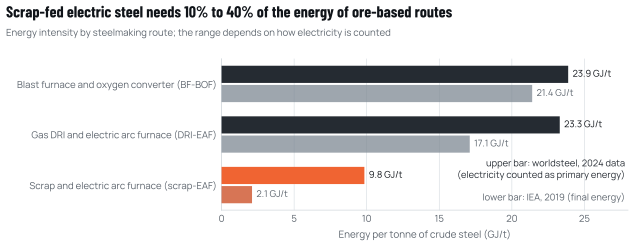
- Energy decides the competitiveness of electric steel. RC-1 Phase 1 would use about 0.96 MWh of electricity per tonne of bars and rod at the planning value of 450 kWh per tonne of liquid steel in the furnace, and about 1.0 MWh at the upper planning value of about 490 kWh with 30% direct-reduced iron in the charge. Across the price benchmarks observed in Cameroon, that is US$30 to US$170 a tonne, a spread of about US$140, equal to about a fifth of the export price of rebar (US$620 to US$630 FOB on 3 October 2026) [S07][S09].
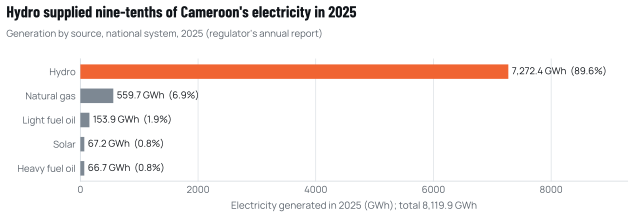
- The grid is low-carbon and hydro-based. Hydro produced 89.6% of Cameroon’s 8,119.9 GWh in 2025 [S01]. At about 226 g CO₂e/kWh in 2024, the grid emits less than half the world average (471 g) and about a third of Indonesia’s (680 g), the origin of 78% of Cameroon’s billet imports in 2023 [S10][S11].
- Capacity is not firm supply. Cameroon had 2,033 MW installed against a 1,278 MW peak in 2025 [S01], yet 150 MW of industrial demand is unmet until the 400 kV Nachtigal evacuation line is completed, now due in November 2026 [S02]. The Kribi gas plant ran at about 30% of capacity, and Nachtigal delivered 28% below plan because of hydrology [S01].
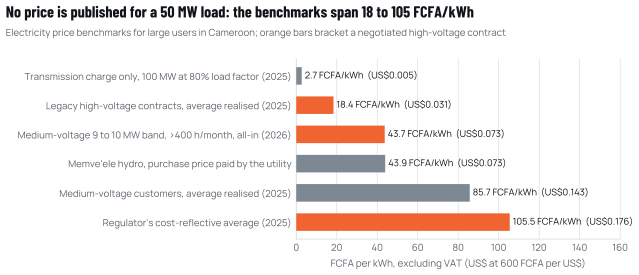
- There is no published tariff for large users. Regulated tariffs stop at 10 MW [S03]. Legacy high-voltage contracts averaged 18.4 FCFA/kWh in 2025, the top medium-voltage band costs about 43.7 FCFA/kWh all-in in 2026, and the regulator’s cost-reflective average is 105.46 FCFA/kWh [S01][S03][S04]. A cost-based price for a firm high-voltage baseload would sit at roughly half the system average before the cost of firmness (derived).
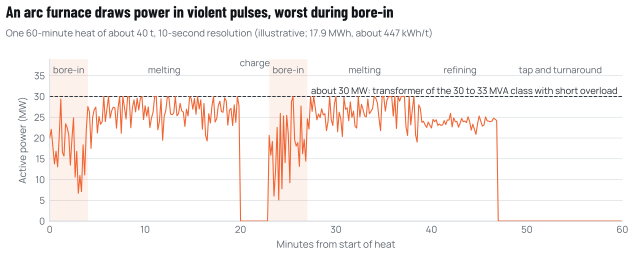
- Tariff structure matters as much as level. Under a capacity-plus-energy structure, an arc-furnace load with RC-1 Phase 1’s shape would pay about 32% more per kWh than a flat load of the same energy (derived from [S03]). Measurement intervals, rewards for scheduling load around peaks and reactive-energy rules must be explicit.
- An arc furnace needs a strong connection and its own compensation. A simplified screening suggests that a furnace with a transformer of the 30 to 33 MVA class needs about 4,000 to 7,000 MVA of short-circuit power at the connection point to keep flicker within the high-voltage planning level, or about 2,000 to 3,500 MVA with a static var compensator (derived; inputs from [S12][S13]). A 30 kV feeder would be too weak; a dedicated 225 kV bay is needed.
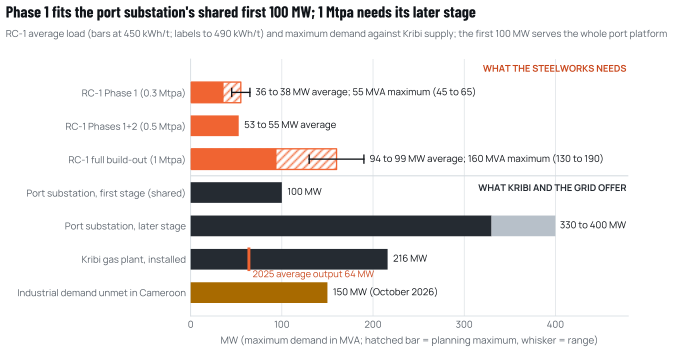
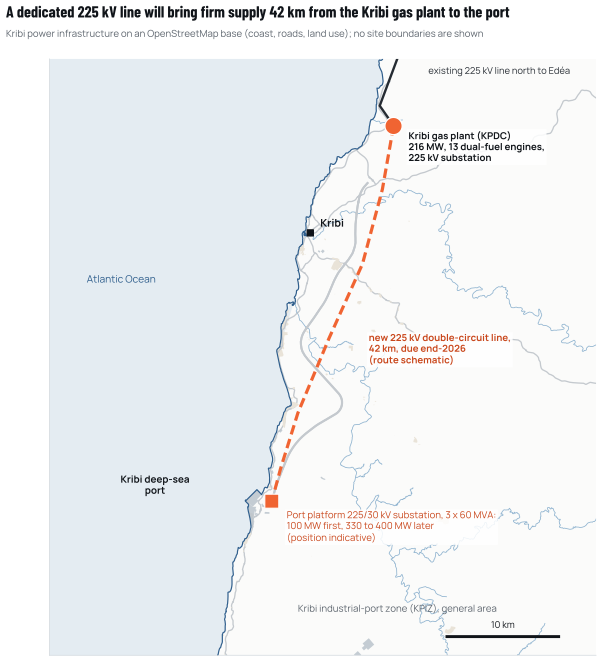
- Kribi’s new 225 kV supply can carry Phase 1. The 42 km double-circuit line from the Kribi gas plant and the 225/30 kV substation (3 x 60 MVA) at the port will offer 100 MW at first and 330 to 400 MW later, with commissioning planned for the end of 2026 [S14][S15]. The first 100 MW is shared by every user of the port platform. Phase 1, at 55 MVA maximum demand, would take about half of it; the 1 Mtpa works, at about 160 MVA, needs the later stage [S07].
- The FLNG’s departure changed the gas balance. About 95% of Cameroon’s 75.5 bcf of gas went to LNG in 2025 [S05]. With the vessel gone since July 2026 [S16], plausible domestic uses at Kribi add up to about 20 to 36 bcf a year (derived). The binding unknown is the remaining certified reserve of the Sanaga Sud field, which is not public [S17].
- Gas for direct reduction is affordable but not yet available on financeable terms. A 1 Mtpa DRI module would need about 8.4 to 9.1 bcf a year, nearly twice what the Kribi power plant used in 2025. At 2025 prices of about US$3.2/Mscf (power) and US$5.0 to 5.6/Mscf (industry) [S05], gas would cost US$27 to US$51 per tonne of DRI, against traded HBI at US$340 to US$370 a tonne in March 2026 [S18] (derived). Reserves, a price formula and DR-grade pellets are the constraints.
- Hydro, not solar, is the renewable that matters for steel. A solar plant at Kribi would yield about 1,335 kWh per kWp a year [S19]; 50 MWp would cover about 23% of Phase 1’s electricity but none of its night-time load. A contracted hydro supply, reported under the market-based method, could bring Scope 2 emissions close to zero and the plant close to low-emission steel thresholds (derived from [S20]).
Contents
12 chapters, 4 annexes
Every chapter opens with its conclusion. The annexes set out the method, the glossary and the list of sources.
- SummaryExecutive summary: the grid is an asset, but heavy industry needs firm supply, a tariff and gas11 min · 1 fig.
- Chapter 1Energy decides the cost and the carbon of electric steel14 min · 2 fig.
- Chapter 2Cameroon has the capacity on paper, but not yet firm supply where industry needs it14 min · 3 fig.
- Chapter 3Large users have no published tariff, so their price depends on negotiation rather than rules11 min · 2 fig.
- Chapter 4An arc furnace needs a strong connection and its own compensation, or it disturbs everyone else12 min · 3 fig.
- Chapter 5Kribi’s new 225 kV supply can carry a first-phase steelworks; 1 Mtpa needs its later stage and a dedicated bay11 min · 3 fig.
- Chapter 6The Hilli FLNG’s departure makes Cameroon’s gas a domestic question, and reserves are now the binding unknown11 min · 3 fig.
- Chapter 7A 1 Mtpa direct-reduction plant would need about 9 bcf of gas a year: affordable, but only with certified supply and DR-grade ore12 min · 2 fig.
- Chapter 8Hydro is Cameroon’s renewable advantage for steel; solar and storage help at the margin but cannot firm an arc furnace12 min · 3 fig.
- Chapter 9An electric steelworks at Kribi can be supplied in three steps: grid power first, firm gas-backed capacity for growth, gas for iron last12 min · 2 fig.
- Chapter 10Five rules, not subsidies, would make Cameroon’s energy system ready for heavy industry10 min · 1 fig.
- Chapter 11Thirteen evidence gaps remain, and most can be closed by publishing data that already exist6 min
Annexes
Go further
Related white papers
- WP06Lower-carbon steel from Cameroon: it could reach a third of the world’s carbon intensityClimate · 3 h
- WP03Electric steelmaking is the right route for Central AfricaTechnology · 2.9 h
- WP02Kribi can become Central Africa’s steel platform if infrastructure keeps paceSite and logistics · 2.8 h
Related Labs tools
- Power demand
How much electricity does an electric steelworks need, hour by hour?
- Steel route lab
Which steelmaking route uses the least energy and emits the least CO₂?
- Carbon and CBAM calculator
What is the footprint of a tonne of steel, and what would it cost at the EU border?
Cite this white paper
CS-WP-05
Cameroon Steel (2026). Cameroon’s hydro grid can power low-carbon steel if large users get firm supply, clear tariffs and gas. White paper 05, CS-WP-05. https://www.cameroon-steel.com/en/library/energy-for-industry/
- Reference
- CS-WP-05
- Edition
- 10 October 2026
- Status
- First edition
- Classification
- Public