White paper 03 · Technology
Electric steelmaking is the right route for Central Africa
An arc furnace fed first with scrap and DRI, later with Cameroonian iron, offers the best balance of capital, flexibility and carbon.
Derived Counted from the English manuscript when the site was generated; print equivalent = words ÷ 350.
You are reading the full English edition. Also online: Édition française complète中文摘要版
Executive summary
What the study shows
Read the full executive summaryChoosing the route: why an electric arc furnace, fed first with scrap and imported DRI/HBI and later with direct-reduced iron from concentrated Cameroonian ore, balances capital, flexibility, emissions and speed better than a blast furnace.
Source: white paper 03, executive summary; bracketed markers refer to the list of sources in the annex.
Main findings
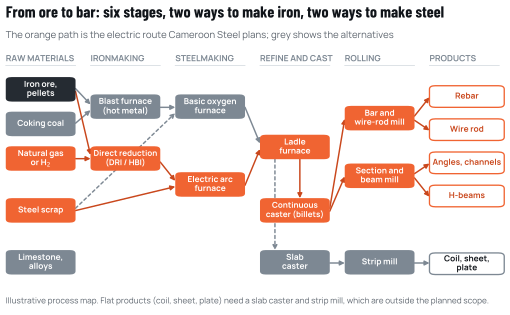
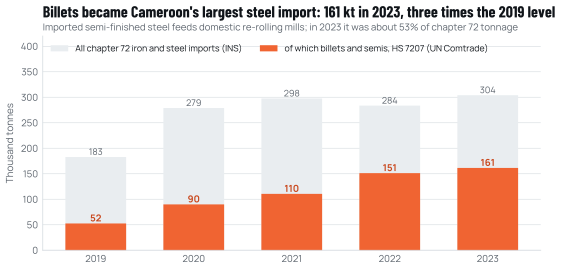
- The route choice is a choice about iron units. Rolling, casting and refining are common to every route; what differs is how iron is obtained. Cameroon’s shortfall is in iron, not in rolling: billets became the country’s largest single steel import, at 161,400 t in 2023, three times the 2019 level [S05], while domestic rolling capacity exceeds demand [S06].
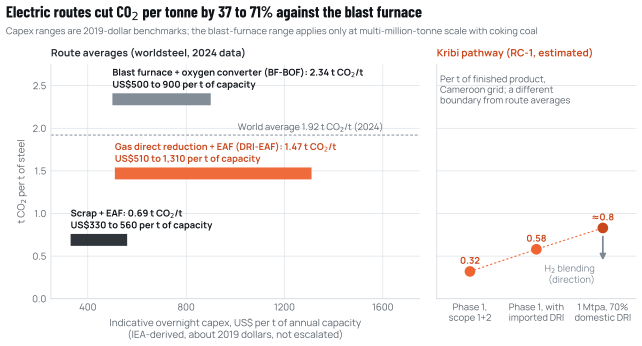
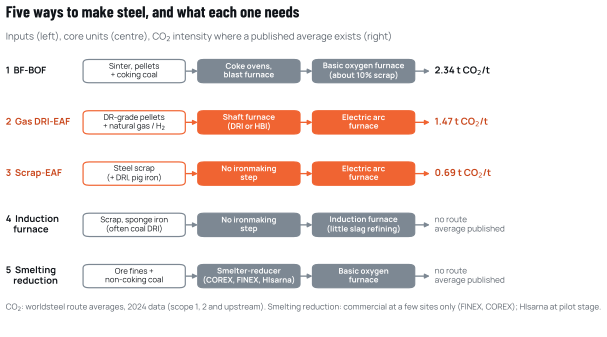
- Electric routes cut CO2 per tonne by 37 to 71%. worldsteel’s 2024 route averages are 2.34 t of CO2 per tonne of crude steel for the blast furnace and oxygen converter, 1.47 t for DRI-EAF and 0.69 t for scrap-EAF [S01]. On Cameroon’s hydro-dominated grid, about 226 g CO2/kWh in 2024 [S07], the electric routes’ advantage is larger still.
- Capital per tonne is not what separates the routes; the size of the indivisible step is. On IEA-derived benchmarks in 2019 dollars, indicative capex is about US$500 to 900 per tonne of capacity for a new blast-furnace works, US$510 to 1,310 for gas DRI-EAF and US$330 to 560 for scrap-EAF [S02]; budgets announced from 2020 to 2026, which include rolling mills and site works, run higher, from about US$660 to 1,560 per tonne (Chapter 2). But a blast furnace is economic only at several million tonnes a year, while melt shops and mills of about 0.3 Mt a year are being ordered in Africa today [S08, S09].
- Induction furnaces and smelting reduction do not fit. Induction furnaces refine poorly; most Indian induction-furnace steel made from DRI exceeded the phosphorus limits of national and ASTM standards [S10]. Smelting reduction still feeds an oxygen converter, depends on coal and is commercial at only a few sites [S11, S12].
- A 1 Mtpa melt shop needs about 1.2 Mt of iron units a year. RC-1, Cameroon Steel’s reference configuration, implies about 363,000 t in Phase 1 and 1.21 Mt at full development (derived) [S03]. Cameroon collects of the order of 0.1 Mt of scrap a year (derived), already used by existing mills; the only national study estimated scrap arising at 53,000 to 61,833 t a year [S13]. RC-1 therefore assumes that the plant can buy only about 30,000 t of domestic scrap a year (range 0 to 60,000 t) [S03].
- Phase 1 should run on scrap and imported DRI or HBI. RC-1 assumes about 30% DRI or HBI in the Phase 1 charge, within a range of 20 to 50% [S03]. HBI is the practical traded form because it ships with surface ventilation, whereas cold DRI must travel under inert gas [S14, S15]. Two suppliers per iron unit and covered storage are the minimum.
- Cameroonian ore needs a concentrator and a pellet plant before it can feed a shaft furnace. Direct reduction needs ore of at least 64% iron [S16], and traded DR grade is typically 67 to 68% [S17]. Mbalam’s JORC reserve grades 62.2% iron with 7.3% silica and alumina [S18]; testwork on Mbalam itabirite produced a 68% iron DR concentrate [S19]. That product exists only at testwork scale.
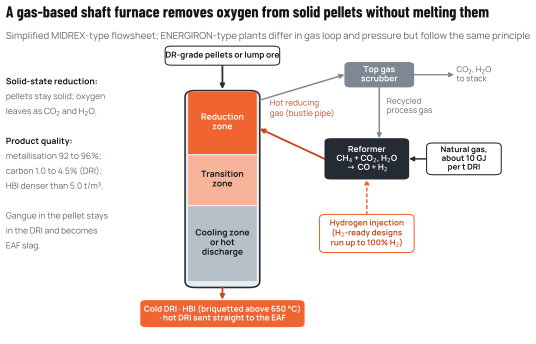
- Gas and hydrogen set the pace of domestic ironmaking. A 1 Mtpa DRI module would need about 9 bcf of gas a year, about 12% of Cameroon’s 2025 output (derived) [S20, S21]. Hydrogen-ready shaft furnaces can run on any mix of gas and hydrogen without fundamental changes to the furnace [S22], but full hydrogen operation for 1 Mt of DRI would need about 2.7 TWh of electricity a year (derived), so blending must follow new low-carbon power.
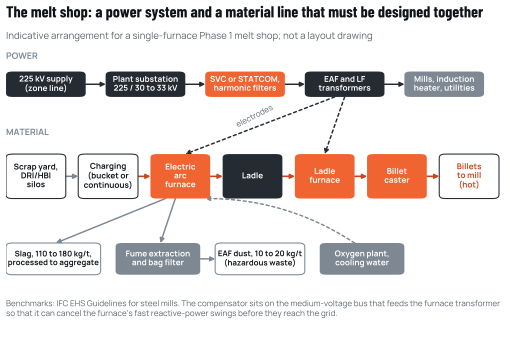
- One furnace of the 40 t class can carry most of Phase 1; the full 0.3 Mtpa needs high availability or a larger transformer. At the RC-1 planning value of 450 kWh per tonne of liquid steel, a heat of about 40 t takes about 55 minutes tap to tap; at about 490 kWh/t, the upper planning value with 30% DRI or HBI in the charge, about 59 minutes. Nameplate output, about 8,000 heats a year, then needs about 7,300 to 7,900 of the 8,760 hours in a year, so at a realistic 7,000 to 7,700 operating hours Phase 1 delivers about 270,000 to 300,000 t of finished products (derived) [S03]. The furnace offers schedulable load, melting around the grid’s peaks, not interruptible load. Arc furnaces cause flicker; other rebar mills have had to retrofit STATCOM compensators under regulatory pressure [S23, S24]. Phase 1’s maximum demand, about 55 MVA (assumed), fits the 100 MW initial stage of the zone’s 225 kV line [S03, S25].
- Quality and data are part of the product. Cameroon’s rebar standard NC 236 is mandatory and enforced [S26, S27]. An EAF with a ladle furnace and an in-line quench-and-self-temper mill makes ductile, weldable bars to NC 236, BS 4449 and ASTM A615 [S28, S29, S30]. Traceability from heat to bundle, energy management (about 4% savings in the first year in ISO 50001 plants [S31]) and measured CO2 per product complete the design.
Contents
12 chapters, 4 annexes
Every chapter opens with its conclusion. The annexes set out the method, the glossary and the list of sources.
- SummaryExecutive summary: start with the furnace that accepts any iron11 min · 1 fig.
- Chapter 1How steel is made: two ways to make iron, two ways to make steel13 min · 3 fig.
- Chapter 2The routes compared: electric routes win on carbon, scale and speed14 min · 3 fig.
- Chapter 3Metallics: Cameroon is short of iron units, not of rolling capacity11 min · 2 fig.
- Chapter 4Direct reduction and ore quality: Cameroonian iron needs a concentrator and a pellet plant first13 min · 5 fig.
- Chapter 5The EAF melt shop: one furnace of the 40 t class can carry most of Phase 1 if the power system is designed with it15 min · 3 fig.
- Chapter 6Rolling long products: hot billets and induction heating make Phase 1 an all-electric line10 min · 3 fig.
- Chapter 7Product quality for tropical construction: ductile, certified rebar matters more than strength alone10 min · 4 fig.
- Chapter 8Digitalisation and automation: control systems are part of the process, not an add-on10 min · 3 fig.
- Chapter 9The phased pathway applied: how RC-1 reaches 1 Mtpa in four steps14 min · 3 fig.
- Chapter 10Technology risks and decision criteria: retire the big risks before each commitment11 min · 1 fig.
- Chapter 11Evidence gaps: what is not yet known, and how it will be resolved6 min
Annexes
Go further
Related white papers
- WP05Cameroon’s hydro grid can power low-carbon steel if large users get firm supply, clear tariffs and gasEnergy · 2.9 h
- WP06Lower-carbon steel from Cameroon: it could reach a third of the world’s carbon intensityClimate · 3 h
- WP10Safer buildings need rebar that meets its declared gradeQuality · 2.8 h
Related Labs tools
- Steel route lab
Which steelmaking route uses the least energy and emits the least CO₂?
- Carbon and CBAM calculator
What is the footprint of a tonne of steel, and what would it cost at the EU border?
- Value-chain explorer
How many tonnes go in and out at each stage, from ore to finished product?
Cite this white paper
CS-WP-03
Cameroon Steel (2026). Electric steelmaking is the right route for Central Africa. White paper 03, CS-WP-03. https://www.cameroon-steel.com/en/library/technology-routes/
- Reference
- CS-WP-03
- Edition
- 10 October 2026
- Status
- First edition
- Classification
- Public