White paper 03 · Chapter 7
Product quality for tropical construction: ductile, certified rebar matters more than strength alone
Rebar for Central Africa has to satisfy two sets of rules: Cameroon’s mandatory national standard for reinforcing steel, NC 236 [S26, S27], and the international grades that contractors and lenders specify, chiefly BS 4449 B500B or B500C and ASTM A615 Grade 60 [S29, S30]. All of them set a minimum strength; the better ones also set minimum ductility, the ability of a bar to stretch and harden before it fails, which is what gives a concrete structure warning and resilience. An electric melt shop with a ladle furnace and an in-line quench-and-self-temper mill can make weldable bars that meet these grades from plain carbon-manganese steel [S28]. In Kribi’s humid, salt-laden coastal climate, durability depends mostly on how the bar is protected in concrete, and coated or stainless bars are a niche for the most exposed structures.
In this chapter (9)
- 7.1 A mandatory standard governs Cameroon’s rebar market
- 7.2 Strength is necessary; ductility is decisive
- 7.3 How the melt shop and mill deliver the properties
- 7.4 The mill laboratory and the testing regime
- 7.5 Site practice protects the product
- 7.6 Wire rod and sections have their own quality drivers
- 7.7 Corrosion: the climate at Kribi sets the protection strategy
- 7.8 The plant itself lives in the same climate
- 7.9 What quality means for the route choice
7.1 A mandatory standard governs Cameroon’s rebar market
Cameroon regulates rebar closely. The national standard for reinforcing steel, in force as NC 236/2024/06, has been mandatory since a ministerial order of 20 April 2022, and the Fe450 grade is not in its catalogue [S26, S27]. In October 2024 the national standards agency, ANOR, withdrew a producer’s compliance certificate for Fe450 bars and ordered the recall of the product, after an industry association complained [S26, S27]. In January 2026 the Prime Minister’s office rejected a request to revise the standard, at a time when the poor quality of some construction materials, rebar included, was being linked to building collapses [S26, S27]. Rebar imports have been prohibited since 2016, a position Customs confirmed in April 2023 [S69].
The regulatory message is clear and favourable to a producer that invests in quality: the market rewards bars that meet the standard and penalises those that do not. For a new producer that also intends to supply public works, international contractors and neighbouring countries, certification to NC 236 is the minimum; capability to certify to the main international grades is the design target.
Table 7.1 Rebar grades that a Central African producer must be able to meet
| Standard and grade | Yield strength | Ductility requirements | Notes |
|---|---|---|---|
| NC 236/2024/06 (Cameroon) | Grades as listed in the standard | As set in the standard | Mandatory since 20 April 2022; Fe450 not in the standard [S26, S27] |
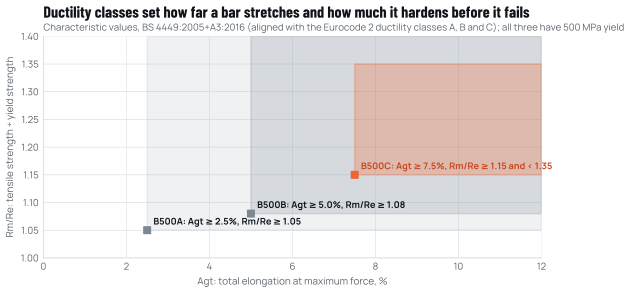
| BS 4449:2005+A3:2016, B500A | 500 MPa (characteristic) | Rm/Re at least 1.05; Agt at least 2.5% | Low-ductility class [S29] |
| BS 4449:2005+A3:2016, B500B | 500 MPa | Rm/Re at least 1.08; Agt at least 5.0% | Normal-ductility class, most widely specified [S29] |
| BS 4449:2005+A3:2016, B500C | 500 MPa | Rm/Re at least 1.15 and below 1.35; Agt at least 7.5% | High-ductility class [S29] |
| ASTM A615/A615M Grade 60 (420) | 420 MPa minimum; tensile 620 MPa minimum | Elongation 7 to 9% depending on bar size; 180° bend test | Phosphorus at most 0.060% (cast) [S30] |
Source: Cameroon standard as reported by Business in Cameroon and EcoMatin [S26, S27]; The Concrete Centre summary of BS 4449 [S29]; technical specification of an ASTM A615 Grade 60 TEMPCORE bar [S30]. Rm/Re: tensile to yield strength ratio; Agt: total elongation at maximum force.
7.2 Strength is necessary; ductility is decisive
Two numbers on a rebar certificate say more about a bar’s behaviour than its yield strength. Agt, the total elongation at maximum force, measures how far the bar stretches before it begins to neck. Rm/Re, the ratio of tensile strength to yield strength, measures how much stronger the bar becomes after it yields. A bar with good values for both yields gradually, spreads damage along its length and gives visible warning before failure; a brittle bar can snap with little warning.
Source: The Concrete Centre, Standards for reinforcement, summarising BS 4449:2005+A3:2016 [S29].
The three classes in Figure 7.1 share the same 500 MPa yield strength but differ in ductility: class A requires an Agt of at least 2.5%, class B 5.0% and class C 7.5%, with rising minimum ratios of tensile to yield strength [S29]. The three grades conform to the ductility classes recommended in Eurocode 2 [S29]. Class C also caps Rm/Re below 1.35 so that the bar does not become so much stronger after yielding that it overloads the surrounding concrete or connections.
For tropical construction, ductility matters for reasons beyond earthquakes. Buildings in fast-growing cities face overloading, uneven settlement on soft soils, impact and later alterations that were never designed for. Bars that can stretch before breaking give a structure the robustness to survive these, and give inspectors and occupants time to notice distress. The Cameroonian authorities’ concern about building collapses [S26, S27] is, at bottom, a concern about this kind of resilience.
7.3 How the melt shop and mill deliver the properties
Rebar quality is the product of three controls that the electric route performs well.
Chemistry. The melt shop sets carbon, manganese and silicon in the ladle furnace and keeps phosphorus and sulphur low through slag practice in the arc furnace and desulphurisation in the ladle. ASTM A615 limits phosphorus to 0.060% in the cast [S30]. Induction furnaces fed with DRI struggle here: India’s National Metallurgical Laboratory found phosphorus of 0.08 to 0.11% in most induction-furnace steel made from DRI, against 0.03 to 0.06% required by Indian and ASTM standards [S10]. DRI and HBI in the EAF charge also dilute copper and tin from scrap, which embrittle steel at high levels.
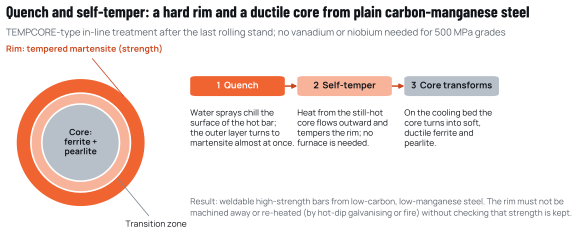
Thermomechanical treatment. The quench-and-self-temper process gives the bar its strength without expensive alloying (Figure 7.2). Water sprays chill the surface immediately after the last stand, forming martensite in an outer ring; heat from the still-hot core then tempers that ring; and the core transforms to ductile ferrite and pearlite on the cooling bed [S28]. The result is a bar with a strong rim and a ductile core, made from low-carbon, low-manganese steel that remains weldable [S28]. The mill in Tanzania ordered in September 2026 includes in-line quenching and tempering for this reason [S47].
Source: Cameroon Steel, after CRM Group’s description of the TEMPCORE process [S28].
The treatment has one practical caveat: a bar’s properties depend on its heat history. Heat introduced later, for example by hot-dip galvanising at about 450 °C, can reduce the strength of steels whose properties come from thermomechanical processing [S98]. Galvanised quenched-and-tempered bars must therefore be tested after coating, and the same consideration applies to fire damage assessments.
Testing and certification. Each cast lot is sampled for chemistry and for tensile, elongation and bend tests, and the results feed a mill certificate that travels with the bundles (Chapter 8). Certification by ANOR for the national market, and by recognised third-party schemes for export markets that require them, closes the loop between the plant’s records and the customer’s acceptance.
7.4 The mill laboratory and the testing regime
A rebar plant’s laboratory is where quality becomes evidence. For every cast lot, the plant analyses chemistry with an optical emission spectrometer and tests samples of each size for yield strength, tensile strength and elongation (including Agt), bend or rebend performance, mass per metre and rib geometry, which governs the bond between bar and concrete. The results are compared with the limits of the standard to which the lot is certified, recorded against the heat and rolling-lot numbers and printed on the inspection certificate that accompanies the bundles (Chapter 8). Independent audits by the certification body check that the laboratory’s equipment is calibrated and its procedures are followed.
For Phase 1 this means a laboratory specified with the mill, not after it: tensile machines with extensometers capable of measuring Agt, bend rigs for the full diameter range, a spectrometer, sample preparation and a data system linked to production. It also means trained staff and accreditation of the laboratory to recognised standards, so that the plant’s certificates are trusted by contractors and lenders.
7.5 Site practice protects the product
Bars that leave the mill to standard can be damaged on site. Three practices matter most. Bars should be cut and bent cold, on mandrels of the diameter the standard specifies, and not heated to make bending easier, because heat changes the properties of quench-and-self-tempered bars [S28, S98]. Welding of reinforcement should follow qualified procedures suited to the bar’s chemistry. And bars should be stored off the ground, under cover and away from salt spray until they are fixed, particularly in coastal sites such as Kribi. Cameroon Steel’s product guidance and its training for contractors should cover all three.
7.6 Wire rod and sections have their own quality drivers
Wire rod is sold to drawers who make wire, nails, mesh and binding wire. Their main requirements are clean steel (low inclusions and residuals, which cause breaks during drawing), consistent chemistry from coil to coil and a microstructure set by the controlled cooling after the laying head. Sections and beams are judged on dimensional tolerances (flange and web thickness, straightness, squareness) and on structural grades to EN 10025 or ASTM standards, which set strength, toughness and weldability. In each case, the melt shop’s control of chemistry and the mill’s measurement of dimensions and temperatures are what make consistent quality possible.
7.7 Corrosion: the climate at Kribi sets the protection strategy
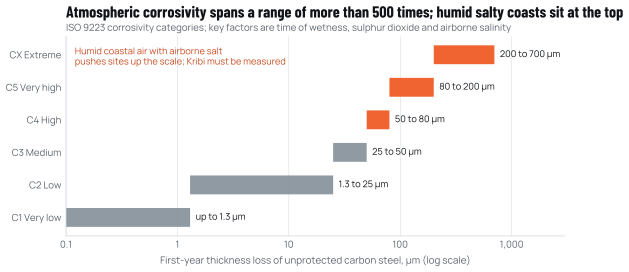
Kribi has an equatorial coastal climate with about 2,836 mm of rain a year and daily maximum relative humidity of 92 to 96% [S99]. Steel corrodes in the atmosphere when its surface is wet and when chlorides from sea spray or sulphur dioxide from pollution are present. ISO 9223 classifies the corrosivity of atmospheres from C1 (very low) to CX (extreme) using exactly those factors: time of wetness, sulphur dioxide and airborne salinity [S100]. The first-year thickness loss of unprotected carbon steel ranges from up to 1.3 µm in category C1 to 200 to 700 µm in category CX, a range of more than 500 times (Figure 7.3) [S98].
Source: Šmak et al. (2021), Table 1, reproducing EN ISO 9223 [S98]; factors from the ISO 9223 description [S100].
No measured corrosivity classification for Kribi has been published. The combination of high humidity and proximity to the sea points towards the upper categories, but the classification should be measured on site with standard exposure specimens over a year, as ISO 9223 allows [S100]. That measurement matters for three things: the protection of the plant’s own structures and equipment, the storage of products before dispatch, and the advice given to customers.
For reinforcement embedded in concrete, the atmosphere is only part of the story. Sound, dense concrete protects steel chemically for decades; corrosion starts when chlorides or carbonation penetrate the concrete cover and reach the bar. Durability therefore depends first on the depth and quality of the cover concrete, its water-cement ratio, its curing and its control of cracking, all of which Eurocode 2 and its companion concrete standard EN 206 govern through exposure classes for chloride-laden and marine environments. Coated or corrosion-resistant bars are a second line of defence for the most exposed structures:
- Hot-dip galvanised rebar (ISO 14657, ASTM A767) adds a sacrificial zinc layer; for quench-and-tempered bars, strength must be verified after coating [S98].
- Fusion-bonded epoxy-coated rebar (ASTM A775) forms a barrier but must be handled carefully to avoid coating damage on site.
- Stainless steel rebar (BS 6744) offers the highest resistance at a much higher price and is used selectively in splash zones and critical elements.
7.8 The plant itself lives in the same climate
The corrosivity that threatens customers’ structures also threatens the steelworks. Melt-shop and mill buildings, crane rails, conveyors, cooling towers, pipe racks and the high-voltage substation are exposed to the same humid, salt-laden air, often with added heat, steam and dust. Their protective coating systems should be specified for the measured corrosivity category rather than for an inland default, with inspection and maintenance budgeted from the start. Finished products need the same care: bundles and coils waiting for dispatch should be stored under cover and off the ground, and the dispatch yard designed to drain quickly in the September to October rains. These are small design choices that protect yield, quality and the plant’s own assets over decades.
7.9 What quality means for the route choice
Quality strengthens the case for the electric route with a ladle furnace. An arc furnace with refining slag, a ladle furnace and a quench-and-self-temper mill can make NC 236, BS 4449 and ASTM A615 grades consistently from a mix of scrap and DRI; an induction furnace without ladle refining has difficulty meeting phosphorus limits [S10]; and a re-roller that buys billets cannot control the chemistry of the steel it rolls. As domestic DRI enters the charge, the melt shop gains clean iron with low residuals, which improves wire-rod drawability and gives more room on chemistry. The specification of the Phase 1 mill should therefore include in-line quenching, continuous dimensional measurement and a laboratory able to test every cast lot, from the first day of production.
Sources cited in this chapter
Bracketed markers refer to these sources; the full list is in the annex. Full list of sources
- S26Cameroon rejects fresh push to revise rebar standard. Business in Cameroon, 26 Jan 2026.businessincameroon.com/construction/2601-15657-cameroon-rejects-fresh-…
- S27Cameroun: le gouvernement rejette une demande de révision de la norme du fer à béton. EcoMatin, 5 Feb 2026.ecomatin.net/cameroun-le-gouvernement-rejette-une-demande-de-revision-…
- S69Métallurgie: les importations du fer à béton interdites jusqu’à nouvel ordre. EcoMatin, 10 Apr 2023.ecomatin.net/metallurgie-les-importations-du-fer-a-beton-interdites-ju…
- S29Standards for reinforcement (BS 4449:2005+A3:2016 grades). The Concrete Centre, Undated, accessed Oct 2026.concretecentre.com/Codes/European-standards-for-reinforcement.aspx
- S30Technical specification SPB300: deformed steel bars, ASTM A615 Grade 60. Pittini Group (Siderpotenza), 1 Jan 2020.pittini.it/wp-content/uploads/Pittini-Group-rebar-SPB300.pdf
- S10Development of synthetic flux and a process for de-phosphorization of steel in induction furnace. CSIR National Metallurgical Laboratory, India, Undated, accessed Oct 2026.nmlindia.org/node/288
- S28TEMPCORE: quench and self-tempering process for reinforcing bars. CRM Group, Undated, accessed Oct 2026.old.crmgroup.be/en/industrialised-results/bulk-processes/tempcore
- S47GSM Tanzania selects Danieli Technologies for new rebar and wire rod mill. SteelOrbis, 15 Sep 2026.steelorbis.com/steel-news/latest-news/gsm-tanzania-selects-danieli-tec…
- S98Šmak M., Kubíček J., Kala J., Podaný K., Vaněrek J., The influence of hot-dip galvanizing on the mechanical properties of high-strength steels, Materials 14(18):5219, doi:10.3390/ma14185219. MDPI (via PubMed Central PMC8467660), 2021.pmc.ncbi.nlm.nih.gov/articles/PMC8467660/
- S99Olivry J.-C., Monographie du Nyong et des fleuves côtiers, tome 1. ORSTOM / IRGM, Jul 1979.horizon.documentation.ird.fr/exl-doc/pleins_textes/divers11-03/01948.p…
- S100ISO 9223:2012 Corrosion of metals and alloys: corrosivity of atmospheres (resource description). Standards New Zealand, Building Code Hub.codehub.building.govt.nz/assets/_generated_pdfs/iso-92232012-7236.pdf
Cite this chapter
Cameroon Steel (2026). Electric steelmaking is the right route for Central Africa. White paper 03, chapter 7: Product quality for tropical construction: ductile, certified rebar matters more than strength alone. CS-WP-03. https://www.cameroon-steel.com/en/library/technology-routes/product-quality/
Source