White paper 03 · Chapter 6
Rolling long products: hot billets and induction heating make Phase 1 an all-electric line
The rolling mills decide what Cameroon Steel sells, and much of the energy it uses outside the melt shop. Phase 1 plans a bar and wire-rod mill for rebar of 8 to 32 mm and wire rod of 5.5 to 12 mm, heated by induction from billets that arrive hot from the caster [S03]. Later phases add a light and medium section mill for angles, channels and flats, then a heavy-section mill for H-beams, both with gas-fired reheating furnaces [S03]. Charging billets hot saves about 0.55 GJ per tonne at 700 °C compared with a cold charge [S50], and one Italian mill cut reheating fuel by 40% after converting to hot charging [S95]. On Cameroon’s 2024 grid, induction heating emits about as much CO2 per tonne as an efficient gas furnace while removing the need for gas in Phase 1 (derived).
In this chapter (8)
- 6.1 Rolling turns billets into the products customers specify
- 6.2 Each phase adds a mill for products the region still imports
- 6.3 Heating is the mill’s largest energy decision
- 6.4 Yield and quality are made in the mill as much as in the melt shop
- 6.5 Wire rod feeds a downstream cluster
- 6.6 Water, scale and the mill’s utilities
- 6.7 Commissioning and ramp-up take months, not weeks
- 6.8 Flexibility in the mill keeps the market open
6.1 Rolling turns billets into the products customers specify
A long-products mill receives billets (or, for large sections, blooms and beam blanks) and turns them into bars, coils and profiles by successive hot deformation. Each stand of rolls reduces the cross-section and lengthens the stock; the shape of the rolls (the "pass design") determines the final profile. Figure 6.1 shows the logic of the Phase 1 mill: a common heating and roughing train, then two finishing routes, one producing straight rebar in bundles and the other producing wire rod in coils.
The rebar route
After the roughing and intermediate stands, the bar passes through finishing stands whose last pass rolls the ribs. Immediately after the last stand, a water box quenches the bar’s surface. This quenching and self-tempering treatment, known by trade names such as TEMPCORE, gives a hard tempered-martensite rim and a ductile ferrite-pearlite core, and produces weldable high-strength bars from plain low-carbon, low-manganese steel without costly vanadium or niobium [S28]. CRM Group, which developed the process, reports more than 100 industrial installations, for bar diameters up to 75 mm [S28]. The bars then cool on a cooling bed, are cut to commercial lengths by cold shears, counted and bundled.
Smaller rebar sizes are often rolled in two or more strands at once by slitting the bar lengthwise in the finishing train, which raises mill output for the diameters where demand is largest. The 300,000 t/yr mill ordered by GSM in Tanzania in September 2026 combines 14 cartridge-type stands, a 10-pass finishing block for wire rod and in-line quenching and tempering, and makes rebar of 8 to 32 mm and wire rod of 5.5 to 6.5 mm from 150 mm billets at up to 50 t per hour [S08, S47].
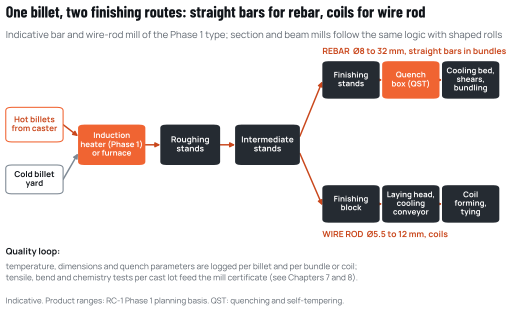
Source: Cameroon Steel; product ranges from the Cameroon Steel reference configuration RC-1 (planning estimate) [S03]; mill architecture as in the 2026 African mill orders [S08, S47].
The wire-rod route
Wire rod is rolled to small diameters in a high-speed finishing block, a compact group of stands driven together, then formed into rings by a laying head and cooled in a controlled way on a conveyor before being collected as coils. The cooling programme determines the rod’s microstructure and therefore how easily it can be drawn into wire, mesh, nails and binding wire. Rod for fine drawing needs a clean steel with low residuals, which is one reason why DRI and HBI in the melt shop’s charge matter for the wire-rod product (Chapter 3).
6.2 Each phase adds a mill for products the region still imports
RC-1 sequences the mills so that each phase adds products rather than more of the same [S03]. Phase 1 serves the construction market with rebar and wire rod, but its mill is not the only outlet for its steel: domestic rebar capacity already exceeds demand by more than three times [S06], so Phase 1 output is planned to be flexible between rolled products and merchant billets for the existing re-rollers, and to displace imported billets and wire rod and reach CEMAC markets rather than add rebar to a saturated market (Chapter 9). Phase 2 adds a light and medium section mill for angles, channels and flats, used in building frames, roofs, towers, transmission structures and fabrication. Phase 3 adds a heavy-section mill for H-beams and I-beams, which are used in industrial buildings, bridges and port structures. Sections and fabricated structures are still largely imported in Cameroon: in 2023 the country imported US$26.3 million of sections (HS 7216) and 25,700 t of fabricated structures (HS 7308) [S05].
Table 6.1 Rolling mills by RC-1 phase (indicative)
| Phase | Mill | Products | Indicative finished capacity | Feed | Heating |
|---|---|---|---|---|---|
| Phase 1 | Bar and high-speed wire-rod mill | Rebar Ø8 to 32 mm in bundles; wire rod Ø5.5 to 12 mm in coils | Nameplate about 300,000 t/yr; expected sustained 270,000 to 300,000 | Billets, hot from the caster or cold from the yard | Induction billet heating, partly hot-charged |
| Phase 2 | Light and medium section mill | Angles, channels, flats | About 200,000 t/yr (150,000 to 200,000) | Billets from a second melt line | Gas-fired walking-beam furnace |
| Phase 3 | Heavy-section mill | H-beams, I-beams, heavy sections | About 500,000 t/yr | Blooms or beam blanks from an expanded melt shop | Gas-fired walking-beam furnace |
| Reserve | Downstream processing | Wire drawing, welded mesh, cut-and-bend | To be defined | Wire rod, rebar | Not applicable |
Source: Cameroon Steel reference configuration RC-1 (planning estimate), edition 10 October 2026 [S03]. Capacities are planned (Phase 1) or indicative (Phases 2 and 3).
The heavy-section mill imposes requirements upstream. Wide-flange beams are rolled from larger, shaped semis, so Phase 3 requires a caster for blooms or beam blanks in addition to billets, and a melt-shop expansion. That is one reason why Phase 3 is the largest step in the pathway and comes after Phases 1 and 2 have proved the market and the operating team.
6.3 Heating is the mill’s largest energy decision
Before rolling, steel must be brought back to a temperature at which it deforms easily; reheating furnaces typically discharge at about 1,250 °C [S50]. How that heat is supplied is the main energy decision in the mill. EU best available techniques associate bars and rods reheating with 0.6 to 1.9 GJ per tonne and the reheating of billets, blooms and beams with 1.4 to 2.2 GJ per tonne, while the rolling itself takes 0.1 to 0.5 GJ per tonne [S49]. RC-1 assumes a gas walking-beam furnace using 1.1 to 1.6 GJ per tonne for the later section mills [S03].
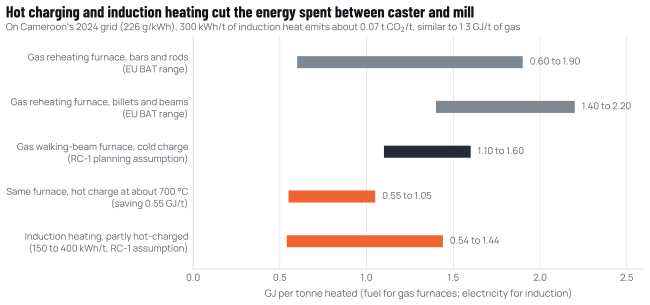
Source: EU BAT conclusions for ferrous metals processing [S49]; planning assumptions of the Cameroon Steel reference configuration RC-1 (planning estimate) [S03]; hot-charging saving [S50]; CO2 comparison from the IPCC default factor for natural gas [S96] and Cameroon’s 2024 grid intensity [S07].
Two techniques reduce heating energy substantially.
Hot charging. Billets that go from the caster to the furnace before they cool need much less fuel. A 2025 industry analysis estimates a saving of about 0.55 GJ per tonne for steel charged at 700 °C, a furnace productivity increase of about 28% and a CO2 saving of about 27 kg per tonne; it also notes that gas-fired furnaces lose 0.5 to 1.0% of the steel as scale [S50]. In 2023, Acciaierie di Sicilia in Italy reported a 40% cut in fuel use on its 80 t per hour pusher furnace after Danieli installed direct hot-billet charging [S95]. Hot charging requires the caster and mill to be laid out and scheduled together, with a short transfer table and a buffer for interruptions.
Induction heating. Induction heaters warm billets electrically with coils whose power can be controlled one by one, which suits direct transfer from the caster: the billet only needs its temperature restored and equalised, not raised from cold. Danieli describes direct casting-rolling lines in which billets pass from the caster through induction heaters to the mill without any gas-fired furnace, reducing scale formation and emissions [S97]. RC-1 assumes 150 to 400 kWh per tonne for partly hot-charged induction heating in Phase 1, with a central value of 300 kWh [S03].
On Cameroon’s grid, the carbon comparison is close. At the 2024 average intensity of about 226 g CO2/kWh [S07], 300 kWh of induction heating emits about 0.068 t of CO2 per tonne, while 1.3 GJ of natural gas in a reheating furnace emits about 0.073 t at the IPCC default factor of 56.1 t CO2 per TJ [S96] (both derived). The case for induction in Phase 1 is therefore less about carbon than about simplicity: it needs no gas connection, starts and stops quickly, reduces scale loss and couples naturally to a caster next door. RC-1 accordingly plans Phase 1 with no gas use at all, adding about 260,000 GJ of gas a year with the Phase 2 section mill and about 910,000 GJ at full development [S03].
6.4 Yield and quality are made in the mill as much as in the melt shop
Every tonne lost between the caster and the finished bundle is a tonne of iron units, energy and labour wasted. Losses arise from scale on the billet surface, crop ends cut from each bar, cobbles (bars that jam in the mill) and out-of-tolerance product. RC-1 assumes a combined casting and rolling yield of 0.94 t of finished product per tonne of liquid steel, within a range of 0.92 to 0.96, and about 20 kg of mill scale per tonne of product, which is collected and recycled [S03]. Hot charging and induction heating both reduce scale; good pass design, guides and automation reduce cobbles and crop losses.
Quality is controlled by measurement. Modern mills measure bar dimensions continuously with laser gauges after the finishing stands, log quench water flow and temperature for every bar, and test samples from each cast lot for tensile strength, elongation and bendability before the mill certificate is issued (Chapters 7 and 8). For wire rod, the cooling-conveyor settings and coil properties are recorded coil by coil. These records are not administrative overhead: they are what allows a customer, an inspector or a court to trace a bar back to the heat it came from.
6.5 Wire rod feeds a downstream cluster
Wire rod is an intermediate product. It is drawn into wire for binding, nails, fencing and welded mesh, and its customers are small and medium manufacturers whose productivity depends on rod that draws without breaking. Cameroon’s recorded wire-rod imports fell from 50,800 t in 2019 to 7,800 t in 2023 [S05], and the industry now reports domestic capacity for wire rod and nails well above demand [S06]. A new rod mill therefore competes on quality, consistency and the range of grades it can supply, not on volume alone. Welded mesh and cut-and-bent rebar are a natural extension: they move value added from building sites to factories, reduce waste and improve accuracy on site. RC-1 keeps a reserve for downstream processing of this kind [S03]. A Kribi rod mill would supply both its own downstream units and independent drawers in the region.
6.6 Water, scale and the mill’s utilities
A rolling mill uses water to cool rolls, to descale billets with high-pressure jets and, for rebar, to quench the bar after the last stand. IFC benchmarks for rolling mills give a wide range of water use, depending on the extent of recirculation [S44]. The water picks up scale and oil and must be settled, skimmed and cooled before it is reused; the scale is recovered and can be sold or recycled to the melt shop. RC-1 assumes closed cooling loops and a make-up of 1.5 to 3.0 m³ of water per tonne of product for the whole plant [S03]. Compressed air, lubrication and hydraulic systems complete the mill’s utilities; all of them are electric in Phase 1.
6.7 Commissioning and ramp-up take months, not weeks
A new mill does not reach its design output on the first day. Cold tests of each stand and drive, hot trials with the first billets, calibration of pass schedules and quench settings for each product, and the training of crews on live equipment all take time. Supplier contracts should specify a progressive ramp-up, performance tests at defined output, yield and energy levels, and the supplier’s presence on site until those tests are passed. The Gate 2 criterion in Chapter 10, twelve months at or near design performance, reflects this.
6.8 Flexibility in the mill keeps the market open
A long-products mill is more flexible than its name suggests. The bar mill can shift between rebar diameters within a shift, roll plain rounds or small flats, and supply wire rod to downstream drawing. The section mills can follow demand between angles, channels and flats. The billets themselves are a saleable product: when a mill is down for maintenance or demand is weak, the melt shop can sell billets to other rolling mills that currently import them (Chapter 3).
Three design choices protect that flexibility at modest cost: a cold-billet yard and loading table beside the hot-charge line, so that the mill can run when the melt shop is down; space and foundations for downstream processing (wire drawing, welded mesh, cut-and-bend), which RC-1 reserves [S03]; and a mill automation system that stores pass schedules and quench recipes for every product, so that changes are fast and repeatable.
Sources cited in this chapter
Bracketed markers refer to these sources; the full list is in the annex. Full list of sources
- S28TEMPCORE: quench and self-tempering process for reinforcing bars. CRM Group, Undated, accessed Oct 2026.old.crmgroup.be/en/industrialised-results/bulk-processes/tempcore
- S08GSM Tanzania selects Danieli for new rebar and wire-rod mill. Danieli, 14 Sep 2026.danieli.com/en/GSM-Tanzania-selects-Danieli-for-new-rebar-and-wirerod-…
- S47GSM Tanzania selects Danieli Technologies for new rebar and wire rod mill. SteelOrbis, 15 Sep 2026.steelorbis.com/steel-news/latest-news/gsm-tanzania-selects-danieli-tec…
- S03Cameroon Steel reference configuration RC-1 (planning estimate): phases, benchmarks with ranges and indicative balances for the Kribi steelworks (Class 5), edition 10 October 2026, values as revised on that date. Cameroon Steel, 10 Oct 2026.Cited by title and date
- S06Production: les acteurs en présence. Cameroon Tribune, 11 May 2026.cameroon-tribune.cm/article.html/76600/fr.html/details_2
- S05UN Comtrade public API: Cameroon (reporter 120), HS 72 and 73 and six-digit lines, 2019 to 2023. United Nations Statistics Division.comtradeapi.un.org/public/v1/preview/C/A/HS?reporterCode=120&period=20…
- S50Hot charging of steel billets and slabs: impact on energy costs and emissions (S. W. Hesling). Steelonthenet, 1 Jan 2025.steelonthenet.com/insights/hot-charging.html
- S49Commission Implementing Decision (EU) 2022/2110, BAT conclusions for the ferrous metals processing industry. European Commission, Official Journal L 284, 11 Oct 2022.eur-lex.europa.eu/legal-content/EN/TXT/PDF/?uri=CELEX:32022D2110
- S962006 IPCC Guidelines for National Greenhouse Gas Inventories, Volume 2 (Energy), Chapter 1, default CO₂ emission factor for natural gas (56,100 kg/TJ). Intergovernmental Panel on Climate Change, 2006.ipcc-nggip.iges.or.jp/public/2006gl/pdf/2_Volume2/V2_1_Ch1_Introductio…
- S07Carbon intensity of electricity generation (Ember data). Our World in Data, Dataset accessed Oct 2026.ourworldindata.org/grapher/carbon-intensity-electricity
- S95Danieli implements new hot billet charging system at Acciaierie di Sicilia. AIST, 10 Aug 2023.aist.org/danieli-implements-new-hot-billet-charging-system-at-acciaier…
- S97Electric heating systems (Q-Heat induction heaters). Danieli, Undated, accessed Oct 2026.danieli.com/en/danieli-green-metal/electric-heating-systems.htm
- S44Environmental, Health, and Safety Guidelines for Integrated Steel Mills. IFC, World Bank Group, 30 Apr 2007.ifc.org/content/dam/ifc/doc/2000/2007-integrated-steel-mills-ehs-guide…
Cite this chapter
Cameroon Steel (2026). Electric steelmaking is the right route for Central Africa. White paper 03, chapter 6: Rolling long products: hot billets and induction heating make Phase 1 an all-electric line. CS-WP-03. https://www.cameroon-steel.com/en/library/technology-routes/rolling-long-products/
Source