White paper 03 · Summary
Executive summary: start with the furnace that accepts any iron
For a new steel producer in Central Africa, an electric arc furnace fed first with scrap and imported direct-reduced iron (DRI) or hot-briquetted iron (HBI), and later with DRI made from concentrated Cameroonian ore, offers the best balance of capital intensity, flexibility, emissions and speed. It emits a fraction of the blast furnace’s CO2, can be built in steps of a few hundred thousand tonnes, starts producing without waiting for a mine, a pellet plant and a gas contract, and keeps the path to Cameroonian iron open. Blast-furnace routes suit very large, coking-coal-backed integrated works that Cameroon does not have. This paper explains the technology choices behind that conclusion and applies them to Cameroon Steel’s planned complex at Mboro, in the Kribi industrial-port zone.
In this chapter (8)
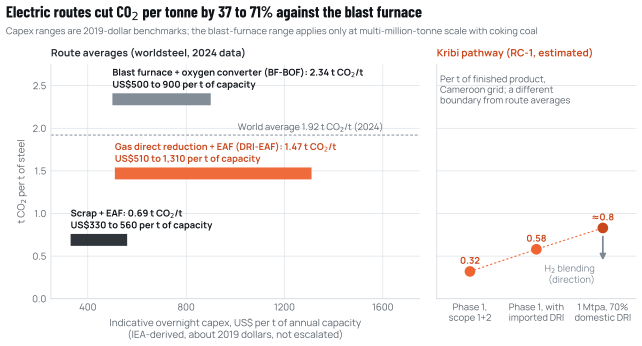
Source: worldsteel Sustainability Indicators 2025, 2024 data [S01]; capex ranges derived from IEA annualised costs, about 2019 US dollars, not escalated [S02]; pathway intensities from the Cameroon Steel reference configuration RC-1 (planning estimate), per tonne of finished product, a different boundary from the route averages [S03]; method in Annex A.
ES.1 The finding in brief
Steelmaking routes differ above all in where their iron comes from. The blast furnace makes iron from ore with coke at a scale of millions of tonnes a year; the gas-based direct-reduction shaft makes solid iron from high-grade pellets with natural gas or hydrogen, in modules from 0.25 to 2.5 Mt a year [S04]; the electric arc furnace melts whatever iron units it is given, scrap, DRI, HBI or pig iron. An electric melt shop can therefore start on purchased iron units and add domestic ironmaking later, without changing the furnace, the caster or the mills. The blast-furnace route offers no such sequence.
ES.2 Ten findings
- The route choice is a choice about iron units. Rolling, casting and refining are common to every route; what differs is how iron is obtained. Cameroon’s shortfall is in iron, not in rolling: billets became the country’s largest single steel import, at 161,400 t in 2023, three times the 2019 level [S05], while domestic rolling capacity exceeds demand [S06].
- Electric routes cut CO2 per tonne by 37 to 71%. worldsteel’s 2024 route averages are 2.34 t of CO2 per tonne of crude steel for the blast furnace and oxygen converter, 1.47 t for DRI-EAF and 0.69 t for scrap-EAF [S01]. On Cameroon’s hydro-dominated grid, about 226 g CO2/kWh in 2024 [S07], the electric routes’ advantage is larger still.
- Capital per tonne is not what separates the routes; the size of the indivisible step is. On IEA-derived benchmarks in 2019 dollars, indicative capex is about US$500 to 900 per tonne of capacity for a new blast-furnace works, US$510 to 1,310 for gas DRI-EAF and US$330 to 560 for scrap-EAF [S02]; budgets announced from 2020 to 2026, which include rolling mills and site works, run higher, from about US$660 to 1,560 per tonne (Chapter 2). But a blast furnace is economic only at several million tonnes a year, while melt shops and mills of about 0.3 Mt a year are being ordered in Africa today [S08, S09].
- Induction furnaces and smelting reduction do not fit. Induction furnaces refine poorly; most Indian induction-furnace steel made from DRI exceeded the phosphorus limits of national and ASTM standards [S10]. Smelting reduction still feeds an oxygen converter, depends on coal and is commercial at only a few sites [S11, S12].
- A 1 Mtpa melt shop needs about 1.2 Mt of iron units a year. RC-1, Cameroon Steel’s reference configuration, implies about 363,000 t in Phase 1 and 1.21 Mt at full development (derived) [S03]. Cameroon collects of the order of 0.1 Mt of scrap a year (derived), already used by existing mills; the only national study estimated scrap arising at 53,000 to 61,833 t a year [S13]. RC-1 therefore assumes that the plant can buy only about 30,000 t of domestic scrap a year (range 0 to 60,000 t) [S03].
- Phase 1 should run on scrap and imported DRI or HBI. RC-1 assumes about 30% DRI or HBI in the Phase 1 charge, within a range of 20 to 50% [S03]. HBI is the practical traded form because it ships with surface ventilation, whereas cold DRI must travel under inert gas [S14, S15]. Two suppliers per iron unit and covered storage are the minimum.
- Cameroonian ore needs a concentrator and a pellet plant before it can feed a shaft furnace. Direct reduction needs ore of at least 64% iron [S16], and traded DR grade is typically 67 to 68% [S17]. Mbalam’s JORC reserve grades 62.2% iron with 7.3% silica and alumina [S18]; testwork on Mbalam itabirite produced a 68% iron DR concentrate [S19]. That product exists only at testwork scale.
- Gas and hydrogen set the pace of domestic ironmaking. A 1 Mtpa DRI module would need about 9 bcf of gas a year, about 12% of Cameroon’s 2025 output (derived) [S20, S21]. Hydrogen-ready shaft furnaces can run on any mix of gas and hydrogen without fundamental changes to the furnace [S22], but full hydrogen operation for 1 Mt of DRI would need about 2.7 TWh of electricity a year (derived), so blending must follow new low-carbon power.
- One furnace of the 40 t class can carry most of Phase 1; the full 0.3 Mtpa needs high availability or a larger transformer. At the RC-1 planning value of 450 kWh per tonne of liquid steel, a heat of about 40 t takes about 55 minutes tap to tap; at about 490 kWh/t, the upper planning value with 30% DRI or HBI in the charge, about 59 minutes. Nameplate output, about 8,000 heats a year, then needs about 7,300 to 7,900 of the 8,760 hours in a year, so at a realistic 7,000 to 7,700 operating hours Phase 1 delivers about 270,000 to 300,000 t of finished products (derived) [S03]. The furnace offers schedulable load, melting around the grid’s peaks, not interruptible load. Arc furnaces cause flicker; other rebar mills have had to retrofit STATCOM compensators under regulatory pressure [S23, S24]. Phase 1’s maximum demand, about 55 MVA (assumed), fits the 100 MW initial stage of the zone’s 225 kV line [S03, S25].
- Quality and data are part of the product. Cameroon’s rebar standard NC 236 is mandatory and enforced [S26, S27]. An EAF with a ladle furnace and an in-line quench-and-self-temper mill makes ductile, weldable bars to NC 236, BS 4449 and ASTM A615 [S28, S29, S30]. Traceability from heat to bundle, energy management (about 4% savings in the first year in ISO 50001 plants [S31]) and measured CO2 per product complete the design.
ES.3 The phased pathway applied to Kribi
Cameroon Steel’s reference configuration, RC-1, applies the pathway in four steps [S03]:
- Phase 1 (planned): one electric arc furnace of the 40 t class with a ladle furnace, a billet caster, induction billet heating and a bar and wire-rod mill; nameplate capacity 0.3 Mtpa, with an expected sustained output of 270,000 to 300,000 t a year of billets, rebar (8 to 32 mm) and wire rod (5.5 to 12 mm). Works are targeted to start in 2029, after the environmental certificate, with a first heat in the second half of 2030 and ramp-up in 2031.
- Phase 2 (indicative): a second melt line and a light and medium sections mill for about 0.2 Mtpa of angles, channels and flats, indicatively 2032 to 2034.
- Phase 3 (indicative): melt-shop expansion and a heavy-section mill for H-beams after 2034, bringing the plant to its design capacity of about 1 Mtpa, subject to markets and financing.
- Reserve (indicative): a hydrogen-ready direct-reduction (DR) module of about 1 Mt of DRI a year for Cameroonian ore, later, subject to ore quality, gas supply and approvals.
Phase 1’s melt shop makes billets, and its output is flexible between rolled products (wire rod and rebar) and merchant billets sold to existing re-rolling mills, for which local scrap covers only about 40% of needs and which imported 161,400 t of billets in 2023 [S05, S32, S33]. Rebar is not where the gap lies: domestic rebar capacity, about 627,000 t a year (read from a source that prints 627 tonnes; White paper 04, Chapter 5), is more than three times rebar demand of about 180,000 t [S06]. Phase 1 tonnage is therefore aimed at displacing imported billets and wire rod and at exports within CEMAC, not at adding rebar to a saturated market. White paper 04 sets out the market evidence and an indicative cost of a Kribi billet against a delivered import.
Phase 1 is all-electric: induction heating removes the need for gas until the Phase 2 section mill [S03]. Its scope 1 and 2 emissions are estimated at about 0.32 t of CO2 per tonne of finished product (0.33 t at the upper electricity value), and about 0.58 t including the upstream emissions of imported DRI (derived) [S03]. Full development needs the zone line’s later stage of 330 to 400 MW [S25, S34]. This paper gives no investment amounts; they will be established by engineering and financing.
ES.4 Why the alternatives fall short
Each alternative fails at least one of the four tests of capital, flexibility, emissions and speed. A blast-furnace works would need several million tonnes a year to be efficient, imported coking coal and the highest carbon intensity of any route; it would commit all its capital before producing a tonne. A re-rolling mill without a melt shop would be quick and cheap, but it would add to rolling capacity that already exceeds demand [S06] and leave the plant dependent on imported billets, the very import that most needs replacing [S05]. Induction furnaces cannot reliably meet the phosphorus and ductility requirements of modern rebar standards without additional refining [S10], in a market whose regulators are enforcing quality [S26, S27]. A direct-reduction plant built first would tie the start of production to a concentrator, a pellet plant and a gas contract that do not yet exist. Only the phased electric route starts within a few years, spends capital in steps, meets quality standards with proven equipment and keeps the path to Cameroonian iron open.
ES.5 Decision criteria
The pathway’s main technology risks sit at its interfaces with the grid, the iron-unit markets, the mine and the gas supply. Each can be reduced before the corresponding money is committed. Chapter 10 proposes four gates, each opened by evidence rather than by date:
- Phase 1 investment: a firm 225 kV connection with an accepted flicker study; two sources for each iron unit; a certification path for NC 236 and international grades; performance guarantees for electricity per tonne and furnace availability; an approved impact assessment, disclosed for the period lenders require before board approval.
- Phase 2: twelve months of Phase 1 at design yield, energy and output; confirmed demand for sections; electrical headroom.
- Phase 3: the zone line’s later stage contracted; a proven heavy-section market; a metallics plan for 1.2 Mt a year.
- Domestic DRI: DR-grade concentrate of at least 67% iron proven at pilot scale; a pellet supply; audited gas reserves and a long-term contract; a hydrogen-ready design with CO2 measurement.
ES.6 What remains uncertain
The paper is explicit about what is not yet known (Chapter 11). The most important open questions are the short-circuit strength of the grid at the plant’s connection point; the remaining reserves of Cameroon’s producing gas field; whether, when and where a DR-grade concentrator and pellet plant will be built; the measured atmospheric corrosivity at Kribi; and the prices at which imported HBI and scrap can be contracted for the life of Phase 1. None of these uncertainties argues for a different route; each argues for the phased, gated approach.
ES.7 What the pathway asks of public partners
The phased pathway depends on decisions that are not Cameroon Steel’s alone. Six of them shape its timing and its value to the country.
- A firm grid connection with clear power-quality rules. The zone’s 225 kV line and substation [S25] must be commissioned, and the plant’s connection agreement must set the flicker and harmonic limits that its compensator is designed to meet.
- A framework for industrial gas. Before any direct-reduction module, the State, the national oil company and producers will need to clarify how gas is allocated, priced and taxed for industrial users over periods of twenty years or more [S21, S35].
- A bridge between mine and steelworks. The 15% local-transformation clause in Cameroon Mining Company’s convention [S36] becomes valuable for steelmaking only if a DR-grade concentrate is proven and pelletised. A joint pilot programme is the logical first step.
- Port capacity for bulk iron units. Phase 1 will import about 351,000 t a year of iron units and consumables through Kribi (derived) [S03]. The mineral terminal, the subject of a memorandum of understanding signed on 4 November 2025 and expected by the port’s Director General in March 2026 to be completed within five to six years [S37, S38], matters as much to a steelworks as to a mine; Phase 1 will use the existing terminals.
- Consistent enforcement of product standards. The mandatory rebar standard and its enforcement [S26, S27] protect producers that invest in quality, and the public that occupies the buildings.
- Skills. Cameroon’s engineering schools have no dedicated metallurgy department [S39]; a steel programme with schools and technology suppliers will be needed from Phase 1.
None of these is a precondition for every step. Together they decide how quickly the pathway moves from purchased iron to Cameroonian iron.
ES.8 How this paper is organised
Chapter 1 explains how steel is made, for readers outside the industry. Chapter 2 compares the five routes. Chapter 3 examines iron units and Cameroon’s scrap shortfall. Chapter 4 covers direct reduction and ore quality. Chapters 5 and 6 describe the melt shop and the rolling mills. Chapter 7 addresses product quality for tropical construction, and Chapter 8 automation and data. Chapter 9 applies the pathway to RC-1, and Chapter 10 sets out risks and decision criteria. Chapter 11 lists the evidence gaps. The annexes give the method and assumptions, a glossary, the full list of sources and the data behind every chart.
Statement of interest. This paper is published by Cameroon Steel, which is developing a steelworks at Kribi. It is written to inform public debate; its analysis is independent of any commercial offer, and every figure is sourced or labelled with its status.
Sources cited in this chapter
Bracketed markers refer to these sources; the full list is in the annex. Full list of sources
- S01Sustainability Indicators 2025 report (2024 data; route table added Feb 2026). worldsteel, Nov 2025, updated Feb 2026.worldsteel.org/wider-sustainability/sustainability-indicators/
- S02Iron and Steel Technology Roadmap. International Energy Agency, Oct 2020.iea.blob.core.windows.net/assets/eb0c8ec1-3665-4959-97d0-187ceca189a8/…
- S03Cameroon Steel reference configuration RC-1 (planning estimate): phases, benchmarks with ranges and indicative balances for the Kribi steelworks (Class 5), edition 10 October 2026, values as revised on that date. Cameroon Steel, 10 Oct 2026.Cited by title and date
- S042025 World Direct Reduction Statistics. Midrex Technologies, Sep 2026.midrex.com/world-dri-statistics/world-dri-production-reaches-151-0-mt-…
- S05UN Comtrade public API: Cameroon (reporter 120), HS 72 and 73 and six-digit lines, 2019 to 2023. United Nations Statistics Division.comtradeapi.un.org/public/v1/preview/C/A/HS?reporterCode=120&period=20…
- S06Production: les acteurs en présence. Cameroon Tribune, 11 May 2026.cameroon-tribune.cm/article.html/76600/fr.html/details_2
- S07Carbon intensity of electricity generation (Ember data). Our World in Data, Dataset accessed Oct 2026.ourworldindata.org/grapher/carbon-intensity-electricity
- S08GSM Tanzania selects Danieli for new rebar and wire-rod mill. Danieli, 14 Sep 2026.danieli.com/en/GSM-Tanzania-selects-Danieli-for-new-rebar-and-wirerod-…
- S09B5Plus Group awards Danieli bar and wire-rod mill project. Danieli, 23 Sep 2026.danieli.com/en/B5Plus-Group-awards-Danieli-bar-and-wirerod-mill-projec…
- S10Development of synthetic flux and a process for de-phosphorization of steel in induction furnace. CSIR National Metallurgical Laboratory, India, Undated, accessed Oct 2026.nmlindia.org/node/288
- S11Plaul F. J., Böhm C., Schenk J. L., Fluidized-bed technology for the production of iron products for steelmaking, Journal of the SAIMM 109(2). Southern African Institute of Mining and Metallurgy, Feb 2009.scielo.org.za/pdf/jsaimm/v109n2/05.pdf
- S12Tata Steel invests $1.2 billion in green steel technology in Jharkhand. GMK Center, 20 Jan 2026.gmk.center/en/news/tata-steel-invests-1-2-billion-in-green-steel-techn…
- S13Bidoung J., Fomethe A., Yantio G., Melo U., La récupération et le recyclage des déchets ferromagnétiques: analyse de la situation au Cameroun, Déchets, Revue francophone d’écologie industrielle n°48. ENSP Yaoundé and MIPROMALO, Q4 2007.eid.episciences.org/7942/pdf
- S14Direct Reduced Iron (DRI): specifications and handling. International Iron Metallics Association, Undated, accessed Oct 2026.metallics.org/dri.html
- S15Hot Briquetted Iron (HBI): specifications and handling. International Iron Metallics Association, Undated, accessed Oct 2026.metallics.org/hbi.html
- S16Climate change and the production of iron and steel (policy paper). worldsteel.worldsteel.org/climate-action/climate-change-and-the-production-of-iro…
- S17Global high-grade iron ore market is set to grow (S. Basirat). Institute for Energy Economics and Financial Analysis (IEEFA), Mar 2026.ieefa.org/sites/default/files/2026-03/IEEFA_Global%20high-grade%20iron…
- S18Mbalam-Nabeba resources and reserves as at 20 May 2015 (JORC Code). Previous holder of the Mbalam permit (ASX-listed company disclosure), 2015.Cited by title and date
- S19Mbalam iron ore project: presentation to Mining Indaba 2014 (metallurgical testwork on itabirite). Previous holder of the Mbalam permit (ASX-listed company disclosure), Feb 2014.Cited by title and date
- S20ENERGIRON technology: DRI-EAF production route using natural gas or H2. European Commission, Innovation Centre for Industrial Transformation, Referenced 12 Feb 2026.innovation-centre-for-industrial-transformation.ec.europa.eu/innovativ…
- S21Données pétrolières 2025. Société Nationale des Hydrocarbures (SNH), Jun 2026.snh.cm/wp-content/uploads/2026/06/Donnees-petrolieres-2025.pdf
- S22MIDREX Flex: minimizing technology risks in the transition to carbon-free steelmaking (V. Chevrier), worldsteel Breakthrough Technology Conference. Midrex Technologies, hosted by worldsteel, 6 Dec 2023.worldsteel.org/wp-content/uploads/Presentation_Vincent-CHEVRIER-Midrex…
- S23Gerdau plant in Charlotte, US: SVC Light for EAF flicker mitigation (customer story). Hitachi Energy, Undated, accessed Oct 2026.hitachienergy.com/news-and-events/customer-stories/gerdau-plant-in-cha…
- S24Modular multilevel converter based STATCOM for electrical arc furnace application: Metalfer steel mill, Serbia (case study GEA34872). GE Vernova Power Conversion, Rev. 20 Feb 2024.gevernova.com/power-conversion/sites/default/files/2024-02/GEA34872_Po…
- S25Kribi franchit la ligne électrique 225 kV. Port Autonome de Kribi, 6 Aug 2025.Cited by title and date
- S26Cameroon rejects fresh push to revise rebar standard. Business in Cameroon, 26 Jan 2026.businessincameroon.com/construction/2601-15657-cameroon-rejects-fresh-…
- S27Cameroun: le gouvernement rejette une demande de révision de la norme du fer à béton. EcoMatin, 5 Feb 2026.ecomatin.net/cameroun-le-gouvernement-rejette-une-demande-de-revision-…
- S28TEMPCORE: quench and self-tempering process for reinforcing bars. CRM Group, Undated, accessed Oct 2026.old.crmgroup.be/en/industrialised-results/bulk-processes/tempcore
- S29Standards for reinforcement (BS 4449:2005+A3:2016 grades). The Concrete Centre, Undated, accessed Oct 2026.concretecentre.com/Codes/European-standards-for-reinforcement.aspx
- S30Technical specification SPB300: deformed steel bars, ASTM A615 Grade 60. Pittini Group (Siderpotenza), 1 Jan 2020.pittini.it/wp-content/uploads/Pittini-Group-rebar-SPB300.pdf
- S31Fitzgerald P., Therkelsen P. L., Sheaffer P., Rao P., Deeper and persistent energy savings and carbon dioxide reductions achieved through ISO 50001 in the manufacturing sector, Sustainable Energy Technologies and Assessments. Lawrence Berkeley National Laboratory, 2023.eta-publications.lbl.gov/publications/deeper-and-persistent-energy-sav…
- S32Cameroun: Prometal décroche 26,2 milliards FCFA d’Afreximbank. Camer.be, 1 Oct 2026.camer.be/actualites/economie/cameroun-prometal-decroche-262-milliards-…
- S3340 millions d’euros d’Afreximbank: Prometal sécurise ses billettes d’acier alors que la ferraille camerounaise s’épuise. Cameroun24, 10 Oct 2026.cameroun24.net/article/76267-40-millions-d-euros-d-afreximbank-prometa…
- S34Énergie et infrastructures: un nouvel élan pour la compétitivité du Port de Kribi. Port Autonome de Kribi, 19 Aug 2026.Cited by title and date
- S35Cameroon’s SNH eyes Yoyo-Yolanda and new exploration blocks to sustain gas growth. Business in Cameroon, 6 Jul 2026.businessincameroon.com/energy/0607-16422-cameroon-s-snh-eyes-yoyo-yola…
- S36Cameroon Mining Company confirme l’entrée du projet Mbalam dans sa phase irréversible d’exécution. Camer.be via AllAfrica, 12 Dec 2025.fr.allafrica.com/stories/202512120475.html
- S37Port de Kribi: un terminal minéralier d’avenir (memorandum of understanding for a 125 Mt a year mineral terminal). Port Autonome de Kribi, 4 Nov 2025.Cited by title and date
- S38Zone industrialo-portuaire de Kribi (KPIZ): jusqu’à +8 points de croissance et 150 000 emplois attendus sur 15 ans. Investir au Cameroun, 4 Mar 2026.investiraucameroun.com/gestion-publique/0403-23163-zone-industrialo-po…
- S39École Nationale Supérieure Polytechnique de Yaoundé: departments. ENSP Yaoundé, Undated, accessed Oct 2026.polytechnique.cm/
Cite this chapter
Cameroon Steel (2026). Electric steelmaking is the right route for Central Africa. White paper 03, Executive summary: start with the furnace that accepts any iron. CS-WP-03. https://www.cameroon-steel.com/en/library/technology-routes/executive-summary/
Source