白皮书03 · 摘要 · 中文摘要
执行摘要:先建能够接受任何铁源的电弧炉
对中部非洲的新钢铁生产商而言,电弧炉先以废钢和进口直接还原铁(DRI)或热压块铁(HBI)为原料,日后再改用喀麦隆精矿生产的直接还原铁,能够在资本强度、灵活性、排放和建设速度之间取得最佳平衡。电弧炉的CO2排放仅为高炉的一小部分,可按每期数十万吨分步建设,无需等待矿山、球团厂和天然气合同即可投产,同时为使用喀麦隆本土铁资源保留通道。高炉路线适合以炼焦煤为支撑的超大型联合钢厂,而喀麦隆并不具备这些条件。本文阐述支撑这一结论的技术选择,并将其应用于Cameroon Steel规划在克里比港综合工业区姆博罗(Mboro)建设的钢铁综合体。
本页为本章中文摘要;英文全文附于其后,可展开阅读。
本章目录(9)
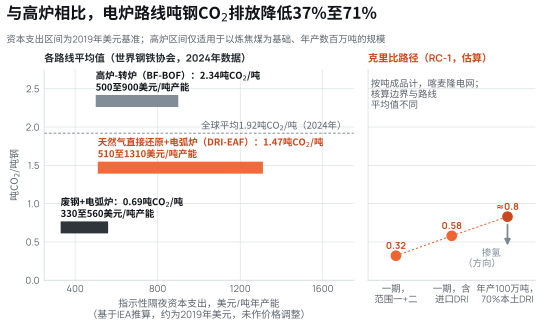
ES.1 结论概要
各种炼钢路线的根本区别在于铁从何而来。高炉以焦炭还原矿石生产铁水,规模为每年数百万吨;天然气基直接还原竖炉以天然气或氢气将高品位球团还原为固态铁,单个模块年产25万至250万吨[S04];电弧炉则可熔化任何含铁原料,包括废钢、DRI、HBI或生铁。因此,电炉炼钢车间可以先使用外购含铁原料投产,以后再增加本土炼铁环节,而无需更换电弧炉、连铸机或轧机。高炉路线不具备这种分步推进的可能。
ES.2 十项结论
- 选择工艺路线,就是选择含铁原料。轧制、连铸和精炼是所有路线的共同环节,区别在于铁的获取方式。喀麦隆缺的是铁,而不是轧制能力:钢坯已成为该国最大的单项钢材进口商品,2023年进口16.14万吨,是2019年的三倍[S05],而国内轧制能力已超过需求[S06]。
- 电炉路线使吨钢CO2排放降低37%至71%。根据世界钢铁协会2024年路线平均值,高炉-转炉路线每吨粗钢排放2.34吨CO2,DRI-电弧炉路线1.47吨,废钢电弧炉路线0.69吨[S01]。喀麦隆电网以水电为主,2024年电网排放因子约为226克CO2/千瓦时[S07],电炉路线的优势更加明显。
- 区分各路线的不是每吨资本支出,而是不可分割的最小投资规模。按基于IEA推算的2019年美元基准,新建高炉钢厂的指示性资本支出约为每吨产能500至900美元,天然气DRI-电弧炉为510至1310美元,废钢电弧炉为330至560美元[S02];2020至2026年公布的项目预算包含轧机和场地工程,水平更高,约为每吨660至1560美元(第2章)。但高炉只有在年产数百万吨时才具经济性,而非洲目前订购的炼钢车间和轧机规模约为年产30万吨[S08, S09]。
- 感应炉和熔融还原不适用。感应炉精炼能力差;印度以DRI为原料的感应炉钢大多超出本国标准和ASTM标准的磷含量上限[S10]。熔融还原仍需配套转炉,依赖煤炭,且仅在少数地点实现商业化运行[S11, S12]。
- 年产100万吨的炼钢车间每年需要约120万吨含铁原料。Cameroon Steel的参考配置RC-1显示,一期约需36.3万吨,全面建成后需121万吨(推算)[S03]。喀麦隆每年回收的废钢约在10万吨量级(推算),且已被现有钢厂使用;唯一一项全国性研究估计的废钢年产生量为5.3万至6.18万吨[S13]。因此,RC-1假设本厂每年只能采购约3万吨本土废钢(区间0至6万吨)[S03]。
- 一期应以废钢和进口DRI或HBI为原料。RC-1假设一期炉料中DRI或HBI约占30%,区间为20%至50%[S03]。HBI是实际可行的贸易形态,因为它只需表面通风即可海运,而冷态DRI必须在惰性气体保护下运输[S14, S15]。每种含铁原料至少两家供应商并配备有盖仓储,是最低要求。
- 喀麦隆矿石须先经选矿厂和球团厂处理,才能供竖炉使用。直接还原要求矿石铁品位至少为64%[S16],贸易中的直接还原级产品品位通常为67%至68%[S17]。姆巴拉姆JORC储量的铁品位为62.2%,二氧化硅和氧化铝合计7.3%[S18];对姆巴拉姆铁英岩(itabirite)的试验得到了品位68%的直接还原级精矿[S19]。该产品目前仅停留在试验规模。
- 天然气和氢气决定本土炼铁的推进节奏。年产100万吨的DRI模块每年约需90亿立方英尺(9 bcf)天然气,约为喀麦隆2025年产量的12%(推算)[S20, S21]。氢能就绪的竖炉可在天然气与氢气任意比例下运行,炉体无需根本性改造[S22];但100万吨DRI若完全使用氢气,每年约需27亿千瓦时电力(推算),因此掺氢必须与新增低碳电力同步推进。
- 一座40吨级电弧炉可支撑一期的大部分产量;达到30万吨名义产能需要很高的可用率或更大的变压器。按RC-1规划值每吨钢水450千瓦时计,每炉约40吨,冶炼周期约55分钟;按上限规划值约490千瓦时(炉料中DRI或HBI占30%)计,约59分钟。名义产能所需的约8000炉将占用全年8760小时中的约7300至7900小时;按年运行7000至7700小时这一现实假设,一期可生产约27万至30万吨成品(推算)[S03]。电弧炉提供的是可调度负荷,即将熔炼安排在电网高峰之外,而不是可中断负荷。电弧炉会造成电压闪变;其他钢筋厂曾在监管压力下加装STATCOM补偿装置[S23, S24]。一期最大需量约55兆伏安(假设),在园区225千伏线路初期100兆瓦的范围之内[S03, S25]。
- 质量与数据是产品的组成部分。喀麦隆钢筋标准NC 236为强制性标准且得到执行[S26, S27]。配备钢包精炼炉和在线淬火自回火轧机的电弧炉,能够生产符合NC 236、BS 4449和ASTM A615的高延性、可焊接钢筋[S28, S29, S30]。从炉次到钢筋捆的全程追溯、能源管理(通过ISO 50001认证的工厂第一年节能约4%[S31])以及按产品计量的CO2排放,共同构成完整的设计。
ES.3 分期路径在克里比的应用
Cameroon Steel的参考配置RC-1将该路径分为四步[S03]:
- 一期(规划):一座40吨级电弧炉及钢包精炼炉、一台钢坯连铸机、钢坯感应加热装置和一条棒线材轧机;名义产能每年30万吨,预计持续产量每年27万至30万吨,产品为钢坯、钢筋(8至32毫米)和线材(5.5至12毫米)。目标于2029年在取得环境证书后开工,2030年下半年首炉出钢,2031年爬坡。
- 二期(指示性):第二条熔炼线和轻中型型材轧机,年产约20万吨角钢、槽钢、扁钢,暂定2032至2034年。
- 三期(指示性):炼钢扩能及重型型材轧机(H型钢),2034年后,产能达约100万吨,视市场和融资而定。
- 预留(指示性):为喀麦隆矿石预留一个年产约100万吨DRI的氢能就绪直接还原模块,时间更晚,视矿石、天然气和审批情况而定。
一期炼钢车间生产钢坯,产品可在轧材(线材和钢筋)与商品钢坯之间灵活分配;商品钢坯销往现有再轧厂,这些工厂的需求中本地废钢仅能满足约40%,2023年进口钢坯16.14万吨[S05, S32, S33]。缺口不在钢筋:国内钢筋产能约62.7万吨(原始资料印作627吨,此处按千吨理解,见白皮书04第5章),是约18万吨需求的三倍以上[S06]。因此,一期产量的目标是替代进口钢坯和线材并出口中部非洲经济与货币共同体(CEMAC)市场,而不是向已饱和的市场增加钢筋。白皮书04阐述市场证据,并给出克里比钢坯与进口到岸钢坯的指示性成本比较。
一期全部使用电力:感应加热使工厂在二期型材轧机之前无需天然气[S03]。一期范围一和范围二排放估计约为每吨成品0.32吨CO2(按电力上限值为0.33吨),计入进口DRI的上游排放后约为0.58吨(推算)[S03]。全面建成需要园区线路后期330至400兆瓦的供电能力[S25, S34]。本文不提供任何投资金额,相关金额将通过工程设计和融资确定。
ES.4 其他方案为何不足取
每一种替代方案都至少在资本、灵活性、排放和速度四项标准中的一项上不达标。高炉钢厂需年产数百万吨才能高效运行,需进口炼焦煤,且碳强度在所有路线中最高;它必须在产出第一吨钢之前投入全部资本。没有炼钢车间的再轧厂建设快、投资少,但会进一步增加本已过剩的轧制能力[S06],并使工厂依赖进口钢坯,而钢坯恰恰是最需要替代的进口商品[S05]。在监管机构严格执行质量要求的市场中[S26, S27],感应炉若不增加精炼环节,难以稳定满足现代钢筋标准对磷含量和延性的要求[S10]。先建直接还原厂,则会使投产时间取决于尚不存在的选矿厂、球团厂和天然气合同。只有分期电炉路线能够在数年内投产、分步投入资本、以成熟设备满足质量标准,并为使用喀麦隆本土铁保留通道。
ES.5 决策标准
该路径的主要技术风险集中在与电网、含铁原料市场、矿山和天然气供应的接口上。每项风险都可以在相应资金投入之前得到降低。第10章提出四道关口,每道关口都以证据而非日期为开启条件:
- 一期投资:确定的225千伏接入及获认可的闪变研究;每种含铁原料两个来源;NC 236及国际牌号的认证路径;吨钢电耗和电弧炉可用率的性能保证;环境与社会影响评估获批,并在贷款方董事会批准前按其要求的期限公开披露。
- 二期:一期连续十二个月达到设计收得率、能耗和产量;型材需求得到确认;电力容量留有余量。
- 三期:园区线路后期供电已签约;重型材市场得到验证;落实每年120万吨含铁原料计划。
- 本土DRI:铁品位至少67%的直接还原级精矿通过中试验证;球团供应落实;天然气储量经审计并签订长期合同;采用带CO2计量的氢能就绪设计。
ES.6 仍不确定的事项
本文明确列出尚不掌握的信息(第11章)。最重要的未决问题包括:工厂接入点的电网短路容量;喀麦隆在产气田的剩余储量;直接还原级选矿厂和球团厂是否建设、何时建设、建在何处;克里比实测的大气腐蚀性;以及一期运营期内进口HBI和废钢的合同价格。这些不确定性都不支持改选其他路线,而是都支持分期、设关口的推进方式。
ES.7 该路径对公共部门合作伙伴的期待
分期路径取决于并非由Cameroon Steel单方面作出的决定。其中六项决定影响其时间安排和对国家的价值。
- 确定的电网接入和明确的电能质量规则。园区225千伏线路和变电站[S25]须投入运行,工厂的接入协议须规定其补偿装置设计所要满足的闪变和谐波限值。
- 工业用天然气框架。在建设任何直接还原模块之前,国家、国家石油公司和生产商须明确二十年或更长期限内工业用户天然气的分配、定价和税收安排[S21, S35]。
- 矿山与钢厂之间的桥梁。Cameroon Mining Company采矿协议中15%本地加工的条款[S36],只有在直接还原级精矿得到验证并完成造球后,才对炼钢具有价值。联合中试计划是合乎逻辑的第一步。
- 散装含铁原料的港口能力。一期每年将经克里比进口约35.1万吨含铁原料和消耗品(推算)[S03]。矿石码头已于2025年11月4日签署谅解备忘录,克里比自治港(PAK)总经理在2026年3月预计其将在五至六年内建成[S37, S38];该码头对钢厂与对矿山同样重要,一期将使用现有码头。
- 持续执行产品标准。强制性钢筋标准及其执行[S26, S27]保护投资于质量的生产商,也保护建筑物中的公众。
- 技能。喀麦隆的工程院校没有专门的冶金系[S39];从一期开始就需要与院校和技术供应商合作开展钢铁人才培养计划。
这些决定并非每一步的前提条件。但它们共同决定该路径从外购铁过渡到喀麦隆本土铁的速度。
ES.8 本文结构
第1章为业外读者说明钢铁生产方式。第2章比较五种工艺路线。第3章分析含铁原料和喀麦隆的废钢缺口。第4章讨论直接还原和矿石质量。第5章和第6章介绍炼钢车间和轧机。第7章论述热带地区建筑用产品的质量,第8章论述自动化和数据。第9章将该路径应用于RC-1,第10章阐述风险和决策标准。第11章列出证据缺口。附录(方法和假设、术语表、来源清单和数据表)及完整正文以英文和法文发布;本中文摘要版逐章摘要第1至第11章。
利益声明。本文由正在克里比筹建钢铁厂的Cameroon Steel发布,旨在为公共讨论提供参考;其分析独立于任何商业要约,所有数据均注明来源或标明其状态。
英文全文 11分钟 · 2535词Executive summary: start with the furnace that accepts any iron
For a new steel producer in Central Africa, an electric arc furnace fed first with scrap and imported direct-reduced iron (DRI) or hot-briquetted iron (HBI), and later with DRI made from concentrated Cameroonian ore, offers the best balance of capital intensity, flexibility, emissions and speed. It emits a fraction of the blast furnace’s CO2, can be built in steps of a few hundred thousand tonnes, starts producing without waiting for a mine, a pellet plant and a gas contract, and keeps the path to Cameroonian iron open. Blast-furnace routes suit very large, coking-coal-backed integrated works that Cameroon does not have. This paper explains the technology choices behind that conclusion and applies them to Cameroon Steel’s planned complex at Mboro, in the Kribi industrial-port zone.
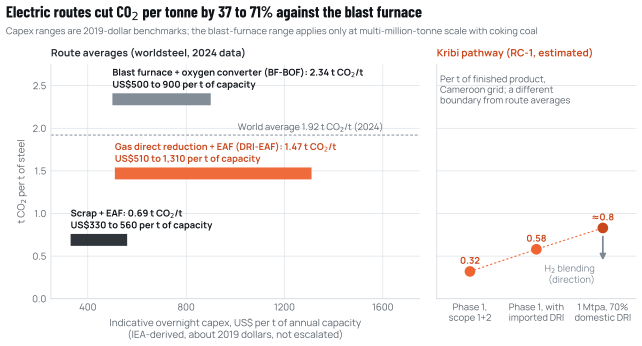
Source: worldsteel Sustainability Indicators 2025, 2024 data [S01]; capex ranges derived from IEA annualised costs, about 2019 US dollars, not escalated [S02]; pathway intensities from the Cameroon Steel reference configuration RC-1 (planning estimate), per tonne of finished product, a different boundary from the route averages [S03]; method in Annex A.
ES.1 The finding in brief
Steelmaking routes differ above all in where their iron comes from. The blast furnace makes iron from ore with coke at a scale of millions of tonnes a year; the gas-based direct-reduction shaft makes solid iron from high-grade pellets with natural gas or hydrogen, in modules from 0.25 to 2.5 Mt a year [S04]; the electric arc furnace melts whatever iron units it is given, scrap, DRI, HBI or pig iron. An electric melt shop can therefore start on purchased iron units and add domestic ironmaking later, without changing the furnace, the caster or the mills. The blast-furnace route offers no such sequence.
ES.2 Ten findings
- The route choice is a choice about iron units. Rolling, casting and refining are common to every route; what differs is how iron is obtained. Cameroon’s shortfall is in iron, not in rolling: billets became the country’s largest single steel import, at 161,400 t in 2023, three times the 2019 level [S05], while domestic rolling capacity exceeds demand [S06].
- Electric routes cut CO2 per tonne by 37 to 71%. worldsteel’s 2024 route averages are 2.34 t of CO2 per tonne of crude steel for the blast furnace and oxygen converter, 1.47 t for DRI-EAF and 0.69 t for scrap-EAF [S01]. On Cameroon’s hydro-dominated grid, about 226 g CO2/kWh in 2024 [S07], the electric routes’ advantage is larger still.
- Capital per tonne is not what separates the routes; the size of the indivisible step is. On IEA-derived benchmarks in 2019 dollars, indicative capex is about US$500 to 900 per tonne of capacity for a new blast-furnace works, US$510 to 1,310 for gas DRI-EAF and US$330 to 560 for scrap-EAF [S02]; budgets announced from 2020 to 2026, which include rolling mills and site works, run higher, from about US$660 to 1,560 per tonne (Chapter 2). But a blast furnace is economic only at several million tonnes a year, while melt shops and mills of about 0.3 Mt a year are being ordered in Africa today [S08, S09].
- Induction furnaces and smelting reduction do not fit. Induction furnaces refine poorly; most Indian induction-furnace steel made from DRI exceeded the phosphorus limits of national and ASTM standards [S10]. Smelting reduction still feeds an oxygen converter, depends on coal and is commercial at only a few sites [S11, S12].
- A 1 Mtpa melt shop needs about 1.2 Mt of iron units a year. RC-1, Cameroon Steel’s reference configuration, implies about 363,000 t in Phase 1 and 1.21 Mt at full development (derived) [S03]. Cameroon collects of the order of 0.1 Mt of scrap a year (derived), already used by existing mills; the only national study estimated scrap arising at 53,000 to 61,833 t a year [S13]. RC-1 therefore assumes that the plant can buy only about 30,000 t of domestic scrap a year (range 0 to 60,000 t) [S03].
- Phase 1 should run on scrap and imported DRI or HBI. RC-1 assumes about 30% DRI or HBI in the Phase 1 charge, within a range of 20 to 50% [S03]. HBI is the practical traded form because it ships with surface ventilation, whereas cold DRI must travel under inert gas [S14, S15]. Two suppliers per iron unit and covered storage are the minimum.
- Cameroonian ore needs a concentrator and a pellet plant before it can feed a shaft furnace. Direct reduction needs ore of at least 64% iron [S16], and traded DR grade is typically 67 to 68% [S17]. Mbalam’s JORC reserve grades 62.2% iron with 7.3% silica and alumina [S18]; testwork on Mbalam itabirite produced a 68% iron DR concentrate [S19]. That product exists only at testwork scale.
- Gas and hydrogen set the pace of domestic ironmaking. A 1 Mtpa DRI module would need about 9 bcf of gas a year, about 12% of Cameroon’s 2025 output (derived) [S20, S21]. Hydrogen-ready shaft furnaces can run on any mix of gas and hydrogen without fundamental changes to the furnace [S22], but full hydrogen operation for 1 Mt of DRI would need about 2.7 TWh of electricity a year (derived), so blending must follow new low-carbon power.
- One furnace of the 40 t class can carry most of Phase 1; the full 0.3 Mtpa needs high availability or a larger transformer. At the RC-1 planning value of 450 kWh per tonne of liquid steel, a heat of about 40 t takes about 55 minutes tap to tap; at about 490 kWh/t, the upper planning value with 30% DRI or HBI in the charge, about 59 minutes. Nameplate output, about 8,000 heats a year, then needs about 7,300 to 7,900 of the 8,760 hours in a year, so at a realistic 7,000 to 7,700 operating hours Phase 1 delivers about 270,000 to 300,000 t of finished products (derived) [S03]. The furnace offers schedulable load, melting around the grid’s peaks, not interruptible load. Arc furnaces cause flicker; other rebar mills have had to retrofit STATCOM compensators under regulatory pressure [S23, S24]. Phase 1’s maximum demand, about 55 MVA (assumed), fits the 100 MW initial stage of the zone’s 225 kV line [S03, S25].
- Quality and data are part of the product. Cameroon’s rebar standard NC 236 is mandatory and enforced [S26, S27]. An EAF with a ladle furnace and an in-line quench-and-self-temper mill makes ductile, weldable bars to NC 236, BS 4449 and ASTM A615 [S28, S29, S30]. Traceability from heat to bundle, energy management (about 4% savings in the first year in ISO 50001 plants [S31]) and measured CO2 per product complete the design.
ES.3 The phased pathway applied to Kribi
Cameroon Steel’s reference configuration, RC-1, applies the pathway in four steps [S03]:
- Phase 1 (planned): one electric arc furnace of the 40 t class with a ladle furnace, a billet caster, induction billet heating and a bar and wire-rod mill; nameplate capacity 0.3 Mtpa, with an expected sustained output of 270,000 to 300,000 t a year of billets, rebar (8 to 32 mm) and wire rod (5.5 to 12 mm). Works are targeted to start in 2029, after the environmental certificate, with a first heat in the second half of 2030 and ramp-up in 2031.
- Phase 2 (indicative): a second melt line and a light and medium sections mill for about 0.2 Mtpa of angles, channels and flats, indicatively 2032 to 2034.
- Phase 3 (indicative): melt-shop expansion and a heavy-section mill for H-beams after 2034, bringing the plant to its design capacity of about 1 Mtpa, subject to markets and financing.
- Reserve (indicative): a hydrogen-ready direct-reduction (DR) module of about 1 Mt of DRI a year for Cameroonian ore, later, subject to ore quality, gas supply and approvals.
Phase 1’s melt shop makes billets, and its output is flexible between rolled products (wire rod and rebar) and merchant billets sold to existing re-rolling mills, for which local scrap covers only about 40% of needs and which imported 161,400 t of billets in 2023 [S05, S32, S33]. Rebar is not where the gap lies: domestic rebar capacity, about 627,000 t a year (read from a source that prints 627 tonnes; White paper 04, Chapter 5), is more than three times rebar demand of about 180,000 t [S06]. Phase 1 tonnage is therefore aimed at displacing imported billets and wire rod and at exports within CEMAC, not at adding rebar to a saturated market. White paper 04 sets out the market evidence and an indicative cost of a Kribi billet against a delivered import.
Phase 1 is all-electric: induction heating removes the need for gas until the Phase 2 section mill [S03]. Its scope 1 and 2 emissions are estimated at about 0.32 t of CO2 per tonne of finished product (0.33 t at the upper electricity value), and about 0.58 t including the upstream emissions of imported DRI (derived) [S03]. Full development needs the zone line’s later stage of 330 to 400 MW [S25, S34]. This paper gives no investment amounts; they will be established by engineering and financing.
ES.4 Why the alternatives fall short
Each alternative fails at least one of the four tests of capital, flexibility, emissions and speed. A blast-furnace works would need several million tonnes a year to be efficient, imported coking coal and the highest carbon intensity of any route; it would commit all its capital before producing a tonne. A re-rolling mill without a melt shop would be quick and cheap, but it would add to rolling capacity that already exceeds demand [S06] and leave the plant dependent on imported billets, the very import that most needs replacing [S05]. Induction furnaces cannot reliably meet the phosphorus and ductility requirements of modern rebar standards without additional refining [S10], in a market whose regulators are enforcing quality [S26, S27]. A direct-reduction plant built first would tie the start of production to a concentrator, a pellet plant and a gas contract that do not yet exist. Only the phased electric route starts within a few years, spends capital in steps, meets quality standards with proven equipment and keeps the path to Cameroonian iron open.
ES.5 Decision criteria
The pathway’s main technology risks sit at its interfaces with the grid, the iron-unit markets, the mine and the gas supply. Each can be reduced before the corresponding money is committed. Chapter 10 proposes four gates, each opened by evidence rather than by date:
- Phase 1 investment: a firm 225 kV connection with an accepted flicker study; two sources for each iron unit; a certification path for NC 236 and international grades; performance guarantees for electricity per tonne and furnace availability; an approved impact assessment, disclosed for the period lenders require before board approval.
- Phase 2: twelve months of Phase 1 at design yield, energy and output; confirmed demand for sections; electrical headroom.
- Phase 3: the zone line’s later stage contracted; a proven heavy-section market; a metallics plan for 1.2 Mt a year.
- Domestic DRI: DR-grade concentrate of at least 67% iron proven at pilot scale; a pellet supply; audited gas reserves and a long-term contract; a hydrogen-ready design with CO2 measurement.
ES.6 What remains uncertain
The paper is explicit about what is not yet known (Chapter 11). The most important open questions are the short-circuit strength of the grid at the plant’s connection point; the remaining reserves of Cameroon’s producing gas field; whether, when and where a DR-grade concentrator and pellet plant will be built; the measured atmospheric corrosivity at Kribi; and the prices at which imported HBI and scrap can be contracted for the life of Phase 1. None of these uncertainties argues for a different route; each argues for the phased, gated approach.
ES.7 What the pathway asks of public partners
The phased pathway depends on decisions that are not Cameroon Steel’s alone. Six of them shape its timing and its value to the country.
- A firm grid connection with clear power-quality rules. The zone’s 225 kV line and substation [S25] must be commissioned, and the plant’s connection agreement must set the flicker and harmonic limits that its compensator is designed to meet.
- A framework for industrial gas. Before any direct-reduction module, the State, the national oil company and producers will need to clarify how gas is allocated, priced and taxed for industrial users over periods of twenty years or more [S21, S35].
- A bridge between mine and steelworks. The 15% local-transformation clause in Cameroon Mining Company’s convention [S36] becomes valuable for steelmaking only if a DR-grade concentrate is proven and pelletised. A joint pilot programme is the logical first step.
- Port capacity for bulk iron units. Phase 1 will import about 351,000 t a year of iron units and consumables through Kribi (derived) [S03]. The mineral terminal, the subject of a memorandum of understanding signed on 4 November 2025 and expected by the port’s Director General in March 2026 to be completed within five to six years [S37, S38], matters as much to a steelworks as to a mine; Phase 1 will use the existing terminals.
- Consistent enforcement of product standards. The mandatory rebar standard and its enforcement [S26, S27] protect producers that invest in quality, and the public that occupies the buildings.
- Skills. Cameroon’s engineering schools have no dedicated metallurgy department [S39]; a steel programme with schools and technology suppliers will be needed from Phase 1.
None of these is a precondition for every step. Together they decide how quickly the pathway moves from purchased iron to Cameroonian iron.
ES.8 How this paper is organised
Chapter 1 explains how steel is made, for readers outside the industry. Chapter 2 compares the five routes. Chapter 3 examines iron units and Cameroon’s scrap shortfall. Chapter 4 covers direct reduction and ore quality. Chapters 5 and 6 describe the melt shop and the rolling mills. Chapter 7 addresses product quality for tropical construction, and Chapter 8 automation and data. Chapter 9 applies the pathway to RC-1, and Chapter 10 sets out risks and decision criteria. Chapter 11 lists the evidence gaps. The annexes give the method and assumptions, a glossary, the full list of sources and the data behind every chart.
Statement of interest. This paper is published by Cameroon Steel, which is developing a steelworks at Kribi. It is written to inform public debate; its analysis is independent of any commercial offer, and every figure is sourced or labelled with its status.
本章引用的资料来源
方括号内的标记对应以下来源(按原文语言列出),完整列表见附录。 完整来源列表
- S01Sustainability Indicators 2025 report (2024 data; route table added Feb 2026). worldsteel,2025年11月,更新:2026年2月.worldsteel.org/wider-sustainability/sustainability-indicators/
- S02Iron and Steel Technology Roadmap. International Energy Agency,2020年10月.iea.blob.core.windows.net/assets/eb0c8ec1-3665-4959-97d0-187ceca189a8/…
- S03Cameroon Steel reference configuration RC-1 (planning estimate): phases, benchmarks with ranges and indicative balances for the Kribi steelworks (Class 5), edition 10 October 2026, values as revised on that date. Cameroon Steel,2026年10月10日.按标题和日期引用
- S042025 World Direct Reduction Statistics. Midrex Technologies,2026年9月.midrex.com/world-dri-statistics/world-dri-production-reaches-151-0-mt-…
- S05UN Comtrade public API: Cameroon (reporter 120), HS 72 and 73 and six-digit lines, 2019 to 2023. United Nations Statistics Division.comtradeapi.un.org/public/v1/preview/C/A/HS?reporterCode=120&period=20…
- S06Production: les acteurs en présence. Cameroon Tribune,2026年5月11日.cameroon-tribune.cm/article.html/76600/fr.html/details_2
- S07Carbon intensity of electricity generation (Ember data). Our World in Data,数据集访问于2026年10月.ourworldindata.org/grapher/carbon-intensity-electricity
- S08GSM Tanzania selects Danieli for new rebar and wire-rod mill. Danieli,2026年9月14日.danieli.com/en/GSM-Tanzania-selects-Danieli-for-new-rebar-and-wirerod-…
- S09B5Plus Group awards Danieli bar and wire-rod mill project. Danieli,2026年9月23日.danieli.com/en/B5Plus-Group-awards-Danieli-bar-and-wirerod-mill-projec…
- S10Development of synthetic flux and a process for de-phosphorization of steel in induction furnace. CSIR National Metallurgical Laboratory, India,未注明日期,访问于2026年10月.nmlindia.org/node/288
- S11Plaul F. J., Böhm C., Schenk J. L., Fluidized-bed technology for the production of iron products for steelmaking, Journal of the SAIMM 109(2). Southern African Institute of Mining and Metallurgy,2009年2月.scielo.org.za/pdf/jsaimm/v109n2/05.pdf
- S12Tata Steel invests $1.2 billion in green steel technology in Jharkhand. GMK Center,2026年1月20日.gmk.center/en/news/tata-steel-invests-1-2-billion-in-green-steel-techn…
- S13Bidoung J., Fomethe A., Yantio G., Melo U., La récupération et le recyclage des déchets ferromagnétiques: analyse de la situation au Cameroun, Déchets, Revue francophone d’écologie industrielle n°48. ENSP Yaoundé and MIPROMALO,2007年第四季度.eid.episciences.org/7942/pdf
- S14Direct Reduced Iron (DRI): specifications and handling. International Iron Metallics Association,未注明日期,访问于2026年10月.metallics.org/dri.html
- S15Hot Briquetted Iron (HBI): specifications and handling. International Iron Metallics Association,未注明日期,访问于2026年10月.metallics.org/hbi.html
- S16Climate change and the production of iron and steel (policy paper). worldsteel.worldsteel.org/climate-action/climate-change-and-the-production-of-iro…
- S17Global high-grade iron ore market is set to grow (S. Basirat). Institute for Energy Economics and Financial Analysis (IEEFA),2026年3月.ieefa.org/sites/default/files/2026-03/IEEFA_Global%20high-grade%20iron…
- S18Mbalam-Nabeba resources and reserves as at 20 May 2015 (JORC Code). Previous holder of the Mbalam permit (ASX-listed company disclosure),2015年.按标题和日期引用
- S19Mbalam iron ore project: presentation to Mining Indaba 2014 (metallurgical testwork on itabirite). Previous holder of the Mbalam permit (ASX-listed company disclosure),2014年2月.按标题和日期引用
- S20ENERGIRON technology: DRI-EAF production route using natural gas or H2. European Commission, Innovation Centre for Industrial Transformation,引用:2026年2月12日.innovation-centre-for-industrial-transformation.ec.europa.eu/innovativ…
- S21Données pétrolières 2025. Société Nationale des Hydrocarbures (SNH),2026年6月.snh.cm/wp-content/uploads/2026/06/Donnees-petrolieres-2025.pdf
- S22MIDREX Flex: minimizing technology risks in the transition to carbon-free steelmaking (V. Chevrier), worldsteel Breakthrough Technology Conference. Midrex Technologies, hosted by worldsteel,2023年12月6日.worldsteel.org/wp-content/uploads/Presentation_Vincent-CHEVRIER-Midrex…
- S23Gerdau plant in Charlotte, US: SVC Light for EAF flicker mitigation (customer story). Hitachi Energy,未注明日期,访问于2026年10月.hitachienergy.com/news-and-events/customer-stories/gerdau-plant-in-cha…
- S24Modular multilevel converter based STATCOM for electrical arc furnace application: Metalfer steel mill, Serbia (case study GEA34872). GE Vernova Power Conversion,修订:2024年2月20日.gevernova.com/power-conversion/sites/default/files/2024-02/GEA34872_Po…
- S25Kribi franchit la ligne électrique 225 kV. Port Autonome de Kribi,2025年8月6日.按标题和日期引用
- S26Cameroon rejects fresh push to revise rebar standard. Business in Cameroon,2026年1月26日.businessincameroon.com/construction/2601-15657-cameroon-rejects-fresh-…
- S27Cameroun: le gouvernement rejette une demande de révision de la norme du fer à béton. EcoMatin,2026年2月5日.ecomatin.net/cameroun-le-gouvernement-rejette-une-demande-de-revision-…
- S28TEMPCORE: quench and self-tempering process for reinforcing bars. CRM Group,未注明日期,访问于2026年10月.old.crmgroup.be/en/industrialised-results/bulk-processes/tempcore
- S29Standards for reinforcement (BS 4449:2005+A3:2016 grades). The Concrete Centre,未注明日期,访问于2026年10月.concretecentre.com/Codes/European-standards-for-reinforcement.aspx
- S30Technical specification SPB300: deformed steel bars, ASTM A615 Grade 60. Pittini Group (Siderpotenza),2020年1月1日.pittini.it/wp-content/uploads/Pittini-Group-rebar-SPB300.pdf
- S31Fitzgerald P., Therkelsen P. L., Sheaffer P., Rao P., Deeper and persistent energy savings and carbon dioxide reductions achieved through ISO 50001 in the manufacturing sector, Sustainable Energy Technologies and Assessments. Lawrence Berkeley National Laboratory,2023年.eta-publications.lbl.gov/publications/deeper-and-persistent-energy-sav…
- S32Cameroun: Prometal décroche 26,2 milliards FCFA d’Afreximbank. Camer.be,2026年10月1日.camer.be/actualites/economie/cameroun-prometal-decroche-262-milliards-…
- S3340 millions d’euros d’Afreximbank: Prometal sécurise ses billettes d’acier alors que la ferraille camerounaise s’épuise. Cameroun24,2026年10月10日.cameroun24.net/article/76267-40-millions-d-euros-d-afreximbank-prometa…
- S34Énergie et infrastructures: un nouvel élan pour la compétitivité du Port de Kribi. Port Autonome de Kribi,2026年8月19日.按标题和日期引用
- S35Cameroon’s SNH eyes Yoyo-Yolanda and new exploration blocks to sustain gas growth. Business in Cameroon,2026年7月6日.businessincameroon.com/energy/0607-16422-cameroon-s-snh-eyes-yoyo-yola…
- S36Cameroon Mining Company confirme l’entrée du projet Mbalam dans sa phase irréversible d’exécution. Camer.be(经AllAfrica转载),2025年12月12日.fr.allafrica.com/stories/202512120475.html
- S37Port de Kribi: un terminal minéralier d’avenir (memorandum of understanding for a 125 Mt a year mineral terminal). Port Autonome de Kribi,2025年11月4日.按标题和日期引用
- S38Zone industrialo-portuaire de Kribi (KPIZ): jusqu’à +8 points de croissance et 150 000 emplois attendus sur 15 ans. Investir au Cameroun,2026年3月4日.investiraucameroun.com/gestion-publique/0403-23163-zone-industrialo-po…
- S39École Nationale Supérieure Polytechnique de Yaoundé: departments. ENSP Yaoundé,未注明日期,访问于2026年10月.polytechnique.cm/
引用本章
Cameroon Steel(2026)。电炉炼钢是中部非洲的正确路线(中文摘要版)。白皮书03,摘要:执行摘要:先建能够接受任何铁源的电弧炉。CS-WP-03。https://www.cameroon-steel.com/zh/library/technology-routes/executive-summary/
来源