白皮书03 · 第1章 · 中文摘要
钢铁如何生产:两种炼铁方式,两种炼钢方式
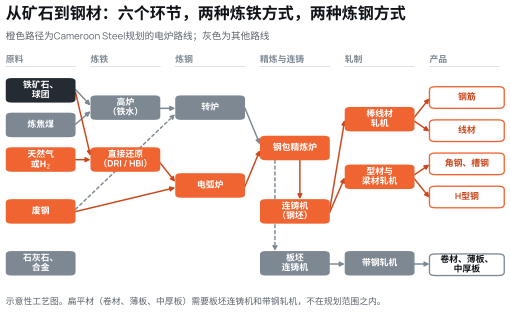
每座钢厂首先要回答的问题是:含铁原料从何而来。铁可以通过高炉或直接还原厂从矿石中获取,也可以从废钢中回收;钢则通过向铁水吹氧或在电炉中熔化固态铁来生产。钢包、连铸和轧制等下游环节在各路线中基本相同。
本页为本章中文摘要;英文全文附于其后,可展开阅读。
2025年全球粗钢产量18.494亿吨,其中约69.4%来自转炉路线,30.3%来自电炉[S40, S41];非洲产量2980万吨,89.0%来自电弧炉[S41]。同年全球直接还原铁产量1.51亿吨,三分之二以天然气生产[S04]。高炉需炼焦煤和数百万吨级规模;竖炉以富氢还原气在固态下去除矿石中的氧,但无法去除脉石,因此要求更高品位的原料。电弧炉耗电约347至500千瓦时/吨钢水(国际金融公司基准)[S44],可在数小时内启停,是废钢和DRI的天然搭档。
能源在各环节以不同形式进入:天然气基直接还原每吨DRI消耗约9.2至10吉焦天然气[S20, S48],轧前加热每吨0.6至1.9吉焦[S49],因此选择路线也就是选择能源供应方式。钢坯从连铸机热送轧机、热态DRI直接装入电弧炉,都可节约大量本需重新加热的能源[S50]。
本章结论是:决定性变量是含铁原料的来源,而不是炼钢炉本身。连铸和轧制可先行建设并长期沿用;电炉车间年产数十万吨即具经济性,而高炉只有在年产数百万吨时才有意义。
英文全文 13分钟 · 2977词How steel is made: two ways to make iron, two ways to make steel
Every steelworks answers one question before any other: where do its iron units come from? Iron can be won from ore in a blast furnace or in a direct-reduction plant, or it can be recovered from scrap. Steel is then made either by blowing oxygen through liquid iron or by melting solid iron in an electric furnace. Everything downstream, from the ladle to the rolling mill, is broadly common to all routes. This chapter explains each stage in plain language so that readers who do not work in the industry can follow the route comparison in Chapter 2 and the choices made in the rest of this paper.
1.1 Steel is refined iron: the chemistry is simple, the scale is not
Steel is iron that has been refined to a controlled, low carbon content and alloyed in small, precise amounts so that it is strong, tough and weldable. The raw material for new iron is iron ore, a rock in which iron is chemically bound to oxygen. Making steel from ore therefore always involves two operations: removing the oxygen from the ore (ironmaking) and then adjusting the carbon and impurities of the iron and casting it into a shape that can be rolled (steelmaking and casting). Recycled steel scrap skips the first operation, because its iron is already metallic.
The industry is large, and its routes are well established. The world produced 1,849.4 million tonnes (Mt) of crude steel in 2025, 2.0% less than in 2024 [S40]. About 69.4% of that tonnage was made by the oxygen route and 30.3% in electric furnaces [S41]. Africa produced 29.8 Mt, and 89.0% of it came from electric arc furnaces [S41]. The world also produced 151.0 Mt of direct-reduced iron (DRI) in 2025, two thirds of it with natural gas and one third with coal [S04].
The value chain in Figure 1.1 has six stages. Raw materials (ore or pellets, a reductant such as coke or natural gas, scrap, fluxes and alloys) feed ironmaking. Ironmaking produces either liquid "hot metal" from a blast furnace or solid DRI from a direct-reduction shaft. Steelmaking converts hot metal in a basic oxygen furnace (BOF), or melts DRI and scrap in an electric arc furnace (EAF). Secondary metallurgy, usually a ladle furnace, sets the final chemistry and temperature. A continuous caster solidifies the liquid steel into billets, blooms or slabs. Rolling mills then reheat and deform those semi-finished shapes into finished products: reinforcing bar (rebar), wire rod, angles, channels, beams, plate or coil.
Long products, which are the subject of this paper, are made from billets and blooms on bar, rod and section mills. Flat products (plate, hot-rolled coil, sheet) need a slab caster and a strip mill, which are far larger investments and are outside the scope that Cameroon Steel plans.
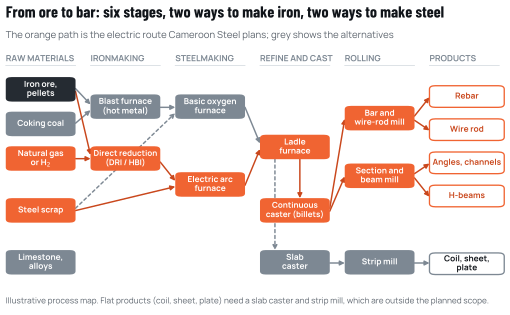
Source: Cameroon Steel; process stages as described in the IEA Iron and Steel Technology Roadmap [S02] and the EU reference document on iron and steel production [S42].
1.2 Ironmaking means taking oxygen out of ore
The iron in commercial ore is mostly hematite (Fe2O3) or magnetite (Fe3O4). Pure hematite is 69.9% iron by mass; pure magnetite 72.4% (Figure 1.2). Natural ores are lower because they also contain gangue, mostly silica and alumina, which is chemically inert in the furnace and must eventually leave as slag. Removing oxygen requires a reducing agent that has a stronger affinity for oxygen than iron does at high temperature. Carbon, as carbon monoxide, and hydrogen are the two used at industrial scale. Carbon leaves as carbon dioxide; hydrogen leaves as water vapour.
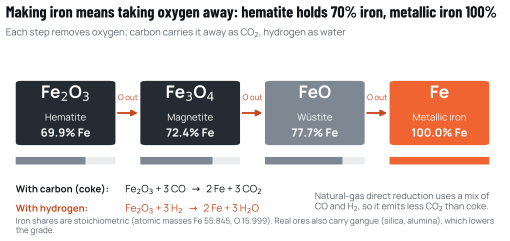
Source: Cameroon Steel, from atomic masses (Fe 55.845, O 15.999); reaction scheme as in the IEA roadmap [S02].
The blast furnace
A blast furnace is a tall, continuously operated shaft into which sinter or pellets, lump ore and coke are charged from the top while hot air is blown in near the bottom. Coke burns to carbon monoxide, which reduces the ore as it descends; the iron melts, absorbs carbon and collects at the hearth as hot metal. Solidified hot metal is pig iron, which typically contains 3.5 to 4.5% carbon [S43]. The blast furnace is efficient and proven, but it depends on coking coal (and therefore on coke ovens) and on agglomerated ore (sinter plants or pellets), and it is economic only at very large scale. A modern integrated works is built around one or more furnaces producing several million tonnes a year.
Direct reduction
Direct reduction removes oxygen from ore pellets or lump ore while they remain solid. In the gas-based shaft furnaces that dominate the technology, a hot reducing gas rich in hydrogen and carbon monoxide, made from natural gas, rises through a descending bed of pellets. MIDREX and HYL/ENERGIRON plants together produced 64.5% of the world’s DRI in 2025, and coal-fired rotary kilns, mostly in India, produced 33.1% [S04]. The product, DRI, is porous metallic iron that keeps the shape of the pellet. Typical DRI is 92 to 96% metallised and carries 1.0 to 4.5% carbon [S14]. Compressed while hot into dense briquettes, it becomes hot-briquetted iron (HBI), with an apparent density above 5.0 t/m³, which is easier and safer to ship [S15].
Because the ore never melts in a shaft furnace, nothing removes its gangue. Every per cent of silica and alumina in the pellet remains in the DRI and has to be melted and slagged off in the electric furnace. That is why direct reduction needs richer, cleaner feed than a blast furnace. Chapter 4 explains why this single fact governs when Cameroonian ore can be used.
1.3 Steelmaking either burns out carbon or melts solid iron
Hot metal from a blast furnace contains too much carbon, silicon and phosphorus to be useful steel. In a basic oxygen furnace, pure oxygen is blown onto the liquid metal and oxidises those elements in a matter of minutes; the reactions release so much heat that the converter needs no external energy and can melt a share of scrap as coolant. worldsteel’s route average for blast furnace and oxygen steelmaking assumes about 10% scrap [S01].
An electric arc furnace works differently. Three graphite electrodes (in the most common AC design) strike arcs onto a charge of scrap, DRI, HBI or pig iron and melt it with electrical energy, helped by oxygen and carbon injected to form a foaming slag that shields the arc and adds chemical energy. The furnace refines the melt through its slag (removing phosphorus, for example) and taps liquid steel into a ladle. EU melt shops use 404 to 748 kWh of electricity per tonne of liquid steel [S42]; IFC benchmarks give 1,250 to 1,800 MJ per tonne, or 347 to 500 kWh [S44]. The EAF needs no ironmaking step of its own and can start and stop within hours, which makes it the natural partner of scrap and of DRI.
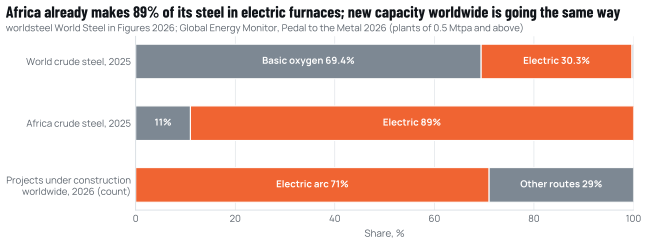
Source: worldsteel, World Steel in Figures 2026 [S41]; Global Energy Monitor, Pedal to the Metal 2026, plants of 0.5 Mtpa and above [S45].
Induction furnaces are a third, simpler melting technology. They heat metal by electromagnetic induction in a crucible and are widely used in South Asia for small-scale steelmaking from scrap and coal-based sponge iron. Because the slag is cold and difficult to keep fluid in an induction crucible, they refine poorly. Chapter 2 returns to this point.
1.4 Secondary metallurgy sets the final chemistry in the ladle
The steel tapped from a converter or an electric furnace is not yet a finished grade. In a ladle furnace, a smaller arc reheats the steel in the ladle while operators add alloys (manganese, silicon and, for some grades, vanadium or niobium), desulphurise the metal under a basic slag, float out non-metallic inclusions and bring the temperature to the window that the caster needs. A ladle furnace can raise steel temperature by about 4 °C per minute; a twin-station unit commissioned at ArcelorMittal Bremen in 2013 achieved that rate over 30 minutes [S46]. Separating these tasks from the melting furnace lets the EAF do what it does best, which is to melt quickly, and makes the plant more productive.
1.5 Continuous casting turns liquid steel into billets
A continuous caster pours liquid steel from the ladle into a tundish, a refractory-lined distributor, and from there into water-cooled copper moulds. A solid shell forms against the mould wall, and the strand is drawn downward and bent to the horizontal while water sprays complete solidification. Torches or shears cut the strand to length. For long products, the caster makes billets, usually of square section; a 300,000 t/yr bar and wire-rod mill ordered in Tanzania in September 2026 is designed for 150 mm by 150 mm billets at up to 50 t per hour [S08, S47]. Continuous casting replaced ingot casting because it raises yield and consistency and allows billets to travel hot to the rolling mill, which saves energy (Chapter 6).
1.6 Rolling shapes the steel and sets much of its strength
A rolling mill reheats billets to a plastic state and passes them through a series of stands, each pair of rolls reducing the section and lengthening the bar. A bar mill typically has roughing, intermediate and finishing groups. For rebar, the last rolls engrave the ribs that give the bar its bond with concrete, and a water box immediately after the finishing stand quenches the surface: the quench-and-self-temper treatment described in Chapter 7 gives 500 MPa strength from plain carbon-manganese steel [S28]. For wire rod, a high-speed finishing block delivers small sections at high speed to a laying head that forms rings, which cool in a controlled way on a conveyor and are collected as coils. Section and beam mills follow the same logic with shaped rolls and, for wide-flange beams, universal stands.
Rolling is where a long-products plant meets its customers: the size range, tolerance, surface and mechanical properties of the bars and sections are set here, and so is much of the plant’s energy use outside the melt shop. A billet that enters the mill hot needs far less heating than a cold one.
1.7 Energy enters at every stage, in different forms
Steelmaking is energy-intensive, and each stage uses energy in a different form, which is why the choice of route is also a choice of energy supply. Ironmaking takes the most: a gas-based direct-reduction plant burns and reforms about 9.2 to 10 GJ of natural gas per tonne of DRI [S20, S48], while a blast furnace draws its energy from coke made from coking coal. Melting in an electric arc furnace takes electricity, 347 to 500 kWh per tonne of liquid steel on IFC benchmarks [S44], supplemented by chemical energy from oxygen and carbon. Reheating billets before rolling takes 0.6 to 1.9 GJ per tonne in EU bar and rod mills, while the rolling itself takes only 0.1 to 0.5 GJ per tonne [S49]. Casting and ladle refining take comparatively little.
Two consequences follow for a country deciding on a route. First, a route that starts with scrap or purchased iron and an electric furnace needs mainly electricity, so its feasibility depends on the grid; a route that includes ironmaking also needs a fuel, natural gas or coal, in large and steady quantities. Second, heat that is not lost does not have to be bought again: billets that go hot from the caster to the mill, and DRI that goes hot from the shaft furnace to the arc furnace, save a large share of the energy that cooling and reheating would waste [S50]. These two points explain why the pathway proposed in this paper starts all-electric, adds gas only when a mill or a direct-reduction plant requires it, and places each plant next to the one it feeds.
1.8 Iron units are the currency of an electric steelworks
An electric steelworks does not make iron: it buys or produces iron units and melts them. The term "iron units" or "metallics" covers every iron-bearing material that can be charged to the furnace. Their properties determine yield, energy use, chemistry and, ultimately, product quality. Table 1.1 summarises the main ones.
Table 1.1 The main iron units for an electric arc furnace, and what each brings to the melt
| Iron unit | What it is | Typical iron and carbon | Strengths | Limits and handling |
|---|---|---|---|---|
| Steel scrap | Recycled steel: home scrap, new (prompt) scrap from manufacturing, old (obsolete) scrap from demolition and end-of-life goods | Metallic iron; carbon low; residual copper, tin and zinc vary by grade | Lowest energy and CO2 route; no ironmaking needed | Supply limited by a country’s stock of old steel; residuals accumulate in obsolete scrap; needs sorting and preparation |
| DRI (cold) | Porous pellets of iron reduced in the solid state | 92 to 96% metallisation; 1.0 to 4.5% carbon [S14] | Clean iron with low residuals; dilutes scrap impurities; can be fed continuously | Re-oxidises and self-heats if wet; shipped under inert gas; gangue adds slag [S14] |
| HBI | DRI compacted while hot into briquettes | 94% metallisation; 0.5 to 1.6% carbon; apparent density above 5.0 t/m³ [S15] | Safer and denser to ship and store than DRI; tradeable commodity | Needs surface ventilation in transit; same gangue penalty as DRI [S15] |
| Pig iron | Solidified blast-furnace hot metal | At least 92% iron; 3.5 to 4.5% carbon [S43] | Carbon adds chemical energy; very low residuals | Made by the blast furnace route, with its emissions; supply concentrated in a few exporters |
| Billets (semi-finished) | Cast steel bars ready for rolling | Finished steel chemistry | Lets a mill roll without a melt shop | No control over chemistry; exposes the mill to import prices and freight |
Source: International Iron Metallics Association fact sheets [S14, S15, S43]; Cameroon Steel. Values are typical ranges, not specifications.
Scrap is the cheapest and lowest-carbon iron unit wherever it is plentiful. DRI and HBI are "virgin" iron with low residual elements, used to make up for scrap shortages and to dilute impurities. Pig iron does the same job but carries the emissions of the blast furnace. Billets are not an iron unit for a melt shop but the input of a re-rolling mill, which buys steel already made elsewhere. Chapter 3 shows that billets are now Cameroon’s largest single steel import.
1.9 What the primer means for Central Africa
Four practical points follow from the process description and frame the rest of this paper.
First, the decisive variable is the source of iron units, not the steelmaking furnace as such. Scrap is cheap and clean but scarce in an economy whose stock of old steel is small. DRI can be imported now and made locally later from Cameroonian ore, provided the ore is upgraded to direct-reduction grade. Pig iron and billets can be bought, but each carries someone else’s emissions and margins.
Second, the casting and rolling steps are common to every route, so they can be built first and kept as the route evolves. A billet caster and a bar and wire-rod mill serve a scrap-fed EAF today and a DRI-fed EAF tomorrow equally well.
Third, scale matters differently on each route. An EAF melt shop is economic at a few hundred thousand tonnes a year; recent bar and rod mills ordered in Tanzania and Côte d’Ivoire are each about 300,000 t a year [S08, S09]. A blast furnace and its coke ovens and sinter plant only make sense at several million tonnes a year. For a market of Cameroon’s size, that difference alone narrows the choice, as Chapter 2 shows.
Fourth, each route asks something different of the national energy system. A melt shop running on purchased iron units needs firm, high-quality electricity and little else; a direct-reduction plant adds a long-term demand for natural gas or, later, for very large quantities of low-carbon electricity to make hydrogen; a blast furnace needs a coal supply chain and port facilities for it. A route choice is therefore also a commitment about which energy infrastructure the country will build around the plant, and when.
These four points explain the structure of the chapters that follow. Chapter 2 compares the routes on energy, carbon, capital, scale and raw materials. Chapters 3 and 4 examine the iron units that an electric melt shop would use, from scrap and imported DRI to Cameroonian ore. Chapters 5 to 8 describe how the melt shop, the mills, the products and the control systems would work, and Chapters 9 and 10 apply the result to Cameroon Steel’s planned complex and to the decisions that remain.
Other sources cited in the English text
- S43Pig iron. International Iron Metallics Association, Undated, accessed Oct 2026.metallics.org/pig-iron.html
- S14Direct Reduced Iron (DRI): specifications and handling. International Iron Metallics Association, Undated, accessed Oct 2026.metallics.org/dri.html
- S15Hot Briquetted Iron (HBI): specifications and handling. International Iron Metallics Association, Undated, accessed Oct 2026.metallics.org/hbi.html
- S01Sustainability Indicators 2025 report (2024 data; route table added Feb 2026). worldsteel, Nov 2025, updated Feb 2026.worldsteel.org/wider-sustainability/sustainability-indicators/
- S45Pedal to the Metal 2026. Global Energy Monitor, May 2026.globalenergymonitor.org/sites/default/files/2026-05/Pedal%20to%20the%2…
- S46Siemens puts twin ladle furnace into operation for ArcelorMittal Bremen. AIST, Apr 2013.aist.org/siemens-puts-twin-ladle-furnace-into-operation-for-arcelormit…
- S08GSM Tanzania selects Danieli for new rebar and wire-rod mill. Danieli, 14 Sep 2026.danieli.com/en/GSM-Tanzania-selects-Danieli-for-new-rebar-and-wirerod-…
- S47GSM Tanzania selects Danieli Technologies for new rebar and wire rod mill. SteelOrbis, 15 Sep 2026.steelorbis.com/steel-news/latest-news/gsm-tanzania-selects-danieli-tec…
- S28TEMPCORE: quench and self-tempering process for reinforcing bars. CRM Group, Undated, accessed Oct 2026.old.crmgroup.be/en/industrialised-results/bulk-processes/tempcore
- S09B5Plus Group awards Danieli bar and wire-rod mill project. Danieli, 23 Sep 2026.danieli.com/en/B5Plus-Group-awards-Danieli-bar-and-wirerod-mill-projec…
本章引用的资料来源
方括号内的标记对应以下来源(按原文语言列出),完整列表见附录。 完整来源列表
- S40December 2025 crude steel production and 2025 global totals. worldsteel,2026年1月23日.worldsteel.org/media/press-releases/2026/december-2025-crude-steel-pro…
- S41World Steel in Figures 2026. worldsteel,2026年6月4日.worldsteel.org/data/world-steel-in-figures/world-steel-in-figures-2026…
- S042025 World Direct Reduction Statistics. Midrex Technologies,2026年9月.midrex.com/world-dri-statistics/world-dri-production-reaches-151-0-mt-…
- S44Environmental, Health, and Safety Guidelines for Integrated Steel Mills. IFC, World Bank Group,2007年4月30日.ifc.org/content/dam/ifc/doc/2000/2007-integrated-steel-mills-ehs-guide…
- S20ENERGIRON technology: DRI-EAF production route using natural gas or H2. European Commission, Innovation Centre for Industrial Transformation,引用:2026年2月12日.innovation-centre-for-industrial-transformation.ec.europa.eu/innovativ…
- S48Suez Steel sets new benchmark in energy consumption for DRI production. Danieli,2026年4月16日.danieli.com/en/news-media/news/suez-steel-sets-new-benchmark-energy-co…
- S49Commission Implementing Decision (EU) 2022/2110, BAT conclusions for the ferrous metals processing industry. European Commission, Official Journal L 284,2022年10月11日.eur-lex.europa.eu/legal-content/EN/TXT/PDF/?uri=CELEX:32022D2110
- S50Hot charging of steel billets and slabs: impact on energy costs and emissions (S. W. Hesling). Steelonthenet,2025年1月1日.steelonthenet.com/insights/hot-charging.html
- S02Iron and Steel Technology Roadmap. International Energy Agency,2020年10月.iea.blob.core.windows.net/assets/eb0c8ec1-3665-4959-97d0-187ceca189a8/…
- S42Best Available Techniques Reference Document for Iron and Steel Production (EUR 25521). European Commission, Joint Research Centre,2013年.bureau-industrial-transformation.jrc.ec.europa.eu/sites/default/files/…
引用本章
Cameroon Steel(2026)。电炉炼钢是中部非洲的正确路线(中文摘要版)。白皮书03,第1章:钢铁如何生产:两种炼铁方式,两种炼钢方式。CS-WP-03。https://www.cameroon-steel.com/zh/library/technology-routes/how-steel-is-made/
来源