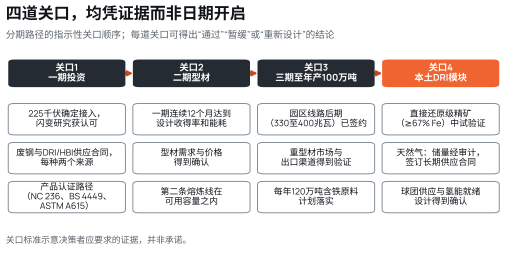
本章提出四道以证据而非日期为准的关口,每道关口可得出“通过”“暂缓”或“重新设计”的结论。关口1(一期投资)要求确定的225千伏接入和获认可的闪变研究、每种含铁原料两个来源且价格相对进口到岸钢坯留有正差额、产品认证路径、获批并在贷款方董事会审批前按期公开披露的环境与社会影响评估[S106],以及供应商对吨钢电耗、电弧炉可用率和产能的性能保证(变压器规格须能实现27万至30万吨的预计持续产量);关口2要求一期连续十二个月达到设计水平;关口3要求线路后期供电签约并落实每年120万吨含铁原料;关口4要求铁品位不低于67%的精矿中试验证、球团供应、经审计的天然气储量和长期合同,以及氢能就绪设计。与之相比,再轧厂、高炉、感应炉或先建直接还原厂的风险都更大。
结论是:大部分技术风险可以在投入前化解,四道关口把这一原则变成了决策规则。
英文全文 11分钟 · 2572词Technology risks and decision criteria: retire the big risks before each commitment
The phased electric route is lower-risk than the alternatives, but it is not risk-free. Its technology risks are concentrated at a few interfaces: the plant’s connection to a grid that already leaves 150 MW of industrial demand unmet [S89]; the supply of iron units in a market where DR-grade feed is expected to tighten [S17]; the quality of Cameroonian ore, which reaches DR grade only in testwork [S19]; the gas supply that a direct-reduction module would need; and the reliability of a single furnace that must run most of the year. Each of these can be reduced before money is committed, by studies, pilot tests and contracts. This chapter sets out a technology risk register, a four-gate decision process and a checklist that ministers’ advisers, lenders, engineers and journalists can use to test the project’s progress.
10.1 Technology risk is concentrated at a few interfaces
Most of the equipment in a long-products steelworks is mature: arc furnaces, ladle furnaces, billet casters and bar mills have been built in large numbers for decades, including recently in Africa [S08, S09]. The risks lie where the plant depends on systems outside its fence (the grid, the gas network, the mine, the port) and where a new organisation must learn to run complex equipment. Table 10.1 lists the main technology risks, the evidence behind each, the early signals to watch and the mitigations.
Table 10.1 Technology risk register for the phased electric pathway
| Risk | Why it matters (evidence) | Early indicator | Mitigation | Decided at |
|---|---|---|---|---|
| Grid strength and power quality | Arc furnaces cause flicker and harmonics; other EAF rebar mills had to retrofit compensators under regulatory pressure [S23, S24] | Short-circuit level at the 225 kV connection; results of the flicker study | Flicker study before ordering; STATCOM and filters specified with the furnace | Gate 1 |
| Firm power supply | 150 MW of industrial demand unmet in October 2026 [S89]; hydro output varies with rainfall [S51]; the zone line delivers 100 MW at first [S25] | Commissioning of the 225 kV line and substation; connection contract terms | Capacity contract on the zone line; schedulable melting around peaks rather than curtailment; emergency supply for critical systems | Gate 1, then Gate 3 |
| Iron-unit supply and price | Domestic scrap about 0.1 Mt a year (derived), of which RC-1 assumes about 30,000 t for the plant [S03]; seaborne DR-grade pellet deficits forecast [S17]; scrap prices up about 30% in a year [S32] | Term-contract offers; spread between delivered billet prices and the cost of the metallic charge (White paper 04, Chapter 8) | Two suppliers per iron unit; covered storage; charge-mix flexibility; formal scrap collection | Gate 1, reviewed yearly |
| Single-furnace capacity and reliability | About 8,000 heats need about 7,300 to 7,900 furnace hours a year at 450 to 490 kWh/t; expected sustained output 270,000 to 300,000 t (derived) | Supplier time balance; planned and unplanned downtime in commissioning | Capacity guarantee; transformer rating set in front-end engineering; maintenance system; critical spares (transformer, panels, electrodes); cold-billet yard for the mill | Gate 1, proven before Gate 2 |
| Product certification | Mandatory NC 236; a certificate withdrawn and non-compliant rebar recalled in 2024 [S26, S27] | Laboratory accreditation; first certification audits | In-line quenching; laboratory testing each cast lot; traceability system | Gate 1 |
| Supplier capability and scope gaps | First-of-a-kind plants have overrun costs, as at Stegra [S62] | Supplier references for similar plants; completeness of scope | Proven designs; performance guarantees; independent owner’s engineer | Gate 1 |
| Skills | No dedicated metallurgy department at the main engineering school [S39] | Recruitment and training progress against plan | Vendor training, simulators, partnerships with engineering schools [S39, S103] | Gate 1 onward |
| DR-grade ore | Mbalam DR concentrate exists only in testwork [S19]; direct-shipping ore is not DR grade [S18] | Pilot-plant results; concentrator and pellet-plant plans | Pilot-scale proof; bridging contract for imported DR pellets | Gate 4 |
| Gas for direct reduction | Reserves of the producing field not public; main new resource without investment decision [S35] | Reserve audit; gas sales agreement terms | Audited reserves; long-term contract; smaller first module | Gate 4 |
| Hydrogen availability | 100% hydrogen for 1 Mt DRI would need about 2.7 TWh a year (derived), about a third of 2025 generation [S51] | New hydro and transmission projects | Hydrogen-ready furnace; blend as low-carbon power becomes available | Gate 4 and later |
| Carbon rules in export markets | CBAM definitive phase from 2026; certificate price €82.32 in Q3 2026 [S53, S54] | Share of exports to carbon-priced markets | Measured emissions per product from day one; low-carbon power | All gates |
| By-product management | EAF dust carries zinc, lead and cadmium [S44]; slag must be stable for reuse | Treatment route agreed; slag test results | Dust management plan; slag processing and certification | Gate 1 |
Source: Cameroon Steel assessment, using the evidence cited in each row.
10.2 Four gates, each opened by evidence rather than by date
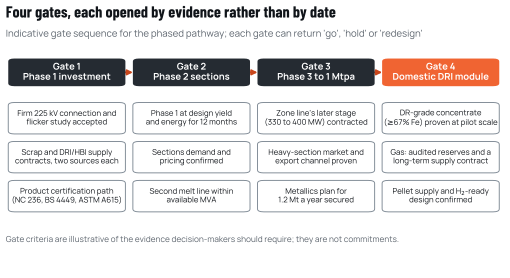
A phased pathway is only as good as the discipline with which each step is decided. Figure 10.1 sets out four decision gates. At each gate, the decision is "go" if the evidence meets the criteria, "hold" if it is incomplete and "redesign" if it shows that the plan must change. The gates are linked to evidence, not to dates: the schedule in Chapter 9 shows when each gate is targeted, not when it must be passed.
Source: Cameroon Steel.
Gate 1, the Phase 1 investment decision, is the most consequential. It requires a firm connection to the zone’s 225 kV supply, with a flicker and harmonics study accepted by the grid operator; term contracts or binding offers for scrap and DRI or HBI from at least two sources each, at prices that leave a positive spread against delivered billet imports; a product certification path for NC 236 and the main international grades; completed site studies and an approved environmental and social impact assessment, disclosed for the period that lenders require before board approval (60 days for IFC’s highest-risk category) [S106]; and a supplier scope with performance guarantees for electricity per tonne at the planned DRI share, furnace availability, yield and capacity, with a transformer rating that delivers the expected sustained output of 270,000 to 300,000 t.
Gate 2, the Phase 2 section mill and second melt line, should require twelve months of Phase 1 operation at or near design yield, energy and capacity; confirmed demand and prices for angles, channels and flats; and confirmation that the second melt line fits within the available electrical capacity and compensator.
Gate 3, Phase 3 to 1 Mtpa, requires the zone line’s later stage of 330 to 400 MW to be contracted [S25]; a proven market and export channel for heavy sections; a caster solution for blooms or beam blanks; and a metallics plan for about 1.2 Mt of iron units a year.
Gate 4, the domestic direct-reduction module, requires DR-grade concentrate of at least 67% iron, with low gangue, proven at pilot scale from a defined ore body; a secured pellet supply; audited gas reserves and a long-term gas contract for the module’s life; and a hydrogen-ready shaft-furnace design with a monitoring, reporting and verification plan for CO2.
10.3 The alternatives carry larger risks
Decision-makers should weigh the pathway’s risks against those of the alternatives, not against an imaginary risk-free option.
A re-rolling mill without a melt shop would be cheaper and faster, but it would add rolling capacity to a market that already has more than it uses [S06] and would depend entirely on imported billets, whose supply and prices it cannot control [S05, S72]. It would add the least value and transfer the most risk to the State’s foreign-exchange balance.
A blast-furnace works would need several million tonnes a year of capacity to be efficient, imported coking coal and the highest carbon intensity of any route, 2.34 t of CO2 per tonne on worldsteel’s 2024 average [S01]. It would commit all of its capital before producing a tonne, and it could not easily scale down if demand disappointed.
An induction-furnace plant would be cheap, but it would struggle to meet phosphorus limits and the ductility requirements of modern rebar standards without additional refining [S10], in a market whose regulators are actively enforcing quality [S26, S27].
A direct-reduction plant built first would tie the start of steelmaking to the readiness of a concentrator, a pellet plant and a gas contract, none of which exists today (Chapter 4). It would postpone production by years and raise the capital required before any revenue.
The phased electric route is the only option that starts producing within a few years, uses capital in steps, meets quality standards with proven equipment and keeps the path to Cameroonian iron open.
10.4 Who carries which risk
A risk is best carried by the party that can control it. For the phased pathway, the allocation is broadly clear.
The technology supplier carries the performance of the equipment: capacity, yield, energy use and availability, backed by guarantees and tests. The grid operator and the zone carry the delivery of the connection at the agreed capacity and, with the plant, the agreed power-quality limits. Cameroon Steel carries operations, metallics procurement, product quality, safety and environmental performance. The mining company carries the proof of a DR-grade concentrate, and the gas producer and the State the availability, pricing and taxation of gas for any direct-reduction module. Lenders will expect each of these allocations to be written into contracts before they commit.
Some risks cannot be transferred: market demand, the price of imported iron units and the evolution of carbon rules. The pathway handles them by keeping each commitment small enough to be justified on its own results.
10.5 Indicators to watch after start-up
Once Phase 1 runs, a small set of indicators will show whether the technology choice is delivering. They should be reported regularly to the board and, in summary, to lenders and the public:
- electricity per tonne of liquid steel, against the guaranteed value, and the DRI share of the charge;
- tap-to-tap time and furnace availability, against the 55 to 59 minutes and 7,000 to 7,700 operating hours a year that Phase 1 planning assumes;
- metallic yield and casting-and-rolling yield, against the RC-1 assumptions of 0.88 and 0.94 [S03];
- flicker (Pst and Plt) and harmonic distortion at the connection point, against the limits in the connection agreement;
- the share of cast lots certified first time to NC 236 and international grades;
- CO2 per tonne of product, measured, against the RC-1 estimate [S03];
- lost-time injuries and process-safety incidents.
10.6 A checklist for decision-makers
The questions in Table 10.2 are designed to be asked at any stage of the project by anyone who needs to judge its technical progress: a ministry adviser reviewing incentives, a development-finance officer preparing a credit paper, an engineer reviewing a design or a journalist following the project.
Table 10.2 Checklist for decision-makers reviewing the Kribi steelworks
| Question | Evidence that answers it | Relevant gate |
|---|---|---|
| Is the plant’s grid connection firm, and does it come with an accepted flicker and harmonics study? | Connection agreement; study report accepted by the grid operator; compensator specification | Gate 1 |
| Does the plant have at least two sources for each iron unit, under contract? | Term contracts or binding offers for scrap and HBI; storage design | Gate 1 |
| Can the furnace, caster and mill deliver the planned tonnage with realistic utilisation? | Supplier time balance at the guaranteed kWh per tonne; transformer rating; capacity guarantee; maintenance plan | Gate 1 |
| Will the rebar be certified to NC 236 from the first month, and capable of BS 4449 and ASTM A615 grades? | Mill design with in-line quenching; laboratory plan; certification schedule with ANOR | Gate 1 |
| Are energy, yield and capacity guaranteed by the technology supplier? | Performance-guarantee schedule; test protocol; owner’s engineer’s review | Gate 1 |
| Are the environmental and social impact assessment and its management plan approved, including EAF dust and slag, and disclosed in time for lenders? | Certificate of environmental compliance; waste management plan; lender disclosure record | Gate 1 |
| Is there a training plan that will staff the plant with qualified nationals? | Training plan; agreements with schools and suppliers; simulator plan | Gate 1 |
| Has Phase 1 reached design yield, energy and output for twelve months? | Operating reports; energy-management data | Gate 2 |
| Is the electrical capacity for 1 Mtpa contracted? | Contract for the zone line’s later stage; updated flicker study | Gate 3 |
| Has a Cameroonian DR-grade concentrate been proven at pilot scale? | Pilot-plant report with chemistry, yield and pellet tests from a defined ore body | Gate 4 |
| Is gas for a DR module secured for its life? | Independent reserve audit; long-term gas sales agreement; tax treatment | Gate 4 |
| Is the DR module hydrogen-ready, and are emissions measured per product? | Furnace specification; monitoring, reporting and verification plan | Gate 4 |
Source: Cameroon Steel.
10.7 What the decision criteria mean for the route choice
The decision criteria reinforce the conclusion of this paper. The electric route allows the project’s first commitment to rest on evidence that can be obtained now, about the grid, the iron units, the equipment and the product, while the evidence for domestic ironmaking (ore, pellets, gas) is still being built. No other route allows the same separation. That is why an electric arc furnace, fed first with scrap and imported DRI or HBI and later with direct-reduced iron from concentrated Cameroonian ore, offers the best balance of capital intensity, flexibility, emissions and speed for a new Central African producer.
10.8 What would change the conclusion
A recommendation is only as strong as the conditions under which it holds. Four developments would change the balance described in this paper, and decision-makers should watch for them.
A much larger market with a coal supply chain would reopen the case for a blast furnace. If regional demand for long and flat products grew to several million tonnes a year and a secure source of coking coal and port capacity for it were developed, an integrated works could become economic, although its carbon intensity would weigh more heavily each year as carbon border measures tighten [S53, S55].
A prolonged shortage of traded iron units would slow the pathway. If HBI and scrap became scarce or very expensive before domestic DRI was ready, Phase 1 would run below capacity or with a lower DRI share, and the case for bringing the direct-reduction gate forward would strengthen, subject to the same evidence on ore and gas.
No long-term gas would change the form of domestic ironmaking rather than the route. Without a gas contract, a direct-reduction module could only run on hydrogen, which would have to wait for new low-carbon generation (Chapter 4).
A grid connection that cannot carry an arc furnace would require captive or dedicated generation and a larger compensator, raising costs but not changing the steelmaking technology.
None of these developments is the central case on the evidence available in October 2026. Each would be visible early, and the gate structure allows the plan to respond without stranding the investments already made.
Other sources cited in the English text
- S08GSM Tanzania selects Danieli for new rebar and wire-rod mill. Danieli, 14 Sep 2026.danieli.com/en/GSM-Tanzania-selects-Danieli-for-new-rebar-and-wirerod-…
- S09B5Plus Group awards Danieli bar and wire-rod mill project. Danieli, 23 Sep 2026.danieli.com/en/B5Plus-Group-awards-Danieli-bar-and-wirerod-mill-projec…
- S23Gerdau plant in Charlotte, US: SVC Light for EAF flicker mitigation (customer story). Hitachi Energy, Undated, accessed Oct 2026.hitachienergy.com/news-and-events/customer-stories/gerdau-plant-in-cha…
- S24Modular multilevel converter based STATCOM for electrical arc furnace application: Metalfer steel mill, Serbia (case study GEA34872). GE Vernova Power Conversion, Rev. 20 Feb 2024.gevernova.com/power-conversion/sites/default/files/2024-02/GEA34872_Po…
- S51Rapport d’activités 2025. Agence de Régulation du Secteur de l’Électricité (ARSEL), 7 Sep 2026.arsel-cm.org/wp-content/uploads/2026/09/Rapport-ARSEL-2025.pdf
- S25Kribi franchit la ligne électrique 225 kV. Port Autonome de Kribi, 6 Aug 2025.Cited by title and date
- S03Cameroon Steel reference configuration RC-1 (planning estimate): phases, benchmarks with ranges and indicative balances for the Kribi steelworks (Class 5), edition 10 October 2026, values as revised on that date. Cameroon Steel, 10 Oct 2026.Cited by title and date
- S32Cameroun: Prometal décroche 26,2 milliards FCFA d’Afreximbank. Camer.be, 1 Oct 2026.camer.be/actualites/economie/cameroun-prometal-decroche-262-milliards-…
- S26Cameroon rejects fresh push to revise rebar standard. Business in Cameroon, 26 Jan 2026.businessincameroon.com/construction/2601-15657-cameroon-rejects-fresh-…
- S27Cameroun: le gouvernement rejette une demande de révision de la norme du fer à béton. EcoMatin, 5 Feb 2026.ecomatin.net/cameroun-le-gouvernement-rejette-une-demande-de-revision-…
- S62Stegra requires additional funding for the construction of a green plant. GMK Center, 1 Oct 2026.gmk.center/en/news/stegra-requires-additional-funding-for-the-construc…
- S39École Nationale Supérieure Polytechnique de Yaoundé: departments. ENSP Yaoundé, Undated, accessed Oct 2026.polytechnique.cm/
- S103Institut Universitaire de Technologie de Douala: departments. IUT Douala, Undated, accessed Oct 2026.iut-dla.cm/
- S18Mbalam-Nabeba resources and reserves as at 20 May 2015 (JORC Code). Previous holder of the Mbalam permit (ASX-listed company disclosure), 2015.Cited by title and date
- S35Cameroon’s SNH eyes Yoyo-Yolanda and new exploration blocks to sustain gas growth. Business in Cameroon, 6 Jul 2026.businessincameroon.com/energy/0607-16422-cameroon-s-snh-eyes-yoyo-yola…
- S53Regulation (EU) 2023/956 establishing a carbon border adjustment mechanism, Annex I. EUR-Lex, Official Journal L 130, 16 May 2023.eur-lex.europa.eu/legal-content/EN/TXT/PDF/?uri=CELEX:32023R0956
- S54Price of CBAM certificates. European Commission, DG TAXUD, 5 Oct 2026 (latest quarterly price).taxation-customs.ec.europa.eu/carbon-border-adjustment-mechanism/price…
- S44Environmental, Health, and Safety Guidelines for Integrated Steel Mills. IFC, World Bank Group, 30 Apr 2007.ifc.org/content/dam/ifc/doc/2000/2007-integrated-steel-mills-ehs-guide…
- S06Production: les acteurs en présence. Cameroon Tribune, 11 May 2026.cameroon-tribune.cm/article.html/76600/fr.html/details_2
- S05UN Comtrade public API: Cameroon (reporter 120), HS 72 and 73 and six-digit lines, 2019 to 2023. United Nations Statistics Division.comtradeapi.un.org/public/v1/preview/C/A/HS?reporterCode=120&period=20…
- S72Cameroun: le groupe Prometal décroche 26 milliards FCFA auprès d’Afreximbank. Sikafinance, 30 Sep 2026.sikafinance.com/marches/cameroun-le-groupe-prometal-decroche-26-millia…
- S01Sustainability Indicators 2025 report (2024 data; route table added Feb 2026). worldsteel, Nov 2025, updated Feb 2026.worldsteel.org/wider-sustainability/sustainability-indicators/
- S10Development of synthetic flux and a process for de-phosphorization of steel in induction furnace. CSIR National Metallurgical Laboratory, India, Undated, accessed Oct 2026.nmlindia.org/node/288
- S55Directive (EU) 2023/959 amending the EU emissions trading system. EUR-Lex, Official Journal L 130, 16 May 2023.eur-lex.europa.eu/legal-content/EN/TXT/?uri=CELEX:32023L0959
本章引用的资料来源
方括号内的标记对应以下来源(按原文语言列出),完整列表见附录。 完整来源列表
- S106IFC Access to Information Policy: disclosure of the Summary of Investment Information and the Environmental and Social Review Summary 60 days (Category A) or 30 days before Board consideration. IFC, World Bank Group,生效:2012年1月1日.ifc.org/en/insights-reports/2012/ifc-access-to-information-policy
- S89Nachtigal power line delays leave 150 MW of industrial demand unmet. Business in Cameroon,2026年10月9日.businessincameroon.com/public-management/0910-16939-nachtigal-power-li…
- S17Global high-grade iron ore market is set to grow (S. Basirat). Institute for Energy Economics and Financial Analysis (IEEFA),2026年3月.ieefa.org/sites/default/files/2026-03/IEEFA_Global%20high-grade%20iron…
- S19Mbalam iron ore project: presentation to Mining Indaba 2014 (metallurgical testwork on itabirite). Previous holder of the Mbalam permit (ASX-listed company disclosure),2014年2月.按标题和日期引用
引用本章
Cameroon Steel(2026)。电炉炼钢是中部非洲的正确路线(中文摘要版)。白皮书03,第10章:技术风险与决策标准:在投入前化解重大风险。CS-WP-03。https://www.cameroon-steel.com/zh/library/technology-routes/risks-decisions/
来源