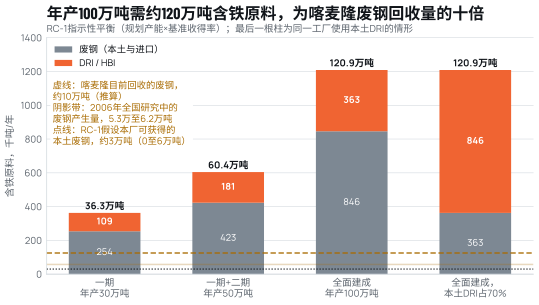
按RC-1规划,年产30万吨、50万吨和100万吨的产能分别需要约36.3万吨、60.4万吨和120.9万吨含铁原料(推算)[S03]。喀麦隆唯一的全国研究估计废钢年产生量为5.3万至6.18万吨[S13],目前回收量约在10万吨量级,且已被现有钢厂消耗(推算)。因此,RC-1假设本厂每年只能采购约3万吨本土废钢(区间0至6万吨)[S03],一期须以进口废钢和进口DRI或HBI为主:按30%的DRI比例,每年约需10.9万吨DRI或HBI和25.4万吨废钢,其中约22.4万吨废钢需进口,港口进口量约35.1万吨(推算)[S03]。任何需要每年6万吨以上本土废钢的方案,按现有证据均不可行。每种原料至少两家供应商、有盖仓储、进场检验和正规废钢回收体系是基本做法。
国际市场可以满足一期需求:2025年DRI国际贸易量约1080万吨,HBI产量1160万吨,占全球DRI产量的7.7%[S04];废钢主要出口地为欧盟和美国[S64]。但长期依赖外购将使工厂的大部分成本暴露于进口价格、运费和汇率风险之下。
长期答案是在克里比用喀麦隆矿石生产DRI:全面建成且本土DRI占炉料70%时,每年约需84.6万吨DRI。
英文全文 11分钟 · 2584词Metallics: Cameroon is short of iron units, not of rolling capacity
Cameroon’s steel industry already rolls more than the country consumes; what it lacks is the iron to feed its mills. Billets became the country’s largest single steel import, at 161,400 t in 2023 [S05], and local scrap covers only about 40% of the existing mills’ needs [S32, S33]. A 1 Mtpa electric melt shop would need about 1.2 Mt of iron units a year, roughly ten times the scrap collected in Cameroon today. The first phase must therefore be planned on imported scrap and imported DRI or HBI alongside domestic scrap, and the long-term answer is iron made in Cameroon from Cameroonian ore.
3.1 Billets show where the shortfall lies
Cameroon’s imports of iron and steel (customs chapter 72) rose from 182,890 t in 2019 to 412,049 t in 2025, according to the national statistics institute; in 2025 alone they rose by 33% [S67, S68]. The composition of those imports is more revealing than the total. In 2023, the last year reported to the UN Comtrade database, semi-finished steel (HS 7207, mostly billets) amounted to 161,400 t worth US$151.7 million, three times the 2019 level [S05]. Indonesia supplied 125,500 t of it, or 78% [S05]. Imports of rebar, by contrast, were marginal because rebar imports have been prohibited since 2016, a ban that Customs confirmed in April 2023 [S69].
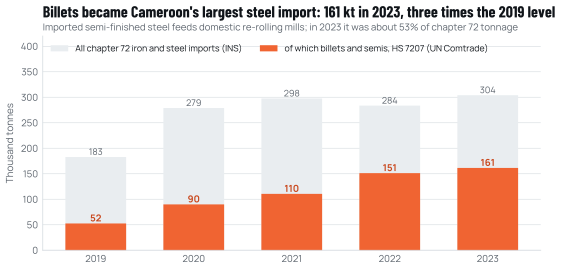
Source: INS Cameroun foreign-trade notes for chapter 72 tonnage [S67, S70, S71]; UN Comtrade for HS 7207 [S05]. The 2023 billet share of chapter 72 tonnage (about 53%) is derived.
The pattern is that of an industry that owns rolling mills but not enough steelmaking. Cameroon Tribune, citing the industry association, reported in May 2026 that domestic rebar capacity far exceeds the rebar market [S06]. Industry sources describe about 1.2 Mt a year of installed steel transformation capacity running at about half of its potential, and note that local scrap now covers only about 40% of mill needs [S32, S33]. In September 2026 a leading domestic producer secured a €40 million revolving facility from Afreximbank, reported by the financial press as intended to import billets [S33, S72].
Cameroon is not new to electric steelmaking: in 2023 Cameroon Tribune described a Douala producer’s electric arc furnace, of about 200,000 t of rebar a year, as the first of its kind in Central Africa [S73]. But domestic melting remains far smaller than domestic rolling.
The implication for technology is direct. A new producer adds the least value, and takes the most market risk, if it builds another re-rolling mill that buys imported billets. It adds the most value by making steel, the step the country lacks. A melt shop with a billet caster also has an option that a re-roller does not: it can supply billets to other mills.
3.2 Domestic scrap is a fraction of what a steelworks needs
Scrap supply grows with a country’s accumulated stock of steel in use: buildings, bridges, vehicles, machinery and packaging that reach the end of their lives. Cameroon’s stock is small, and so is its scrap. The only quantified national study, published in 2007 by researchers from the National Advanced School of Engineering in Yaoundé, estimated annual ferrous scrap arising at 53,000 to 61,833 t, of which 53% was collected by recyclers, 29% by informal dismantlers and 15% by exporters [S13]. Recorded scrap exports have since fallen to near zero: 3,675 t in 2019 and 15 t in 2023 [S05]. Scrap purchase prices rose by about 30% in the year to September 2026, according to the press [S32].
No more recent survey exists. A rough cross-check is possible: domestic mills produced about 260,000 t in 2022 [S74]; if they consume about 1.2 t of metallic charge per tonne of product (the RC-1 yields) and local scrap covers about 40% of it, domestic scrap collected is of the order of 0.1 Mt a year (derived; Annex A). That scrap is already consumed by existing mills. A new melt shop that competed for it would mainly raise its price.
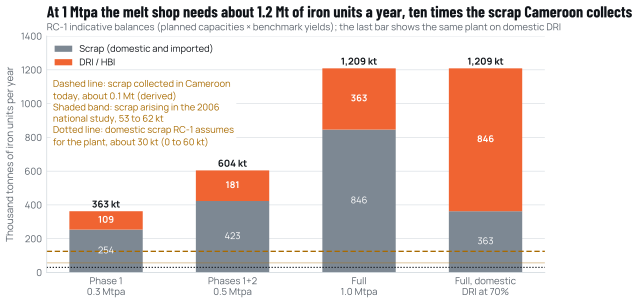
Source: Cameroon Steel reference configuration RC-1 (planning estimate), indicative balances [S03]; scrap study [S13]; production and scrap-share inputs [S32, S74]; derivations in Annex A.
Figure 3.2 shows the scale of the gap. Cameroon Steel’s reference configuration (RC-1) plans 0.3 Mtpa of finished products in Phase 1, rising to 0.5 Mtpa and then to 1 Mtpa [S03]. With a metallic yield of 0.88 t of liquid steel per tonne charged and a casting and rolling yield of 0.94, those capacities need about 363,000 t, 604,000 t and 1.21 Mt of iron units a year (derived from RC-1 assumptions) [S03]. Even Phase 1 would need between three and four times the scrap that Cameroon collects today, and about six times the scrap arising estimated by the 2006 national study.
3.3 Imported scrap, DRI, HBI and pig iron fill the gap
An electric melt shop at a deep-water port can buy iron units on the international market. Each has a different profile.
Imported scrap is the cheapest iron unit per tonne of iron where it is available, but Africa as a whole was a net importer of ferrous scrap in 2025, importing 3.4 Mt and exporting 1.2 Mt [S41]. The large exporting regions are the European Union and the United States, which shipped 16.7 Mt and 11.8 Mt respectively in 2025, while Türkiye imported 18.8 Mt [S64]. Scrap prices follow those flows, and the quality of imported scrap (its residual copper and tin, its density and its contamination) varies widely.
Direct-reduced iron and hot-briquetted iron are the traded virgin iron units. International DRI trade was about 10.8 Mt in 2025 on trade data, or about 13.2 Mt including sanctioned origins; Russia exported more than 2.0 Mt of HBI and India 1.6 Mt, while the United States, Türkiye, India, Nepal and Italy were the largest importers [S04]. HBI accounted for 11.6 Mt, or 7.7% of world DRI output [S04]. For a buyer without its own reduction plant, HBI is the practical form: it can be shipped with surface ventilation, whereas cold DRI must travel under an inert atmosphere because it re-oxidises and self-heats when wet [S14, S15].
Merchant pig iron offers clean iron with high carbon, which adds chemical energy in the EAF [S43]. Its supply is concentrated in a few exporting countries and it carries the emissions of the blast furnace that made it.
Table 3.1 Iron-unit options for the Kribi melt shop, by role and risk
| Option | Role in the charge | Quality profile | Supply and logistics | Main risk | Use in the pathway |
|---|---|---|---|---|---|
| Domestic scrap | Base charge where available | Variable; needs sorting, shredding and inspection | About 0.1 Mt collected a year (derived), already used by existing mills; RC-1 assumes about 30,000 t a year for the plant (0 to 60,000) [S03] | Competition and price; quality | Buy where economic; support formal collection |
| Imported scrap | Base charge | Grade-dependent; residuals vary | Bulk or container shipments through Kribi | Price volatility; residuals | Main scrap source in Phase 1 |
| Imported HBI | Clean iron to dilute residuals and stabilise chemistry | 94% metallisation; dense briquettes [S15] | Traded internationally; ventilated holds [S15] | Price; supplier concentration | 20 to 50% of the charge in Phase 1 (RC-1 assumption) [S03] |
| Imported cold DRI | As HBI | 92 to 96% metallisation [S14] | Inert-gas shipping; dry covered storage [S14] | Re-oxidation, fire risk | Only if HBI is unavailable |
| Pig iron | Carbon and clean iron | 3.5 to 4.5% C [S43] | Few exporters | Price; blast-furnace emissions | Trim addition |
| Domestic DRI (Kribi) | Main virgin iron unit | Depends on pellet gangue (Chapter 4) | Hot charge possible | Ore, gas, pellet plant readiness | Later phase, subject to the gate in Chapter 10 |
Source: Cameroon Steel; [S03, S04, S14, S15, S41, S43, S64].
3.4 How iron units change the melt shop’s performance
The choice of iron units is not only a supply question; it changes how the furnace operates.
Scrap is already metallic and melts with the least energy, but its residual elements (copper, tin, nickel, chromium) cannot be removed in the furnace and accumulate in each recycling cycle. For rebar these residuals are tolerable within limits; for wire rod destined for fine drawing, they matter more. DRI and HBI dilute residuals because they contain almost none.
DRI and HBI carry gangue (silica and alumina from the ore) and some unreduced iron oxide. The furnace must melt the gangue and flux it with lime, which increases slag volume, electrical energy and refractory wear, and reduces metallic yield. The ENERGIRON reference indicates that each additional 10% of DRI in the charge adds about 14.5 kWh per tonne of liquid steel (Chapter 5) [S20]. That penalty is the price of independence from scrap.
Pig iron and the carbon in DRI add chemical energy when oxidised with injected oxygen, which partly offsets the electrical penalty and helps form the foaming slag that protects the furnace walls.
The planning assumption in RC-1 is that imported DRI or HBI forms about 30% of the Phase 1 charge, within a range of 20 to 50%, with the balance in scrap [S03]. On that basis, Phase 1 would use about 109,000 t of DRI or HBI and 254,000 t of scrap a year (derived) [S03]. Because domestic scrap is scarce and already in use, RC-1 assumes that the plant can buy only about 30,000 t of it a year, within a range of 0 to 60,000 t bounded by the 2006 national estimate of scrap arising [S03, S13]; about 224,000 t of the scrap, and all of the DRI or HBI, would be imported. Any configuration that relied on more than about 60,000 t a year of domestic scrap would not be feasible on current evidence. RC-1 estimates inbound port tonnage of about 351,000 t a year in Phase 1 for imported metallics and consumables (derived) [S03].
3.5 Scrap quality and preparation decide yield
Scrap is not a single commodity. It arrives as heavy melting steel from demolition, light sheet and packaging, turnings and borings from machining, and shredded scrap from end-of-life vehicles and appliances. Each grade has a different density, cleanliness and residual content, and the melt shop’s yield, energy use and charging time depend on the mix. Dense scrap fills the furnace in fewer charges: a large modern furnace published in 2026 is designed to run on two bucket charges with scrap densities down to 550 kg/m³ [S75]. Light, dirty or wet scrap needs more charges, more energy and more fume treatment.
Preparation therefore belongs to the melt shop’s design. A scrap yard needs space to separate grades, shears or balers to cut and compact oversized and light material, magnets and cranes to build buckets to a recipe, and inspection at the gate for sealed containers, explosives and radioactive sources, which are standard hazards in scrap trading. Imported scrap should be bought to recognised grade specifications and checked on arrival; domestic scrap, much of it collected informally [S13], will need sorting and cleaning before it can be charged safely.
3.6 Receiving iron units through Kribi
Because most Phase 1 iron units will be imported, the plant’s metallics chain starts at the port. The Port Autonome de Kribi inaugurated its second container terminal, with a 715 m quay and 16 m of water depth, in May 2025 [S76]. A mineral terminal of 125 Mt a year was the subject of a memorandum of understanding signed on 4 November 2025 [S37], and in March 2026 the port’s Director General expected the mineral and hydrocarbon terminals to be completed within five to six years [S38]. Phase 1 therefore plans on the existing general-cargo and container terminals; White paper 02 examines the port’s bulk capacity. HBI and scrap move in bulk carriers or containers; both need covered or well-drained storage at the port and at the plant. RC-1 estimates that Phase 1 would bring in about 351,000 t a year of imported metallics and consumables, and about 74 truck loads a day if all movements go by road before a rail siding exists (derived) [S03]. The site layout keeps a reserve for a rail siding and logistics corridor [S03]. When a direct-reduction module is built, the same logistics chain will handle about 1.45 t of pellets for every tonne of DRI (Chapter 4).
3.7 A metallics strategy, not a single supplier
Iron-unit security will be one of the main operating risks of the Kribi melt shop, and it can be managed with a small number of disciplined practices.
Two sources for every iron unit. Phase 1 should be supplied under term contracts with at least two suppliers each for scrap and for HBI, from different regions, with spot purchases on top. That reduces exposure to a single supplier, freight lane or sanctions regime.
Storage sized for disruption. HBI and DRI must be stored dry and covered; scrap yards need space for grading and preparation. RC-1 reserves a scrap and metallics stockyard with a covered DRI/HBI store in Phase 1 [S03].
Quality at the gate. Every delivery should be sampled for metallisation, carbon and gangue (for DRI/HBI) or inspected and graded (for scrap), and the results linked to the heats in which the material is used (Chapter 8).
Formal domestic collection. Supporting a formal scrap collection and preparation chain, with weighbridges, shears and safe handling, improves quality and traceability and keeps domestic scrap in Cameroon.
A clear path to domestic iron. The decisive step is to make DRI at Kribi from Cameroonian ore. The mining convention of Cameroon Mining Company, Cameroon Steel’s sister company and holder of the Mbalam permit [S77], is reported to provide for 15% of production to be transformed locally; the same press report presents Cameroon Steel as the national steel hub of the programme [S36]. Chapter 4 examines what has to happen to the ore before that clause can feed a shaft furnace.
3.8 What the metallics balance means for the pathway
The metallics balance explains the shape of the pathway. Phase 1 can be built and run on purchased iron units because a 0.3 Mtpa melt shop needs about 0.36 Mt of them a year, a quantity the international market can supply. At 1 Mtpa the requirement rises to about 1.2 Mt a year. Buying that quantity indefinitely would expose the plant to import prices, freight and foreign-exchange risk for most of its costs; making a large part of it in Cameroon would retain the value added and reduce imports. Figure 3.2 shows that with domestic DRI at 70% of the charge, the full plant would need about 846,000 t of DRI and about 363,000 t of scrap a year (derived) [S03]. That is why RC-1 keeps a reserve for a direct-reduction module of about 1 Mt of DRI a year at full development, subject to ore quality and gas supply [S03].
Other sources cited in the English text
- S67Commerce extérieur du Cameroun en 2020. Institut National de la Statistique (INS), Cameroon, Jul 2021.ins-cameroun.cm/wp-content/uploads/2025/07/Note-Commerce-exterieur-202…
- S68Évolution du commerce extérieur en 2025 (version provisoire). Institut National de la Statistique (INS), Cameroon, Feb 2026.ins-cameroun.cm/wp-content/uploads/2026/04/Note-sur-le-commerce-exteri…
- S69Métallurgie: les importations du fer à béton interdites jusqu’à nouvel ordre. EcoMatin, 10 Apr 2023.ecomatin.net/metallurgie-les-importations-du-fer-a-beton-interdites-ju…
- S70Note sur le commerce extérieur 2022. Institut National de la Statistique (INS), Cameroon, Dec 2023, revised 13 Feb 2024.ins-cameroun.cm/wp-content/uploads/2025/07/Note-sur-le-Commerce-Exteri…
- S71Commerce extérieur du Cameroun en 2023. Institut National de la Statistique (INS), Cameroon, Apr 2024.ins-cameroun.cm/wp-content/uploads/2025/07/Note-sur-le-Commerce-Exteri…
- S06Production: les acteurs en présence. Cameroon Tribune, 11 May 2026.cameroon-tribune.cm/article.html/76600/fr.html/details_2
- S72Cameroun: le groupe Prometal décroche 26 milliards FCFA auprès d’Afreximbank. Sikafinance, 30 Sep 2026.sikafinance.com/marches/cameroun-le-groupe-prometal-decroche-26-millia…
- S73Matériaux de construction: l’offensive locale. Cameroon Tribune, 24 Apr 2023.cameroon-tribune.cm/article.html/56766/en.html/details_2
- S41World Steel in Figures 2026. worldsteel, 4 Jun 2026.worldsteel.org/data/world-steel-in-figures/world-steel-in-figures-2026…
- S14Direct Reduced Iron (DRI): specifications and handling. International Iron Metallics Association, Undated, accessed Oct 2026.metallics.org/dri.html
- S15Hot Briquetted Iron (HBI): specifications and handling. International Iron Metallics Association, Undated, accessed Oct 2026.metallics.org/hbi.html
- S43Pig iron. International Iron Metallics Association, Undated, accessed Oct 2026.metallics.org/pig-iron.html
- S20ENERGIRON technology: DRI-EAF production route using natural gas or H2. European Commission, Innovation Centre for Industrial Transformation, Referenced 12 Feb 2026.innovation-centre-for-industrial-transformation.ec.europa.eu/innovativ…
- S75BSE-EAF: future-proof melting automated system for safe, reliable and efficient steelmaking (R. Schweikle, J. Apfel, A. Pezza), DOI 10.36146/2026_06_50. La Metallurgia Italiana (AIM), Jun 2026.aimnet.it/la_metallurgia_italiana/2026/giugno/Aim_giugno2026_6.pdf
- S76La Lettre du PAK n°254. Port Autonome de Kribi, May 2025.Cited by title and date
- S37Port de Kribi: un terminal minéralier d’avenir (memorandum of understanding for a 125 Mt a year mineral terminal). Port Autonome de Kribi, 4 Nov 2025.Cited by title and date
- S38Zone industrialo-portuaire de Kribi (KPIZ): jusqu’à +8 points de croissance et 150 000 emplois attendus sur 15 ans. Investir au Cameroun, 4 Mar 2026.investiraucameroun.com/gestion-publique/0403-23163-zone-industrialo-po…
- S77Kribi: le Premier ministre, chef du gouvernement est là. Cameroon Tribune, 30 Dec 2024.cameroon-tribune.cm/article.html/68499/fr.html/details_2
- S36Cameroon Mining Company confirme l’entrée du projet Mbalam dans sa phase irréversible d’exécution. Camer.be via AllAfrica, 12 Dec 2025.fr.allafrica.com/stories/202512120475.html
本章引用的资料来源
方括号内的标记对应以下来源(按原文语言列出),完整列表见附录。 完整来源列表
- S03Cameroon Steel reference configuration RC-1 (planning estimate): phases, benchmarks with ranges and indicative balances for the Kribi steelworks (Class 5), edition 10 October 2026, values as revised on that date. Cameroon Steel,2026年10月10日.按标题和日期引用
- S13Bidoung J., Fomethe A., Yantio G., Melo U., La récupération et le recyclage des déchets ferromagnétiques: analyse de la situation au Cameroun, Déchets, Revue francophone d’écologie industrielle n°48. ENSP Yaoundé and MIPROMALO,2007年第四季度.eid.episciences.org/7942/pdf
- S042025 World Direct Reduction Statistics. Midrex Technologies,2026年9月.midrex.com/world-dri-statistics/world-dri-production-reaches-151-0-mt-…
- S64Global scrap consumption rose by 4.5% y/y in 2025 (BIR World Steel Recycling in Figures). GMK Center,2026年6月4日.gmk.center/en/news/global-scrap-consumption-rose-by-4-5-y-y-in-2025-bi…
- S32Cameroun: Prometal décroche 26,2 milliards FCFA d’Afreximbank. Camer.be,2026年10月1日.camer.be/actualites/economie/cameroun-prometal-decroche-262-milliards-…
- S74Métallurgie: les industriels dénoncent la présence du fer à béton contrefait. EcoMatin,2023年6月22日.ecomatin.net/metallurgie-les-industriels-du-secteur-denoncent-la-prese…
- S05UN Comtrade public API: Cameroon (reporter 120), HS 72 and 73 and six-digit lines, 2019 to 2023. United Nations Statistics Division.comtradeapi.un.org/public/v1/preview/C/A/HS?reporterCode=120&period=20…
- S3340 millions d’euros d’Afreximbank: Prometal sécurise ses billettes d’acier alors que la ferraille camerounaise s’épuise. Cameroun24,2026年10月10日.cameroun24.net/article/76267-40-millions-d-euros-d-afreximbank-prometa…
引用本章
Cameroon Steel(2026)。电炉炼钢是中部非洲的正确路线(中文摘要版)。白皮书03,第3章:含铁原料:喀麦隆缺的是铁,而不是轧制能力。CS-WP-03。https://www.cameroon-steel.com/zh/library/technology-routes/metallics/
来源