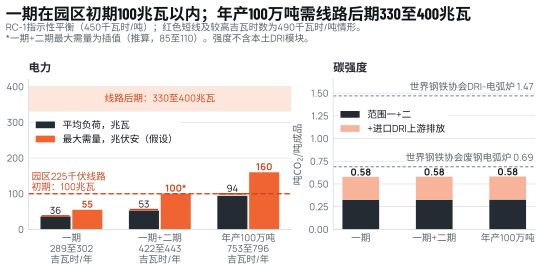
一期(规划)名义产能每年约30万吨(钢水约32万吨),预计持续产量27万至30万吨;目标于2029年第一季度在取得环境证书后开工,2030年下半年首炉出钢,2031年爬坡;二期(第二条熔炼线及轻中型型材轧机,约20万吨型材)暂定2032至2034年;三期(炼钢扩能及重型型材轧机)2034年后,产能达约100万吨;直接还原模块更晚,视矿石、天然气和审批情况而定[S03]。一期平均负荷约36至38兆瓦、最大需量约55兆伏安,在园区225千伏线路初期100兆瓦以内;全面建成平均约94至99兆瓦、最大需量约160兆伏安,需线路后期330至400兆瓦[S25, S34]。一期不用天然气。在30%进口DRI条件下,范围一和范围二排放约为每吨成品0.32至0.34吨CO2,计入进口DRI上游排放约0.58至0.59吨,低于世界钢铁协会废钢电弧炉0.69吨和DRI-电弧炉1.47吨的平均值[S01, S03]。
一期炼钢车间生产钢坯,产品可在轧材与商品钢坯之间灵活分配:国内钢筋产能约62.7万吨,是约18万吨需求的三倍以上[S06];现有再轧厂2023年进口钢坯16.14万吨[S05]。因此,一期产量用于替代进口钢坯和线材并出口CEMAC市场,而非增加钢筋(白皮书04)。
时间顺序同样重要:前端工程设计、环境与社会影响评估(2028年第三季度听证、第四季度取得证书)和融资均为目标日期;其后各步均为指示性日期[S03]。从开工到首炉出钢约18至24个月,须在融资关闭时订购长周期设备;国际金融公司对最高风险类别项目须在董事会审批前60天披露环境与社会审查[S106];二期投资决策不太可能早于2032年。一期的任何环节都不取决于姆巴拉姆(Mbalam)矿山或新气田的开发进度。
结论是:RC-1是一座按模块成长的工厂,每一步都可依据自身结果融资和论证。
英文全文 14分钟 · 3231词The phased pathway applied: how RC-1 reaches 1 Mtpa in four steps
Cameroon Steel’s reference configuration, RC-1, applies the phased electric pathway to the Kribi project. Phase 1 (planned) is a single electric arc furnace with a ladle furnace, a billet caster and a bar and wire-rod mill, with a nameplate capacity of 0.3 Mtpa and an expected sustained output of 270,000 to 300,000 t a year; works are targeted to start in 2029, with a first heat in the second half of 2030 and ramp-up in 2031 [S03]. Phase 2 (indicative) adds a second melt line and a light and medium sections mill for about 0.2 Mtpa of angles, channels and flats, indicatively 2032 to 2034. Phase 3 (indicative) adds melt-shop capacity and a heavy-section mill after 2034, bringing the plant to its design capacity of about 1 Mtpa, subject to markets and financing. A site reserve is kept for a direct-reduction (DR) module for Cameroonian ore, which would follow later, subject to ore, gas and approvals [S03]. Phase 1 fits within the initial 100 MW stage of the zone’s 225 kV line and needs no natural gas; full development needs the line’s later 330 to 400 MW stage [S03, S25]. This chapter presents those planning values with their status, explains where Phase 1 tonnage can be sold, and gives no investment amounts, which will be set by engineering and financing.
9.1 The project on the public record
Cameroon Steel is developing a steel complex at Mboro, in the Kribi industrial-port zone. The foundation stone was laid on 30 December 2024 by the Prime Minister, representing the Head of State [S77, S104]. The design capacity reported by Cameroon Tribune in January 2025 is 1 Mt of steel a year, to be reached in phases [S105], and the first phase focuses on reinforcing bar and wire rod made in an electric arc furnace melt shop. Cameroon Mining Company, Cameroon Steel’s sister company, holds the Mbalam exploitation permit [S77]. The zone’s development company lists "steelmaking linked to mineral exports" among the industrial clusters it plans for the zone [S38].
RC-1, cited in this paper as the Cameroon Steel reference configuration RC-1 (planning estimate), is the engineering basis that translates that public description into units, capacities and utilities. It is a Class 5 planning configuration (an order-of-magnitude definition used before front-end engineering) and every value in it carries a qualifier, planned, target or indicative, defined in Annex A [S03]. This edition uses the values as revised on 10 October 2026, including a domestic-scrap assumption of about 30,000 t a year and the schedule below.
9.2 Four steps, one melt-shop logic
Table 9.1 RC-1 phases (Cameroon Steel planning basis, edition 10 October 2026)
| Step | Main units | Products | Finished capacity | Liquid steel | Status |
|---|---|---|---|---|---|
| Phase 1: bar and wire-rod works | One EAF of the 40 t class; one ladle furnace; billet caster; induction billet heating; rebar mill; high-speed wire-rod mill | Billets; rebar Ø8 to 32 mm; wire rod Ø5.5 to 12 mm | Nameplate about 300,000 t/yr; expected sustained 270,000 to 300,000 | About 320,000 t/yr at nameplate | Planned |
| Phase 2: sections | Second melt line (EAF, ladle furnace, caster); light and medium section mill | Angles, channels, flats | About 200,000 t/yr (150,000 to 200,000) | About 215,000 t/yr | Indicative |
| Phase 3: heavy sections to 1 Mtpa | Melt-shop expansion; H-beam and heavy-section mill | H-beams, I-beams, heavy sections | About 500,000 t/yr | About 535,000 t/yr | Indicative |
| Reserve: direct reduction | Gas-based, hydrogen-ready DR module; pellet yard | DRI or hot DRI for the melt shop | About 1 Mt DRI/yr (0.8 to 1.1) | Not applicable | Indicative; subject to ore quality, gas and approvals |
Source: Cameroon Steel reference configuration RC-1 (planning estimate) [S03]. Values are planning figures, to be confirmed in front-end engineering.
Each step reuses what the previous one built. The Phase 1 caster and mill continue to run when the second melt line arrives; the melt shop’s charge shifts from purchased to domestic iron units without any change to the furnaces; the substation and compensator are sized so that a second furnace transformer can be added. The pathway is therefore not a series of separate projects but one plant that grows by adding modules.
9.3 The timeline: a first heat in 2030, domestic DRI as an option after 2034
Figure 9.1 shows the RC-1 schedule. Front-end engineering for Phase 1 and the utility agreements are targeted for 2027. The field baseline for the environmental and social impact assessment covers the wet and dry seasons of 2027 and 2028, with public hearings in the third quarter of 2028 and the certificate of environmental compliance in the fourth quarter; financing is targeted for 2028, and no construction works start before the certificate [S03]. Phase 1 works are targeted to start in the first quarter of 2029, with a first heat in the second half of 2030 and ramp-up through 2031 towards the nameplate of 0.3 Mtpa [S03]. Phase 2 (second melt line and light and medium sections mill) is indicative for 2032 to 2034, and Phase 3 (melt-shop expansion and heavy-section mill), which brings the plant to 1 Mtpa, for after 2034, both subject to market and financing; the direct-reduction module would follow later, subject to ore quality, gas supply and approvals [S03].
Three features of this schedule deserve scrutiny. First, it allows about 18 to 24 months from the start of works to the first heat for a greenfield melt shop, caster and two mills. That is achievable only if long-lead equipment (the furnace transformer, the caster and the mill stands) is ordered at financial close and the 225 kV supply is available on time; a longer construction period would move the first heat into 2031 without changing the pathway. Second, development lenders disclose a project’s environmental and social review before their boards approve it: IFC, for example, does so 60 days before board consideration for its highest-risk category and 30 days for others [S106]. A certificate in the fourth quarter of 2028 leaves little room before financing, so the disclosure period is one of the Gate 1 conditions (Chapter 10). Third, Gate 2 requires twelve months of Phase 1 at design performance, so a Phase 2 investment decision is unlikely before 2032, which places Phase 2 towards the end of its indicative 2032 to 2034 window.
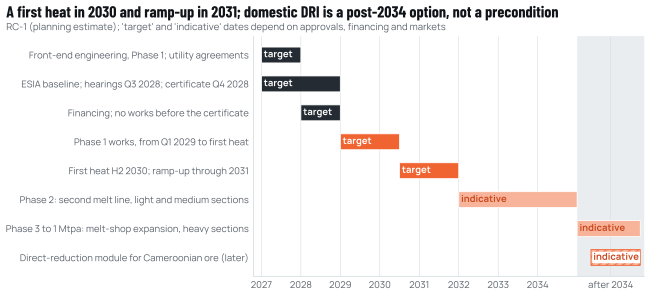
Source: Cameroon Steel reference configuration RC-1 (planning estimate), schedule [S03]. "Target" and "indicative" dates depend on approvals, financing and markets.
The order matters. The steps that depend only on Cameroon Steel and its suppliers (engineering, the melt shop, the mill) come first. The steps that depend on other parties’ projects (a concentrator and pellet plant, a long-term gas supply, the later stage of the 225 kV line) come later and are gated by evidence (Chapter 10). Nothing in Phase 1 depends on the timing of the Mbalam mine or of new gas developments.
9.4 Utilities by phase: Phase 1 is all-electric and fits the zone’s first 100 MW
RC-1 derives indicative utility balances by multiplying planned capacities by benchmark consumption values [S03]. They are summarised in Table 9.2 and Figure 9.2.
Table 9.2 Indicative utility, by-product and emissions balances by RC-1 phase (derived)
| Item | Phase 1 | Phases 1 and 2 | Full, 1 Mtpa |
|---|---|---|---|
| Finished products, t/yr | 300,000 | 500,000 | 1,000,000 |
| Liquid steel, t/yr | 319,000 | 532,000 | 1,064,000 |
| Iron units (metallics), t/yr | 363,000 | 604,000 | 1,209,000 |
| of which DRI/HBI at 30% of charge, t/yr | 109,000 | 181,000 | 363,000 |
| Electricity, GWh/yr | 289 | 422 | 753 |
| Electricity at the upper value of 490 kWh/t, GWh/yr | 302 | 443 | 796 |
| Average electrical load, MW (upper value in brackets) | 36 (38) | 53 (55) | 94 (99) |
| Maximum demand, MVA (assumed; Phases 1 and 2 interpolated) | About 55 (45 to 65) | About 100 (85 to 110), derived | About 160 (130 to 190) |
| Natural gas for reheating, GJ/yr | 0 | 260,000 | 910,000 |
| Water make-up, m³/yr | 600,000 | 1,000,000 | 2,000,000 |
| Oxygen, million Nm³/yr | 11.2 | 18.6 | 37.2 |
| EAF slag, t/yr | 44,700 | 74,500 | 148,900 |
| EAF dust (hazardous), t/yr | 4,800 | 8,000 | 16,000 |
| Scope 1 and 2 CO2, t per t finished (upper value in brackets) | 0.32 (0.33) | 0.33 (0.34) | 0.33 (0.34) |
| Including upstream of imported DRI, t per t finished | 0.58 (0.59) | 0.58 (0.59) | 0.58 (0.59) |
Source: Cameroon Steel reference configuration RC-1 (planning estimate), indicative balances at 450 kWh per tonne in the furnace [S03]; upper-value rows and bracketed values at 490 kWh per tonne (derived); the Phases 1 and 2 maximum demand is interpolated (derived): about 85 MVA pro rata to output between the Phase 1 and full-development values, and up to about 110 if the second melt line draws as much as the first; Figure 9.2 plots about 100 MVA. Benchmark inputs as listed in Annex A. Rounded.
Three points stand out. First, Phase 1’s average load of about 36 to 38 MW and maximum demand of about 55 MVA sit within the 100 MW that the Port Autonome de Kribi’s 225 kV line is designed to deliver at first [S25]. Full development, at about 94 to 99 MW average and about 160 MVA maximum demand, needs the line’s later stage of 330 to 400 MW [S25, S34]. The power path is therefore phased in the same way as the plant.
Second, Phase 1 needs no natural gas: induction heating replaces a gas reheating furnace (Chapter 6). Gas enters only with the Phase 2 section mill, at about 260,000 GJ a year, and reaches about 910,000 GJ at full development, before any direct-reduction module [S03]. A DR module of 1 Mt a year would need about ten times that quantity (Chapter 4).
Third, the carbon intensity of the planned product mix is low by international standards. With 30% imported DRI or HBI in the charge, RC-1 estimates scope 1 and 2 emissions of about 0.32 to 0.34 t of CO2 per tonne of finished product, and about 0.58 to 0.59 t including the upstream emissions of the imported DRI, the higher figures at the upper electricity value [S03]. Those figures compare with worldsteel’s 2024 averages of 0.69 t for scrap-EAF and 1.47 t for DRI-EAF crude steel [S01], although the boundaries differ (Annex A).
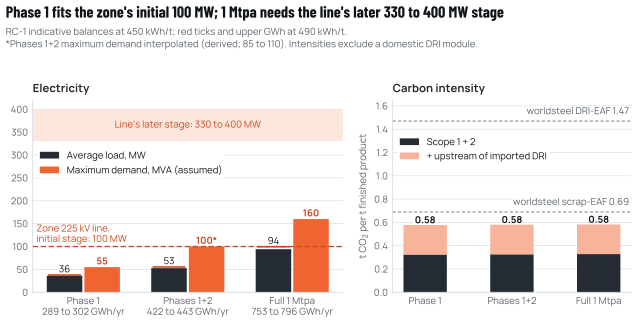
Source: Cameroon Steel reference configuration RC-1 (planning estimate), indicative balances [S03]; zone 225 kV line and substation stages [S25, S34]; worldsteel route averages [S01].
When the direct-reduction module runs, its emissions move inside the plant’s boundary. On the RC-1 benchmarks, a full plant with 70% domestic gas-based DRI in the charge would emit about 0.8 t of CO2 per tonne of finished product, excluding pellet production and mining (derived; Annex A). Blending hydrogen into the shaft furnace, as hydro-based electricity allows, would bring that figure down progressively (Chapter 4).
9.5 Logistics, jobs and land follow the same phasing
RC-1 estimates inbound port tonnage of about 351,000 t a year in Phase 1 for imported metallics and consumables, rising to about 1.24 Mt at full development before any domestic DRI, and outbound finished products of 0.3 Mt rising to 1 Mt; moved entirely by road before any rail siding, Phase 1 would generate about 74 truck loads a day [S03] (all derived). A rail siding and logistics corridor are kept in the site reserve [S03].
RC-1 plans about 500 direct jobs in Phase 1 (450 to 550) and about 1,000 indirect jobs, rising to about 1,100 direct jobs at full development (indicative range 900 to 1,300), with a target of about 90% Cameroonian nationals in operations by the fifth year [S03]. Those figures are planning values that the employment study will refine.
The site layout keeps space for each later step: melt-shop expansion, the section and heavy-section mills, stockyard expansion, the direct-reduction module and pellet yard next to the melt shop, downstream processing, a rail siding and a permanent environmental buffer [S03].
9.6 How RC-1 performs on the four criteria
The phased pathway was chosen to balance capital intensity, flexibility, emissions and speed (Chapter 2). RC-1 shows how that balance looks in practice.
Capital. The first commitment is a single melt line and one mill for about 0.3 Mtpa [S03], a scale at which comparable bar and rod mills are being ordered in Africa today [S08, S09]. Each later step is a separate decision, financed on the results of the previous one.
Flexibility. The melt shop accepts any mix of scrap, DRI, HBI and pig iron; the mill can move between rebar sizes and wire rod; and Phase 1 output is flexible between rolled products and merchant billets for the existing re-rollers, which import most of their charge, so Phase 1 does not depend on adding rebar to a market whose capacity is already more than three times demand [S06]. Each later phase adds a product family (sections, then heavy sections) rather than more of the same.
Emissions. With 30% imported DRI or HBI and Cameroon’s grid, RC-1 estimates about 0.32 t of CO2 per tonne of finished product for scope 1 and 2, and about 0.58 t including the upstream of imported DRI [S03], well below worldsteel’s route averages [S01]. Domestic DRI raises the plant’s own emissions but replaces imported iron whose emissions occur elsewhere; hydrogen blending then lowers them.
Speed. Phase 1’s first heat is targeted for the second half of 2030 [S03] and depends only on the plant, its suppliers, its permits and the zone’s 225 kV line, not on a mine, a pellet plant or a gas field.
9.7 Interfaces with the zone’s infrastructure
The plant is designed to fit the infrastructure that the zone is building. The Port Autonome de Kribi’s 225 kV line and 225/30 kV substation are designed for 100 MW at first and 330 to 400 MW later [S25]; in August 2026 the port also reported a water plant for the Mboro area due in early 2027 [S34]. The deep-water port’s existing terminals can handle Phase 1’s imported iron units and consumables; a mineral terminal of 125 Mt a year is at the stage of a memorandum of understanding signed on 4 November 2025, with completion expected within five to six years [S37, S38]. The zone’s development company lists steelmaking linked to mineral exports among its planned clusters [S38], which places a steelworks and a future direct-reduction plant in the zone’s own logic. RC-1 keeps a rail siding in reserve for the day a rail link reaches the port [S03].
9.8 Skills and jobs follow the technology
The electric route shapes the plant’s workforce as much as its equipment. A melt shop and mill need furnace and caster operators, roll-shop technicians, electrical and instrument technicians able to maintain high-voltage equipment and power electronics, laboratory analysts and process engineers. RC-1 plans about 500 direct jobs in Phase 1 [S03], most of them in these trades. Cameroon’s engineering schools train mechanical, electrical and industrial engineers but have no dedicated metallurgy department [S39], and the University Institute of Technology in Douala trains maintenance, thermal and electrical technicians [S103]. The gap is therefore in steel-specific process skills, which suppliers’ training packages, simulators and a plant training centre can fill. Cameroon’s Mining Code also reserves 95% of non-skilled jobs in mining companies for nationals [S107]; although it governs mines rather than steelworks, it signals the local-content expectations that the steel chain linked to Cameroonian ore will face. Each later phase adds trades: gas-fired furnaces with Phase 2, heavy-section rolling with Phase 3, and process-gas, reformer and pellet-handling skills with a direct-reduction module.
9.9 What stays fixed and what remains open
The pathway fixes the decisions that are hard to reverse and leaves open those that depend on external evidence.
Fixed at Phase 1: the electric route; the melt-shop building, crane and caster layout with space for a second furnace; a substation and compensator designed for growth; the rebar and wire-rod mill with in-line quenching; the automation and traceability architecture; and the site reserve for a direct-reduction module next to the melt shop.
Open until their gates: the size and timing of the second melt line; the heavy-section mill’s product range and the caster for blooms or beam blanks; and every element of domestic ironmaking (pellet source, DR technology supplier, module size, gas contract and hydrogen blending schedule).
9.10 Where Phase 1 tonnage goes: billets, rolled products and exports
A melt shop with a caster can sell billets as well as roll them, and in Cameroon’s market that option is central rather than incidental. Domestic rebar capacity, about 627,000 t a year, is more than three times rebar demand of about 180,000 t, and capacity for wire rod and nails, about 72,000 t, is twice demand [S06]. Rebar is therefore a saturated market in which new capacity alone closes no gap. What the country lacks is steel to roll: local scrap covers only about 40% of the existing mills’ needs, so they import most of their charge [S32, S33], and Cameroon imported 161,400 t of billets in 2023 [S05].
Phase 1’s melt shop makes billets, and its output is planned to be flexible between three outlets: merchant billets sold to the existing re-rolling mills in place of imports; wire rod and rebar from its own mill, certified to NC 236 and to the international grades that contractors and lenders specify; and exports of billets and rolled products within CEMAC. The split between them will follow prices and contracts, not a fixed plan. Table 9.3 sets out the logic; White paper 04 examines each market and gives an indicative cost of a Kribi billet against a delivered import.
Table 9.3 Where Phase 1 output can go (illustrative)
| Outlet | Market evidence | What Phase 1 offers | Condition |
|---|---|---|---|
| Merchant billets for existing re-rollers | 161,400 t of billets imported in 2023; local scrap covers about 40% of mill needs [S05, S32, S33] | Billets cast at Kribi and delivered by road | Price at or below delivered imports; quality agreements |
| Wire rod | Imports fell to 7,800 t in 2023; domestic capacity above demand [S05, S06] | Clean rod for drawing, from a charge with DRI or HBI | Drawing quality and consistency |
| Certified rebar | Mandatory NC 236; capacity more than three times demand [S06, S26] | Bars certified to NC 236, BS 4449 and ASTM A615 | Replaces imported and non-compliant product, not compliant domestic supply |
| Exports within CEMAC | Neighbouring markets import long products (White paper 04, Chapter 6) | Billets and rolled products by road and sea | Logistics cost and regional trade rules |
Source: Cameroon Steel assessment from the sources cited; illustrative, not a sales plan.
The option costs little to keep: billet storage, weighing and a loading point. It also strengthens the case for the melt shop as the core of the plant: whichever outlet pays best, the value lies in making steel, the step that the country lacks.
Other sources cited in the English text
- S38Zone industrialo-portuaire de Kribi (KPIZ): jusqu’à +8 points de croissance et 150 000 emplois attendus sur 15 ans. Investir au Cameroun, 4 Mar 2026.investiraucameroun.com/gestion-publique/0403-23163-zone-industrialo-po…
- S08GSM Tanzania selects Danieli for new rebar and wire-rod mill. Danieli, 14 Sep 2026.danieli.com/en/GSM-Tanzania-selects-Danieli-for-new-rebar-and-wirerod-…
- S09B5Plus Group awards Danieli bar and wire-rod mill project. Danieli, 23 Sep 2026.danieli.com/en/B5Plus-Group-awards-Danieli-bar-and-wirerod-mill-projec…
- S37Port de Kribi: un terminal minéralier d’avenir (memorandum of understanding for a 125 Mt a year mineral terminal). Port Autonome de Kribi, 4 Nov 2025.Cited by title and date
- S39École Nationale Supérieure Polytechnique de Yaoundé: departments. ENSP Yaoundé, Undated, accessed Oct 2026.polytechnique.cm/
- S103Institut Universitaire de Technologie de Douala: departments. IUT Douala, Undated, accessed Oct 2026.iut-dla.cm/
- S107Mining 2026: Cameroon (Chazai Wamba), practice guide on Law No. 2023/014 of 19 December 2023 (Mining Code). Chambers Global Practice Guides, Updated 27 Jan 2026.practiceguides.chambers.com/practice-guides/mining-2026/cameroon
- S32Cameroun: Prometal décroche 26,2 milliards FCFA d’Afreximbank. Camer.be, 1 Oct 2026.camer.be/actualites/economie/cameroun-prometal-decroche-262-milliards-…
- S3340 millions d’euros d’Afreximbank: Prometal sécurise ses billettes d’acier alors que la ferraille camerounaise s’épuise. Cameroun24, 10 Oct 2026.cameroun24.net/article/76267-40-millions-d-euros-d-afreximbank-prometa…
- S26Cameroon rejects fresh push to revise rebar standard. Business in Cameroon, 26 Jan 2026.businessincameroon.com/construction/2601-15657-cameroon-rejects-fresh-…
本章引用的资料来源
方括号内的标记对应以下来源(按原文语言列出),完整列表见附录。 完整来源列表
- S03Cameroon Steel reference configuration RC-1 (planning estimate): phases, benchmarks with ranges and indicative balances for the Kribi steelworks (Class 5), edition 10 October 2026, values as revised on that date. Cameroon Steel,2026年10月10日.按标题和日期引用
- S25Kribi franchit la ligne électrique 225 kV. Port Autonome de Kribi,2025年8月6日.按标题和日期引用
- S34Énergie et infrastructures: un nouvel élan pour la compétitivité du Port de Kribi. Port Autonome de Kribi,2026年8月19日.按标题和日期引用
- S01Sustainability Indicators 2025 report (2024 data; route table added Feb 2026). worldsteel,2025年11月,更新:2026年2月.worldsteel.org/wider-sustainability/sustainability-indicators/
- S06Production: les acteurs en présence. Cameroon Tribune,2026年5月11日.cameroon-tribune.cm/article.html/76600/fr.html/details_2
- S05UN Comtrade public API: Cameroon (reporter 120), HS 72 and 73 and six-digit lines, 2019 to 2023. United Nations Statistics Division.comtradeapi.un.org/public/v1/preview/C/A/HS?reporterCode=120&period=20…
- S106IFC Access to Information Policy: disclosure of the Summary of Investment Information and the Environmental and Social Review Summary 60 days (Category A) or 30 days before Board consideration. IFC, World Bank Group,生效:2012年1月1日.ifc.org/en/insights-reports/2012/ifc-access-to-information-policy
- S77Kribi: le Premier ministre, chef du gouvernement est là. Cameroon Tribune,2024年12月30日.cameroon-tribune.cm/article.html/68499/fr.html/details_2
- S104Cameroun: Complexe moderne de sidérurgie de Kribi, le PM Joseph Dion Ngute effectue la pose de la première pierre. Camer.be,2025年1月5日.camer.be/87795/12:1/cameroun-complexe-moderne-de-siderurgie-de-kribi-l…
- S105Industrialisation: la voie royale de l’émergence. Cameroon Tribune,2025年1月2日.cameroon-tribune.cm/article.html/68558/fr.html/details_2
引用本章
Cameroon Steel(2026)。电炉炼钢是中部非洲的正确路线(中文摘要版)。白皮书03,第9章:分期路径的应用:RC-1分四步达到年产100万吨。CS-WP-03。https://www.cameroon-steel.com/zh/library/technology-routes/staged-pathway/
来源