Communities
In Kribi, we will be neighbours before we are a plant.
The Kribi coast depends on fishing, farming, tourism and its forests. Villages surround the industrial-port zone, and Bagyeli and Bakola Indigenous communities live in the region. Trust cannot be ordered into being: it is built by informing early, listening properly and keeping our word.
Choose a village to follow a concern from voice to answer.Tap a village to follow a concern from voice to answer. Illustrative The moving line illustrates this path. It is not a record of concerns received.
Sourced Stage of the project: nothing is built yet. Site surveys, the impact assessment, engineering and financing are still ahead.
The project area
An indicative area of 1.5 km radius. No boundary is published at this stage.
Before works Topographic, geotechnical and hydrological surveys, census of any land uses and heritage. Objective
Permit Conducted under framework law No. 96/12 and Decree No. 2013/0171/PM, with public hearings, and aligned with the IFC Performance Standards. The certificate of environmental compliance will be obtained before any works begin. Objective
Monitoring On-site meteorology and air quality, water, noise and biodiversity, across dry and wet seasons, before final design. Objective
The neighbouring villages
7 villages, 3 to 9 km from the centre of the indicative area, in one-kilometre bands. Derived
Works Information and consultation of neighbouring villages, fishers, traditional authorities and institutions, in appropriate languages, at every stage of the project. In preparation
Traffic Truck traffic plan, dust reduction, malaria and disease prevention, emergency preparedness with Kribi services. Objective
Monitoring Electric-furnace fume capture and baghouse filters, continuous monitoring, in line with the IFC EHS Guidelines for steel. Objective
The coast and the Kribi area
Beyond the rings: the coast, its fishers and farmers, and the Bagyeli and Bakola communities of the region.
Jobs Priority recruitment in the Kribi area, then across Cameroon, at equivalent qualification and cost. Objective
Indigenous peoples Should Bagyeli or Bakola communities be affected, culturally appropriate consultation and the pursuit of their free, prior and informed consent. Objective
Reporting Annual publication of safety, environment, employment and local-content indicators, from the start of works. Objective
How a concern is heard
You speakFrom today
Today, by the contact form. With the mechanism: several channels, free of charge and free from reprisal.
It is recorded
With tracking of every grievance.
You get a written answerTime limit not set yet
Within published response times.
The result is public
Published: response times and resolution rate.
In preparation Deadline in the data: the mechanism is to operate before works begin (late 2028 to Q1 2029, an objective of the reference schedule). The response time will be published with it.
Villages: OpenStreetMap contributors, extract of 24 July 2026. Distances in a straight line from the centre of the indicative area, in one-kilometre bands; directions rounded to the compass point. This is a diagram, not a map.
The territory
An inhabited coastline with many uses.
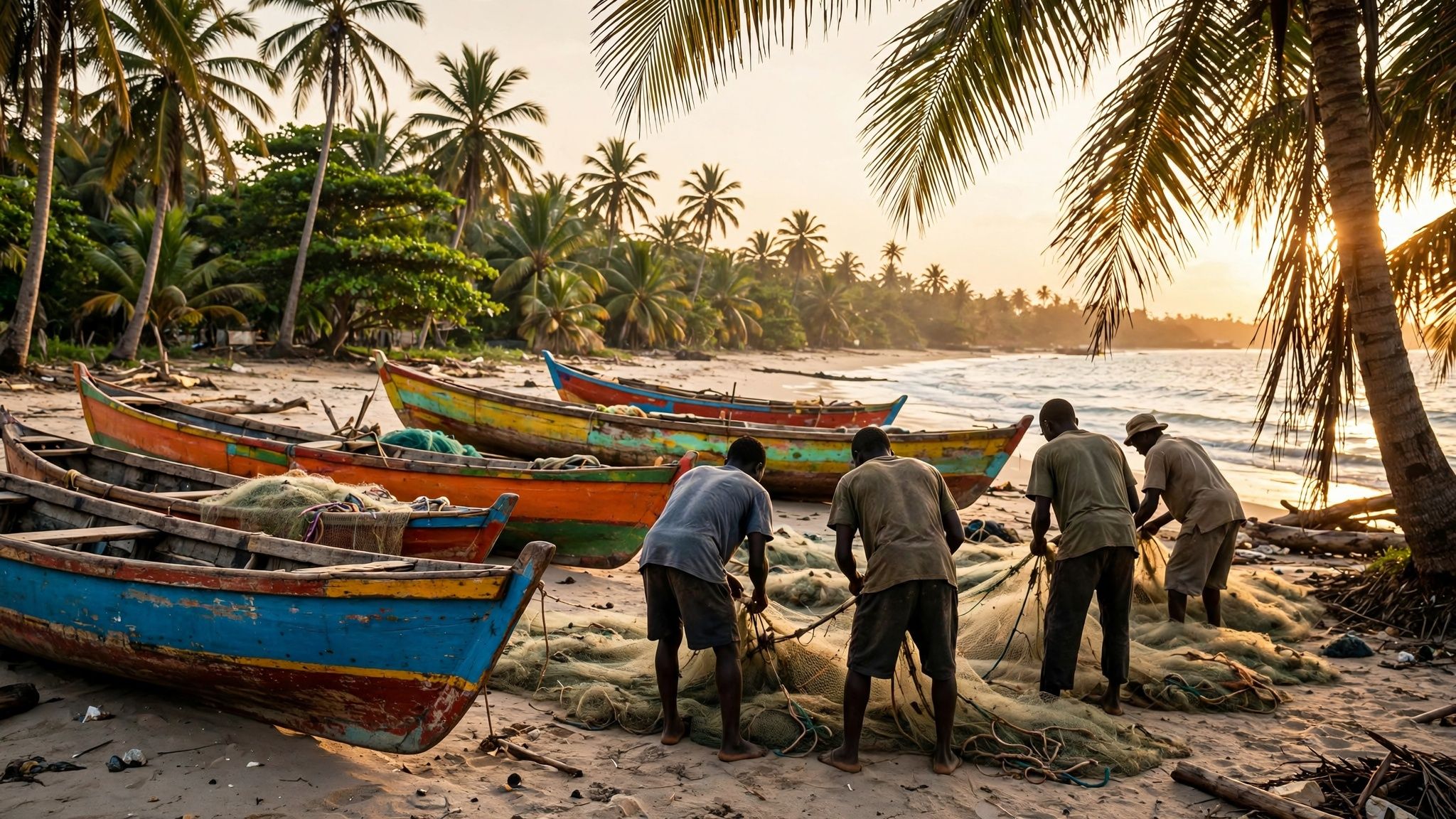
The villages closest to the Mboro area, such as Boussibelika, Mbodé, Mboro and Lolabé, depend on artisanal fishing, food crops and small trade. The coast also draws visitors, from its beaches to the Lobé falls, which are on Cameroon’s tentative list for World Heritage.
The development of the deep-water port has already changed the region. Past experiences with land acquisition and compensation have left people with strong expectations, and we take them seriously. Any land question will be handled under Cameroonian law and IFC Performance Standard 5, after a transparent census.
The plant will sit inland, several kilometres from the shore, so fishing grounds and beaches will stay open. Our design objectives follow from that: process water recycled in closed loops, stormwater treated before release, truck routes and hours agreed with neighbouring villages, and a liaison committee that meets before any work starts on site. Each objective will be measured and reported publicly once the environmental and social impact assessment has set its indicators.
Sourced Sources: OpenStreetMap contributors (villages, extract of 24 July 2026); UNESCO, Cameroon’s Tentative List (Lobé falls); IFC, Performance Standard 5 (2012).
Our method
Inform, consult, involve and report, at every stage.
The stakeholder engagement plan is in preparation. These are the steps it provides for, from the impact assessment to operation.
01
Before the studies
Information meetings with administrative and traditional authorities, presentation of the project and of the field-study calendar.
In preparation02
Impact assessment
Consultations in every village concerned, in French and in local languages; public hearings as required by Decree No. 2013/0171/PM.
In preparation03
Indigenous peoples
Should Bagyeli or Bakola communities be affected: culturally appropriate consultation and the pursuit of their free, prior and informed consent.
Objective04
Grievances
An accessible, free mechanism without reprisal, with published response times, operating before works begin.
In preparation05
Construction
Liaison committees, a truck traffic plan, priority local hiring, regular progress updates.
Objective06
Operation
A public annual report, monitoring of environmental and social indicators, and a community investment programme designed with neighbours.
Objective
What neighbours can expect
Commitments that anyone can check.
To be informed
Before every stage: field studies, hearings, works. Information will be available in French, English and local languages.
To be heard
Every concern will receive a written answer within a stated time, and follow-up will be public.
To be protected
Road safety, dust, noise, water: concrete measures, measured and published.
To be involved
Local jobs, training and purchasing first, at equivalent qualification and cost.
Do you live in the Kribi area?
You can ask us a question or share a concern today. We will answer in writing.