White paper 07 · Environment and society
Building responsibly in Kribi: a steelworks can meet international standards on four conditions
Early assessment, measurements across all seasons, honest engagement with communities and international standards from design.
Derived Counted from the English manuscript when the site was generated; print equivalent = words ÷ 350.
You are reading the full English edition. Also online: Édition française complète中文摘要版

Executive summary
What the study shows
Read the full executive summaryEnvironmental and social stewardship for Cameroon Steel’s complex at Mboro: early assessment, baselines measured across seasons, engagement with integrity including with Bagyeli communities, and IFC Performance Standards applied from design.
Source: white paper 07, executive summary; bracketed markers refer to the list of sources in the annex.
Main findings
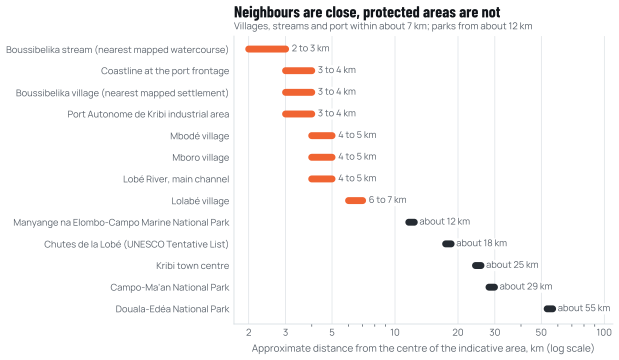
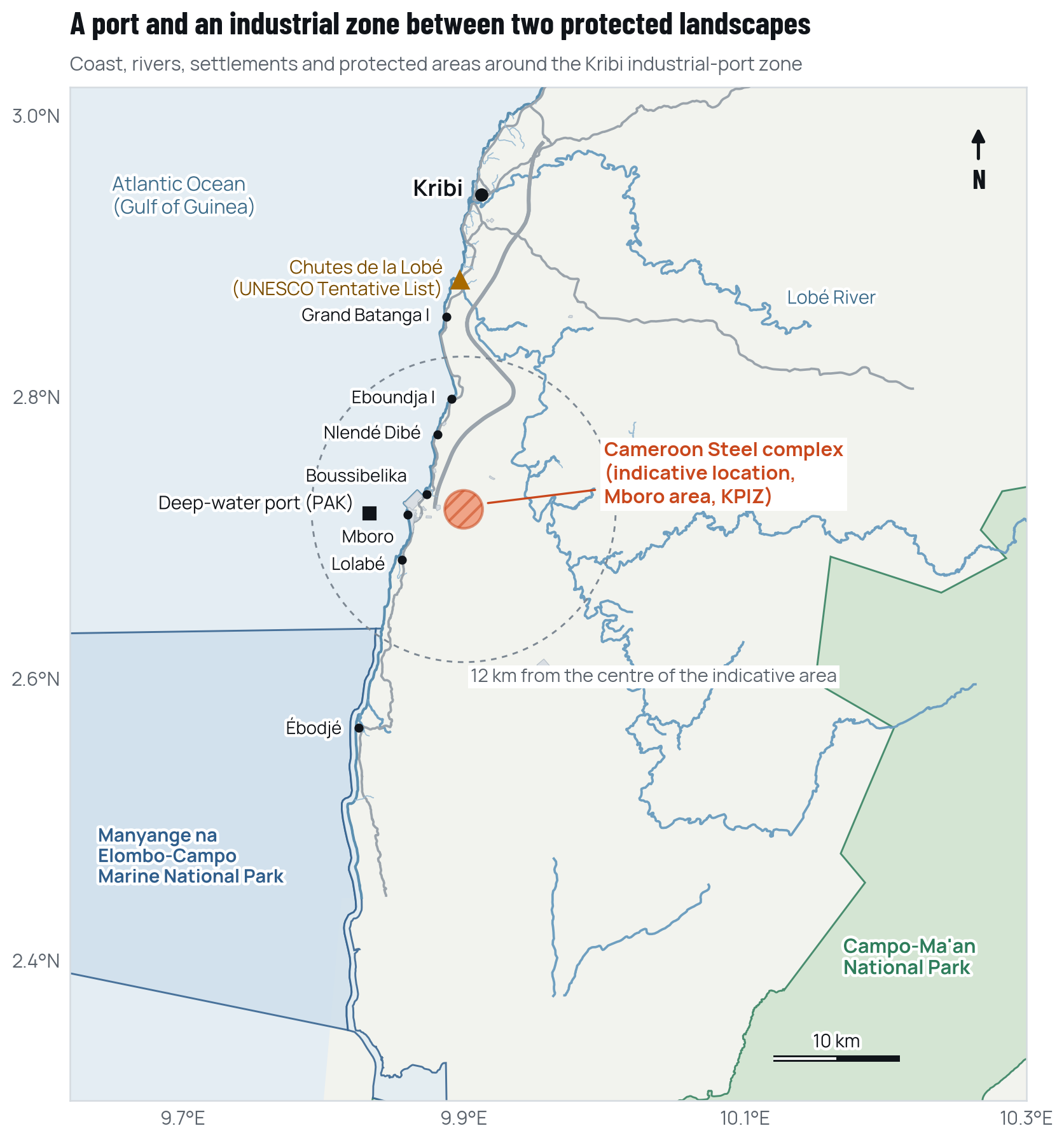
- The setting is sensitive, but the steel site is set back from its most valued assets. The site area lies on the coastal plateau about 3 to 4 km inland from the port frontage. The marine national park begins about 12 km away, the Lobé falls about 18 km and Campo-Ma’an National Park about 29 km. Villages and small streams are closer: the nearest mapped stream is about 2 to 3 km away and the nearest village, Boussibelika, about 3 to 4 km (Chapter 1 and Annex D, Table D.1).
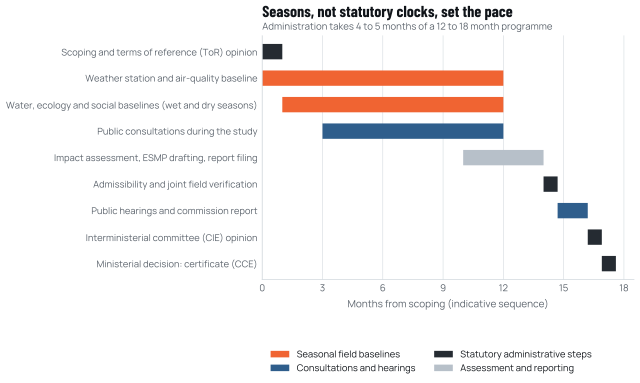
- Cameroonian law already requires a detailed, public assessment. Steelmaking needs a detailed EIES under the 2016 order, with consultations during the study, public hearings, an interministerial review and a certificate before any works. A separate classified-establishment authorisation requires a hazard study and an emergency plan. The administrative clock is four to five months, but seasonal baselines make the realistic timetable 12 to 18 months (Chapter 2).
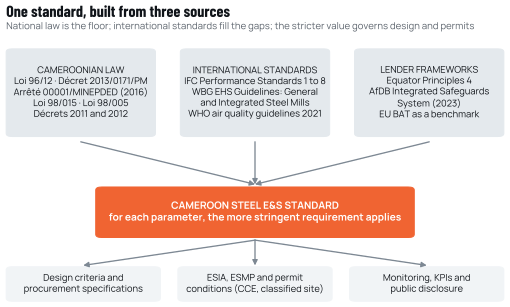
- National law sets no numeric emission or ambient limits for steel, so international values must fill the gap. Cameroon Steel will apply the stricter of national and international requirements for every parameter, and will ask for them to be written into its permits (Chapters 2 and 3).
- Phase 1 sits at the Equator Principles’ climate threshold. Indicative Scope 1 and 2 emissions are about 97,000 tCO₂e a year in Phase 1 and about 328,000 tCO₂e at full capacity. We will carry out the full climate risk and alternatives assessment and report publicly from the first year (Chapter 3).
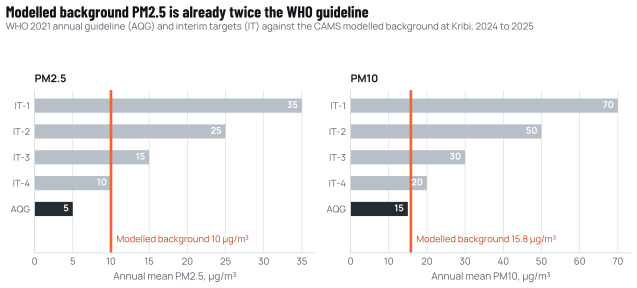
- The airshed is already above the WHO fine-particle guideline. Modelled background PM2.5 is about 10 µg/m³, twice the guideline, mostly from harmattan dust and regional smoke. The plant must therefore add as little as possible. Our objectives are melt-shop dust below 5 mg/Nm³, dioxins below 0.1 ng I-TEQ/Nm³, and a project contribution at any village below a quarter of the WHO guideline (Chapter 4).
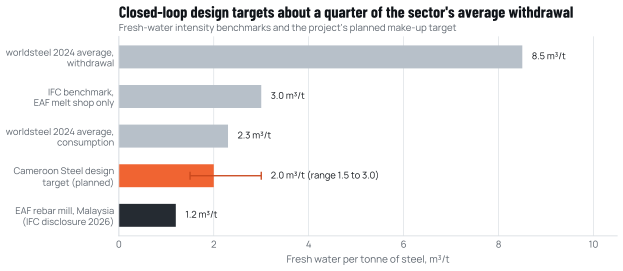
- In Kribi, water design is about rain, not supply. Planned fresh-water demand is about 2 m³ per tonne, less than 1% of the Lobé’s low flow even at full capacity. The challenge is about 2,850 mm of rain a year and a 100-year day of 264 mm. Our objectives are no process-water discharge in normal operation and no direct or indirect abstraction from the Lobé without a specific study (Chapter 5).
- Four fifths of the residues can become products; the hazardous dust needs a secure route first. At full capacity, residues are about 185,000 t a year, mostly slag suitable for aggregate after testing. EAF dust, about 16,000 t a year, is hazardous. There will be no first heat without a contracted, compliant outlet (Chapter 6).
- Critical habitat is unlikely on the site but present in the landscape. The main risks come from what a project brings, such as in-migration, hunting, traffic and coastal pressure, rather than from its footprint. We commit to two-season surveys, no net loss of natural habitat and a contribution to conservation co-designed with communities (Chapter 7).
- The social licence depends on engagement with integrity. The land has a history dating from the 2009 declaration of public utility. HIV prevalence in the South Region is the highest in Cameroon. Bagyeli communities live in the department. We commit to a land legacy review, early Indigenous Peoples screening, free, prior and informed consent where required, and a grievance mechanism open before any fieldwork (Chapter 8).
- Kribi’s own record shows that timing and transparency decide outcomes. Land questions outlived the port’s construction. The coast changed after the breakwater, and a park offset was designed without the people who used the land. A shared approach to cumulative effects, with published data, is the main lesson (Chapter 9).
Contents
12 chapters, 4 annexes
Every chapter opens with its conclusion. The annexes set out the method, the glossary and the list of sources.
- SummaryExecutive summary10 min · 1 fig.
- Chapter 1The Kribi setting: a sensitive coast, with the steel site set back from it12 min · 3 fig.
- Chapter 2The regulatory path: Cameroonian law already requires a detailed, public assessment11 min · 1 fig.
- Chapter 3International standards fill the gaps national law leaves, so we apply them from design12 min · 2 fig.
- Chapter 4Air quality: the airshed already exceeds the WHO fine-particle guideline, so the works must add as little as possible11 min · 3 fig.
- Chapter 5Water: in Kribi the design challenge is rain, not supply, and the goal is no process discharge10 min · 3 fig.
- Chapter 6Wastes and by-products: most residues can become products, but the hazardous dust needs a secure route before start-up10 min · 3 fig.
- Chapter 7Biodiversity: critical habitat is unlikely on the site but present in the landscape, so the plan reaches beyond the fence11 min · 2 fig.
- Chapter 8People and communities: the project’s social licence depends on engagement with integrity, above all with the Bagyeli14 min · 3 fig.
- Chapter 9Lessons from Kribi’s port and other heavy industry: problems usually came from timing, and transparency usually helped11 min · 1 fig.
- Chapter 10Commitments and how to measure them: objectives that others can check10 min · 2 fig.
- Chapter 11Evidence gaps: what is not yet known, and how it will be found out7 min · 1 fig.
Annexes
Go further
Related white papers
- WP02Kribi can become Central Africa’s steel platform if infrastructure keeps paceSite and logistics · 2.8 h
- WP06Lower-carbon steel from Cameroon: it could reach a third of the world’s carbon intensityClimate · 3 h
- WP08Cameroon can staff its steel industry if training starts before the furnace doesSkills · 2.7 h
Related Labs tools
- Project timeline
What is verified, what is planned, and when?
- Logistics simulator
How many ships, trucks and trains does the plant need?
- Jobs impact
How many direct, indirect and induced jobs by phase?
Cite this white paper
CS-WP-07
Cameroon Steel (2026). Building responsibly in Kribi: a steelworks can meet international standards on four conditions. White paper 07, CS-WP-07. https://www.cameroon-steel.com/en/library/responsible-kribi/
- Reference
- CS-WP-07
- Edition
- 10 October 2026
- Status
- First edition
- Classification
- Public