White paper 07 · Chapter 2
The regulatory path: Cameroonian law already requires a detailed, public assessment
Under Cameroonian law, a steelworks must undergo a detailed environmental and social impact assessment (EIES détaillée). The law requires public consultations during the study, public hearings on the finished report, an interministerial review, and a certificate of environmental compliance before any works start. In parallel, the plant must be authorised as a first-class classified establishment, with a hazard study and an emergency plan. The statutory deadlines add up to about four or five months of administrative time. The real timetable is 12 to 18 months, because it is set by baselines measured across the wet and dry seasons. National law sets no numeric emission or ambient air limits for steel, so we propose that international values become the permit conditions.
In this chapter (7)
- 2.1 The framework law sets the obligation and the penalties
- 2.2 Steelmaking is classified for a detailed assessment
- 2.3 The procedure, step by step
- 2.4 A classified establishment, with a hazard study and an emergency plan
- 2.5 Pollution, water, waste, forest and labour permits
- 2.6 Where national standards are silent, we apply the stricter international value
- 2.7 A realistic timetable, and why it serves everyone
2.1 The framework law sets the obligation and the penalties
The foundation is Loi n° 96/12 of 5 August 1996, the framework law on environmental management [L01]. Article 17 requires the promoter of any project likely to harm the environment to carry out an impact study at its own cost. Article 18 states that a study that does not meet the prescribed terms of reference is null and void. Article 19 sets the minimum content:
- the initial state of the site;
- the reasons for choosing it;
- the expected effects;
- mitigation and compensation measures with their cost;
- the alternatives considered [L01].
Article 72 establishes public participation. Article 77 makes the operators of classified establishments strictly liable for damage. Article 79 punishes carrying out a project without the required study, or failing to respect its measures, with fines of 2 to 5 million FCFA, imprisonment of six months to two years, or both [L01].
The law is old but still in force. National consultations on its revision were held in September 2024 with support from the United Nations Environment Programme [L14]. An assessment of Cameroon’s environmental and social management system, published by the AfDB in July 2026, still describes Loi 96/12 as the backbone of the national system [L13]. We plan on the basis of the current texts. We will update this analysis if a new framework law is promulgated before the certificate is issued.
2.2 Steelmaking is classified for a detailed assessment
Cameroonian practice does not use the "Category A, B, C" labels familiar to lenders. It distinguishes three instruments:
- the Notice d’Impact Environnemental (NIE), for minor operations;
- the EIES sommaire, for operations of moderate impact;
- the EIES détaillée, for operations with significant impacts.
It also provides for a strategic environmental assessment (évaluation environnementale stratégique, EES) of plans, programmes and zones [L03]. Arrêté n° 00001/MINEPDED of 8 February 2016 lists the operations in each class. Article 4, under industries and metalworking, places "installation de production et fabrication des métaux" in the detailed category [L03]. Several facilities associated with a steelworks are also listed in their own right:
- thermal power plants above 10 MW;
- port facilities for ships of 1,350 t or more;
- fuel storage above 140 m³;
- industrial waste treatment [L03].
Article 3 of the same order requires an EES for "la création et l’aménagement des zones industrielles" and for "la création de complexes industrialo-portuaires" [L03]. If an EES exists for the Kribi industrial-port zone, our assessment should build on it: it should adopt its zoning, its cumulative-impact findings and any conditions it sets for tenants. If it does not, the burden of cumulative assessment on each tenant rises. We will request this information from the port and zone authorities at scoping, and we list it as an evidence gap in Chapter 11.
2.3 The procedure, step by step
Décret n° 2013/0171/PM of 14 February 2013 sets out how an EIES is carried out and reviewed [L02]. Its main provisions are summarised in Table 2.1. Three features matter most for a project of this kind.
The study must be done by an approved firm. The consultant must hold an approval (agrément) from the Ministry of Environment, Protection of Nature and Sustainable Development (MINEPDED). Foreign firms may work only in association with an approved Cameroonian firm [L02][L11]. We welcome this rule. Local consultants bring knowledge of language, tenure and administration that no international team can replace.
Public participation is required twice. Public consultations take place during the study. MINEPDED must approve the programme, and it must reach representatives of the affected population at least 30 days before the first meeting, with signed minutes of every meeting [L02]. Public hearings (audiences publiques) are then held on the finished report. An ad hoc commission reports on them [L02]. The ministry’s procedure manual confirms that hearings are reserved for detailed studies [L10].
No works before approval. Article 3 forbids any implementation before the study is approved. The ministry’s decision, issued after the opinion of the Interministerial Committee on the Environment (Comité Interministériel de l’Environnement, CIE), is a Certificate of Environmental Compliance (Certificat de Conformité Environnementale, CCE). The certificate lapses if the project is not implemented within three years [L02]. Once the plant operates, the operator sends MINEPDED half-yearly reports on implementation of the environmental and social management plan (plan de gestion environnementale et sociale, PGES). Departmental committees monitor that implementation [L02][L12].
Table 2.1 Main steps and statutory deadlines of a detailed EIES under Décret 2013/0171/PM
| Step | Requirement | Statutory deadline | Article |
|---|---|---|---|
| Terms of reference (ToR) | Filed with the sector ministry and MINEPDED; MINEPDED issues its opinion and the terms of reference (cahier des charges) | Sector ministry 10 days; MINEPDED 20 days; ToR deemed acceptable after 30 days of silence | 13 |
| Content | Bilingual (French and English) summary; initial state; site choice; project description and alternatives; legal framework; impacts and mitigation; awareness programme with signed minutes; PGES with monitoring; approved ToR | Not applicable | 10 |
| Consultant | Approved by MINEPDED; foreign firms only with an approved Cameroonian partner | Not applicable | 14 |
| Public consultations | Programme approved by MINEPDED and sent to population representatives in advance; signed minutes | At least 30 days’ notice before the first meeting | 20 to 21 |
| Filing and admissibility | 20 copies to MINEPDED, 2 to the sector ministry; joint field verification | Admissibility within 20 days (silence means admissible) | 18 |
| Public hearings | On the finished study, run by an ad hoc commission | Commission report in about 30 days | 20 to 22 |
| Interministerial review | Opinion of the CIE | 20 days (silence means favourable) | 24 |
| Decision | Favourable (CCE), conditional or unfavourable | 20 days after the CIE opinion | 26 |
| Validity and follow-up | CCE lapses if the project is not implemented within 3 years; half-yearly PGES reports | Continuous | 25, 27 to 30 |
| Fees | 2,000,000 FCFA for the ToR review and 5,000,000 FCFA for the report review (detailed EIES) | Paid on filing | 17 |
Source: Décret n° 2013/0171/PM of 14 February 2013 [L02]; MINEPDED procedure manual [L10]; Arrêté n° 0010/MINEP of 3 April 2013 [L12].
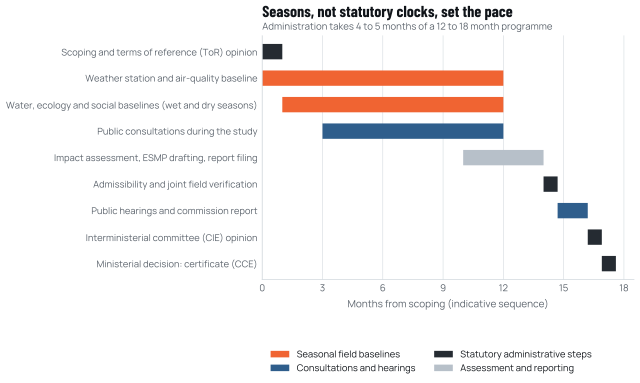
Source: Décret 2013/0171/PM [L02]; MINEPDED procedure manual [L10]; Cameroon Steel indicative sequence.
The statutory clock looks fast. Ten plus twenty days for the terms of reference, then about twenty, thirty, twenty and twenty days after filing, add up to about four to five months of administrative time. The ministry’s manual cites 120 days from filing to decision for non-petroleum sectors [L10]. In practice, field baselines set the timetable. Air quality and meteorology need at least a full year. Ecological surveys must cover both wet and dry seasons. Public consultations need time to be meaningful. A realistic programme runs 12 to 18 months from filing the terms of reference to the certificate (Figure 2.1). Any schedule that compresses this into a few months either skips the seasons or skips the people. We will not do either.
2.4 A classified establishment, with a hazard study and an emergency plan
The environmental certificate is necessary but not sufficient. Loi n° 98/015 of 14 July 1998 on classified establishments, and its implementing Décret n° 99/818/PM of 9 November 1999, create a separate authorisation track run by the ministry in charge of mines and industry (MINMIDT) [L04]. A steelworks will almost certainly be a first-class establishment. The application must include the environmental study, a hazard study (étude des dangers) and an emergency plan (plan d’urgence), with maps at 1:50,000 and 1:10,000 [L04]. The process involves a 30-day public inquiry, a decision within one month (extendable to two) and an authorisation fee of 500,000 FCFA [L04]. Article 7 of the law requires a safety perimeter free of housing. Article 8 requires emissions self-monitoring, and the authorisation lapses after two years of non-use [L04].
For an EAF works, the hazard study should model the consequences of several major-accident scenarios:
- contact between molten metal and water, the classic cause of steam explosions in melt shops;
- releases from oxygen storage and supply;
- fuel gas or liquefied petroleum gas systems for ladle preheating and reheating furnaces;
- carbon-monoxide-rich off-gas;
- transformer fires.
The safety perimeter must then be reconciled with the zone’s land-use plan and with the nearest village, Boussibelika, which lies about 3 to 4 km away (Annex D, Table D.1). We intend to run the classified-establishment and environmental tracks in parallel. A hazard study prepared late, after the layout is frozen, can only add protective measures. A hazard study prepared early can move hazardous units away from people.
2.5 Pollution, water, waste, forest and labour permits
Several sector decrees add specific obligations (Table 2.2):
- Air. Décret n° 2011/2582/PM on atmospheric protection requires stationary sources to meet emission standards and to keep records for ten years. Its article 9(2) provides for sector limits by ministerial order, and its annex names iron and steel production [L05]. We did not find the steel-sector order in force.
- Noise and odours. Décret n° 2011/2583/PM contains no numeric decibel limits and leaves them to the national standards body [L05].
- Discharges. Décret n° 2011/2585/PM requires prior authorisation to discharge metals such as iron, zinc, chromium, nickel, lead and cadmium. It also requires monthly sampling by an approved laboratory [L05].
- Waste. Décret n° 2012/2809/PM and its implementing orders restrict industrial hazardous waste to approved operators. They require an environmental permit, a tracking manifest and a generator’s register [L06].
- Water. Loi n° 98/005 prohibits polluting discharges to surface water, groundwater and the sea without authorisation, and requires new installations to meet discharge norms from start-up [L07]. Industrial abstraction needs prior authorisation after a 30-day public inquiry, valid for five years and renewable. Discharge authorisations are granted for at most five years [L07].
- Forests. The new forest and wildlife law, Loi n° 2024/008, governs clearing and the salvage of timber [L15].
- Labour. The Labour Code requires occupational health and safety measures and a company medical service [L17].
Table 2.2 Indicative permits and approvals for the steel complex
| Permit or approval | Authority | Legal basis | What triggers it |
|---|---|---|---|
| ToR approval and Certificate of Environmental Compliance | MINEPDED, after CIE opinion | Loi 96/12; Décret 2013/0171/PM; Arrêté 00001/2016 | The whole works and listed associated facilities |
| First-class classified-establishment authorisation | MINMIDT | Loi 98/015; Décret 99/818/PM | Melt shop, gas and oxygen storage |
| Authorisation to occupy and develop the port domain | PAK and KPIZ | Décret 2020/251 (art. 11) and occupation conditions | Land occupation and works in the port domain |
| Water abstraction and discharge authorisations | Ministry of Water and Energy (MINEE), with MINEPDED opinion | Loi 98/005; Décrets 2001/164 and 2001/165; Décret 2011/2585/PM | Boreholes or surface intake; any treated-water outfall |
| Environmental permit for hazardous waste | MINEPDED | Décret 2012/2809/PM; Arrêtés 001 and 002/MINEPDED of 2012 | EAF dust, oily wastes, sludges |
| Clearing and timber salvage | Ministry of Forests and Wildlife (MINFOF) | Loi 2024/008 | Clearing of vegetation |
| Building permits | Kribi urban council | Urban planning law | Buildings |
| Grid connection and any captive power above 10 MW | MINEE and the electricity regulator | Electricity law; Arrêté 00001/2016 | Substation connection; any on-site generation |
Source: legal texts as cited [L02][L03][L04][L05][L06][L07][L15][L19]. Indicative list, to be confirmed with each authority during scoping.
2.6 Where national standards are silent, we apply the stricter international value
Two gaps stand out. First, no national numeric emission limits for steelmaking, and no adopted national ambient air quality standard, were found in force [L05][L13]. A 2008 ministerial document on environmental norms for industrial installations is widely cited in Cameroonian studies, but we could not obtain a primary copy, so we do not quote its values. Second, national land law compensates customary occupants without title only for their improvements, not for the land. It uses crop rates fixed in 2003 and contains no explicit requirement to restore livelihoods [L08][L09]. Both gaps are well known to lenders, and both have a well-known remedy.
For every parameter, Cameroon Steel will apply the more stringent of the national requirement and the relevant international value: the World Bank Group EHS Guidelines, the WHO 2021 air quality guidelines, and, for EAF emissions, the levels associated with best available techniques in the European Union. We will ask MINEPDED to write these values into the certificate’s conditions, so that they bind us in law and not only by contract. For land and livelihoods, we will apply IFC Performance Standard 5 where it goes beyond national law (Chapter 8).
The port domain adds a further layer. Under Décret n° 2020/251, every private activity inside the port’s area of jurisdiction requires the port authority’s authorisation [L19]. The port authority has stated that it monitors health, safety and environmental performance on occupied sites [K24]. The 2013 law on economic zones obliges enterprises admitted to a zone to protect the environment [L20]. Our assessment will be shared with the port and zone authorities so that their own conditions, and ours, point in the same direction.
2.7 A realistic timetable, and why it serves everyone
Early assessment costs time at the start and saves it later. Three features of the national procedure reward early starts:
- the certificate’s three-year validity;
- the 30-day notice for consultations;
- the requirement that the hazard study accompany the classified-establishment application.
Starting the twelve-month air and weather monitoring immediately puts the critical path in the field, where it belongs, rather than in review. Filing a complete study, with seasonal data and signed minutes, avoids repeated requests for information. Running the environmental and classified-establishment tracks together lets one layout answer both. Chapter 10 sets out the sequence we intend to follow. Chapter 11 lists the information we still need from public authorities to complete it.
Sources cited in this chapter
Bracketed markers refer to these sources; the full list is in the annex. Full list of sources
- L01Loi n° 96/12 portant loi-cadre relative à la gestion de l’environnement. Presidency of the Republic (FAOLEX copy), 5 Aug 1996.faolex.fao.org/docs/pdf/cmr19578.pdf
- L14National consultations advance revision of Cameroon’s framework environmental law. UNEP Law and Environment Assistance Platform, Sep 2024.leap.unep.org/en/about/news/national-consultations-advance-revision-ca…
- L13Rapport d’évaluation du Système de Gestion Environnementale et Sociale (SGES) du Cameroun. African Development Bank (published by MINFI), Jul 2026.minfi.gov.cm/wp-content/uploads/2026/08/Rapport-Evaluation-SGES_GPD-Du…
- L03Arrêté n° 00001/MINEPDED fixant les catégories d’opérations soumises à une évaluation environnementale stratégique ou à une étude d’impact environnemental et social. MINEPDED (FAOLEX copy), 8 Feb 2016.faolex.fao.org/docs/pdf/cmr172054.pdf
- L02Décret n° 2013/0171/PM fixant les modalités de réalisation des études d’impact environnemental et social. Prime Minister (FAOLEX copy), 14 Feb 2013.faolex.fao.org/docs/pdf/cmr179401.pdf
- L11Arrêté n° 00004/MINEP fixant les conditions d’agrément des bureaux d’études. MINEP, 3 Jul 2007.minepded.gov.cm/wp-content/uploads/2021/09/Arrêté-n°00004-MINEP-du-03-…
- L10Manuel de procédure générale des études d’impact et audits environnementaux. MINEPDED, n.d..minepded.gov.cm/wp-content/uploads/2021/09/Manuel-de-procédure-général…
- L12Arrêté n° 0010/MINEP portant organisation et fonctionnement des comités départementaux de suivi de la mise en œuvre des PGES. MINEP, 3 Apr 2013.minepded.gov.cm/wp-content/uploads/2021/09/Arrêté-n°0010-MINEP-du-03-a…
- L04Loi n° 98/015 relative aux établissements classés dangereux, insalubres ou incommodes; Décret n° 99/818/PM fixant les modalités d’implantation et d’exploitation. Presidency; Prime Minister (FAOLEX copies), 14 Jul 1998; 9 Nov 1999.faolex.fao.org/docs/pdf/cmr141675.pdf
- L05Décrets n° 2011/2582/PM (atmosphere), 2011/2583/PM (noise and odours), 2011/2584/PM (soils) and 2011/2585/PM (discharges). Prime Minister (FAOLEX copies), 23 Aug 2011.faolex.fao.org/docs/pdf/cmr195746.pdf
- L06Décret n° 2012/2809/PM fixant les conditions de tri, collecte, stockage, transport, récupération, recyclage, traitement et élimination finale des déchets; Arrêtés n° 001 and 002/MINEPDED. Prime Minister; MINEPDED, 26 Sep 2012; 15 Oct 2012.faolex.fao.org/docs/pdf/cmr195749.pdf
- L07Loi n° 98/005 portant régime de l’eau; Décrets n° 2001/164/PM and 2001/165/PM. Presidency; Prime Minister (FAOLEX copies), 14 Apr 1998; 8 May 2001.faolex.fao.org/docs/pdf/cmr33974.pdf
- L15Loi n° 2024/008 portant régime des forêts et de la faune. Presidency of the Republic, 24 Jul 2024.prc.cm/fr/actualites/actes/lois/7298-loi-n-2024-008-du-24-juillet-2024…
- L17Loi n° 92/007 portant Code du travail. Presidency (FAOLEX copy), 14 Aug 1992.faolex.fao.org/docs/pdf/cmr198304.pdf
- L19Décret n° 2020/251 portant réorganisation et fonctionnement du Port Autonome de Kribi. Presidency of the Republic (copy published by the Port Autonome de Kribi), 5 May 2020.Cited by title and date
- L08Loi n° 85/09 relative à l’expropriation pour cause d’utilité publique et aux modalités d’indemnisation. Presidency (FAOLEX copy), 4 Jul 1985.faolex.fao.org/docs/pdf/cmr1474.pdf
- L09Nachtigal Hydropower Project, ESIA update, legal and institutional chapter (Décret n° 2003/418/PM crop rates; building valuation). AECOM and Sogreah (European Investment Bank register), Sep 2011.eib.org/attachments/registers/86536111.pdf
- K24Visites des projets et autorisations d’occupation temporaire: le PAK au cœur du développement industriel (acronym in the original title expanded). Port Autonome de Kribi, 28 Aug 2025.Cited by title and date
- L20Loi n° 2013/011 régissant les zones économiques au Cameroun. Presidency (FAOLEX copy), 16 Dec 2013.faolex.fao.org/docs/pdf/cmr141879.pdf
Cite this chapter
Cameroon Steel (2026). Building responsibly in Kribi: a steelworks can meet international standards on four conditions. White paper 07, chapter 2: The regulatory path: Cameroonian law already requires a detailed, public assessment. CS-WP-07. https://www.cameroon-steel.com/en/library/responsible-kribi/regulatory-path/
Source