White paper 07 · Chapter 9
Lessons from Kribi’s port and other heavy industry: problems usually came from timing, and transparency usually helped
Kribi has fifteen years of experience with large-scale industrial development. A declaration of public utility came in 2009, followed by compensation under a decree of 2010. A port was built that has reshaped the shoreline, a marine park was created after it, and an industrial zone was launched in 2026. Elsewhere in Cameroon, the Chad to Cameroon oil pipeline, the Kribi gas power plant and the Nachtigal hydropower project offer further lessons. Read neutrally, the record shows four recurring weaknesses:
In this chapter (8)
- 9.1 Fifteen years of change at Kribi
- 9.2 Land and compensation: what the record shows
- 9.3 The coast: an unintended consequence
- 9.4 Conservation designed without people
- 9.5 Informal users fall through the gaps
- 9.6 What disclosure added at the Kribi gas power plant
- 9.7 What modern EAF plants show
- 9.8 Cumulative effects need a shared table
- land and livelihood questions that outlive the projects that raised them;
- informal resource users, such as fishers, sand miners and hunter-gatherers, who fall between compensation categories;
- cumulative effects that no single project owns;
- plans that were not published or monitored independently.
The record also shows what works: early, measured baselines, public disclosure and independent oversight. This chapter draws those lessons together and states what we will do differently because of them.
9.1 Fifteen years of change at Kribi
The deep-water port changed the scale of everything around it. The State declared the port of public utility in February 2009 and set the compensation framework in November 2010 [H03]. The first container terminal opened in 2018. A second container terminal began operating on 9 May 2025 [K07]. Traffic through the port rose from about 7 Mt in 2018 to 10.84 Mt in 2024 and 12.7 Mt in 2025, according to the port authority [K08][K09]. Meanwhile, the land reserve was formalised: the 2023 decree delimited a public port domain of about 15,000 ha within the larger industrial-port complex [K05]. In February 2026, KPIZ was launched to develop an integrated zone of about 4,000 ha over 15 years, with a target of up to 150,000 direct and indirect jobs [K02]. Demand for land is strong. By mid-2025 the port authority had received about 150 requests for space covering 3,883 ha, and had granted 48 occupation authorisations covering 196 ha [K25].
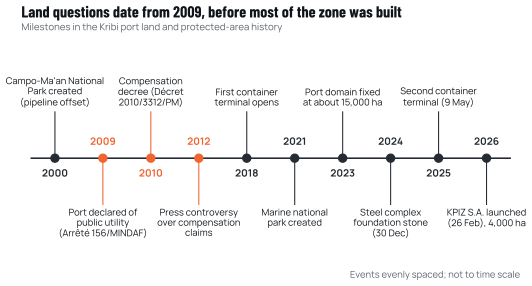
Source: Décret 2000/004/PM [B02]; Arrêté 156/MINDAF and Décret 2010/3312/PM as cited in [H03]; Décret 2021/4804/PM [B01]; PAK [K05]; Cameroon Tribune [X01]; Business in Cameroon [K07]; KPIZ launch [K02].
Table 9.1 Key figures of the Kribi industrial-port complex
| Indicator | Value | Date | Source |
|---|---|---|---|
| Industrial-port complex (original land reserve) | About 26,000 to 26,300 ha, along about 30 km of coast | 2018 to 2023 | [K05][K06] |
| Public port domain (presidential decree) | About 15,000 ha | 23 June 2023 | [K05] |
| Integrated industrial zone managed by KPIZ | About 4,000 ha, developed over 15 years | Launched 26 February 2026 | [K02][K03] |
| Planned investment in the industrial zone | €795 million, of which €400 million in phase 1 | February 2026 | [K03] |
| Port traffic | 7 Mt (2018); 10.84 Mt (2024); 12.7 Mt (2025) | 2018 to 2025 | [K08][K09] |
| Requests for space and authorisations granted | About 150 requests for 3,883 ha; 48 authorisations for 196 ha | Mid-2025 | [K25] |
| Job target of the industrial zone | Up to 150,000 direct and indirect jobs | 15-year horizon | [K02] |
| Kribi population (press estimate) | About 90,000; projected 300,000 by 2040 | 2024 | [E13] |
Source: as cited in the table. Port authority documents are cited by title and date.
These numbers describe a coast in rapid transition. Whatever a steelworks does, it does so in a landscape where land, labour, traffic and coastal processes are already changing quickly. That has two implications. The project’s own effects must be separated carefully from the background trend, or the project will be blamed for everything or for nothing. And the project has an interest in helping to manage the trend, because its own social licence depends on it.
9.2 Land and compensation: what the record shows
The land for the port and its industrial hinterland was acquired under national law. Compensation was paid at official rates: 2,000 FCFA per square metre for titled land and 1,500 FCFA for land being registered. Crops, buildings and graves were compensated according to official schedules. By 2015, land compensation was reported to be about 90% complete, and compensation for crops, buildings and graves complete [H03]. The process later attracted public controversy, reported in the national press, over the eligibility of some claimants. We have not verified those reports and do not repeat their figures.
Three lessons follow, and none of them requires taking sides on contested facts.
Compensation at official rates can leave gaps. National law compensates customary occupants without title only for their improvements, and uses crop rates fixed in 2003 [L08][L09]. People who lose access to land they farmed under custom may receive little, even when every legal step is followed. This is why IFC Performance Standard 5 requires replacement cost and livelihood restoration [G01], and why we will review the legacy of the land we occupy (Chapter 8).
Records matter as much as payments. When it is unclear who was compensated, for what and on what basis, grievances persist for years. A project that arrives later inherits them unless it can show, from the records, what happened. Our legacy review will start with the 2009 and 2010 files, and we will ask the port authority to share them.
Grievances do not expire. A complaint about land taken in 2010 is as real to the person making it in 2027 as it was then. Our grievance mechanism will accept legacy complaints related to the land we occupy, refer them to the competent authority where they fall outside our responsibility, and track them to an answer.
We do not need to resolve past controversies to learn from them. We need the records, a census of who uses the land today, a grievance mechanism that accepts old complaints, and the willingness to address gaps against PS5 with the State and the port authority. All four are commitments in Chapter 8.
9.3 The coast: an unintended consequence
The port’s breakwater and quays changed the movement of sand along the coast. Before 2000 the Kribi coastline was accreting slowly. Since then it has retreated, by about 2 m a year on average between 2015 and 2020, with much faster local rates near the Lobé falls and Lolabé (Chapter 1) [E02]. A 2025 study rates more than two thirds of the 31.5 km Kribi coast as highly vulnerable, and links this to sediment trapping by the breakwater [E03]. A turtle specialist reports about 15 m of retreat in places at Ebodjé [B05]. The port authority has supported turtle conservation at Ebodjé through its social programme [B07], and has stated that it installed monitoring equipment, though it has not published the data [E13].
The lesson is not that the port should not have been built. The sediment budget of a sandy coast with strong longshore drift is complex, and its response to large structures can only be predicted by measurement and modelling over years. Coastal effects need long, measured baselines and continued monitoring that others can see. They also need management at the scale of the coast rather than the project. For a steelworks on the plateau, the practical lesson is to add nothing to the coast: no jetty, intake or outfall of our own (Chapter 1). The port’s existing and planned terminals serve our logistics, and we support coast-wide monitoring.
9.4 Conservation designed without people
The Chad to Cameroon oil pipeline ends at Kribi. Its environmental and social programme included an Indigenous Peoples Plan for the Bagyeli and Bakola communities along its route. As an offset, it also funded the creation of Campo-Ma’an National Park and a foundation, the Fondation pour l’Environnement et le Développement au Cameroun (FEDEC), to fund the plan and the parks [H06]. On paper, this was ambitious practice for its time. In the field, participatory mapping by Bagyeli communities in 2003 and 2004 found that up to 85% of one community’s livelihood activities took place inside the new park. The Indigenous Peoples Plan was still unpublished and described as a work in progress years later [H06]. More recently, press reporting has said that the marine national park was created without prior community consultation [B05].
The lesson is that conservation and Indigenous Peoples’ rights must be designed together, and with the people concerned. A biodiversity contribution that restricts access to land used for hunting and gathering is a resettlement impact by another name. It requires consent where Performance Standard 7 applies [G01]. Our commitment in Chapter 7, that no conservation measure we support will restrict Bagyeli access without their consent, follows directly from this history.
9.5 Informal users fall through the gaps
The Nachtigal hydropower project on the Sanaga, 420 MW and in operation since 2025, is one of Cameroon’s largest internationally financed projects, prepared under lender standards. It, too, shows how informal livelihoods can fall between categories. Sand miners and fishers who lost access to their workplaces received compensation. Their representatives later described it as inadequate. They filed complaints with the project’s lenders in 2022, and a mediation process concluded in May 2024 [H08]. Sand miners received 6.6 million FCFA for six months of compensation, according to their representative, who said that promised livelihood restoration had not yet materialised [H08]. Closer to Kribi, civil-society organisations have raised concerns about displacement at Lolabé in connection with the planned Lobé iron ore project [H09].
Fishers, sand miners, gatherers of forest products and hunter-gatherers do not own the river bank, the beach or the forest they work. Their losses are real but hard to see on a cadastral plan. The lesson is to identify them early, in the census and in specialised studies, and to design livelihood restoration with them rather than for them. Restoration should be measured by household income and not by cheques issued, and grievances should be resolved before they need outside mediation. In Kribi, the groups most at risk are artisanal fishers and fish processors, sand extractors along the streams and coast, and Bagyeli communities.
9.6 What disclosure added at the Kribi gas power plant
The 216 MW Kribi gas power plant was financed with support from the IFC and MIGA. Its environmental study produced the only measured air quality data we could find for the Kribi area: diffusion-tube measurements of sulphur dioxide and ozone in 2006 [E06]. The lenders’ review summaries are public [E15][E16]. MIGA reported in 2014 that monitoring in 2012 complied with the applicable guidelines, but did not publish the measurements [E16].
That is better than nothing, and it is the reason we have any baseline at all. It also shows the limit of disclosure without data. A statement that monitoring "complied" cannot be checked, compared or reused. Had the monitoring data been published, they would now form a ten-year record of air quality on the Kribi coast, valuable to every project that followed. We will publish our monitoring data, not just our conclusions (Chapter 10).
9.7 What modern EAF plants show
Two disclosures by the IFC show what EAF plants achieve under lender supervision. The first is a 2010 review of an Egyptian steelmaker’s expansion with direct reduction, EAFs and a hot strip mill. It records baghouse dedusting, the crushing and sale of slag to the construction industry, and large-scale recycling of process water [T09]. The second is a 2026 review of a Malaysian EAF rebar works with 600,000 t a year of steelmaking capacity. It records dust held at or below 30 mg/Nm³, recovery of EAF dust for zinc, sale of slag, about 80% water recycling, and grievance and engagement plans with deadlines [T08]. Neither plant is a perfect model for Kribi. Both confirm that the techniques described in Chapters 4 to 6 are proven, affordable and expected.
9.8 Cumulative effects need a shared table
The most important lesson is also the hardest. The pressures on the Kribi coast come from many projects, each assessed on its own. They include:
- the port’s existing and planned phases, among them a mineral terminal of 125 Mt a year, for which a memorandum of understanding was signed on 4 November 2025 and which the port’s Director General expects to be completed within five to six years [K19][K02];
- new railways, including a memorandum of understanding signed in June 2026 for an Édéa to Kribi, Lolabé and Campo line [K20], and the agreements for a railway from the Mbalam iron ore deposit to Kribi [K21];
- the planned Lobé iron ore project [H09];
- cement plants and quarries;
- the gas power plant;
- the build-out of the industrial zone itself.
Each may be acceptable alone. Together they determine the airshed, the sediment budget, traffic on the N7, in-migration and hunting pressure on Campo-Ma’an.
Table 9.2 Lessons from the record and Cameroon Steel’s response
| Lesson | Evidence | Our response |
|---|---|---|
| Land and livelihood questions outlive projects | Compensation completed at official rates; later public controversy; national law gaps against PS5 | Land legacy review before clearing; legacy grievances accepted and tracked; PS5 gap measures if needed |
| Informal users fall between categories | Nachtigal sand miners and fishers; Lolabé displacement concerns | Early identification of fishers, sand extractors, gatherers and Bagyeli users; livelihood restoration measured by income |
| Conservation without people harms both | Campo-Ma’an offset over Bagyeli lands; marine park created without prior consultation | Biodiversity contribution co-designed with communities; FPIC before any restriction of access |
| Coastal effects need long baselines | Shoreline switched from accretion to retreat after the breakwater | No coastal structures of our own; support for coast-wide monitoring |
| Disclosure without data cannot be checked | Gas plant monitoring reported as compliant without figures | Publication of monitoring data online, not only conclusions |
| Cumulative effects belong to no one | Many projects in one landscape, each assessed alone | Proposal for a zone-wide cumulative assessment and monitoring forum, with our data and a share of the cost |
Source: as cited in the text [H03][H06][H08][H09][E02][E16][B05]; Cameroon Steel commitments (planned).
Decree n° 2013/0171/PM and the 2016 order already provide a vehicle for this. A strategic environmental assessment is required for industrial zones and industrial-port complexes [L03]. We will support an assessment at that scale, in which the port and zone authorities, MINEPDED, tenants, communities and the conservation authorities agree on shared baselines, thresholds and monitoring. We will offer our own baseline data to it from the start. We will propose that the zone’s tenants co-fund shared monitoring stations for air, water and the coast, with results published in one place. A steelworks cannot solve Kribi’s cumulative pressures. It can refuse to add to them unknowingly, and it can help build the institutions that manage them.
Sources cited in this chapter
Bracketed markers refer to these sources; the full list is in the annex. Full list of sources
- H03Le port de Kribi: force ou menace pour la proposition d’inscription des chutes de la Lobé sur la liste du patrimoine mondial (academic thesis). Memoire Online, 2021.memoireonline.com/12/21/12599/m_Le-port-de-Kribi-Force-ou-menace-pour-…
- K07Cameroon’s Kribi port triples capacity with launch of second container terminal. Business in Cameroon, May 2025.businessincameroon.com/infrastructures/1205-14650-cameroon-s-kribi-por…
- K08Port de Kribi: la performance au service de la Nation (op-ed by the Director General of the port). Port Autonome de Kribi, 21 Apr 2026.Cited by title and date
- K09Bilan et perspectives: les voyants sont au vert. Port Autonome de Kribi, 13 Mar 2025.Cited by title and date
- K05Le PAK tient enfin son titre foncier (presidential decree of 23 June 2023 on the port domain). Port Autonome de Kribi, 26 Jun 2023.Cited by title and date
- K02Zone industrialo-portuaire de Kribi (KPIZ): jusqu’à +8 points de croissance et 150 000 emplois attendus sur 15 ans. Investir au Cameroun, 4 Mar 2026.investiraucameroun.com/gestion-publique/0403-23163-zone-industrialo-po…
- K25Avis à manifestation d’intérêt n° 013/AMI/PAK/2026 (statistics on requests for space and authorisations granted). Agence de Régulation des Marchés Publics (ARMP), 30 Jan 2026.armp.cm/details?type_publication=AMI&id_publication=6073
- B02Décret n° 2000/004/PM portant création du Parc National de Campo-Ma’an. Prime Minister (FAOLEX copy), 6 Jan 2000.faolex.fao.org/docs/pdf/cmr26727.pdf
- B01Décret n° 2021/4804/PM portant création du Parc National Marin Manyange na Elombo-Campo. Prime Minister (FAOLEX copy), 9 Jul 2021.faolex.fao.org/docs/pdf/cmr220623.pdf
- X01Kribi: le Premier ministre, chef du gouvernement est là (foundation stone of the Kribi steel complex). Cameroon Tribune, 30 Dec 2024.cameroon-tribune.cm/article.html/68499/fr.html/details_2
- K06Présentation du Port Autonome de Kribi (brochure). Port Autonome de Kribi, Oct 2018.Cited by title and date
- K03Cameroon launches $860m Kribi industrial zone to process raw materials locally; PAK, AGL, Arise IIP and Belmont launch €795m Kribi Port Industrial Zone. Ecofin Agency; Business in Cameroon, 27 Feb 2026.ecofinagency.com/news/2702-53326-cameroon-launches-860m-kribi-industri…
- E13As a megaport rises in Cameroon, a delicate coastal ecosystem ebbs (E. Toto). Mongabay (secondary source), 5 Apr 2024.news.mongabay.com/2024/04/as-a-megaport-rises-in-cameroon-a-delicate-c…
- L08Loi n° 85/09 relative à l’expropriation pour cause d’utilité publique et aux modalités d’indemnisation. Presidency (FAOLEX copy), 4 Jul 1985.faolex.fao.org/docs/pdf/cmr1474.pdf
- L09Nachtigal Hydropower Project, ESIA update, legal and institutional chapter (Décret n° 2003/418/PM crop rates; building valuation). AECOM and Sogreah (European Investment Bank register), Sep 2011.eib.org/attachments/registers/86536111.pdf
- G01Performance Standards on Environmental and Social Sustainability. International Finance Corporation, 1 Jan 2012.ifc.org/en/insights-reports/2012/ifc-performance-standards
- E02Weakening of coastlines and coastal erosion in the Gulf of Guinea: the case of the Kribi coastline in Cameroon (Fendoung, Tchindjang and Hubert-Ferrari), Land 11:1557. MDPI, 2022.doi.org/10.3390/land11091557
- E03Geomatics-based assessment of coastal vulnerability in Kribi (Perabi et al.), Urban Resilience and Sustainability 3(4). AIMS Press, Nov 2025.aimspress.com/aimspress-data/urs/2025/4/PDF/urs-03-04-012.pdf
- B05Unchecked development threatens Cameroon’s Manyange Na Elombo-Campo marine park (L. Bongben). Global Voices (secondary source), 22 Nov 2025.globalvoices.org/2025/11/22/unchecked-development-threatens-cameroons-…
- B07Protecting biodiversity: the Port Authority of Kribi supports turtle conservation in Ebodje. Port Autonome de Kribi, 16 Mar 2023.Cited by title and date
- H06Pipelines, parks, and people: Bagyeli document land use near Campo Ma’an National Park (J. Nelson and B. Tchoumba), Cultural Survival Quarterly 28-1. Cultural Survival, 2004 (web edition 7 May 2010).culturalsurvival.org/publications/cultural-survival-quarterly/pipeline…
- H08Cameroon inaugurates controversial dam despite local dissent (Y. Kenné). Mongabay (secondary source), 10 Oct 2025.news.mongabay.com/2025/10/cameroon-inaugurates-controversial-dam-despi…
- H09Cameroon: Lobé-Kribi iron ore project poses social and environmental challenges, warns NGO (title shortened). Business and Human Rights Resource Centre, Feb and Dec 2025.business-humanrights.org/en/latest-news/cameroon-lob%C3%A9-kribi-iron-…
- E06Kribi Power Project, Environmental and Social Impact Assessment Addendum (gas reciprocating engines). Scott Wilson for AES SONEL (World Bank disclosure), Oct 2007.documents1.worldbank.org/curated/en/760181468239362187/txt/E18210v120E…
- E15Environmental and Social Review Summary 25978, Kribi (gas-fired power plant). International Finance Corporation, 2010.disclosures.ifc.org/project-detail/ESRS/25978/kribi
- E16Kribi Power Development Corporation, Environmental and Social Review Summary. Multilateral Investment Guarantee Agency, 2014.miga.org/project/kribi-power-development-corporation
- T09Environmental and Social Review Summary 8638, Alexandria National Iron and Steel (flat steel production). International Finance Corporation, 5 Feb 2010 (updated 30 Sep 2022).disclosures.ifc.org/project-detail/ESRS/8638/alexandria-national-iron-…
- T08Environmental and Social Review Summary 51259, Esteel Loan (EAF steel and rebar works, Malaysia). International Finance Corporation, 6 Jan 2026.disclosures.ifc.org/project-detail/ESRS/51259/esteel-loan
- K19Kribi Deep Sea Port, investors partner to construct 125-million-tonne mineral terminal worth $2 billion. Business in Cameroon, 5 Nov 2025.businessincameroon.com/transport/0511-15300-kribi-deep-sea-port-invest…
- K20Ligne ferroviaire Édéa, Kribi, Lolabé, Campo: une nouvelle étape pour la connectivité du Port de Kribi. Port Autonome de Kribi, 4 Jun 2026.Cited by title and date
- K21Chemin de fer Mbalam-Kribi et terminal minéralier: un tournant pour l’intégration régionale. Port Autonome de Kribi, 25 Feb 2022.Cited by title and date
- L03Arrêté n° 00001/MINEPDED fixant les catégories d’opérations soumises à une évaluation environnementale stratégique ou à une étude d’impact environnemental et social. MINEPDED (FAOLEX copy), 8 Feb 2016.faolex.fao.org/docs/pdf/cmr172054.pdf
Cite this chapter
Cameroon Steel (2026). Building responsibly in Kribi: a steelworks can meet international standards on four conditions. White paper 07, chapter 9: Lessons from Kribi’s port and other heavy industry: problems usually came from timing, and transparency usually helped. CS-WP-07. https://www.cameroon-steel.com/en/library/responsible-kribi/lessons/
Source