White paper 07 · Chapter 10
Commitments and how to measure them: objectives that others can check
The previous chapters set out what Cameroon Steel intends to do. This chapter turns those intentions into a framework that others can verify. It has four parts: key performance indicators with stated objectives, a sequence of environmental and social workstreams that runs ahead of construction, a disclosure calendar, and independent monitoring. Everything here is a commitment or an objective for a plant that is not yet built. None of it describes performance already achieved. We will report against each item every year, including where we fall short and what we are doing about it.
In this chapter (8)
- 10.1 Five principles
- 10.2 A sequence that runs ahead of construction
- 10.3 Key performance indicators
- 10.4 What we will publish, and when
- 10.5 Independent monitoring and participation
- 10.6 Governance inside the company
- 10.7 What the first annual report will contain
- 10.8 What could go wrong, and how we will tell you
10.1 Five principles
Five principles run through the commitments in this paper. They are the test against which we invite readers to judge what follows.
- The stricter standard applies. For every parameter, we apply the more stringent of Cameroonian law and the relevant international value (Chapters 2 and 3).
- Measure before predicting. No impact will be predicted without measured, seasonal baseline data for the parameter concerned (Chapters 4 to 8 and 11).
- Publish data, not only conclusions. Monitoring results will be published in a form others can check, not summarised as "compliant" (Chapter 9).
- Verify independently. An independent environmental and social consultant and accredited laboratories will verify what we report. Communities will take part in monitoring.
- Correct and report. When an objective is missed, the corrective action, its owner and its deadline will be published, and tracked until closed.
10.2 A sequence that runs ahead of construction
The order of work matters as much as its content. Under Décret 2013/0171/PM, no works may begin before the environmental certificate is issued [L02]. Under the Performance Standards, engagement and grievance management must begin before field activities that could affect people [G01]. Figure 10.1 shows the indicative sequence we intend to follow, in months from the mobilisation of the environmental and social programme. It is a planning objective, not a commitment to dates. The timing of each step depends on the authorities’ review times, the seasons and what the surveys find. On the indicative calendar of Cameroon Steel’s reference configuration, the seasonal baselines run through 2027 and 2028, public hearings are targeted for the third quarter of 2028 and the certificate for the fourth quarter of 2028. Phase 1 works would start in the first quarter of 2029, after the certificate, with a first heat in the second half of 2030 and ramp-up through 2031 [X03]. These dates are targets, not commitments.
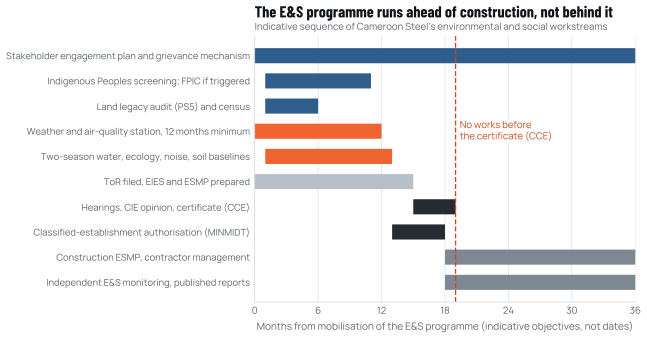
Source: Cameroon Steel objectives (planned); Décret 2013/0171/PM art. 3 [L02]; IFC PS1 [G01].
Three features of the sequence deserve emphasis.
Engagement comes first. The stakeholder engagement plan and the grievance mechanism open at month 0, before survey teams arrive in the villages. The Indigenous Peoples screening and the land legacy review start in the first month, because their findings can change the layout and the scope of everything else.
The long-lead baselines start immediately. The weather station and air quality monitors need a full year. The water, ecology and noise surveys need both seasons. Starting them at once puts the critical path in the field.
The two permitting tracks run together. The hazard study and emergency plan for the classified-establishment authorisation will be prepared alongside the environmental study, so that one layout answers both.
10.3 Key performance indicators
Table 10.1 sets out the indicators against which we will report, with an objective for each. The objectives draw on the chapters above. Where a value is still to be set from baseline data, the table says so rather than inventing a number. The assessment will confirm or tighten each objective. MINEPDED may make some of them conditions of the certificate, in which case they will bind us in law.
Table 10.1 Key performance indicators and objectives (planned; to be confirmed in the assessment)
| Domain | Indicator | Objective | Frequency of reporting |
|---|---|---|---|
| Air | Melt-shop stack dust (daily mean) | Below 5 mg/Nm³ on at least 95% of operating days | Daily online; annual summary |
| Air | PCDD/F at the melt-shop stack | Below 0.1 ng I-TEQ/Nm³ in every campaign | Each campaign (twice a year at first) |
| Air | Modelled and measured project contribution to PM2.5 at villages | Below 25% of the WHO 2021 annual guideline (1.25 µg/m³) | Annual |
| Noise | Night-time level at the nearest residential receptor | 45 dB(A), or no more than 3 dB above background | Quarterly in construction; half-yearly in operation |
| Water | Fresh-water make-up per tonne of product | About 2 m³/t (range 1.5 to 3.0), reported against design | Annual |
| Water | Process-water discharge in normal operation | None | Monthly |
| Water | Outfall samples within IFC effluent values | 100% | Monthly; continuous pH, temperature and flow |
| Residues | Share of slag and mill scale recovered as products | Objective to be set after the market study; reported from year 1 | Annual |
| Residues | EAF dust sent to a compliant, contracted outlet | 100%; no first heat without one | Quarterly |
| Climate | Scope 1 and 2 emissions, absolute and per tonne | Reported from year 1; decarbonisation pathway published within two years of start-up | Annual |
| Safety | Fatalities; lost-time injury frequency rate (employees and contractors) | Zero fatalities; frequency rate published with its trend | Quarterly |
| People | Cameroonian nationals in the operating workforce | About 90% (range 85 to 95%) by year 5 | Annual |
| People | Women in the workforce and in training programmes | Objective set after the baseline; reported from year 1 | Annual |
| People | Grievances acknowledged within 3 working days and answered within 30 days | At least 95% | Quarterly |
| Land | Land legacy review completed before clearing | Yes, published summary | Once, then follow-up |
| Indigenous Peoples | Screening completed; FPIC documented where triggered | Yes, before any affecting activity | On completion |
| Biodiversity | Clearing within the approved footprint; buffers intact | 100% | Half-yearly |
| Biodiversity | Breaches of the hunting and wildlife-trade code | Zero tolerance; every case reported | Quarterly |
| Community safety | Road incidents involving project vehicles and the public | Every incident investigated and reported | Quarterly |
Source: Chapters 2 to 9 of this paper; IFC EHS Guidelines [G03][G04]; WHO 2021 [G09]; EU BAT [G07]; Cameroon Steel planning basis [X03]. All values are objectives for a plant not yet built.
Three observations on the table. First, the safety objective is zero fatalities. Melt shops are among the most hazardous industrial workplaces. Molten metal, heavy lifting, rotating machinery and confined spaces leave no room for a lower ambition, and frequency rates must always be read alongside the absolute record. Second, the climate commitment is to measure and report from the first year, and to publish a pathway within two years. We do not set a reduction target before we have a measured baseline, because a target set without one would not be credible. Third, some objectives are blank by design. A target for women’s employment, or for the share of slag sold, set before the baseline would be a guess. We commit to setting these objectives publicly once the data exist.
10.4 What we will publish, and when
Disclosure is the commitment that makes all the others checkable. Table 10.2 sets out what we will publish and when. Documents will be published in French and English, with plain-language summaries. Summaries for affected communities will also be given orally, in local languages including Gyele.
Table 10.2 Disclosure calendar (planned)
| Document or data | When | Where and how |
|---|---|---|
| Stakeholder engagement plan; grievance mechanism procedures | Before field mobilisation | Online; posted in villages; explained at community meetings |
| Baseline monitoring data (air, weather, water) | Quarterly during the baseline programme | Online data files and plain-language summaries |
| Terms of reference approved by MINEPDED | On approval | Online |
| Environmental and social impact assessment, with non-technical summary | At filing, ahead of the public hearings | Online; copies in the commune and villages; hearings under Décret 2013/0171/PM |
| Environmental and social management plan and action plan | On issue of the certificate | Online |
| Land legacy review; resettlement or livelihood plan if required; Indigenous Peoples Plan if required | On completion; before implementation | Online and in the communities concerned, in appropriate languages |
| Grievance statistics | Quarterly | Online; community meetings |
| Half-yearly ESMP implementation reports to MINEPDED | Every six months, as required by law | Summaries online |
| Stack and ambient air data | Daily averages from start of operations | Online dashboard |
| Annual environmental, social and GHG report | Yearly from the first year of construction | Online; independent consultant’s opinion attached |
| Independent monitoring reports | Half-yearly during construction; yearly in operation | Online, with our responses |
Source: Décret 2013/0171/PM arts 20 to 30 [L02]; IFC PS1 [G01]; EP4 [G05]; AfDB ISS OS10 [G06]; Cameroon Steel commitments (planned).
10.5 Independent monitoring and participation
Self-reported data are necessary but not sufficient. Figure 10.2 shows how monitoring, verification and disclosure fit together.
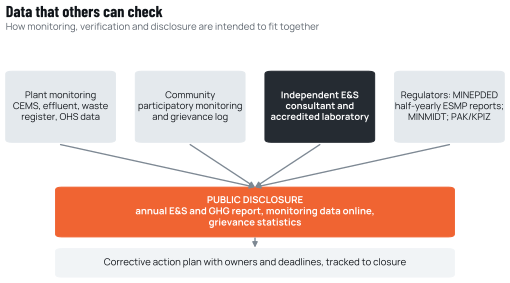
Source: Décret 2013/0171/PM arts 27 to 30 [L02]; Arrêté 0010/MINEP [L12]; IFC PS1 [G01]; EP4 [G05]; Cameroon Steel commitments (planned).
An independent environmental and social consultant will be appointed for construction and the first years of operation. The consultant will report half-yearly during construction and yearly thereafter. Its reports will be published with our responses. If lenders appoint their own independent consultant, as EP4 requires for Category A projects, we will publish that consultant’s summaries too, subject to the lenders’ agreement [G05].
Accredited laboratories will analyse stack, effluent, groundwater and residue samples. Where no accredited laboratory exists in Cameroon for a parameter, such as dioxins, samples will go to an accredited laboratory abroad, with chain-of-custody records.
Community participatory monitoring will give representatives of the neighbouring villages, chosen by them and including women and Bagyeli members, training and a role in sampling and observation. A community monitoring committee will meet quarterly with the plant’s environmental team and the independent consultant. It will receive the data and raise questions.
Regulators will receive the half-yearly reports required by law, and will have access to the site and to the data at any time. The departmental committees for monitoring environmental and social management plans, created in 2013, are the natural local forum [L12]. We will invite the port and zone authorities to the same meetings.
10.6 Governance inside the company
Commitments are only as strong as the internal governance behind them. Cameroon Steel will:
- adopt an environmental and social policy at board level, and review E&S performance at every board meeting;
- appoint a senior environmental and social manager reporting directly to the general management, with authority to stop work on safety or environmental grounds;
- ring-fence an environmental and social budget for the assessment, the baselines, the management plans and the community programmes, so that these are not traded off against schedule;
- write the relevant standards and objectives into every engineering, procurement and construction contract, with penalties and stop-work rights;
- link a share of managers’ performance assessment to environmental, social and safety indicators.
10.7 What the first annual report will contain
The first environmental, social and GHG report will cover the first full year of construction, not the first year of production. By then most of the risks described in this paper will either be under control or visibly not. It will report five things in a fixed format, so that later reports can be compared with it:
- Progress against the sequence in Figure 10.1: what was done, what slipped, and why.
- Every indicator in Table 10.1 that applies during construction, with the measured value, the objective and the trend. Indicators not yet applicable will be listed as such, not omitted.
- The grievance record: numbers received, categories, time to answer and outcomes, including complaints still open.
- Incidents: safety incidents, environmental incidents and community road incidents, with their investigations and corrective actions.
- The independent consultant’s opinion, published in full, with our response to each finding.
The report will be published in French and English, presented in the neighbouring villages and sent to MINEPDED, the port and zone authorities and any lenders.
10.8 What could go wrong, and how we will tell you
- Schedule pressure. The temptation to shorten baselines or consultations will be real. Our safeguard is the sequence in Figure 10.1 and the legal rule of no works before the certificate.
- The EAF dust outlet. A compliant recovery contract may be hard to secure for small volumes. Our safeguard is the rule of no first heat without one, with a permitted secure cell as fallback.
- Power. The low-carbon advantage of the EAF route depends on firm, hydro-dominated grid power. If supply requires fossil back-up, our emissions will rise, and we will report that openly.
- Influx and contractors. The largest social risks arise during construction and through contractors. Our safeguards are contract clauses, the independent consultant and the grievance mechanism.
- Missing data. Some of what we need, such as the zone’s strategic assessment and the 2009 to 2010 land records, is held by others. Chapter 11 lists these gaps and how we will close them.
The test of this paper is not what it promises but what can later be checked against it. We have tried to write each commitment so that a minister’s adviser, a lender’s officer, a journalist or a fisherman at Boussibelika can ask, in a year’s time, whether it was kept. We will publish the answer.
Sources cited in this chapter
Bracketed markers refer to these sources; the full list is in the annex. Full list of sources
- L02Décret n° 2013/0171/PM fixant les modalités de réalisation des études d’impact environnemental et social. Prime Minister (FAOLEX copy), 14 Feb 2013.faolex.fao.org/docs/pdf/cmr179401.pdf
- G01Performance Standards on Environmental and Social Sustainability. International Finance Corporation, 1 Jan 2012.ifc.org/en/insights-reports/2012/ifc-performance-standards
- X03Cameroon Steel reference configuration RC-1 (planning estimate): planned capacities, phases, indicative schedule and benchmark-based estimates, edition of 10 October 2026. Cameroon Steel, 10 Oct 2026.Cited by title and date
- G03Environmental, Health, and Safety Guidelines for Integrated Steel Mills. IFC / World Bank Group, 30 Apr 2007.ifc.org/content/dam/ifc/doc/2000/2007-integrated-steel-mills-ehs-guide…
- G04Environmental, Health, and Safety (General) Guidelines. IFC / World Bank Group, 30 Apr 2007.ifc.org/content/dam/ifc/doc/2000/2007-general-ehs-guidelines-en.pdf
- G09WHO global air quality guidelines: particulate matter (PM2.5 and PM10), ozone, nitrogen dioxide, sulfur dioxide and carbon monoxide. World Health Organization, 22 Sep 2021.who.int/publications/i/item/9789240034228
- G07Commission Implementing Decision 2012/135/EU establishing the best available techniques (BAT) conclusions for iron and steel production. European Commission, 28 Feb 2012.eur-lex.europa.eu/legal-content/EN/TXT/HTML/?uri=CELEX:32012D0135
- G05The Equator Principles EP4. Equator Principles Association, Jul 2020 (effective 1 Oct 2020).equator-principles.com/app/uploads/The-Equator-Principles_EP4_July2020…
- G06African Development Bank Group’s Integrated Safeguards System (2023). African Development Bank, 2023.afdb.org/en/documents/african-development-bank-groups-integrated-safeg…
- L12Arrêté n° 0010/MINEP portant organisation et fonctionnement des comités départementaux de suivi de la mise en œuvre des PGES. MINEP, 3 Apr 2013.minepded.gov.cm/wp-content/uploads/2021/09/Arrêté-n°0010-MINEP-du-03-a…
Cite this chapter
Cameroon Steel (2026). Building responsibly in Kribi: a steelworks can meet international standards on four conditions. White paper 07, chapter 10: Commitments and how to measure them: objectives that others can check. CS-WP-07. https://www.cameroon-steel.com/en/library/responsible-kribi/commitments/
Source