White paper 07 · Chapter 7
Biodiversity: critical habitat is unlikely on the site but present in the landscape, so the plan reaches beyond the fence
The steel site area is most likely modified or secondary natural habitat, within a farm and forest mosaic that the State declared for industry in 2009. Critical habitat, in the sense of IFC Performance Standard 6, is not expected on the site itself. It cannot be ruled out, though, until two seasons of surveys are complete: pangolins could use the site, and its small streams could hold freshwater fishes found nowhere else. Critical habitat is very likely present in the wider landscape. It includes the turtle beaches of the marine park, the coastal estuaries, and the great apes and elephants of Campo-Ma’an. The greatest risks to these come less from the plant’s footprint than from what it brings: more people, more traffic, more hunting and more pressure on the coast. We will apply the mitigation hierarchy strictly on the site. Beyond it, we plan a measurable contribution to conservation, designed with the conservation authorities and with the communities who live from these places.
In this chapter (6)
7.1 A landscape of global importance
The Kribi to Campo coast lies in the Lower Guinean, or Atlantic Biafran, coastal forest belt, one of the richest forest regions of Africa. Campo-Ma’an National Park was created by decree on 6 January 2000 and covers 264,064 ha of evergreen and mixed semi-deciduous forest, from mangroves and coastal forest near the sea to low hills of about 1,100 m [B02][B08]. It was created partly to offset the impacts of the Chad to Cameroon oil pipeline, and it is the core of a larger management unit in which forest concessions and plantations form a peripheral zone [B08]. It shelters several threatened species [B08][B10][B11]:
- the western lowland gorilla and the African forest elephant, both Critically Endangered;
- the central chimpanzee, which is Endangered;
- 302 recorded species of birds [B11], and important populations of more than 120 globally threatened species in all [B08].
The park was placed on Cameroon’s Tentative List of sites proposed for UNESCO World Heritage status in February 2018 [B11].
The sea is just as important. The Manyange na Elombo-Campo Marine National Park, created in 2021, covers 110,300 ha of ocean and coast, plus a 3,400 ha buffer zone. It runs south to the border with Equatorial Guinea and includes the mangroves of the Ntem estuary [B01]. Its beaches at Ebodjé and southwards are nesting sites for olive ridley and leatherback turtles. Juvenile green and hawksbill turtles forage along the coast [B06]. Farther north, the Douala-Edéa National Park protects mangroves, lowland forest and the African manatee [B03]. The coastal rivers, the Lobé, Lokoundjé, Nyong and Ntem, link forest and sea. Their estuaries are habitat for the manatee and nursery areas for fish.
7.2 Species of concern
Table 7.1 lists the threatened species most likely to occur in the project’s area of influence, with their global status on the Red List of the International Union for Conservation of Nature (IUCN). It is a screening list compiled from desk sources, not a survey result. Several statuses have changed recently. Green turtles, for example, were reassessed as Least Concern globally in October 2025, having previously been listed as Endangered [B10][B12]. Every status in the table was checked on the IUCN Red List (version 2026-1) on 10 October 2026 and will be checked again at the time of the assessment [B09][B10].
Table 7.1 Screening list of threatened species likely in the area of influence
| Species | Global status (IUCN) | Likely occurrence relative to the steel site area | Why it matters here |
|---|---|---|---|
| African forest elephant (Loxodonta cyclotis) | Critically Endangered (assessment published 2021) | Campo-Ma’an and adjacent forest blocks; unlikely on the site | Sensitive to forest fragmentation and induced access, for example along transport corridors |
| Western lowland gorilla (Gorilla gorilla gorilla) | Critically Endangered (2016, amended 2018) | Campo-Ma’an; possibly larger forest blocks inland | Vulnerable to hunting pressure from population influx |
| Central chimpanzee (Pan troglodytes troglodytes) | Endangered (2016) | Campo-Ma’an and forest mosaics | Bushmeat pressure |
| White-bellied and giant pangolins (Phataginus tricuspis, Smutsia gigantea) | Endangered (2019, both species) | Secondary forest and farm mosaic; could occur on the site | Trafficking; pre-clearance surveys and rescue needed |
| Grey parrot (Psittacus erithacus) | Endangered (2018) | Forest mosaic | Trade |
| African manatee (Trichechus senegalensis) | Vulnerable (2015) | Lower Lobé, Lokoundjé, Nyong and Ntem estuaries | Sensitive to river water quality and turbidity |
| Leatherback turtle (Dermochelys coriacea) | Vulnerable globally (2013); subpopulations assessed separately | Nests on the Ebodjé to Campo beaches | Sensitive to beach erosion, lighting and pollution |
| Olive ridley turtle (Lepidochelys olivacea) | Vulnerable (2008) | Main nesting species at Ebodjé | Same pressures as leatherback |
| Hawksbill turtle (Eretmochelys imbricata) | Critically Endangered (2008) | Juveniles forage along the coast | Coastal water quality |
| Green turtle (Chelonia mydas) | Least Concern globally (assessment published 2025; formerly Endangered) | Rare nester; juveniles forage | Some subpopulations remain of concern |
| Killifishes of coastal streams (Aphyosemion, Epiplatys spp.) | Several restricted-range species; species and statuses to be identified by survey | Could occur in the small streams draining the plateau | Possible critical habitat under criterion 2; need for a fish survey |
Source: IUCN Red List of Threatened Species, version 2026-1, accessed 10 October 2026, assessments listed in Annex C [B09][B10][B12]; Kew Tropical Important Plant Areas factsheet [B08]; Rufford Foundation project on Ebodjé turtle nesting [B06]. Years are those of the latest global assessment. Killifish species can only be identified by survey.
The last row is easy to overlook and may matter most for the site itself. Small coastal streams in this part of Cameroon are known for killifishes, tiny, colourful fishes, some of which occur in only a handful of streams. If a stream draining the steel site area held such a species, it could meet the IFC’s criterion for restricted-range species, even though the site itself is unremarkable. Only an ichthyological survey in high and low water can tell. Until it does, we treat the streams as potentially critical (Chapter 5).
7.3 Screening for critical habitat
IFC Performance Standard 6 defines critical habitat by five criteria [G01][G02]:
- habitat of significant importance to Critically Endangered or Endangered species;
- habitat of significant importance to endemic or restricted-range species;
- habitat supporting globally significant concentrations of migratory or congregatory species;
- highly threatened or unique ecosystems;
- areas associated with key evolutionary processes.
Guidance Note 6 sets numerical thresholds for the first three [G02]. For example, a site qualifies at the highest tier if it holds at least 10% of the global population of a Critically Endangered or Endangered species. It can also qualify if it supports the regular occurrence of a single individual of a Critically Endangered species. Where critical habitat exists, a project may proceed only if it causes no measurable adverse impact on the values that make it critical, causes no net reduction in the population of any Critically Endangered or Endangered species, and achieves a net gain [G01].
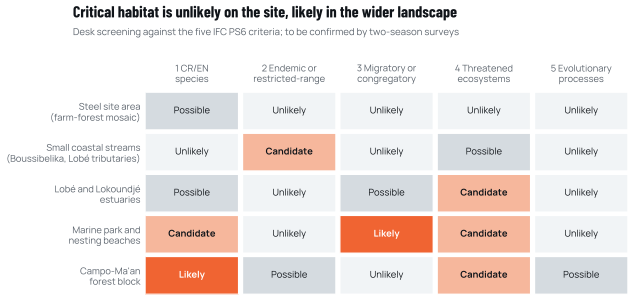
Source: IFC PS6 and Guidance Note 6 [G01][G02]; species information as in Table 7.1; Cameroon Steel desk screening. Qualitative screening, not a critical habitat assessment.
Our desk screening (Figure 7.1) suggests three conclusions.
The steel site area is unlikely to be critical habitat. It is a mosaic of secondary forest and farmland inside an industrial zone, not a refuge for a globally significant population. Endangered pangolins could use it, which makes criterion 1 "possible" rather than "unlikely". The surveys will settle the question.
The small streams are the main open question for the site. They are candidates under criterion 2 because of the possibility of restricted-range fishes.
The wider landscape almost certainly contains critical habitat. Campo-Ma’an qualifies through its Critically Endangered elephants and gorillas. The marine park’s nesting beaches are likely to qualify for their concentrations of migratory turtles. Mangroves and estuaries may qualify as threatened ecosystems.
The project will not occupy any of these areas. But it can affect them indirectly, and PS6 requires those effects to be assessed and managed with the same seriousness.
7.4 How a steelworks could affect a landscape it does not touch
The direct footprint is the least of the issues. Clearing the site will remove secondary forest and farm fallows, and with them the habitat of the animals that use them. That loss is real and must be minimised, restored where possible and, if it involves natural habitat, compensated. But it is bounded and predictable.
The indirect and induced pathways are larger and harder to control.
- Influx. A construction workforce of several hundred, plus the job seekers and traders a large project attracts, raises demand for bushmeat, timber, charcoal and land. Campo-Ma’an’s apes and elephants are threatened mainly by hunting, and hunting follows people and roads.
- Access. New roads, rail sidings and power lines open forest to hunters and settlers. Any corridor the project needs must be assessed for induced access, even if another party builds it.
- Water. Sediment and pollutants that reach the coastal streams flow on to the estuaries used by manatees and juvenile fish (Chapter 5).
- Coast and light. Turtles depend on beaches that are already retreating near the port, and are disoriented by artificial light (Chapter 1). Any coastal component, and lighting visible from the beaches, matters.
- Cumulative pressure. The port’s expansion, a planned mineral terminal, rail lines, other industries in the zone and an iron ore project on the Lobé all act on the same landscape. Press reports have flagged, for example, the risk of dust from the Lobé iron ore project reaching the river [B05]. No single project can manage these pressures alone (Chapter 9).
One lesson from Kribi’s own history shapes our approach to compensation. Campo-Ma’an National Park was created in 2000 partly as an environmental offset for the Chad to Cameroon oil pipeline, which ends at Kribi. Participatory mapping later found that much of the park covered land used by Bagyeli communities for hunting and gathering [H06]. Press reporting has also noted that the marine park was created without prior community consultation [B05]. Conservation that excludes the people who live from the land can harm them, and in the end the conservation itself. Any contribution we make beyond the fence will therefore be designed with the affected communities, including the Bagyeli, and with respect for their rights (Chapter 8).
7.5 The mitigation hierarchy, applied
The mitigation hierarchy orders the responses: avoid first, then minimise, then restore, and only then offset what remains [G01]. Figure 7.2 summarises how we will apply it. The discipline lies in the order. Offsets are not a substitute for avoidance, and a promise to compensate later does not justify a choice that could have been avoided now.
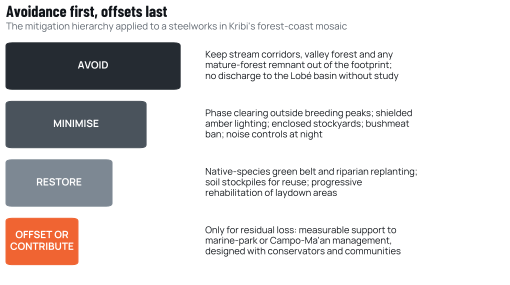
Source: IFC Performance Standards 1 and 6 [G01]; Guidance Note 6 [G02]; Cameroon Steel commitments (planned).
Avoid. The layout will be fitted to the land-cover map and stream survey, not the reverse. Stream corridors, wetlands and valley forest will be kept out of the footprint. Vegetated buffers of at least 30 m will run along watercourses, wider where surveys justify it. Any remnant of mature forest will be retained as part of the green belt. We plan no coastal infrastructure of our own and no discharge to the Lobé basin without study.
Minimise. Clearing will be phased, to keep exposed areas small, and timed to avoid peak breeding periods identified by the surveys. Before each clearing front advances, trained teams will survey it and move slow-moving animals such as pangolins and tortoises. A strict code of conduct will apply to the workforce and all contractors: no hunting, no purchase or transport of bushmeat or live wildlife, and dismissal for breaches. Camps will be provisioned so that workers have no reason to buy bushmeat. Speed limits will apply on all project roads, and lighting will be shielded and warm in spectrum.
Restore. Topsoil will be stored and reused. Laydown areas will be rehabilitated progressively. A native-species nursery will supply a green belt around the site and riparian replanting along the buffers. We will work with a local partner and prefer species chosen with communities for their usefulness as well as their ecology.
Offset or contribute. Residual loss of natural habitat will be quantified in the assessment and compensated so that there is no net loss. If any critical habitat is affected, the aim will be a net gain [G01]. Beyond these requirements, we intend to make a measurable contribution to the management of the wider landscape. Candidate fields include support to the marine park’s turtle monitoring with the Ebodjé community, anti-poaching and law enforcement around Campo-Ma’an, and protection of estuarine habitats. Contributions will be designed with the conservation authorities, the communities and specialist organisations, and will be reviewed by an independent biodiversity adviser.
7.6 From screening to a biodiversity action plan
The screening in this chapter is a starting point. The assessment will replace it with evidence in five steps.
- Land-cover mapping. A habitat map from very-high-resolution imagery and satellite classification, ground-truthed in the field, will distinguish modified from natural habitat on the site and around it.
- Two-season surveys. We will survey flora and vegetation plots, and mammals with camera traps (at least 20 units for 60 days per season), transects and interviews. Birds will be covered by point counts, reptiles and amphibians by searches, and fishes and invertebrates by survey in high and low water (Chapter 11).
- Critical habitat assessment. A formal assessment under Guidance Note 6 will use the survey data and a screening from the Integrated Biodiversity Assessment Tool (IBAT), and will define the ecologically appropriate area of analysis for each feature.
- Biodiversity action plan. The plan will set measurable objectives, actions, responsibilities, budgets and indicators for every residual impact, including the no-net-loss or net-gain accounting.
- Independent review and publication. An independent biodiversity specialist will review the action plan, and a summary will be published with the assessment.
Monitoring will continue for the life of the plant. The indicators will include:
- area cleared against plan;
- integrity of buffers;
- species occupancy from camera traps;
- fish and invertebrate indices in the receiving streams;
- wildlife incidents and code-of-conduct breaches;
- for the landscape contribution, the agreed indicators of the partner programmes, such as turtle nest counts recorded with the park authority.
Chapter 10 sets out how these indicators will be reported.
Two-season surveys before the layout is frozen, including a fish survey of every stream draining the site. A formal critical habitat assessment. No-net-loss accounting for natural habitat, and net gain if any critical habitat is affected. A workforce code with zero tolerance for hunting and wildlife trade. A contribution to conservation of the wider landscape, designed with communities and authorities, never at the expense of the rights of the people who live there.
Sources cited in this chapter
Bracketed markers refer to these sources; the full list is in the annex. Full list of sources
- B02Décret n° 2000/004/PM portant création du Parc National de Campo-Ma’an. Prime Minister (FAOLEX copy), 6 Jan 2000.faolex.fao.org/docs/pdf/cmr26727.pdf
- B08Campo Ma’an National Park, Tropical Important Plant Areas factsheet CMNTIPA025 (B. Murphy and J. M. Onana). Royal Botanic Gardens, Kew.tipas.kew.org/site/campo-maan-national-park/
- B10IUCN Red List assessments (version 2026-1): Gobush et al. 2021, Loxodonta cyclotis , e.T181007989A204404464; Maisels et al. 2018, Gorilla gorilla gorilla , e.T9406A136251508; Maisels et al. 2016, Pan troglodytes troglodytes , e.T15936A102332276; Pietersen et al. 2019, Phataginus tricuspis , e.T12767A123586469; Nixon et al. 2019, Smutsia gigantea , e.T12762A123584478; BirdLife International 2018, Psittacus erithacus , e.T22724813A129879439; Keith Diagne 2015, Trichechus senegalensis , e.T22104A97168578; Wallace et al. 2013, Dermochelys coriacea , e.T6494A43526147; Abreu-Grobois and Plotkin 2008, Lepidochelys olivacea , e.T11534A3292503; Mortimer and Donnelly 2008, Eretmochelys imbricata , e.T8005A12881238; Wallace and Broderick 2025, Chelonia mydas , e.T4615A285108125. International Union for Conservation of Nature, 2008 to 2025; accessed 10 Oct 2026.iucnredlist.org
- B11Parc national de Campo Ma’an (Tentative List, ref. 6312). UNESCO World Heritage Centre, 2 Feb 2018.whc.unesco.org/en/tentativelists/6312/
- B01Décret n° 2021/4804/PM portant création du Parc National Marin Manyange na Elombo-Campo. Prime Minister (FAOLEX copy), 9 Jul 2021.faolex.fao.org/docs/pdf/cmr220623.pdf
- B06Beach patrols for marine turtle nesting stock estimation in the Atlantic coastline of Ebodje, Cameroon (A. H. Nibam). Rufford Foundation, 2018.rufford.org/projects/abi-henry-nibam/beach-patrols-for-marine-turtle-n…
- B03Décret portant mutation de la Réserve de Faune de Douala-Edéa en Parc National. Services du Premier Ministre, 2018.spm.gov.cm/site/sites/default/files/mutation%20de%20la%20reserve%20de%…
- B12Arctic seals threatened by climate change, birds decline globally: IUCN Red List (press release; green turtle moved from Endangered to Least Concern). International Union for Conservation of Nature, 10 Oct 2025.iucn.org/press-release/202510/arctic-seals-threatened-climate-change-b…
- B09The IUCN Red List of Threatened Species. International Union for Conservation of Nature.iucnredlist.org
- G01Performance Standards on Environmental and Social Sustainability. International Finance Corporation, 1 Jan 2012.ifc.org/en/insights-reports/2012/ifc-performance-standards
- G02Guidance Note 6: Biodiversity Conservation and Sustainable Management of Living Natural Resources (updated). International Finance Corporation, 27 Jun 2019.ifc.org/en/insights-reports/2012/ifc-performance-standards
- B05Unchecked development threatens Cameroon’s Manyange Na Elombo-Campo marine park (L. Bongben). Global Voices (secondary source), 22 Nov 2025.globalvoices.org/2025/11/22/unchecked-development-threatens-cameroons-…
- H06Pipelines, parks, and people: Bagyeli document land use near Campo Ma’an National Park (J. Nelson and B. Tchoumba), Cultural Survival Quarterly 28-1. Cultural Survival, 2004 (web edition 7 May 2010).culturalsurvival.org/publications/cultural-survival-quarterly/pipeline…
Cite this chapter
Cameroon Steel (2026). Building responsibly in Kribi: a steelworks can meet international standards on four conditions. White paper 07, chapter 7: Biodiversity: critical habitat is unlikely on the site but present in the landscape, so the plan reaches beyond the fence. CS-WP-07. https://www.cameroon-steel.com/en/library/responsible-kribi/biodiversity/
Source