White paper 07 · Chapter 3
International standards fill the gaps national law leaves, so we apply them from design
Cameroon is a "non-designated country" under the Equator Principles. Any project financed by an Equator bank there must therefore meet the IFC Performance Standards and the World Bank Group Environmental, Health and Safety (EHS) Guidelines in full [G05]. The AfDB, a financing partner of the Kribi industrial zone, applies its own Integrated Safeguards System of 2023, which is close in substance [G06][K04]. These standards matter for more than financing. They fill exactly the gaps that national law leaves open: numeric emission limits, livelihood restoration, the consent of Indigenous Peoples, biodiversity and climate. Cameroon Steel will apply them from the design stage, whatever the final financing structure, because a steelworks is far cheaper to design right than to retrofit.
In this chapter (6)
3.1 Four frameworks, one logic
Four sets of international instruments apply to a steelworks of this kind. They are layered rather than competing (Figure 3.1).
- The IFC Performance Standards (2012) set the outcomes. There are eight standards, covering risk management, labour, pollution, community safety, land, biodiversity, Indigenous Peoples and cultural heritage [G01].
- The World Bank Group EHS Guidelines (2007) set the numbers. The General Guidelines cover cross-cutting issues such as ambient air, noise and waste. The Guidelines for Integrated Steel Mills set sector-specific emission and effluent values and performance benchmarks. Despite their title, they cover electric arc furnace (EAF) steelmaking and rolling as well as blast furnaces [G03][G04].
- The Equator Principles (EP4, 2020) set how private lenders apply the first two. They add requirements on climate risk, human rights and disclosure [G05].
- The AfDB Integrated Safeguards System (2023) sets the AfDB’s requirements through ten operational safeguards. It gives stakeholder engagement a standalone safeguard and gives particular attention to vulnerable groups [G06].
Two reference documents complete the picture. The WHO global air quality guidelines of 2021 update the ambient values that the 2007 EHS Guidelines reproduce [G09]. The European Union’s conclusions on best available techniques (BAT) for iron and steel production set achievable emission levels for modern EAF melt shops [G07]. Lenders increasingly use both as benchmarks.
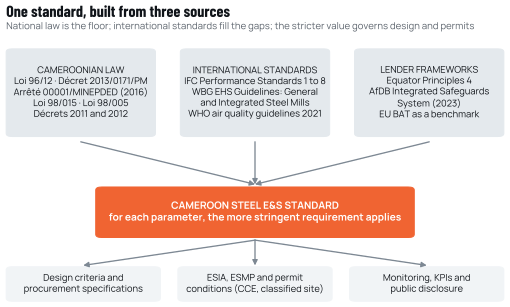
Source: Loi 96/12 [L01]; Décret 2013/0171/PM [L02]; IFC Performance Standards [G01]; WBG EHS Guidelines [G03][G04]; EP4 [G05]; AfDB ISS [G06]; WHO 2021 [G09]; EU BAT [G07].
3.2 The eight Performance Standards, read for Kribi
The Performance Standards are written for every sector and every country. Their value lies in how they are applied to a specific place. Table 3.1 summarises what each standard means for an EAF long-products works on the Kribi plateau. The following chapters develop each point.
Table 3.1 What each IFC Performance Standard requires of a steelworks in Kribi
| Standard | Core requirement | What it means in Kribi |
|---|---|---|
| PS1 Assessment and management | Environmental and social assessment; management system; stakeholder engagement; grievance mechanism | Full assessment including cumulative impacts with the port, the zone, rail and mining projects; grievance mechanism open before fieldwork |
| PS2 Labour and working conditions | Fair terms, non-discrimination, worker grievance mechanism, occupational health and safety, supply-chain checks | Molten metal, gas, cranes, heat and noise; construction contractors and worker accommodation; checks on scrap supply chains for child labour |
| PS3 Resource efficiency and pollution prevention | Apply EHS Guidelines; efficiency in water and energy; quantify GHG above 25,000 tCO₂e per year | EAF dust and dioxin controls; closed-loop water; annual GHG inventory from the first year |
| PS4 Community health, safety and security | Hazardous materials, traffic, disease, emergency preparedness, proportionate security | Truck traffic on the N7 and port roads; influx and disease risks; oxygen and gas hazards; security personnel conduct |
| PS5 Land acquisition and involuntary resettlement | Avoid or minimise displacement; replacement-cost compensation; livelihood restoration | Due diligence on the land’s history since 2009; any current users or graves; legacy gaps addressed |
| PS6 Biodiversity | Mitigation hierarchy; no net loss in natural habitat; net gain in critical habitat | Critical habitat unlikely on site but present in the wider landscape (marine park, Campo-Ma’an, estuaries) |
| PS7 Indigenous Peoples | Informed consultation and participation; free, prior and informed consent in defined circumstances | Bagyeli communities in the Océan department; early specialised screening; consent if customary lands, relocation or critical heritage are affected |
| PS8 Cultural heritage | Protect heritage; chance-finds procedure; consultation on critical heritage | Lobé falls cultural landscape; sacred sites and graves of Batanga, Mabi and Bagyeli lineages |
Source: IFC Performance Standards on Environmental and Social Sustainability, 1 January 2012 [G01]; Cameroon Steel analysis.
The standards share one method: assess first, then avoid, minimise, restore and only then compensate or offset. They also share one demand that is easy to state and hard to meet: engage the people affected early enough that their views can change the project. Most of this paper is about how to meet that demand in Kribi.
3.3 The EHS Guidelines provide the numbers
The EHS Guidelines translate the Performance Standards into values that can be designed, measured and audited. For an EAF works, the most relevant values are the stack emission guidelines. These apply for at least 95% of operating time, without dilution and at standard reference conditions [G03]:
- particulate matter 20 to 50 mg/Nm³, with the lower value where toxic metals are present;
- polychlorinated dibenzo-p-dioxins and furans (PCDD/F) 0.1 ng toxic equivalent (TEQ)/Nm³;
- carbon monoxide 100 mg/Nm³ for the EAF;
- nitrogen oxides 500 mg/Nm³;
- metals: chromium 4, cadmium 0.2, lead 2 and nickel 2 mg/Nm³.
For effluent discharged directly to surface water, the guidelines set a full suite of limits (Chapter 5): pH 6 to 9, total suspended solids 35 mg/L, oil and grease 10 mg/L, zinc 2 mg/L and lead 0.2 mg/L, among others [G03].
The General Guidelines add two rules that are especially important in Kribi [G04]. The first concerns air. A project should not cause ambient concentrations to exceed national standards or, where there are none, the WHO guidelines. As a general rule, it should use no more than 25% of the applicable ambient standard, so as to leave room for other development in the same airshed. Where the airshed is already degraded, the project’s increment should be minimal. Chapter 4 shows why this matters: modelled background fine particulate matter at Kribi is already above the WHO 2021 guideline. The second rule concerns noise. Off-site noise should not exceed 55 dB(A) by day and 45 dB(A) at night at residential receptors, or 70 dB(A) at industrial receptors. Nor should it raise background levels by more than 3 dB at the nearest receptor [G04].
The guidelines are from 2007, and better techniques now exist. The EU BAT conclusions of 2012 associate the following levels with modern EAF primary and secondary dedusting [G07]:
- dust below 5 mg/Nm³ as a daily mean;
- mercury below 0.05 mg/Nm³;
- PCDD/F below 0.1 ng I-TEQ/Nm³;
- a fume capture efficiency above 98%.
Later phases will add gas-fired reheating furnaces, for which the EU’s 2022 conclusions for ferrous metals processing set the relevant levels [G16]. For a new furnace burning natural gas, the BAT-associated level for nitrogen oxides is 80 to 200 mg/Nm³ at 3% oxygen, as a daily average, against 100 to 350 mg/Nm³ for existing furnaces; the indicative level for carbon monoxide is 10 to 50 mg/Nm³. Table 3.2 sets these values side by side with the national position and our design objectives.
Table 3.2 Key air emission values for the melt shop and reheating furnaces: national, IFC, EU BAT and Cameroon Steel design objective
| Parameter | Cameroon (national) | IFC EHS Integrated Steel Mills (2007) | EU BAT conclusions: EAF (2012); reheating furnaces (FMP, 2022) | Cameroon Steel design objective (planned) |
|---|---|---|---|---|
| Dust (particulate matter), mg/Nm³ | No sector limit found in force | 20 to 50 | Below 5 (daily mean) | Below 5 at the melt-shop bag filter |
| PCDD/F, ng TEQ/Nm³ | No sector limit found | 0.1 | Below 0.1 | Below 0.1, verified twice a year at first |
| Mercury, mg/Nm³ | No sector limit found | Not specified for EAF | Below 0.05 | Below 0.05 |
| Carbon monoxide, mg/Nm³ | No sector limit found | 100 (EAF) | EAF: none set; gas-fired reheating furnaces: indicative 10 to 50 (FMP, 2022) | EAF: 100; reheating furnaces (later phases): 50 or less |
| Nitrogen oxides, mg/Nm³ | No sector limit found | 500 | EAF: none set; new gas-fired reheating furnaces: 80 to 200 at 3% O2 (FMP, 2022) | Low-NOx burners; reheating furnaces (later phases): 200 or less at 3% O2; Phase 1 heats billets electrically |
| Fume capture efficiency | Not specified | Not specified | Above 98% | Above 98% (primary and secondary capture) |
Source: Décret 2011/2582/PM [L05]; IFC EHS Guidelines for Integrated Steel Mills, Table 1 [G03]; Commission Implementing Decision 2012/135/EU, BAT 88 to 89 [G07]; Commission Implementing Decision (EU) 2022/2110, BAT 22, Table 1.9 [G16]. Design objectives are Cameroon Steel targets for the assessment and procurement, not measured performance.
3.4 Equator Principles 4: climate, human rights and disclosure
Equator Principles categorisation is based on the magnitude of environmental and social risks and impacts, not on size. We expect lenders to categorise the project as Category A under EP4, which brings the most demanding review [G05]. In a non-designated country, the bank must verify compliance with the Performance Standards and EHS Guidelines. An independent environmental and social consultant reviews the assessment. The borrower commits to an environmental and social action plan (ESAP) through covenants, and at least a summary of the assessment must be published online [G05]. EP4 also expects the project to assess its human-rights risks against the UN Guiding Principles on Business and Human Rights [G05][G13].
EP4’s climate requirements turn on two thresholds (Figure 3.2). All Category A projects need a climate change risk assessment that covers physical risks. Where combined Scope 1 and 2 emissions are expected to exceed 100,000 tonnes of carbon dioxide equivalent (tCO₂e) a year, the assessment must also cover transition risks. It must include an alternatives analysis of lower-carbon technologies, and the borrower must report emissions publicly each year [G05]. IFC Performance Standard 3 separately requires annual quantification above 25,000 tCO₂e [G01].
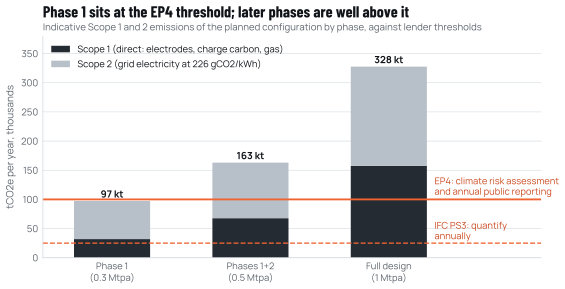
Source: Cameroon Steel planning model, edition of 10 October 2026 (planned capacities multiplied by IFC and worldsteel benchmarks; grid factor 226 gCO₂/kWh for 2024 [T04]) [X03]; IFC PS3 [G01]; EP4 [G05]. Indicative values, not measurements.
Our planning model estimates Scope 1 and 2 emissions of about 97,000 tCO₂e a year for Phase 1 (0.3 Mtpa of finished products). It estimates about 163,000 tCO₂e for Phases 1 and 2 (0.5 Mtpa) and about 328,000 tCO₂e at the full design capacity of 1 Mtpa [X03]. These are planning estimates, built from benchmark energy intensities. They are not measurements. Diesel, LPG and switchgear SF6, which are outside the planning model, would add about 3,000 to 7,000 t a year, taking Phase 1 to about 100,000 to 104,000 tCO₂e (White paper 06, Chapter 9). Phase 1 sits so close to the EP4 threshold that the distinction is academic. We will therefore carry out the full climate change risk assessment, including the alternatives analysis, and report Scope 1 and 2 emissions publicly every year from the first year of operation.
The same model gives an indicative intensity of about 0.32 tCO₂ per tonne of finished product in Phase 1 (about 0.33 t at full build-out) for Scope 1 and 2 emissions. That figure excludes the upstream emissions of any imported direct-reduced or hot-briquetted iron. Including them raises the estimate to about 0.58 t/t [X03]. Published route averages are not directly comparable, because their boundaries differ. For orientation only, worldsteel’s 2024 averages are 2.34 tCO₂/t for the blast furnace route, 1.47 for gas-based direct reduction with an EAF, and 0.69 for the scrap-based EAF route [T01]. Two factors keep the Kribi figure low. The first is the route itself: an EAF melts metallic charge rather than reducing ore with coal. The second is Cameroon’s electricity. The latest published emission factor for the grid is about 226 gCO₂/kWh, for 2024, a year in which the same Ember dataset puts hydropower at about 72% of generation [T04][T05]. The electricity regulator reports a higher hydropower share for 2025, about 90% [T10]; no emission factor has yet been published for that year, and the papers of this series keep 226 g as a conservative planning value. Both advantages depend on firm, low-carbon power, which Chapter 10 treats as a monitored commitment.
Climate rules in export markets add a commercial reason to measure carefully. The definitive regime of the EU Carbon Border Adjustment Mechanism (CBAM) has applied to iron and steel imports since 1 January 2026. Certificates were priced at €82.32/tCO2 for the third quarter of 2026 [T06][T07]. Our planned markets are mainly in Cameroon and the wider Central African region, so CBAM would bite only on any exports to the EU. Even so, buyers and lenders will ask for a verified product carbon footprint, and the inventory we commit to here will provide it.
3.5 The AfDB Integrated Safeguards System
The AfDB revised its safeguards in 2023. The system now has ten operational safeguards (OS), covering [G06]:
- assessment and management of environmental and social risks (OS1);
- labour and working conditions (OS2);
- resource efficiency and pollution prevention (OS3);
- community health, safety and security (OS4);
- land acquisition, restrictions on land use and involuntary resettlement (OS5);
- biodiversity and living natural resources (OS6);
- vulnerable groups, including Indigenous Peoples and historically underserved traditional local communities (OS7);
- cultural heritage (OS8);
- financial intermediaries (OS9);
- stakeholder engagement and information disclosure (OS10).
We paraphrase the subjects here; the exact titles should be confirmed against the published text. Three features make the system relevant to Kribi even before any AfDB financing decision. First, the AfDB is a named partner of the industrial zone, so its standards will shape the zone’s own environmental management [K04]. Second, its treatment of vulnerable groups is broad enough to cover the Bagyeli, women fish processors and others whose situation national law does not single out. Third, its standalone safeguard on engagement and disclosure makes the quality of consultation a reviewable requirement in its own right.
3.6 Why the standards matter beyond financing
It would be possible to treat international standards as a lender’s checklist, completed late and filed away. That approach fails on its own terms. A bag filter sized for 50 mg/Nm³ cannot later be tuned to 5. A stockyard placed on a stream cannot later be moved. A consultation held after the layout is fixed cannot change it. The standards are useful precisely because they force decisions early, while those decisions are still cheap.
Recent practice shows what lenders now ask of an EAF rebar mill. In January 2026 the IFC disclosed its environmental and social review of a loan to an existing EAF works in Malaysia with 600,000 t a year of steelmaking capacity [T08]. The review records several features:
- particulate emissions held at or below 30 mg/Nm³ by a dedusting plant;
- noise kept below 65 dB at the plant boundary, with the nearest homes about 300 m away;
- about 6,000 t a year of EAF dust collected in silos for zinc extraction or reuse;
- about 70,000 t of EAF slag and 18,000 t of ladle slag sold each year to licensed recovery companies;
- about 8,000 m³ of water recycled each day against 2,000 m³ of make-up;
- annual reporting of about 247,000 tCO₂e.
It also required a stakeholder engagement plan and an external grievance mechanism by a set date [T08]. That is an existing plant in an industrial estate. A new plant in Kribi, in a landscape that holds a marine park and Indigenous Peoples’ lands, should aim higher, and can, because nothing has yet been built.
- Adopt a written environmental and social policy that commits to Cameroonian law, the IFC Performance Standards, the WBG EHS Guidelines and EP4, applying the stricter requirement in each case.
- Prepare one assessment that satisfies both the national procedure and the Performance Standards, rather than two documents that diverge.
- Commission an independent gap analysis of the assessment against the Performance Standards and the AfDB safeguards before filing, and publish its conclusions.
- Build an environmental and social management system aligned with ISO 14001 and ISO 45001 during construction, with certification as an objective for the first years of operation.
- Report Scope 1 and 2 emissions publicly every year from the first year of operation.
Sources cited in this chapter
Bracketed markers refer to these sources; the full list is in the annex. Full list of sources
- G01Performance Standards on Environmental and Social Sustainability. International Finance Corporation, 1 Jan 2012.ifc.org/en/insights-reports/2012/ifc-performance-standards
- G03Environmental, Health, and Safety Guidelines for Integrated Steel Mills. IFC / World Bank Group, 30 Apr 2007.ifc.org/content/dam/ifc/doc/2000/2007-integrated-steel-mills-ehs-guide…
- G04Environmental, Health, and Safety (General) Guidelines. IFC / World Bank Group, 30 Apr 2007.ifc.org/content/dam/ifc/doc/2000/2007-general-ehs-guidelines-en.pdf
- G05The Equator Principles EP4. Equator Principles Association, Jul 2020 (effective 1 Oct 2020).equator-principles.com/app/uploads/The-Equator-Principles_EP4_July2020…
- G06African Development Bank Group’s Integrated Safeguards System (2023). African Development Bank, 2023.afdb.org/en/documents/african-development-bank-groups-integrated-safeg…
- G09WHO global air quality guidelines: particulate matter (PM2.5 and PM10), ozone, nitrogen dioxide, sulfur dioxide and carbon monoxide. World Health Organization, 22 Sep 2021.who.int/publications/i/item/9789240034228
- G07Commission Implementing Decision 2012/135/EU establishing the best available techniques (BAT) conclusions for iron and steel production. European Commission, 28 Feb 2012.eur-lex.europa.eu/legal-content/EN/TXT/HTML/?uri=CELEX:32012D0135
- L01Loi n° 96/12 portant loi-cadre relative à la gestion de l’environnement. Presidency of the Republic (FAOLEX copy), 5 Aug 1996.faolex.fao.org/docs/pdf/cmr19578.pdf
- L02Décret n° 2013/0171/PM fixant les modalités de réalisation des études d’impact environnemental et social. Prime Minister (FAOLEX copy), 14 Feb 2013.faolex.fao.org/docs/pdf/cmr179401.pdf
- G16Commission Implementing Decision (EU) 2022/2110 establishing the best available techniques (BAT) conclusions for the ferrous metals processing industry (BAT 22, Table 1.9: feedstock heating in hot rolling). European Commission (Official Journal L 284, p. 69), 11 Oct 2022.eur-lex.europa.eu/legal-content/EN/TXT/HTML/?uri=CELEX:32022D2110
- L05Décrets n° 2011/2582/PM (atmosphere), 2011/2583/PM (noise and odours), 2011/2584/PM (soils) and 2011/2585/PM (discharges). Prime Minister (FAOLEX copies), 23 Aug 2011.faolex.fao.org/docs/pdf/cmr195746.pdf
- G13Guiding Principles on Business and Human Rights. United Nations Office of the High Commissioner for Human Rights, 2011.ohchr.org/sites/default/files/documents/publications/guidingprinciples…
- T04Carbon intensity of electricity generation (Ember data), Cameroon. Our World in Data.ourworldindata.org/grapher/carbon-intensity-electricity
- X03Cameroon Steel reference configuration RC-1 (planning estimate): planned capacities, phases, indicative schedule and benchmark-based estimates, edition of 10 October 2026. Cameroon Steel, 10 Oct 2026.Cited by title and date
- T01Sustainability Indicators Report 2025 (2024 data). World Steel Association (worldsteel), Nov 2025 (updated Feb 2026).worldsteel.org/wider-sustainability/sustainability-indicators/
- T05Electricity production by source (Ember and Energy Institute data), Cameroon. Our World in Data.ourworldindata.org/grapher/electricity-prod-source-stacked
- T10Rapport d’activités 2025 de l’ARSEL. Agence de Régulation du Secteur de l’Électricité (ARSEL), 7 Sep 2026.arsel-cm.org/wp-content/uploads/2026/09/Rapport-ARSEL-2025.pdf
- T06CBAM definitive regime. European Commission, DG Taxation and Customs Union.taxation-customs.ec.europa.eu/carbon-border-adjustment-mechanism/cbam-…
- T07Price of CBAM certificates. European Commission, DG Taxation and Customs Union, Q3 2026 price published 5 Oct 2026.taxation-customs.ec.europa.eu/carbon-border-adjustment-mechanism/price…
- K04Cameroon: African Development Bank Group supports development of integrated industrial zone at the Port of Kribi. African Development Bank (via AllAfrica), 2 Mar 2026.allafrica.com/stories/202603100682.html
- T08Environmental and Social Review Summary 51259, Esteel Loan (EAF steel and rebar works, Malaysia). International Finance Corporation, 6 Jan 2026.disclosures.ifc.org/project-detail/ESRS/51259/esteel-loan
Cite this chapter
Cameroon Steel (2026). Building responsibly in Kribi: a steelworks can meet international standards on four conditions. White paper 07, chapter 3: International standards fill the gaps national law leaves, so we apply them from design. CS-WP-07. https://www.cameroon-steel.com/en/library/responsible-kribi/international-standards/
Source