White paper 07 · Summary
Executive summary
A steelworks can be built responsibly in Kribi’s coastal, biodiverse and culturally rich setting, on four conditions. The assessment must start early, while the design can still change. Baselines must be measured on site across the wet and dry seasons, rather than borrowed from regional averages. Communities must be engaged with integrity, including the Bagyeli (Bakola) peoples, whose consent is required in the circumstances defined by international standards. And the IFC Performance Standards, the World Bank Group EHS Guidelines and the Equator Principles must be applied from design, not at the end. This paper sets out the evidence for that conclusion, the commitments Cameroon Steel makes in response, and the indicators against which those commitments can be checked.
In this chapter (7)
ES.1 Ten findings
- The setting is sensitive, but the steel site is set back from its most valued assets. The site area lies on the coastal plateau about 3 to 4 km inland from the port frontage. The marine national park begins about 12 km away, the Lobé falls about 18 km and Campo-Ma’an National Park about 29 km. Villages and small streams are closer: the nearest mapped stream is about 2 to 3 km away and the nearest village, Boussibelika, about 3 to 4 km (Chapter 1 and Annex D, Table D.1).
- Cameroonian law already requires a detailed, public assessment. Steelmaking needs a detailed EIES under the 2016 order, with consultations during the study, public hearings, an interministerial review and a certificate before any works. A separate classified-establishment authorisation requires a hazard study and an emergency plan. The administrative clock is four to five months, but seasonal baselines make the realistic timetable 12 to 18 months (Chapter 2).
- National law sets no numeric emission or ambient limits for steel, so international values must fill the gap. Cameroon Steel will apply the stricter of national and international requirements for every parameter, and will ask for them to be written into its permits (Chapters 2 and 3).
- Phase 1 sits at the Equator Principles’ climate threshold. Indicative Scope 1 and 2 emissions are about 97,000 tCO₂e a year in Phase 1 and about 328,000 tCO₂e at full capacity. We will carry out the full climate risk and alternatives assessment and report publicly from the first year (Chapter 3).
- The airshed is already above the WHO fine-particle guideline. Modelled background PM2.5 is about 10 µg/m³, twice the guideline, mostly from harmattan dust and regional smoke. The plant must therefore add as little as possible. Our objectives are melt-shop dust below 5 mg/Nm³, dioxins below 0.1 ng I-TEQ/Nm³, and a project contribution at any village below a quarter of the WHO guideline (Chapter 4).
- In Kribi, water design is about rain, not supply. Planned fresh-water demand is about 2 m³ per tonne, less than 1% of the Lobé’s low flow even at full capacity. The challenge is about 2,850 mm of rain a year and a 100-year day of 264 mm. Our objectives are no process-water discharge in normal operation and no direct or indirect abstraction from the Lobé without a specific study (Chapter 5).
- Four fifths of the residues can become products; the hazardous dust needs a secure route first. At full capacity, residues are about 185,000 t a year, mostly slag suitable for aggregate after testing. EAF dust, about 16,000 t a year, is hazardous. There will be no first heat without a contracted, compliant outlet (Chapter 6).
- Critical habitat is unlikely on the site but present in the landscape. The main risks come from what a project brings, such as in-migration, hunting, traffic and coastal pressure, rather than from its footprint. We commit to two-season surveys, no net loss of natural habitat and a contribution to conservation co-designed with communities (Chapter 7).
- The social licence depends on engagement with integrity. The land has a history dating from the 2009 declaration of public utility. HIV prevalence in the South Region is the highest in Cameroon. Bagyeli communities live in the department. We commit to a land legacy review, early Indigenous Peoples screening, free, prior and informed consent where required, and a grievance mechanism open before any fieldwork (Chapter 8).
- Kribi’s own record shows that timing and transparency decide outcomes. Land questions outlived the port’s construction. The coast changed after the breakwater, and a park offset was designed without the people who used the land. A shared approach to cumulative effects, with published data, is the main lesson (Chapter 9).
ES.2 Why this paper
Cameroon Steel is developing a steel complex at Mboro, in the Kribi industrial-port zone. Its design capacity is 1 Mtpa, to be built in phases. The first phase is an electric arc furnace (EAF) melt shop making billets, which are rolled into reinforcing bar and wire rod or sold to existing re-rollers. The Prime Minister, representing the Head of State, laid the foundation stone on 30 December 2024 [X01][X02]. The Kribi Port Industrial Zone lists steelmaking linked to mineral exports among its development clusters [K02].
A steelworks is a heavy industrial plant. Kribi is a coast of forests, rivers, fishing villages, a young marine national park, a waterfall sacred to three peoples, and the forest homeland of the Bagyeli. Both statements are true, and this paper does not pretend otherwise. Its purpose is to show, with sources, how the two can coexist. It explains what national law already requires and what international standards add. It sets out what the main environmental and social risks are and how they will be controlled. It reviews what Kribi’s own recent history teaches. And it states what Cameroon Steel commits to, in terms specific enough to be checked.
Nothing in this paper describes performance already achieved. The plant is not yet built, and its environmental and social impact assessment has not yet been carried out. Every target in these pages is an objective or a commitment, labelled as such.
ES.3 The setting in brief
Kribi lies in one of the wettest belts of Cameroon’s coast, with about 2,800 to 2,900 mm of rain a year. September and October are the wettest months, but even December to February brings about 90 to 120 mm a month [E01]. Winds come mainly from the sea: south-westerly and southerly winds account for about 72% of hours in modelled data [E04]. The coastal plateau on which the site lies is a mosaic of secondary forest, farms and fallows, crossed by small streams that drain west to the sea and east to the Lobé. The coast itself has changed fast since the port was built. It shifted from slow accretion before 2000 to an average retreat of about 2 m a year in 2015 to 2020, with much faster local rates [E02].
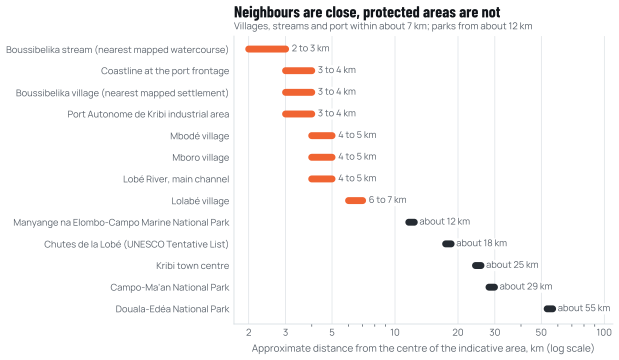
Source: OpenStreetMap (extract base 24 July 2026) [E11]; Décret 2021/4804/PM [B01]; UNESCO Tentative List [B04]. Cameroon Steel analysis from public geodata; no site boundary is used.
The protected areas around Kribi are of global importance (Figure ES.1). Campo-Ma’an National Park shelters forest elephants and western lowland gorillas, both Critically Endangered on the IUCN Red List [B08][B10]. The Manyange na Elombo-Campo Marine National Park, created in 2021, protects turtle nesting beaches and the Ntem mangroves [B01]. The Chutes de la Lobé, where a river falls directly into the sea, are on Cameroon’s UNESCO Tentative List as a cultural landscape sacred to the Batanga, Mabi and Bagyeli [B04]. The population is diverse and growing [H02][E13], and the South Region carries the country’s highest HIV prevalence [H01].
ES.4 Four conditions, and what each requires
Early assessment. The decisions that matter most for the environment are made early: where the stockyards go, how large the bag filter is, whether there is an outfall, where the trucks drive. An assessment that starts after the layout is frozen can only add mitigation. One that starts before can avoid impacts altogether. Cameroon Steel will run the environmental assessment and the hazard study in parallel with the basic engineering, so that their findings shape the layout (Chapters 2 and 10).
Seasonal baselines. There are no measured air, noise, water or ecological data for the site area. Modelled data are useful for planning but cannot support predictions. We will run at least twelve months of on-site weather and air monitoring. Water, ecological and noise surveys will cover both the drier and the wetter seasons. Baseline data will be published quarterly as they are collected (Chapters 4, 5, 7 and 11).
Engagement with integrity. Engagement is required twice by Cameroonian law, during the study and at public hearings. International standards add continuous engagement, a grievance mechanism and, for Indigenous Peoples in defined circumstances, free, prior and informed consent. We will open the grievance mechanism before any fieldwork. We will screen for Bagyeli presence and customary use before other social surveys, and seek consent where IFC Performance Standard 7 requires it. Communities will choose their own representatives (Chapter 8).
International standards from design. The IFC Performance Standards and the World Bank Group EHS Guidelines apply in full to projects financed by Equator banks in Cameroon. The AfDB, a partner of the industrial zone, applies its own similar safeguards [G05][G06][K04]. Cameroon Steel will apply them whatever the financing structure, using European best-available-technique levels as the design benchmark for EAF emissions (Chapter 3).
ES.5 What Cameroon Steel commits to
The commitments in this paper are summarised below and detailed, with indicators and reporting frequencies, in Chapter 10.
- Standards. For every parameter, the stricter of Cameroonian law and international standards; values written into permit conditions where possible.
- Air. Melt-shop dust below 5 mg/Nm³; dioxins below 0.1 ng I-TEQ/Nm³; radiation screening of every scrap load; a project contribution to fine particles at any village below a quarter of the WHO guideline; stack and ambient data published online.
- Water. About 2 m³ of fresh water per tonne; supply from the zone network and rainwater first; no direct or indirect abstraction from the Lobé without a specific study; no process-water discharge in normal operation; IFC effluent values at every outfall.
- Residues. Slag released as aggregate only after ageing and batch testing; no first heat without a compliant outlet for EAF dust; no open burning.
- Biodiversity. Two-season surveys and a critical habitat assessment; buffers of at least 30 m on watercourses; zero tolerance for hunting and wildlife trade; no net loss of natural habitat; a co-designed contribution to conservation of the landscape.
- People. A land legacy review and census before clearing; Indigenous Peoples screening and FPIC where required; workers’ accommodation and conduct to international standards; heavy traffic kept inside the port domain where possible; local hiring and purchasing targets.
- Climate. Full climate risk assessment; Scope 1 and 2 emissions reported publicly every year from the first year of operation; a decarbonisation pathway within two years of start-up.
- Transparency. A disclosure calendar, an independent environmental and social consultant, community participatory monitoring and a corrective action plan tracked to closure.
They are not descriptions of achieved performance; the plant does not yet exist. They are not a substitute for the environmental and social impact assessment, which will test them against measured data and may tighten them. And they are not unconditional on others: some depend on public authorities sharing data and on the zone developing shared facilities. Where that is the case, the paper says so.
ES.6 What remains unknown
Chapter 11 lists the evidence gaps and how each will be closed. The most important are:
- the absence of any measured air quality, noise, water or ecological data for the site area;
- the unknown water-table depth and the condition of the small streams that would receive treated stormwater;
- the vegetation and possible current users of the land;
- whether Bagyeli communities hold customary interests in the site or its area of influence;
- the content of documents held by others, notably any strategic environmental assessment of the zone and the land records from 2009 to 2010.
None of these gaps undermines the conclusion that the project can be built responsibly. All of them must be closed before its impacts can be predicted with confidence.
ES.7 How to read this paper
Chapter 1 describes the Kribi setting. Chapters 2 and 3 set out the national procedure and the international standards. Chapters 4 to 6 cover air, water and residues. Chapters 7 and 8 cover biodiversity and people. Chapter 9 draws lessons from Kribi’s port and from other heavy-industry projects. Chapter 10 sets out commitments and indicators. Chapter 11 lists the evidence gaps. Annexes describe the methods and assumptions, define the technical terms, list every source and tabulate the data behind every chart.
Each number carries a source marker in square brackets that refers to Annex C. Each exhibit carries a status: "sourced" for published data, "derived" for Cameroon Steel calculations from sourced inputs, "assumed" for planning assumptions, and "illustrative" for diagrams and generated visualisations. Distances are approximate and measured from public geodata to a generalised indicative area, not to a surveyed boundary. Planned figures, such as capacities, water demand, emissions and residues, come from Cameroon Steel’s planning model of 10 October 2026. They are indicative and will be revised as the design advances.
Statement of interest. This paper is published by Cameroon Steel, which is developing a steelworks at Kribi. It is written to inform public debate; its analysis is independent of any commercial offer, and every figure is sourced or labelled with its status.
Sources cited in this chapter
Bracketed markers refer to these sources; the full list is in the annex. Full list of sources
- X01Kribi: le Premier ministre, chef du gouvernement est là (foundation stone of the Kribi steel complex). Cameroon Tribune, 30 Dec 2024.cameroon-tribune.cm/article.html/68499/fr.html/details_2
- X02Industrialisation: la voie royale de l’émergence (1 Mtpa capacity). Cameroon Tribune, 2 Jan 2025.cameroon-tribune.cm/article.html/68558/fr.html/details_2
- K02Zone industrialo-portuaire de Kribi (KPIZ): jusqu’à +8 points de croissance et 150 000 emplois attendus sur 15 ans. Investir au Cameroun, 4 Mar 2026.investiraucameroun.com/gestion-publique/0403-23163-zone-industrialo-po…
- E01Monographie du Nyong et des fleuves côtiers, tome 1 (J.-C. Olivry). ORSTOM (now IRD), Jul 1979.horizon.documentation.ird.fr/exl-doc/pleins_textes/divers11-03/01948.p…
- E04ERA5 hourly reanalysis (precipitation, wind, temperature), accessed through the Open-Meteo historical weather API. ECMWF; Open-Meteo.open-meteo.com/en/docs/historical-weather-api
- E02Weakening of coastlines and coastal erosion in the Gulf of Guinea: the case of the Kribi coastline in Cameroon (Fendoung, Tchindjang and Hubert-Ferrari), Land 11:1557. MDPI, 2022.doi.org/10.3390/land11091557
- E11OpenStreetMap data, Overpass API extract for the Kribi area (coastline, watercourses, roads, settlements, landuse, protected areas). OpenStreetMap contributors (ODbL), Base 24 Jul 2026; queried 10 Oct 2026.openstreetmap.org
- B01Décret n° 2021/4804/PM portant création du Parc National Marin Manyange na Elombo-Campo. Prime Minister (FAOLEX copy), 9 Jul 2021.faolex.fao.org/docs/pdf/cmr220623.pdf
- B04Le paysage culturel des chutes de la Lobé (Tentative List, ref. 6330). UNESCO World Heritage Centre, 2018.whc.unesco.org/fr/listesindicatives/6330/
- B08Campo Ma’an National Park, Tropical Important Plant Areas factsheet CMNTIPA025 (B. Murphy and J. M. Onana). Royal Botanic Gardens, Kew.tipas.kew.org/site/campo-maan-national-park/
- B10IUCN Red List assessments (version 2026-1): Gobush et al. 2021, Loxodonta cyclotis , e.T181007989A204404464; Maisels et al. 2018, Gorilla gorilla gorilla , e.T9406A136251508; Maisels et al. 2016, Pan troglodytes troglodytes , e.T15936A102332276; Pietersen et al. 2019, Phataginus tricuspis , e.T12767A123586469; Nixon et al. 2019, Smutsia gigantea , e.T12762A123584478; BirdLife International 2018, Psittacus erithacus , e.T22724813A129879439; Keith Diagne 2015, Trichechus senegalensis , e.T22104A97168578; Wallace et al. 2013, Dermochelys coriacea , e.T6494A43526147; Abreu-Grobois and Plotkin 2008, Lepidochelys olivacea , e.T11534A3292503; Mortimer and Donnelly 2008, Eretmochelys imbricata , e.T8005A12881238; Wallace and Broderick 2025, Chelonia mydas , e.T4615A285108125. International Union for Conservation of Nature, 2008 to 2025; accessed 10 Oct 2026.iucnredlist.org
- H02Répertoire actualisé des villages du Cameroun, 3e Recensement général de la population et de l’habitat (2005), volume IV, tome 07 (arrondissements of Kribi I and Kribi II). Bureau Central des Recensements et des Études de Population (BUCREP); copy published by the Institut National de la Statistique, Census of 2005 (report n.d.).ins-cameroun.cm/wp-content/uploads/2025/06/Repertoire_actualise_villag…
- E13As a megaport rises in Cameroon, a delicate coastal ecosystem ebbs (E. Toto). Mongabay (secondary source), 5 Apr 2024.news.mongabay.com/2024/04/as-a-megaport-rises-in-cameroon-a-delicate-c…
- H01Enquête Démographique et de Santé du Cameroun 2018 (EDSC-V), final report FR360. Institut National de la Statistique and ICF (DHS Program), 2020.dhsprogram.com/pubs/pdf/FR360/FR360.pdf
- G05The Equator Principles EP4. Equator Principles Association, Jul 2020 (effective 1 Oct 2020).equator-principles.com/app/uploads/The-Equator-Principles_EP4_July2020…
- G06African Development Bank Group’s Integrated Safeguards System (2023). African Development Bank, 2023.afdb.org/en/documents/african-development-bank-groups-integrated-safeg…
- K04Cameroon: African Development Bank Group supports development of integrated industrial zone at the Port of Kribi. African Development Bank (via AllAfrica), 2 Mar 2026.allafrica.com/stories/202603100682.html
Cite this chapter
Cameroon Steel (2026). Building responsibly in Kribi: a steelworks can meet international standards on four conditions. White paper 07, Executive summary. CS-WP-07. https://www.cameroon-steel.com/en/library/responsible-kribi/executive-summary/
Source