白皮书07 · 摘要 · 中文摘要
执行摘要
在克里比这一沿海、生物多样性丰富且文化底蕴深厚的地区,只要满足四项条件,就能够以负责任的方式建设钢铁厂。第一,评估必须及早启动,趁设计仍可调整之时进行。第二,基线必须在厂址现场跨雨季和旱季实测取得,而不能借用区域平均值。第三,必须以诚信方式开展社区参与,包括巴吉耶利人(巴科拉人);按照国际标准的规定,在特定情形下须取得其同意。第四,国际金融公司(IFC)绩效标准、世界银行集团环境、健康与安全指南(EHS指南)以及赤道原则必须从设计阶段起适用,而非在项目末期才加以考虑。本白皮书阐述支持上述结论的依据、Cameroon Steel据此作出的承诺,以及可用于核查这些承诺的指标。
本页为本章中文摘要;英文全文附于其后,可展开阅读。
本章目录(8)
ES.1 十项主要结论
- 厂址所处环境较为敏感,但钢铁厂厂址与最具价值的资源保持了一定距离。厂址区域位于沿海台地,距港口前沿约3至4公里。海洋国家公园距厂址约12公里,洛贝瀑布约18公里,坎波-马安国家公园约29公里。村庄和小溪流则较近:最近的已测绘溪流约2至3公里,最近的村庄Boussibelika约3至4公里(第1章及全文版附录D表D.1)。
- 喀麦隆法律已要求开展详细且公开的评估。根据2016年部令,钢铁冶炼须开展详细环境与社会影响评估,包括研究期间的公众咨询、公开听证会、部际审查,并须在任何施工前取得证书。另须单独申请分类设施许可,并编制危险性研究和应急预案。法定行政时限合计为4至5个月,但由于需取得季节性基线,现实的时间表为12至18个月(第2章)。
- 国内法律未就钢铁行业设定排放或环境空气质量数值限值,因此须以国际数值填补空白。Cameroon Steel将对每项参数采用国内与国际要求中更严格者,并申请将其写入许可条件(第2章和第3章)。
- 一期处于赤道原则的气候门槛附近。一期范围一和范围二示意性排放约为每年9.7万吨二氧化碳当量,满产时约为32.8万吨。我们将开展全面的气候风险与替代方案评估,并自第一年起公开报告(第3章)。
- 当地空气流域的细颗粒物已超过世界卫生组织指导值。模拟的PM2.5背景浓度约为10微克/立方米,为指导值的两倍,主要来自哈马丹风沙尘和区域性烟雾。因此,钢铁厂必须将新增贡献降至最低。我们的目标是:炼钢车间粉尘低于5毫克/标准立方米,二噁英低于0.1纳克I-TEQ/标准立方米,项目对任一村庄的贡献低于世卫组织指导值的四分之一(第4章)。
- 在克里比,水务设计的关键在于降雨而非供水。规划新水需求约为每吨2立方米,即使满产也不到洛贝河枯水流量的1%。挑战在于每年约2850毫米的降雨和264毫米的百年一遇日降雨量。我们的目标是正常运行时不排放工艺废水,并且未经专项研究不直接或间接从洛贝河取水(第5章)。
- 五分之四的残余物可转化为产品,但危险粉尘须首先落实安全处置途径。满产时残余物约为每年18.5万吨,主要为经检测后可用作骨料的钢渣。电弧炉粉尘约为每年1.6万吨,属于危险废物。在签订合规的处置合同之前,不进行首炉冶炼(第6章)。
- 厂址内不太可能存在关键栖息地,但更大景观范围内存在。主要风险来自项目带来的影响,如人口涌入、狩猎、交通和海岸压力,而非项目占地本身。我们承诺开展两季调查、实现自然栖息地无净损失,并与社区共同设计对保护工作的贡献(第7章)。
- 项目的社会认可取决于诚信的社区参与。该土地的历史可追溯至2009年的公共利益声明(DUP)。南部大区的艾滋病毒感染率居喀麦隆之首。海洋省境内居住着巴吉耶利人社区。我们承诺开展土地遗留问题审查、尽早开展原住民筛查、在需要时取得自由、事先和知情同意(FPIC),并在任何现场工作之前开放申诉机制(第8章)。
- 克里比自身的经验表明,时机与透明度决定成败。土地问题在港口建成后依然存在。防波堤建成后海岸发生变化,而一处公园补偿方案在设计时未让土地使用者参与。主要教训是以公开数据为基础,共同应对累积影响(第9章)。
ES.2 撰写本白皮书的目的
Cameroon Steel正在克里比港综合工业区内的姆博罗(Mboro)筹建一座钢铁综合体。其设计产能为每年100万吨,将分期建设。一期为生产钢坯的电弧炉炼钢车间,钢坯轧制成钢筋和线材,或出售给现有轧钢厂。2024年12月30日,总理代表国家元首为项目奠基[X01][X02]。克里比港工业区股份有限公司(KPIZ S.A.)将“与矿产出口相关的钢铁冶炼”列为其发展产业集群之一[K02]。
钢铁厂属于重工业设施。克里比则是一片拥有森林、河流、渔村、一座新设立的海洋国家公园、一处被三个民族奉为圣地的瀑布以及巴吉耶利人森林家园的海岸。两种表述同时成立,本文并不回避这一点。本文旨在以有据可查的方式说明两者如何共存:阐释国内法律已有的要求以及国际标准的补充要求;说明主要环境与社会风险及其控制方式;回顾克里比近年的经验教训;并以足以核查的具体表述阐明Cameroon Steel的承诺。
本文所述内容均非已实现的绩效。钢铁厂尚未建成,其环境与社会影响评估亦尚未开展。文中所有目标均为目标值或承诺,并已如实标注。
ES.3 环境概况
克里比位于喀麦隆海岸降雨最多的地带之一,年降雨量约2800至2900毫米。9月和10月降雨最多,但即使在12月至次年2月,每月仍有约90至120毫米降雨[E01]。风主要来自海上:在模拟数据中,西南风和南风约占72%的时数[E04]。厂址所在的沿海台地由次生林、农田和休耕地镶嵌构成,小溪流向西注入大海、向东汇入洛贝河。自港口建成以来,海岸本身变化迅速:2000年以前为缓慢淤积,2015至2020年转为平均每年后退约2米,局部速率更高[E02]。
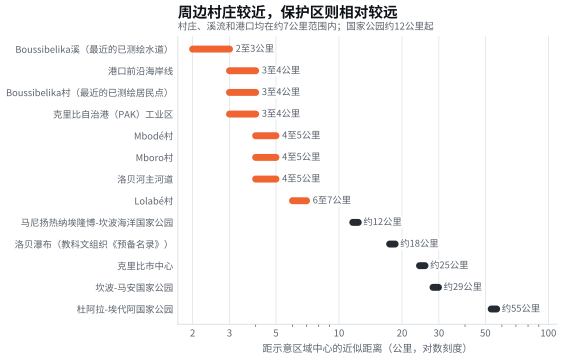
资料来源:OpenStreetMap(2026年7月24日基础数据)[E11];第2021/4804/PM号法令[B01];教科文组织《预备名录》[B04]。Cameroon Steel根据公开地理数据分析;未使用任何厂址边界。
克里比周边的保护区具有全球重要性(图ES.1)。坎波-马安国家公园是森林象和西部低地大猩猩的栖息地,二者在世界自然保护联盟(IUCN)红色名录中均为极危物种[B08][B10]。2021年设立的马尼扬热纳埃隆博-坎波海洋国家公园保护海龟产卵海滩和恩特姆河河口红树林[B01]。洛贝瀑布是河流直接坠入大海的罕见景观,作为巴坦加人、马比人和巴吉耶利人的圣地文化景观,已列入喀麦隆向联合国教科文组织提交的《预备名录》[B04]。当地人口多元且持续增长[H02][E13],南部大区的艾滋病毒感染率为全国最高[H01]。
ES.4 四项条件及其要求
及早评估。对环境影响最大的决定往往在早期作出:料场设在何处、布袋除尘器规模多大、是否设置排放口、卡车走哪条路线。在总平面布置确定之后才开始的评估只能增加缓解措施;在此之前开始的评估则可以从根本上避免影响。Cameroon Steel将与基础设计同步开展环境评估和危险性研究,使其结论能够影响总平面布置(第2章和第10章)。
季节性基线。厂址区域目前没有任何空气、噪声、水或生态的实测数据。模拟数据可用于规划,但不能作为预测的依据。我们将在厂址开展至少12个月的气象和空气监测;水、生态和噪声调查将覆盖较干和较湿两个季节。基线数据将在采集过程中按季度公布(第4、5、7和11章)。
诚信参与。喀麦隆法律两次要求公众参与:研究期间和公开听证会上。国际标准进一步要求持续参与、申诉机制,并在特定情形下取得原住民的自由、事先和知情同意。我们将在任何现场工作之前开放申诉机制;在开展其他社会调查之前,先行筛查巴吉耶利人的存在及其习惯性使用情况,并在国际金融公司绩效标准7有此要求时寻求其同意。社区将自行选择其代表(第8章)。
从设计阶段起适用国际标准。对于由赤道原则银行在喀麦隆提供融资的项目,国际金融公司绩效标准和世界银行集团EHS指南须全面适用。工业区的合作伙伴非洲开发银行适用其自身的类似保障政策[G05][G06][K04]。无论最终融资结构如何,Cameroon Steel都将适用上述标准,并以欧洲最佳可行技术水平作为电弧炉排放的设计基准(第3章)。
ES.5 Cameroon Steel的承诺
本文的承诺概述如下,第10章列出了详细内容及相应指标和报告频率。
- 标准。每项参数均采用喀麦隆法律与国际标准中更严格者;尽可能将相关数值写入许可条件。
- 空气。炼钢车间粉尘低于5毫克/标准立方米;二噁英低于0.1纳克I-TEQ/标准立方米;每批废钢均进行辐射检测;项目对任一村庄细颗粒物的贡献低于世卫组织指导值的四分之一;烟囱和环境监测数据在线公开。
- 水。每吨约2立方米新水;优先使用工业区管网和雨水;未经专项研究不直接或间接从洛贝河取水;正常运行时不排放工艺废水;每个排放口均符合国际金融公司排放标准。
- 残余物。钢渣须经陈化和逐批检测后方可作为骨料出厂;电弧炉粉尘未落实合规去向之前不进行首炉冶炼;禁止露天焚烧。
- 生物多样性。开展两季调查和关键栖息地评估;水道两侧保留至少30米缓冲带;对狩猎和野生动物贸易零容忍;自然栖息地无净损失;与社区共同设计对区域景观保护的贡献。
- 人群。清理场地前开展土地遗留问题审查和人口普查;开展原住民筛查,必要时取得FPIC;工人住宿和行为规范符合国际标准;重型车辆尽可能在港区内通行;设定本地招聘和本地采购目标。
- 气候。开展全面的气候风险评估;自运营第一年起每年公开范围一和范围二排放;投产后两年内制定脱碳路径。
- 透明度。制定信息公开日程,聘请独立环境与社会顾问,开展社区参与式监测,并跟踪纠正行动计划直至关闭。
这些承诺并非已实现绩效的描述,因为工厂尚不存在。它们不能替代环境与社会影响评估,后者将以实测数据对其进行检验,并可能使其更加严格。它们也并非完全不依赖他方:部分承诺取决于公共机构共享数据以及工业区建设共用设施。凡属此类情形,本文均已说明。
ES.6 尚未掌握的信息
第11章列出了证据缺口以及弥补每项缺口的方式。其中最重要的是:
- 厂址区域缺乏任何空气质量、噪声、水或生态的实测数据;
- 地下水位深度未知,接纳处理后雨水的小溪流状况不明;
- 土地上的植被及可能的现有使用者;
- 巴吉耶利人社区是否对厂址或其影响区域享有习惯性权益;
- 他方持有的文件内容,特别是工业区可能已有的战略环境评估以及2009至2010年的土地档案。
上述缺口均不影响“项目能够以负责任方式建设”这一结论,但在能够有把握地预测其影响之前,必须全部予以弥补。
ES.7 如何阅读本文
第1章介绍克里比的环境。第2章和第3章阐述国内程序和国际标准。第4至6章涉及空气、水和残余物。第7章和第8章涉及生物多样性和人群。第9章总结克里比港口及其他重工业项目的经验教训。第10章提出承诺和指标。第11章列出证据缺口。附录介绍方法和假设、界定技术术语、列出全部来源,并以表格形式提供每幅图表的数据。
每个数字均附有方括号内的来源标记,对应全文版附录C。每幅图表均标注状态:“来源”指已公开数据,“推算”指Cameroon Steel基于有来源数据的计算,“假设”指规划假设,“示意”指示意图和生成的可视化图像。距离为近似值,系根据公开地理数据测量至概括性的示意区域,而非经测量的边界。产能、需水量、排放和残余物等规划数据来自Cameroon Steel 2026年10月10日的规划模型,属示意性数据,将随设计推进而修订。
本中文版为摘要版:上文执行摘要为全文翻译;第1至11章各提供一页章节摘要,概述该章结论和关键数据,并附该章最重要的一幅图表;附录A为英文、法文、中文术语对照表。白皮书全文(含附录A方法与假设、附录B术语表、附录C来源清单和附录D图表数据表)有英文版和法文版,均可在Cameroon Steel网站获取。
利益声明。本白皮书由正在克里比筹建钢铁厂的Cameroon Steel发布,旨在为公共讨论提供参考;其分析独立于任何商业要约,所有数据均注明来源或标注其状态。
英文全文 10分钟 · 2371词Executive summary
A steelworks can be built responsibly in Kribi’s coastal, biodiverse and culturally rich setting, on four conditions. The assessment must start early, while the design can still change. Baselines must be measured on site across the wet and dry seasons, rather than borrowed from regional averages. Communities must be engaged with integrity, including the Bagyeli (Bakola) peoples, whose consent is required in the circumstances defined by international standards. And the IFC Performance Standards, the World Bank Group EHS Guidelines and the Equator Principles must be applied from design, not at the end. This paper sets out the evidence for that conclusion, the commitments Cameroon Steel makes in response, and the indicators against which those commitments can be checked.
ES.1 Ten findings
- The setting is sensitive, but the steel site is set back from its most valued assets. The site area lies on the coastal plateau about 3 to 4 km inland from the port frontage. The marine national park begins about 12 km away, the Lobé falls about 18 km and Campo-Ma’an National Park about 29 km. Villages and small streams are closer: the nearest mapped stream is about 2 to 3 km away and the nearest village, Boussibelika, about 3 to 4 km (Chapter 1 and Annex D, Table D.1).
- Cameroonian law already requires a detailed, public assessment. Steelmaking needs a detailed EIES under the 2016 order, with consultations during the study, public hearings, an interministerial review and a certificate before any works. A separate classified-establishment authorisation requires a hazard study and an emergency plan. The administrative clock is four to five months, but seasonal baselines make the realistic timetable 12 to 18 months (Chapter 2).
- National law sets no numeric emission or ambient limits for steel, so international values must fill the gap. Cameroon Steel will apply the stricter of national and international requirements for every parameter, and will ask for them to be written into its permits (Chapters 2 and 3).
- Phase 1 sits at the Equator Principles’ climate threshold. Indicative Scope 1 and 2 emissions are about 97,000 tCO₂e a year in Phase 1 and about 328,000 tCO₂e at full capacity. We will carry out the full climate risk and alternatives assessment and report publicly from the first year (Chapter 3).
- The airshed is already above the WHO fine-particle guideline. Modelled background PM2.5 is about 10 µg/m³, twice the guideline, mostly from harmattan dust and regional smoke. The plant must therefore add as little as possible. Our objectives are melt-shop dust below 5 mg/Nm³, dioxins below 0.1 ng I-TEQ/Nm³, and a project contribution at any village below a quarter of the WHO guideline (Chapter 4).
- In Kribi, water design is about rain, not supply. Planned fresh-water demand is about 2 m³ per tonne, less than 1% of the Lobé’s low flow even at full capacity. The challenge is about 2,850 mm of rain a year and a 100-year day of 264 mm. Our objectives are no process-water discharge in normal operation and no direct or indirect abstraction from the Lobé without a specific study (Chapter 5).
- Four fifths of the residues can become products; the hazardous dust needs a secure route first. At full capacity, residues are about 185,000 t a year, mostly slag suitable for aggregate after testing. EAF dust, about 16,000 t a year, is hazardous. There will be no first heat without a contracted, compliant outlet (Chapter 6).
- Critical habitat is unlikely on the site but present in the landscape. The main risks come from what a project brings, such as in-migration, hunting, traffic and coastal pressure, rather than from its footprint. We commit to two-season surveys, no net loss of natural habitat and a contribution to conservation co-designed with communities (Chapter 7).
- The social licence depends on engagement with integrity. The land has a history dating from the 2009 declaration of public utility. HIV prevalence in the South Region is the highest in Cameroon. Bagyeli communities live in the department. We commit to a land legacy review, early Indigenous Peoples screening, free, prior and informed consent where required, and a grievance mechanism open before any fieldwork (Chapter 8).
- Kribi’s own record shows that timing and transparency decide outcomes. Land questions outlived the port’s construction. The coast changed after the breakwater, and a park offset was designed without the people who used the land. A shared approach to cumulative effects, with published data, is the main lesson (Chapter 9).
ES.2 Why this paper
Cameroon Steel is developing a steel complex at Mboro, in the Kribi industrial-port zone. Its design capacity is 1 Mtpa, to be built in phases. The first phase is an electric arc furnace (EAF) melt shop making billets, which are rolled into reinforcing bar and wire rod or sold to existing re-rollers. The Prime Minister, representing the Head of State, laid the foundation stone on 30 December 2024 [X01][X02]. The Kribi Port Industrial Zone lists steelmaking linked to mineral exports among its development clusters [K02].
A steelworks is a heavy industrial plant. Kribi is a coast of forests, rivers, fishing villages, a young marine national park, a waterfall sacred to three peoples, and the forest homeland of the Bagyeli. Both statements are true, and this paper does not pretend otherwise. Its purpose is to show, with sources, how the two can coexist. It explains what national law already requires and what international standards add. It sets out what the main environmental and social risks are and how they will be controlled. It reviews what Kribi’s own recent history teaches. And it states what Cameroon Steel commits to, in terms specific enough to be checked.
Nothing in this paper describes performance already achieved. The plant is not yet built, and its environmental and social impact assessment has not yet been carried out. Every target in these pages is an objective or a commitment, labelled as such.
ES.3 The setting in brief
Kribi lies in one of the wettest belts of Cameroon’s coast, with about 2,800 to 2,900 mm of rain a year. September and October are the wettest months, but even December to February brings about 90 to 120 mm a month [E01]. Winds come mainly from the sea: south-westerly and southerly winds account for about 72% of hours in modelled data [E04]. The coastal plateau on which the site lies is a mosaic of secondary forest, farms and fallows, crossed by small streams that drain west to the sea and east to the Lobé. The coast itself has changed fast since the port was built. It shifted from slow accretion before 2000 to an average retreat of about 2 m a year in 2015 to 2020, with much faster local rates [E02].
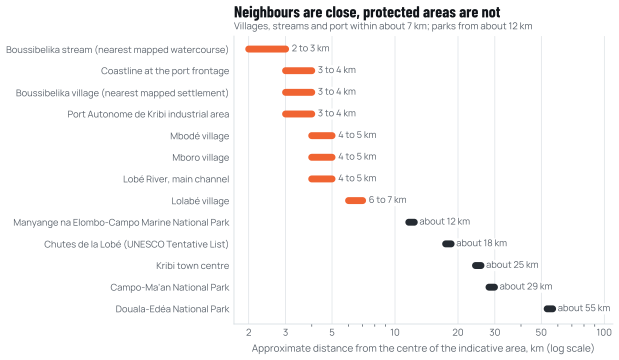
Source: OpenStreetMap (extract base 24 July 2026) [E11]; Décret 2021/4804/PM [B01]; UNESCO Tentative List [B04]. Cameroon Steel analysis from public geodata; no site boundary is used.
The protected areas around Kribi are of global importance (Figure ES.1). Campo-Ma’an National Park shelters forest elephants and western lowland gorillas, both Critically Endangered on the IUCN Red List [B08][B10]. The Manyange na Elombo-Campo Marine National Park, created in 2021, protects turtle nesting beaches and the Ntem mangroves [B01]. The Chutes de la Lobé, where a river falls directly into the sea, are on Cameroon’s UNESCO Tentative List as a cultural landscape sacred to the Batanga, Mabi and Bagyeli [B04]. The population is diverse and growing [H02][E13], and the South Region carries the country’s highest HIV prevalence [H01].
ES.4 Four conditions, and what each requires
Early assessment. The decisions that matter most for the environment are made early: where the stockyards go, how large the bag filter is, whether there is an outfall, where the trucks drive. An assessment that starts after the layout is frozen can only add mitigation. One that starts before can avoid impacts altogether. Cameroon Steel will run the environmental assessment and the hazard study in parallel with the basic engineering, so that their findings shape the layout (Chapters 2 and 10).
Seasonal baselines. There are no measured air, noise, water or ecological data for the site area. Modelled data are useful for planning but cannot support predictions. We will run at least twelve months of on-site weather and air monitoring. Water, ecological and noise surveys will cover both the drier and the wetter seasons. Baseline data will be published quarterly as they are collected (Chapters 4, 5, 7 and 11).
Engagement with integrity. Engagement is required twice by Cameroonian law, during the study and at public hearings. International standards add continuous engagement, a grievance mechanism and, for Indigenous Peoples in defined circumstances, free, prior and informed consent. We will open the grievance mechanism before any fieldwork. We will screen for Bagyeli presence and customary use before other social surveys, and seek consent where IFC Performance Standard 7 requires it. Communities will choose their own representatives (Chapter 8).
International standards from design. The IFC Performance Standards and the World Bank Group EHS Guidelines apply in full to projects financed by Equator banks in Cameroon. The AfDB, a partner of the industrial zone, applies its own similar safeguards [G05][G06][K04]. Cameroon Steel will apply them whatever the financing structure, using European best-available-technique levels as the design benchmark for EAF emissions (Chapter 3).
ES.5 What Cameroon Steel commits to
The commitments in this paper are summarised below and detailed, with indicators and reporting frequencies, in Chapter 10.
- Standards. For every parameter, the stricter of Cameroonian law and international standards; values written into permit conditions where possible.
- Air. Melt-shop dust below 5 mg/Nm³; dioxins below 0.1 ng I-TEQ/Nm³; radiation screening of every scrap load; a project contribution to fine particles at any village below a quarter of the WHO guideline; stack and ambient data published online.
- Water. About 2 m³ of fresh water per tonne; supply from the zone network and rainwater first; no direct or indirect abstraction from the Lobé without a specific study; no process-water discharge in normal operation; IFC effluent values at every outfall.
- Residues. Slag released as aggregate only after ageing and batch testing; no first heat without a compliant outlet for EAF dust; no open burning.
- Biodiversity. Two-season surveys and a critical habitat assessment; buffers of at least 30 m on watercourses; zero tolerance for hunting and wildlife trade; no net loss of natural habitat; a co-designed contribution to conservation of the landscape.
- People. A land legacy review and census before clearing; Indigenous Peoples screening and FPIC where required; workers’ accommodation and conduct to international standards; heavy traffic kept inside the port domain where possible; local hiring and purchasing targets.
- Climate. Full climate risk assessment; Scope 1 and 2 emissions reported publicly every year from the first year of operation; a decarbonisation pathway within two years of start-up.
- Transparency. A disclosure calendar, an independent environmental and social consultant, community participatory monitoring and a corrective action plan tracked to closure.
They are not descriptions of achieved performance; the plant does not yet exist. They are not a substitute for the environmental and social impact assessment, which will test them against measured data and may tighten them. And they are not unconditional on others: some depend on public authorities sharing data and on the zone developing shared facilities. Where that is the case, the paper says so.
ES.6 What remains unknown
Chapter 11 lists the evidence gaps and how each will be closed. The most important are:
- the absence of any measured air quality, noise, water or ecological data for the site area;
- the unknown water-table depth and the condition of the small streams that would receive treated stormwater;
- the vegetation and possible current users of the land;
- whether Bagyeli communities hold customary interests in the site or its area of influence;
- the content of documents held by others, notably any strategic environmental assessment of the zone and the land records from 2009 to 2010.
None of these gaps undermines the conclusion that the project can be built responsibly. All of them must be closed before its impacts can be predicted with confidence.
ES.7 How to read this paper
Chapter 1 describes the Kribi setting. Chapters 2 and 3 set out the national procedure and the international standards. Chapters 4 to 6 cover air, water and residues. Chapters 7 and 8 cover biodiversity and people. Chapter 9 draws lessons from Kribi’s port and from other heavy-industry projects. Chapter 10 sets out commitments and indicators. Chapter 11 lists the evidence gaps. Annexes describe the methods and assumptions, define the technical terms, list every source and tabulate the data behind every chart.
Each number carries a source marker in square brackets that refers to Annex C. Each exhibit carries a status: "sourced" for published data, "derived" for Cameroon Steel calculations from sourced inputs, "assumed" for planning assumptions, and "illustrative" for diagrams and generated visualisations. Distances are approximate and measured from public geodata to a generalised indicative area, not to a surveyed boundary. Planned figures, such as capacities, water demand, emissions and residues, come from Cameroon Steel’s planning model of 10 October 2026. They are indicative and will be revised as the design advances.
Statement of interest. This paper is published by Cameroon Steel, which is developing a steelworks at Kribi. It is written to inform public debate; its analysis is independent of any commercial offer, and every figure is sourced or labelled with its status.
本章引用的资料来源
方括号内的标记对应以下来源(按原文语言列出),完整列表见附录。 完整来源列表
- X01Kribi: le Premier ministre, chef du gouvernement est là (foundation stone of the Kribi steel complex). Cameroon Tribune,2024年12月30日.cameroon-tribune.cm/article.html/68499/fr.html/details_2
- X02Industrialisation: la voie royale de l’émergence (1 Mtpa capacity). Cameroon Tribune,2025年1月2日.cameroon-tribune.cm/article.html/68558/fr.html/details_2
- K02Zone industrialo-portuaire de Kribi (KPIZ): jusqu’à +8 points de croissance et 150 000 emplois attendus sur 15 ans. Investir au Cameroun,2026年3月4日.investiraucameroun.com/gestion-publique/0403-23163-zone-industrialo-po…
- E01Monographie du Nyong et des fleuves côtiers, tome 1 (J.-C. Olivry). ORSTOM (now IRD),1979年7月.horizon.documentation.ird.fr/exl-doc/pleins_textes/divers11-03/01948.p…
- E04ERA5 hourly reanalysis (precipitation, wind, temperature), accessed through the Open-Meteo historical weather API. ECMWF;Open-Meteo.open-meteo.com/en/docs/historical-weather-api
- E02Weakening of coastlines and coastal erosion in the Gulf of Guinea: the case of the Kribi coastline in Cameroon (Fendoung, Tchindjang and Hubert-Ferrari), Land 11:1557. MDPI,2022年.doi.org/10.3390/land11091557
- E11OpenStreetMap data, Overpass API extract for the Kribi area (coastline, watercourses, roads, settlements, landuse, protected areas). OpenStreetMap contributors (ODbL),数据基准日2026年7月24日;查询于2026年10月10日.openstreetmap.org
- B01Décret n° 2021/4804/PM portant création du Parc National Marin Manyange na Elombo-Campo. Prime Minister (FAOLEX copy),2021年7月9日.faolex.fao.org/docs/pdf/cmr220623.pdf
- B04Le paysage culturel des chutes de la Lobé (Tentative List, ref. 6330). UNESCO World Heritage Centre,2018年.whc.unesco.org/fr/listesindicatives/6330/
- B08Campo Ma’an National Park, Tropical Important Plant Areas factsheet CMNTIPA025 (B. Murphy and J. M. Onana). Royal Botanic Gardens, Kew.tipas.kew.org/site/campo-maan-national-park/
- B10IUCN Red List assessments (version 2026-1): Gobush et al. 2021, Loxodonta cyclotis , e.T181007989A204404464; Maisels et al. 2018, Gorilla gorilla gorilla , e.T9406A136251508; Maisels et al. 2016, Pan troglodytes troglodytes , e.T15936A102332276; Pietersen et al. 2019, Phataginus tricuspis , e.T12767A123586469; Nixon et al. 2019, Smutsia gigantea , e.T12762A123584478; BirdLife International 2018, Psittacus erithacus , e.T22724813A129879439; Keith Diagne 2015, Trichechus senegalensis , e.T22104A97168578; Wallace et al. 2013, Dermochelys coriacea , e.T6494A43526147; Abreu-Grobois and Plotkin 2008, Lepidochelys olivacea , e.T11534A3292503; Mortimer and Donnelly 2008, Eretmochelys imbricata , e.T8005A12881238; Wallace and Broderick 2025, Chelonia mydas , e.T4615A285108125. International Union for Conservation of Nature,2008年至2025年;访问于2026年10月10日.iucnredlist.org
- H02Répertoire actualisé des villages du Cameroun, 3e Recensement général de la population et de l’habitat (2005), volume IV, tome 07 (arrondissements of Kribi I and Kribi II). Bureau Central des Recensements et des Études de Population (BUCREP);copy published by the Institut National de la Statistique,2005年人口普查(报告未注明日期).ins-cameroun.cm/wp-content/uploads/2025/06/Repertoire_actualise_villag…
- E13As a megaport rises in Cameroon, a delicate coastal ecosystem ebbs (E. Toto). Mongabay (secondary source),2024年4月5日.news.mongabay.com/2024/04/as-a-megaport-rises-in-cameroon-a-delicate-c…
- H01Enquête Démographique et de Santé du Cameroun 2018 (EDSC-V), final report FR360. Institut National de la Statistique and ICF (DHS Program),2020年.dhsprogram.com/pubs/pdf/FR360/FR360.pdf
- G05The Equator Principles EP4. Equator Principles Association,2020年7月(生效:2020年10月1日).equator-principles.com/app/uploads/The-Equator-Principles_EP4_July2020…
- G06African Development Bank Group’s Integrated Safeguards System (2023). African Development Bank,2023年.afdb.org/en/documents/african-development-bank-groups-integrated-safeg…
- K04Cameroon: African Development Bank Group supports development of integrated industrial zone at the Port of Kribi. African Development Bank (via AllAfrica),2026年3月2日.allafrica.com/stories/202603100682.html
引用本章
Cameroon Steel(2026)。在克里比负责任地建设:满足四项条件,钢铁厂即可达到国际标准(中文摘要版)。白皮书07,摘要:执行摘要。CS-WP-07。https://www.cameroon-steel.com/zh/library/responsible-kribi/executive-summary/
来源