白皮书07 · 第8章 · 中文摘要
人群与社区:项目的社会认可取决于诚信参与,首先是与巴吉耶利人的参与
厂址位于港区国有土地上,但该土地承载着历史:2009年被宣布为因公共利益征收的用地,并依2010年法令进行补偿。主要社会风险包括土地遗留诉求、生计影响、人口涌入带来的健康与安全问题,以及对巴吉耶利人土地、资源和文化的影响。
本页为本章中文摘要;英文全文附于其后,可展开阅读。
周边居住着巴坦加人和马比人沿海社区、因港口而来的移民、从事熏鱼和鱼类贸易的妇女,以及被国际标准认定为原住民的巴吉耶利人(巴科拉人)。喀麦隆征地法与国际金融公司绩效标准5存在差距:无产权的习惯性占用者仅就地上改良物获得补偿,作物补偿标准自2003年起未作调整,也没有恢复生计的明确要求。因此,我们将在清表前开展土地遗留问题审查和人口普查。南部大区成人艾滋病毒感染率为5.8%,为全国最高(全国为2.7%),大规模施工人员涌入须审慎管理。巴吉耶利人估计约4000人,生活在喀麦隆南部约1.2万平方公里的范围内[H11]。依照国际金融公司绩效标准7,若项目影响其习惯性使用的土地和资源、导致搬迁或严重影响关键文化遗产,须取得其自由、事先和知情同意(FPIC)。我们将在其他社会调查之前,由熟悉森林民族的人类学家与巴吉耶利人组织共同开展专项筛查;由社区自行选择代表;在独立协调人协助下进行善意协商,并在相关活动之前形成书面协议。申诉机制将在任何现场工作之前开放。
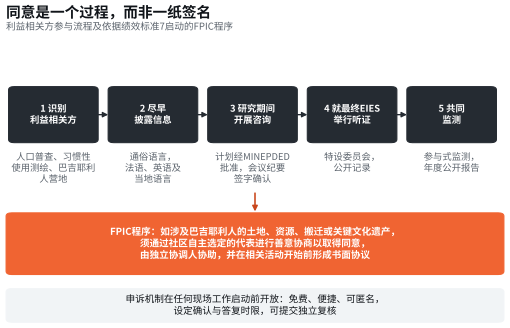
资料来源:第2013/0171/PM号法令[L02];国际金融公司绩效标准1和7 [G01];《联合国土著人民权利宣言》[G14];Cameroon Steel承诺(规划)。
英文全文 14分钟 · 3205词People and communities: the project’s social licence depends on engagement with integrity, above all with the Bagyeli
Several groups will live beside the steel complex: Batanga and Mabi coastal communities, migrants drawn by the port, women who smoke and trade fish, and Bagyeli (Bakola) communities, recognised as Indigenous Peoples under international standards. The works will occupy State land within the port domain, but that land carries a history. It was declared of public utility in 2009 and compensated under a decree of 2010. The main social risks are four:
- legacy land claims and any current users;
- effects on fishing and farming livelihoods;
- population influx, with its health and safety consequences, in the region with Cameroon’s highest HIV prevalence;
- impacts on Bagyeli lands, resources and culture.
Our approach can be stated simply: verify before we build, engage before we decide, seek consent where the standards require it, and open a grievance mechanism before any fieldwork begins.
8.1 Who lives here
Kribi is growing fast, and official figures lag behind. The 2005 census counted 29,886 people in Kribi 1er, the commune in which the industrial-port zone lies, and 40,679 in Kribi 2e, a total of 70,565 for the two communes, of whom about 59,900 lived in Kribi town [H02]. The fourth general census was completed in October 2026 with a provisional national count of about 22.7 million people; no commune results had been published at the time of writing [H10]. A press report in 2024 put the current population at about 90,000, with projections of 300,000 by 2040 [E13]. Port-driven migration since 2011 makes the 2005 figures unreliable. We found no recent official estimates by village.
The nearest mapped settlements to the steel site area are Boussibelika (about 3 to 4 km), Mbodé (about 4 to 5 km) and Mboro (about 4 to 5 km), to the west and north-west. Lolabé lies about 6 to 7 km to the south-west, and the Eboundja villages farther north [E11]. All distances are from the reference table in Annex D (Table D.1). The coastal population is mixed [B04][H05][E13]:
- Batanga families, who fish and farm;
- Mabi lineages;
- Bagyeli communities;
- migrants from other regions of Cameroon, drawn by the port and the industrial zone.
We have seen unverified local reports that Bagyeli families once lived at Mboro and were affected by the port’s land acquisition. We have not been able to confirm them, and the first task of our Indigenous Peoples screening will be to establish the facts.
What is not known matters as much as what is. There is no census of the area of influence, no household survey of livelihoods, and no map of customary land use. The assessment will begin with a census and asset inventory of the site and a surrounding band. It will add a sample survey of at least 400 households across the area of influence, with focus groups disaggregated by gender, age and community (Chapter 11).
8.2 Land: State land with a history
The land for the industrial-port complex was acquired by the State under the expropriation law. A ministerial order, Arrêté n° 156/MINDAF of 6 February 2009, declared the port project of public utility. Décret n° 2010/3312/PM of 30 November 2010 provided for compensation of the people expropriated [H03]. According to interviews reported in a 2021 academic study, the following rates applied [H03]:
- 2,000 FCFA per square metre for titled land;
- 1,500 FCFA per square metre for land in the course of registration.
By 2015, land compensation was reported to be about 90% complete, and compensation for crops, buildings and graves 100% complete [H03]. The compensation process was later the subject of public controversy over the eligibility of some claimants, reported in the national press. We have not verified those reports against primary records and do not repeat their figures. In 2023 a presidential decree delimited the port domain [K05].
Cameroonian expropriation law and IFC Performance Standard 5 differ in three important ways [L08][L09][G01]:
- customary occupants without title are compensated under national law only for their improvements, not for the land;
- crop compensation rates fixed in 2003 lag behind full replacement cost;
- national law contains no explicit obligation to restore livelihoods.
Where land was acquired by the State before a private project arrived, PS5 asks the project to review that process. If the review finds gaps against the standard, the project must address them. A project cannot rely on the fact that the State did the acquiring.
We will therefore carry out a land legacy review before any clearing. It will establish five things:
- who occupied or used the land before 2009;
- whether they were compensated, and at what rates;
- whether anyone farms, lives on or otherwise uses the land today;
- whether there are graves or sacred sites;
- whether any grievances or court cases remain open.
The review will draw on the 2009 and 2010 records held by the port authority and the land administration, on interviews in the villages, and on a census of current users. If it finds people who still use the land, we will first try to avoid displacing them through the layout. Where that is not possible, we will prepare a resettlement or livelihood restoration plan to PS5 standards: replacement-cost compensation, restoration of livelihoods to at least their previous level, and support for the vulnerable. No one will be removed by force. If the review finds legacy gaps in the original process, we will discuss with the State and the port authority how to address them, and we will report the outcome.
8.3 Livelihoods: fishing, farming and the money economy
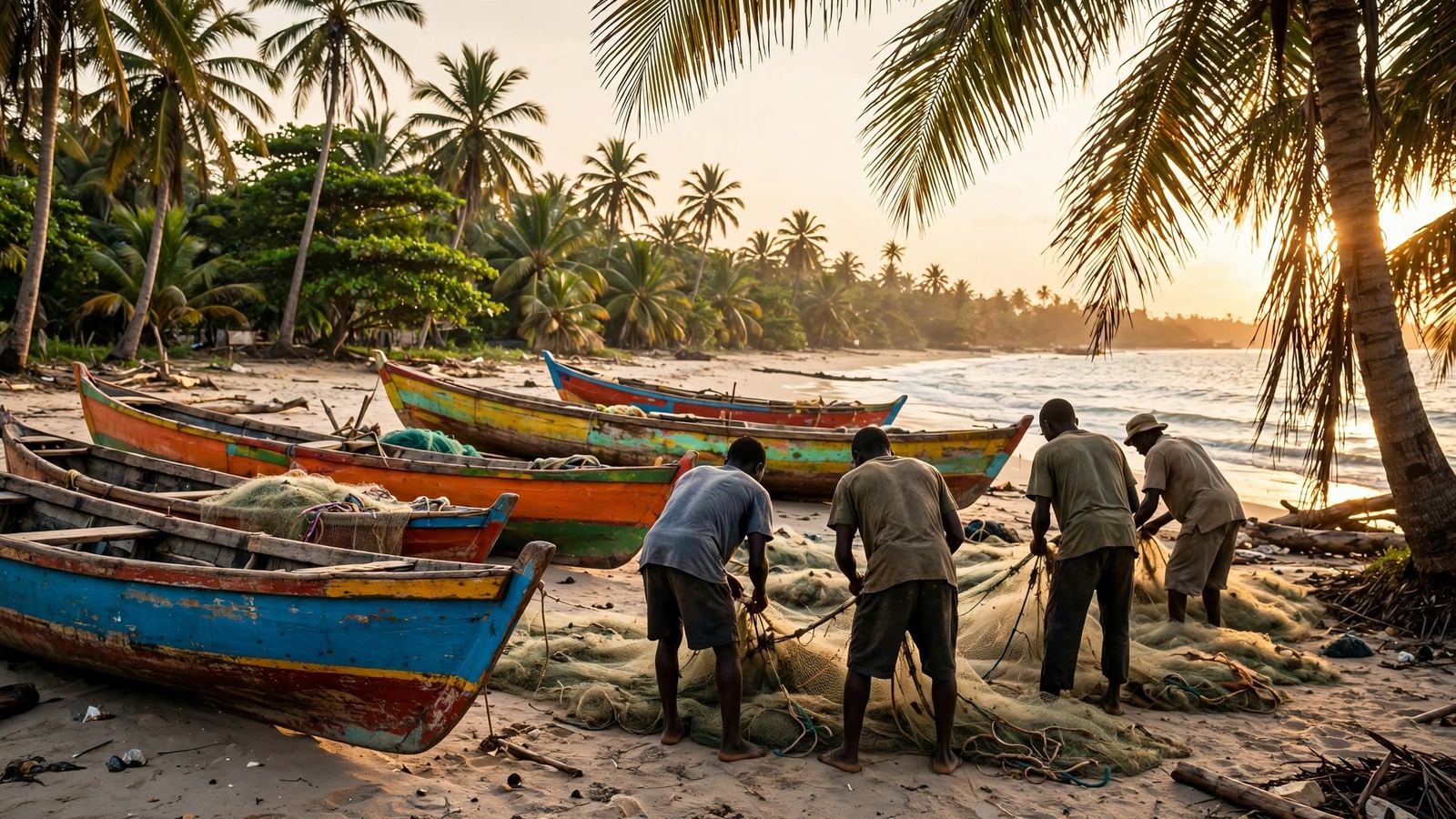
Artisanal fishing is the economic backbone of the coast. Batanga and Iyassa fishermen, and foreign fishers in some camps, catch sardinella, bonga, shrimp and lobster. Women dominate the smoking and trading of fish. Ebodjé, inside the marine park, is a community of about 3,000 people, about 80% of whom work in fishing [B05]. Fishermen interviewed in 2024 reported catches falling from about 100 to 150 kg to about 70 to 80 kg per trip over the decade since port construction began [E13]. These are personal accounts, not survey data, but they show a perceived loss that any new project will be measured against. Inland, households combine food-crop farming with cocoa and oil palm, palm wine, non-timber forest products, sand extraction and work in town.
The steel complex will not build in the sea, so its direct effect on fishing should be small. Its indirect effects are of three kinds. First, water quality in the streams and estuaries matters to fish nurseries (Chapter 5). Second, the plant will add to port traffic, through imported metallic charge and exported products. Third, and probably largest, a big project transforms the local money economy. Wages raise prices for food, rent and land. Labour moves from fishing and farming to construction. Women who process fish face rising costs while their customers’ incomes change. These effects are not inevitably negative, but they fall unevenly. The assessment will measure them by household and by gender, and the management plan will target those who lose out.
The project’s main positive contribution will be employment and purchasing. Our planning figures for Phase 1 are about 500 direct jobs in operations (range 450 to 550) and about 1,000 indirect jobs (range 800 to 1,500). A construction workforce of about 600 to 1,000 at peak is a planning assumption [X03]. Our objective is that Cameroonian nationals hold about 90% of operating jobs (range 85 to 95%) by the fifth year [X03]. We also aim to give real priority to people from the surrounding communities, backed by training that starts before construction rather than after it. Local purchasing of food, services and materials is the second channel. We will set targets and report against them (Chapter 10).
8.4 Influx, health and safety
Large projects attract more people than they employ. Job seekers, traders and service providers arrive in numbers that can exceed the workforce several times over. They put pressure on water, sanitation, housing, health services and natural resources. The IFC’s handbook on project-induced in-migration sets out how to anticipate and manage this [G11]. In Kribi, the port and the industrial zone are already driving in-migration. A steelworks will add to it, and should share the responsibility for managing it.
The health baseline makes this a first-order issue (Figure 8.1). In the 2018 Demographic and Health Survey, HIV prevalence among adults aged 15 to 49 in the South Region was 5.8%, the highest of any region, against 2.7% nationally. Malaria rapid-test positivity among children aged 6 to 59 months was 33.4% in the South Region, against 24.0% nationally [H01]. A large, mostly male construction workforce raises the risks of transmission and of gender-based violence, sexual exploitation and abuse, unless it is managed deliberately.
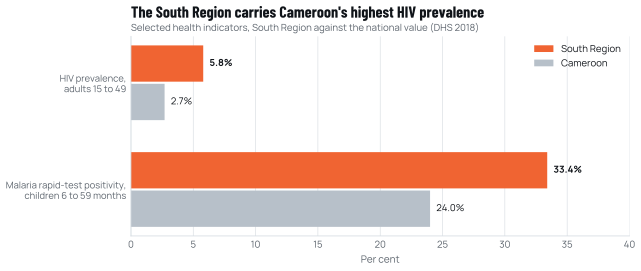
Source: INS and ICF, Enquête Démographique et de Santé du Cameroun 2018 (EDSC-V), 2020 [H01].
Our measures will follow international good practice:
- Workers’ accommodation built and run to the IFC and EBRD guidance on workers’ accommodation: fenced camps with adequate space, sanitation, catering, health care and recreation [G12].
- A worker health programme: HIV and sexually transmitted infection prevention, testing and treatment referral, malaria vector control in and around camps, and screening at recruitment.
- A code of conduct binding on every worker and contractor, prohibiting sexual exploitation and abuse. It will be backed by training, a confidential reporting channel and mapped referral services for survivors.
- An influx management plan prepared with the commune and the zone. It will cover visible local recruitment procedures, so that people do not move simply in the hope of work at the gate. It will also cover support to health and water services in the most affected villages.
Traffic is the most immediate safety risk to the public. Before any rail siding exists, the planning model estimates about 74 truck loads a day for Phase 1 and about 245 a day at full capacity, if everything moves by road [X03]. The N7 coastal road passes through villages, and children walk to school along it. We will route heavy traffic inside the port domain between the port and the plant wherever possible. We will apply journey management, speed limits and driver training to all hauliers. We will audit road safety on the routes that remain, and support crossings and signage near schools. A rail connection, if feasible, would remove most of these movements.
Two further obligations complete the picture. The hazard study and emergency plan required by law (Chapter 2) will be shared with the neighbouring communities and local authorities, and tested in joint drills. Any security personnel will be screened and trained, and their use of force will be proportionate and governed by written rules. Incidents involving the public will be reported and investigated.
8.5 Indigenous Peoples and free, prior and informed consent
The Bagyeli, also called Bakola, are forest peoples of the Océan department. They are estimated at around 4,000 people and live across about 12,000 km² in the south of Cameroon, particularly in the districts of Akom II, Bipindi, Kribi and Lolodorf [H11]. Their language, Gyele (also written Gyeli), is an endangered Bantu language with an estimated 4,000 to 5,000 speakers [H12]. Many Bagyeli live in small settlements near Bantu farming villages. They combine hunting and gathering with farming and work for their neighbours, and their rights to the land and forest they use are often not recognised [H05][H06]. The Lobé falls are associated with their beliefs, as with those of the Batanga and Mabi [B04].
Kribi’s history gives this relationship particular weight. The Chad to Cameroon oil pipeline, which ends at Kribi, crossed more than 100 km of Bagyeli lands. It came with an Indigenous Peoples Plan and with the creation of Campo-Ma’an National Park as an environmental offset [H06]. Participatory mapping by five Bagyeli communities in 2003 and 2004 found that up to 85% of the livelihood activities of one community took place within the new park’s boundaries. The same work concluded that implementation of the plan remained incomplete years later [H06]. The lesson for any new project is plain: consultation that comes late, plans that are not published and offsets designed without the people who use the land can all harm the communities they were meant to protect.
IFC Performance Standard 7 requires informed consultation and participation with Indigenous Peoples whenever they may be affected. It requires their free, prior and informed consent (FPIC) in three circumstances [G01]:
- impacts on lands and natural resources subject to traditional ownership or under customary use;
- relocation from such lands;
- significant impacts on critical cultural heritage.
The UN Declaration on the Rights of Indigenous Peoples sets the broader framework [G14]. The AfDB’s safeguard on vulnerable groups covers the same ground [G06].
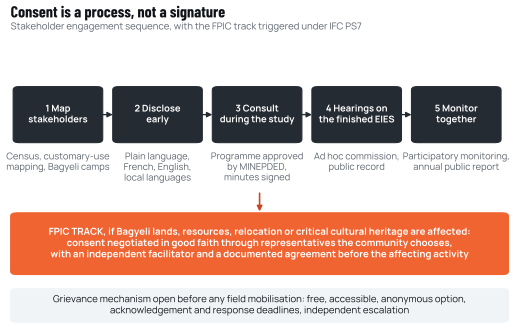
Source: Décret 2013/0171/PM [L02]; IFC Performance Standards 1 and 7 [G01]; UN Declaration on the Rights of Indigenous Peoples [G14]; Cameroon Steel commitments (planned).
Our process will be as follows (Figure 8.2).
- Early, specialised screening. An anthropologist with experience of forest peoples, working with Bagyeli organisations, will establish whether Bagyeli communities live in, use or hold cultural ties to the site or its area of influence. The screening will happen before the assessment’s other social fieldwork, so that its findings shape everything else.
- Engagement on the communities’ terms. Meetings will take place in the communities, in Gyele and French, with interpreters the communities trust. They will be held at times that fit hunting and farming calendars, and with enough time for internal deliberation.
- Representatives chosen by the communities. We will not select interlocutors. Communities will decide who speaks for them, including women.
- Consent where it is required. If the screening shows that the project would affect customary lands or resources, relocate Bagyeli people, or significantly affect critical cultural heritage, we will seek FPIC through good-faith negotiation. An independent facilitator will support the process, and its outcome will be documented. The agreement will come before the affecting activity, not after it.
- A plan the communities can hold us to. If impacts are identified, an Indigenous Peoples Plan will set out measures, benefits and monitoring in a form the communities can use. It will be published, and its implementation will be monitored independently.
The same principles will apply to our contribution to biodiversity conservation (Chapter 7). No conservation measure we support will restrict Bagyeli access to land or resources without their consent.
8.6 Gender and vulnerable groups
Impacts and benefits fall unevenly. Table 8.1 lists the groups most likely to be vulnerable and the specific measures we plan for each. The assessment will collect gender-disaggregated data and map the services available to survivors of gender-based violence before construction begins.
Table 8.1 Groups at risk and specific measures (planned)
| Group | Why vulnerable | Specific measures |
|---|---|---|
| Women fish processors and traders | Rising costs of fuelwood, fish and rent; limited access to credit and to project jobs | Livelihood support and market access; priority in canteen and catering supply; targets for women’s recruitment and training |
| Female-headed households | Lower assets and labour; greater exposure to price inflation | Identification in the census; targeted livelihood restoration if affected |
| Bagyeli communities | Insecure land rights; history of exclusion from consultation and benefits | Specialised screening; FPIC where triggered; Indigenous Peoples Plan; culturally appropriate grievance access |
| Elderly people, orphans and people living with HIV | Limited mobility and income; stigma | Health programme partnerships; accessible engagement; confidential grievance channels |
| Households affected by the 2009 to 2010 land acquisition | Possible unresolved losses | Land legacy review; corrective measures if gaps are found |
| Young job seekers | Expectations of employment; risk of exploitation by intermediaries | Visible recruitment process with no fees; training before construction; local hiring targets |
Source: desk baseline; IFC Performance Standards 1, 5 and 7 [G01]; AfDB ISS [G06]; Cameroon Steel commitments (planned).
8.7 Cultural heritage
The best-known heritage site in the area is the Chutes de la Lobé. This cultural landscape on the UNESCO Tentative List lies about 18 km north of the site [B04]. The works will not affect it directly. Our commitment not to discharge to the Lobé basin without study (Chapter 5) protects its waters. At about 18 km, the plant is unlikely to be visible from the falls; the assessment will verify this.
Closer heritage is less documented. Lineages of the Batanga and Mabi have sacred forests, graves and ancestral sites within the port domain. The region may also hold archaeological remains such as pottery and evidence of early iron-working, an apt reminder that metallurgy here is older than any modern plant. None of these is documented for the site, which is a data gap rather than evidence of absence. Before any clearing, we will commission an archaeological walkover and map sacred sites with chiefs and elders. We will adopt a chance-finds procedure that stops work at any discovery, so that it can be assessed with the competent authorities and the community concerned, as IFC Performance Standard 8 requires [G01].
8.8 A grievance mechanism that works before anything is built
A grievance mechanism is a project’s early warning system. The IFC’s good practice note sets out principles that have since become standard: proportionality, cultural appropriateness, accessibility, transparency, confidentiality and freedom from retaliation [G10]. We will open ours before any field mobilisation, so that the first contact people have with the project’s survey teams already comes with a way to complain. It will have the following features:
- several channels: a free phone and text number, community liaison officers who visit the villages, suggestion boxes and in-person meetings, in French, English and local languages including Gyele;
- an anonymous option and protection against retaliation;
- acknowledgement within 3 working days and a reasoned response within 30 days, as our objectives;
- escalation to an independent panel if the complainant is not satisfied;
- no restriction on anyone’s right to go to the administration or the courts;
- quarterly publication of statistics: numbers, categories, time to resolution and outcomes.
Workers and contractors’ employees will have a separate mechanism, as Performance Standard 2 requires. Its statistics will be published in the same way.
A land legacy review and census before any clearing. Specialised Indigenous Peoples screening before other social fieldwork, and FPIC where IFC PS7 requires it. A grievance mechanism open before field mobilisation. Workers’ accommodation and a code of conduct to international standards. Heavy traffic kept inside the port domain where possible. Local hiring and purchasing targets, published annually with gender-disaggregated data.
Other sources cited in the English text
- H02Répertoire actualisé des villages du Cameroun, 3e Recensement général de la population et de l’habitat (2005), volume IV, tome 07 (arrondissements of Kribi I and Kribi II). Bureau Central des Recensements et des Études de Population (BUCREP); copy published by the Institut National de la Statistique, Census of 2005 (report n.d.).ins-cameroun.cm/wp-content/uploads/2025/06/Repertoire_actualise_villag…
- H10Cameroun: bouclage du 4e RGPH, 22,7 millions d’habitants recensés (provisional field count). Journal du Cameroun, 5 Oct 2026.fr.journalducameroun.com/cameroun-bouclage-du-4e-rgph-227-millions-dha…
- E13As a megaport rises in Cameroon, a delicate coastal ecosystem ebbs (E. Toto). Mongabay (secondary source), 5 Apr 2024.news.mongabay.com/2024/04/as-a-megaport-rises-in-cameroon-a-delicate-c…
- E11OpenStreetMap data, Overpass API extract for the Kribi area (coastline, watercourses, roads, settlements, landuse, protected areas). OpenStreetMap contributors (ODbL), Base 24 Jul 2026; queried 10 Oct 2026.openstreetmap.org
- B04Le paysage culturel des chutes de la Lobé (Tentative List, ref. 6330). UNESCO World Heritage Centre, 2018.whc.unesco.org/fr/listesindicatives/6330/
- H05Bagyeli/Bakola documentation project: geography. DoBeS programme (Documentation of Endangered Languages), Max Planck Institute for Psycholinguistics.dobes.mpi.nl/?p=984
- H03Le port de Kribi: force ou menace pour la proposition d’inscription des chutes de la Lobé sur la liste du patrimoine mondial (academic thesis). Memoire Online, 2021.memoireonline.com/12/21/12599/m_Le-port-de-Kribi-Force-ou-menace-pour-…
- K05Le PAK tient enfin son titre foncier (presidential decree of 23 June 2023 on the port domain). Port Autonome de Kribi, 26 Jun 2023.Cited by title and date
- L08Loi n° 85/09 relative à l’expropriation pour cause d’utilité publique et aux modalités d’indemnisation. Presidency (FAOLEX copy), 4 Jul 1985.faolex.fao.org/docs/pdf/cmr1474.pdf
- L09Nachtigal Hydropower Project, ESIA update, legal and institutional chapter (Décret n° 2003/418/PM crop rates; building valuation). AECOM and Sogreah (European Investment Bank register), Sep 2011.eib.org/attachments/registers/86536111.pdf
- B05Unchecked development threatens Cameroon’s Manyange Na Elombo-Campo marine park (L. Bongben). Global Voices (secondary source), 22 Nov 2025.globalvoices.org/2025/11/22/unchecked-development-threatens-cameroons-…
- X03Cameroon Steel reference configuration RC-1 (planning estimate): planned capacities, phases, indicative schedule and benchmark-based estimates, edition of 10 October 2026. Cameroon Steel, 10 Oct 2026.Cited by title and date
- G11Projects and People: A Handbook for Addressing Project-Induced In-Migration. International Finance Corporation, Sep 2009.ifc.org/en/insights-reports/2011/handbook-for-addressing-project-induc…
- H01Enquête Démographique et de Santé du Cameroun 2018 (EDSC-V), final report FR360. Institut National de la Statistique and ICF (DHS Program), 2020.dhsprogram.com/pubs/pdf/FR360/FR360.pdf
- G12Workers’ accommodation: processes and standards. IFC and European Bank for Reconstruction and Development, Aug 2009.ifc.org/content/dam/ifc/doc/mgrt/workers-accomodation.pdf
- H12A grammar of Gyeli (N. Grimm), Comprehensive Grammar Library 2, publisher’s synopsis. Language Science Press, Berlin (open access, peer-reviewed), 2021 (accessed 11 Oct 2026).langsci-press.org/catalog/book/298
- H06Pipelines, parks, and people: Bagyeli document land use near Campo Ma’an National Park (J. Nelson and B. Tchoumba), Cultural Survival Quarterly 28-1. Cultural Survival, 2004 (web edition 7 May 2010).culturalsurvival.org/publications/cultural-survival-quarterly/pipeline…
- G06African Development Bank Group’s Integrated Safeguards System (2023). African Development Bank, 2023.afdb.org/en/documents/african-development-bank-groups-integrated-safeg…
- G10Addressing Grievances from Project-Affected Communities (Good Practice Note). International Finance Corporation, Aug 2009.ifc.org/content/dam/ifc/doc/mgrt/ifc-grievance-mechanisms.pdf
本章引用的资料来源
方括号内的标记对应以下来源(按原文语言列出),完整列表见附录。 完整来源列表
- H11The Indigenous World 2026, 40th edition (general editor D. Mamo), chapter "Cameroon" (H. Hamman Bouba), pp. 43 to 50; the figures cited are on p. 44; ISBN 978-87-93961-87-6. International Work Group for Indigenous Affairs (IWGIA), Copenhagen,2026年4月(访问于2026年10月11日).iwgia.org/images/publications/indigenous-world/indigenous-world-2026.p…
- L02Décret n° 2013/0171/PM fixant les modalités de réalisation des études d’impact environnemental et social. Prime Minister (FAOLEX copy),2013年2月14日.faolex.fao.org/docs/pdf/cmr179401.pdf
- G01Performance Standards on Environmental and Social Sustainability. International Finance Corporation,2012年1月1日.ifc.org/en/insights-reports/2012/ifc-performance-standards
- G14United Nations Declaration on the Rights of Indigenous Peoples. United Nations General Assembly,2007年9月13日.un.org/development/desa/indigenouspeoples/declaration-on-the-rights-of…
引用本章
Cameroon Steel(2026)。在克里比负责任地建设:满足四项条件,钢铁厂即可达到国际标准(中文摘要版)。白皮书07,第8章:人群与社区:项目的社会认可取决于诚信参与,首先是与巴吉耶利人的参与。CS-WP-07。https://www.cameroon-steel.com/zh/library/responsible-kribi/people-communities/
来源