White paper 08 · Skills
Cameroon can staff its steel industry if training starts before the furnace does
Steel creates skilled, lasting jobs if training pipelines and local content are built ahead of operations.
Derived Counted from the English manuscript when the site was generated; print equivalent = words ÷ 350.
You are reading the full English edition. Also online: Édition française complète中文摘要版
Executive summary
What the study shows
Read the full executive summarySkills for steel: jobs, training and local content in Cameroon’s steel industry, with an illustrative workforce plan for a phased electric arc furnace works at Kribi.
Source: white paper 08, executive summary; bracketed markers refer to the list of sources in the annex.
Main findings
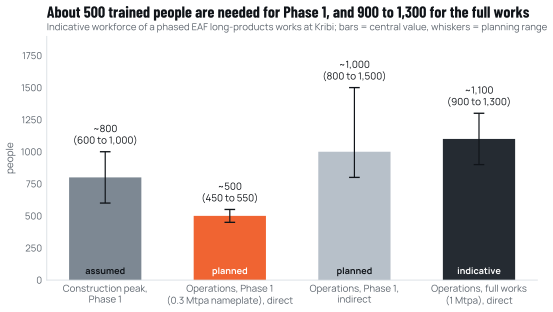
- A steelworks creates few jobs per tonne, but good ones. Direct employment ranges from about 500 to 5,000 jobs per million tonnes across published cases; Cameroon Steel’s planning values, about 1,670 per million tonnes in the first phase and about 1,100 at full capacity, sit in the middle of that range. Almost all are formal, salaried and technical, in a country where only 5.1% of workers hold a formal private-sector job [S02][S03][S05][S11][S12].
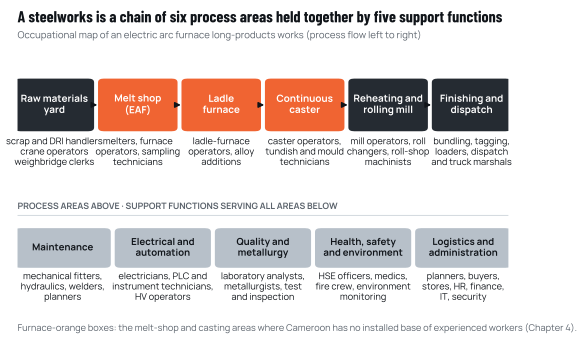
- The jobs span eleven occupational families and every level of technical education. About 60% of the planned first-phase workforce are operators, 20% technicians, 10% engineers and 10% administrative and support staff; about a quarter of all posts are in maintenance, automation, quality and safety functions whose skills transfer to the rest of the Kribi industrial cluster [S11].
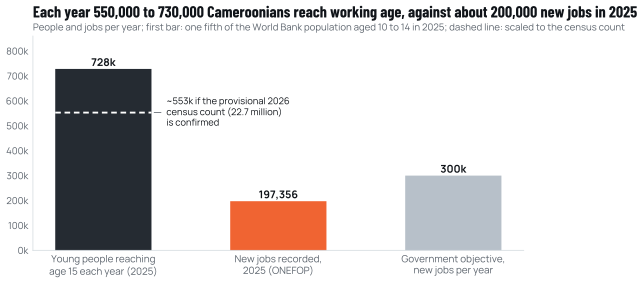
- Cameroon’s constraint is experience, not people. About 730,000 young people reach working age every year on World Bank estimates, or about 550,000 if the provisional 2026 census count of 22.7 million is confirmed, while about 197,000 new jobs were recorded in 2025. Unemployment rises with education, to 17.6% among graduates and 28.2% among women graduates [S14][S19][S17][S12]. Chapter 2 sets out the three explanations usually advanced: graduates queue for scarce formal, salaried jobs; much higher education is general rather than technical; and links between schools and employers are weak. An employer can act on all three by offering formal technical jobs in which schooling becomes competence.
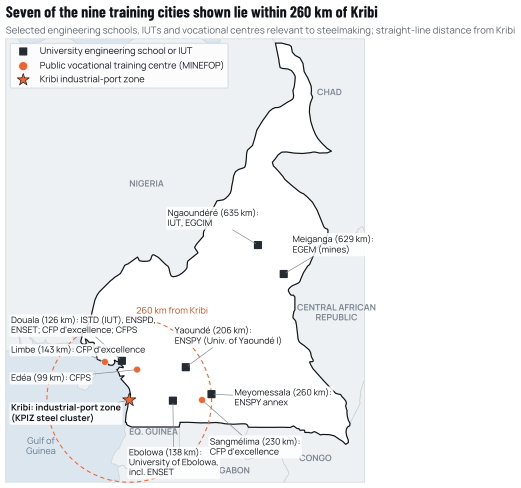
- The schools exist; steelmaking content, workshops and industry links do not. ENSPY (École nationale supérieure polytechnique de Yaoundé), the University of Douala’s engineering school and institute of technology, the University of Ngaoundéré’s institute and mining schools, the new University of Ebolowa and three vocational centres of excellence cover mechanical, electrical, chemical and maintenance disciplines, most within 260 km of Kribi. No programme dedicated to steelmaking has been identified, and 2,694 vocational trainers lack a professional diploma [S18][S21][S22][S23][S24][S28].
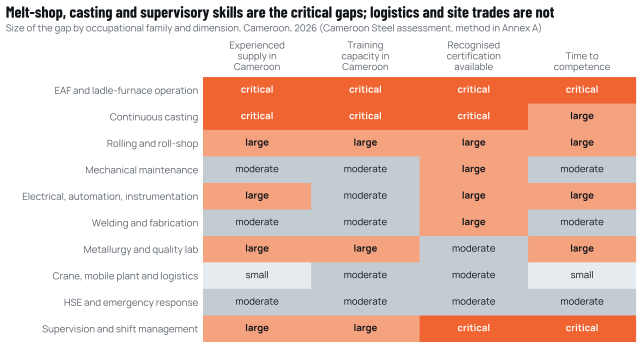
- The critical gaps are in the melt shop, the caster and supervision. Furnace and casting operation and the supervision of a 24-hour process have almost no local base and take two to ten years to form; maintenance, welding and electrical skills exist but need industrial upgrading and, above all, certification.
- Certification is the cheapest lever. International standards exist for welders (ISO 9606-1) and safety management (ISO 45001), and Law No. 2018/010 provides for apprenticeship, work-linked training and validation of experience. What is missing is a set of steel-occupation competence standards written by employers with the ministry, and a centre to test against them [S59][S58][S26].
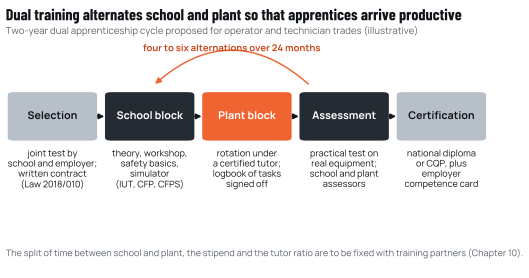
- Training models that work combine school, plant and supplier, and start early. Germany’s dual system, the corporate academies of OCP, Dangote and Tata Steel, vendor training written into equipment contracts and process simulators all point the same way: employers lead, schools certify, suppliers transfer know-how, and the pipeline opens years before production [S48][S42][S47][S43][S50].
- Cameroon’s law now ties incentives to local skills and suppliers, but preference is not capability. The 2025 investment-incentives ordinance requires a local-skills, local-hiring and local-subcontracting programme and allows commitments to be verified. Local suppliers will qualify only through structured development. Dangote Cement’s local procurement share rose from 72% to 82% between 2023 and 2025, a period in which it reports investing in supplier development; the effect of exchange-rate changes on the shares is not separated [S36][S42].
- Women are the largest untapped pool of technical talent. Women are 43.9% of Cameroon’s labour force but about 11% of steel workforces worldwide. Reaching them requires a lawful route past the 1992 Labour Code’s ban on women’s night work in industry, which mirrors ILO Convention No. 89, still in force for Cameroon; a pipeline through schools and scholarships; and facilities and conduct rules designed for a mixed workforce [S14][S51][S33][S69][S73].
- Safety must be the first skill taught. In 2021, 15.4% of workers in the South Region reported a work accident in the previous year and only 6.6% were insured; the best steel companies run below one lost-time injury per million hours. Closing that gap requires certified safety-critical authorisations, a common safety passport for the zone and supervisors who lead in the field [S12][S51].
Contents
12 chapters, 4 annexes
Every chapter opens with its conclusion. The annexes set out the method, the glossary and the list of sources.
- SummaryExecutive summary11 min · 1 fig.
- Chapter 1A steelworks creates hundreds of skilled, durable jobs and a supply chain several times larger12 min · 2 fig.
- Chapter 2Cameroon has young workers in abundance but few formal industrial jobs in which to train them12 min · 3 fig.
- Chapter 3Cameroon has the schools a steel industry needs, but not yet the metallurgy, the workshops or the industrial links11 min · 3 fig.
- Chapter 4The critical gaps are in the melt shop, the caster and supervision, and certification is the weakest link11 min · 4 fig.
- Chapter 5Training models that work combine school, plant and supplier, and start years before production11 min · 3 fig.
- Chapter 6Local content multiplies a steelworks’ jobs only if suppliers are developed, not merely preferred11 min · 3 fig.
- Chapter 7Women are 44% of Cameroon’s labour force but one steelworker in ten worldwide; a new works can do better by design11 min · 1 fig.
- Chapter 8Safety is a skill to be trained, certified and led, and in the South Region it starts from a low base11 min · 4 fig.
- Chapter 9An illustrative workforce plan: about 500 people trained before first steel, and a cascade that grows to 900 to 1,30013 min · 3 fig.
- Chapter 10Twelve actions would put a trained Cameroonian workforce in place before the first heat11 min · 1 fig.
- Chapter 11What we do not yet know, and how it will be resolved6 min
Annexes
Go further
Related white papers
- WP09Domestic steel saves foreign exchange only when it competes at border pricesEconomics · 2.9 h
- WP07Building responsibly in Kribi: a steelworks can meet international standards on four conditionsEnvironment and society · 2.8 h
- WP10Safer buildings need rebar that meets its declared gradeQuality · 2.8 h
Related Labs tools
- Careers pathfinder
Which steel career suits me, and which training should I follow in Cameroon?
- Jobs impact
How many direct, indirect and induced jobs by phase?
Cite this white paper
CS-WP-08
Cameroon Steel (2026). Cameroon can staff its steel industry if training starts before the furnace does. White paper 08, CS-WP-08. https://www.cameroon-steel.com/en/library/skills-for-steel/
- Reference
- CS-WP-08
- Edition
- 10 October 2026
- Status
- First edition
- Classification
- Public