White paper 08 · Chapter 7
Women are 44% of Cameroon’s labour force but one steelworker in ten worldwide; a new works can do better by design
Steel has been one of the most male industries in the world, and it remains so: women made up 11.4% of the workforce of the steel companies reporting to the World Steel Association in 2024 [S51]. Cameroon’s starting point is different. Women are 43.9% of its labour force [S14], and they are more likely than men to be unemployed when they hold a degree [S12]. A new steelworks therefore has a large pool of qualified women to draw on, and an opportunity that established plants do not have: to design recruitment, facilities, shift systems and culture for a mixed workforce from the start. Three obstacles stand in the way: a narrow pipeline of women in technical training, a ban on women’s night work in industry set by the 1992 Labour Code and by an ILO convention still in force for Cameroon, and workplace conditions that have historically excluded them. Each can be addressed, and the earlier the better.
In this chapter (5)
7.1 A leaking pipeline from school to steel
Figure 7.1 follows the share of women at successive points of the industrial skills pipeline. Women are 43.9% of Cameroon’s labour force on the ILO’s 2025 estimate [S14]. They were 36.6% of pupils in technical and vocational secondary streams in 2016, the latest year reported [S16], and 24.6% of tertiary graduates in science, technology, engineering and mathematics in 2023 [S16]. In steel companies worldwide, they are about one employee in nine [S51]; at Dangote Cement, an African heavy-industry group with operations in Cameroon, about one in eleven in 2025 [S42]. Germany’s dual apprenticeship system, a benchmark for industrial training, counts 35% women among its apprentices [S48], although most of them train in commercial and service occupations rather than metal trades.
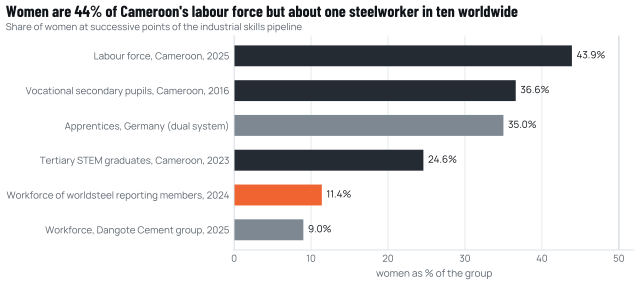
Source: World Bank, World Development Indicators (ILO modelled labour force, 2025; UNESCO Institute for Statistics enrolment and graduates) [S14][S16]; Destatis, vocational training statistics [S48]; worldsteel, Sustainability Indicators 2025 [S51]; Dangote Cement Plc, Annual Report 2025 [S42].
Several features of Cameroon’s labour market sharpen the picture:
- Lower participation. On ILO modelled estimates, 56.6% of women aged 15 and over were in the labour force in 2025, against 73.9% of men [S14]. The national survey shows the same gap for persons aged 14 and over: 47.3% of women and 61.4% of men [S12].
- Fewer women in vocational training. In 2021, 21.6% of women aged 14 and over had followed vocational training, against 28.6% of men [S12].
- Higher unemployment among educated women. 28.2% of women with higher education were unemployed in 2021, against 12.1% of men; in urban areas, 31.5% of women aged 20 to 24 were unemployed [S12].
- More young women outside work and education. On the ILO’s harmonised measure, 30.4% of young women were not in employment, education or training in 2021, twice the rate for young men (14.7%) [S14].
The fourth point is the most important for an employer. A large number of young Cameroonian women with secondary or higher education are not working. Many of them have studied sciences or technical subjects; many more could do so if they saw a realistic path into industrial careers.
7.2 What keeps women out of steel
Barriers to women’s employment in heavy industry are well documented internationally, and most apply in Cameroon. They can be grouped into five families.
The law on night work. Cameroon’s Labour Code, Law No. 92/007 of 14 August 1992, defines night work as work between 10 p.m. and 6 a.m. and provides that "the night work of women and children is prohibited in industry", with exceptions for women in supervisory positions and in services that do not involve manual work (articles 81 and 82, Cameroon Steel translation) [S33]. It also provides that an order of the Minister of Labour sets the kinds of work prohibited to women and to pregnant women (article 83) [S33]. A steelworks runs continuously, so operator and maintenance roles in production areas are organised in rotating shifts that include nights. Read literally, the 1992 provision would confine women to day work, supervisory posts or non-manual services, and keep them out of the operator roles that form the base of every career ladder in Figure 4.2. The provision is not only domestic. Cameroon ratified the ILO Night Work (Women) Convention (Revised), 1948 (No. 89) on 25 May 1970, and it remains in force for the country [S73]. Its article 3 prohibits the night employment of women in industrial undertakings, and its article 8 exempts women in responsible managerial or technical positions and in health and welfare services not ordinarily engaged in manual work, the same exceptions as the Labour Code [S69]. International standards have since moved towards protecting all night workers rather than excluding women. The 1990 Protocol to Convention No. 89 allows national laws, adopted after consulting employers’ and workers’ organisations, to introduce exemptions from the prohibition, with protection of at least 16 weeks around childbirth [S72]; the Night Work Convention, 1990 (No. 171) protects all night workers [S70]. Cameroon has ratified neither [S74]. Convention No. 89, which the ILO classifies as an instrument with interim status, can next be denounced between 27 February 2031 and 27 February 2032 [S69]. The practical route before a 2030 start-up is therefore the ratification of the 1990 Protocol and an implementing regulation; this is a decision for the Ministry of Labour and Social Security with the social partners, and the current application of article 82 is listed in Chapter 11.
The training pipeline. Few girls enter technical secondary streams in mechanics or electrical work, and few women graduate in engineering; those who do often go into civil engineering, IT or services. Without deliberate outreach, a recruitment campaign for melt-shop operators and maintenance technicians will attract very few women applicants.
Workplace facilities and equipment. Plants designed for men often lack separate changing rooms, showers and toilets for women in production areas, and personal protective equipment is often available only in men’s sizes. Ill-fitting equipment is a safety issue, not a matter of comfort.
Safety from harassment and violence. Heavy-industry sites, and construction sites in particular, carry risks of sexual harassment and gender-based violence, which deter women and harm those who stay. The ILO’s Violence and Harassment Convention, 2019 (No. 190), in force since 25 June 2021, recognises the right to a world of work free from violence and harassment, including gender-based violence [S71]; Cameroon has not ratified it [S74]. The International Finance Corporation’s Performance Standard 2, which applies to projects financed by development finance institutions, requires employers to base employment decisions on equal opportunity and fair treatment and to take measures against harassment [S57]. Cameroon’s South Region has an HIV prevalence of 5.8% among adults aged 15 to 49, the highest of any region in the 2018 health survey [S61], which adds a public-health dimension to managing a construction workforce responsibly.
Family responsibilities and transport. Shift work is harder for workers who carry most of the care for children and relatives. Cameroon’s Labour Code already provides for maternity protection and for daily breastfeeding breaks of up to one hour during the 15 months after birth (article 85) [S33]; practical measures such as predictable rosters, safe transport for night shifts and access to childcare determine whether women can stay in shift-based careers.
Table 7.1 Barriers to women’s employment in a steelworks and practical measures
| Barrier | Effect | Measures for a Kribi works | Lead |
|---|---|---|---|
| Labour Code, art. 82, and ILO Convention No. 89 (in force): night work of women prohibited in industry, with exceptions | Excludes women from rotating-shift operator roles | Ratify the 1990 Protocol to Convention No. 89 and adopt a regulation allowing night work with protective measures for all night workers | Ministry of Labour, employers, unions |
| Few women in technical streams and engineering | Very few women applicants for technical roles | School outreach; scholarships for girls in mechanics, electrical and process programmes; women mentors from industry | Employer, schools, MINESEC, MINESUP |
| Recruitment practices | Implicit bias; job adverts aimed at men | Gender-neutral job descriptions; aptitude-based tests; mixed selection panels; objectives for women in each intake | Employer |
| Facilities and PPE designed for men | Discomfort and safety risks | Separate facilities in all production areas; PPE in women’s sizes; ergonomic review of tasks | Employer, designers, suppliers |
| Harassment and gender-based violence | Women leave or never apply; harm to workers | Code of conduct for employees and contractors; confidential grievance channel; training for supervisors; zero-tolerance enforcement | Employer, contractors |
| Shift work and family responsibilities | Women leave shift careers | Predictable rosters; safe night transport; childcare partnerships; maternity and breastfeeding provisions applied in full | Employer |
| Few women role models in steel | Low aspiration and retention | Visible women in technical and leadership roles; women’s network; career-path monitoring | Employer |
Source: Cameroon Steel analysis; legal references from Law No. 92/007 [S33]; standards from IFC Performance Standard 2 [S57] and ILO instruments [S69][S71][S72]; ratification status from ILO NORMLEX [S73][S74].
7.3 What has worked elsewhere
Employers in other heavy industries have combined targeted training, visible role models and changes to working conditions; the examples below illustrate the approach, although none publishes an evaluation of its effect on women’s participation.
- Tata Steel, the Indian steel producer, runs scholarship programmes for women in engineering colleges to create a pipeline into the company [S44] and in 2023 introduced its first batch of women firefighter trainees, a role traditionally reserved for men [S45].
- Mohammed VI Polytechnic University, owned by Morocco’s OCP group through its foundation [S47], has committed with the Mastercard Foundation to support 575 young African women scholars over ten years, in a partnership announced in January 2025 [S46][S79].
- Dangote Cement reports women’s representation by country; in its Cameroonian subsidiary, 84 of 272 employees (31%) were women in 2025, well above the group average of about 9% [S42]. That is a reminder that local employers in Cameroon already reach far higher shares than the global steel average.
The lesson common to these cases is that inclusion is cheaper to design in than to retrofit. Changing rooms and toilets are a minor cost on a new building and an expensive alteration on an old one; a recruitment campaign that targets women from the first intake creates role models for the second; a code of conduct written into construction contracts protects women from the first day on site.
7.4 Keeping women in technical careers
Recruiting women into a steelworks is the first step; keeping them, and seeing them promoted, is the harder one. Steel companies publish little on this, but mining, the closest heavy industry with published evidence, offers a guide: in a 2021 survey of more than 1,000 mining employees in 52 countries, the 549 women who responded were most likely to plan to leave, or to be undecided, before reaching middle management, and most often cited fewer growth opportunities than male colleagues, work that no longer interested them, the lack of a sponsor or mentor and not fitting into the culture [S81]. The strain of shift work combined with family responsibilities, discussed above, adds to these risks. Several measures address them at low cost; their effect at Kribi should be measured rather than assumed.
- Cohorts rather than individuals. Women recruited in groups into the same area and crew are less likely to be isolated, which should help retention. Apprenticeship and operator intakes should be organised accordingly.
- Mentoring and networks. Each woman entering a technical role should have a mentor, and a women’s network across the plant and the zone can give visibility, peer support and a channel for raising problems early.
- Transparent progression. Promotion criteria based on certified competence, as proposed in Chapter 4, reduce the scope for bias and give women a visible path from operator to supervisor.
- Equal pay, verified. Pay should be set by role and grade and reviewed for gender gaps. Dangote Cement, for example, reports a male-to-female remuneration ratio of one to one across employment categories [S42].
- Maternity and return to work. Full application of the Labour Code’s maternity and breastfeeding provisions [S33], with temporary transfer to day work or non-exposed tasks during pregnancy where needed and a structured return to shift work afterwards, keeps trained women in the workforce.
The labour-market data show why these measures matter in Cameroon. Among young people aged 15 to 34, the employment rate was 47.2% for men and only 31.3% for women in 2021 [S13]. Young women have fewer alternatives in formal work than young men, so a technical job is worth more to them; whether that translates into better retention is a hypothesis to test with the indicators in Section 9.8.
7.5 Objectives for a new works
Cameroon Steel proposes the following objectives for its phased works, as illustrative targets to be refined with training partners and reported publicly:
- Apprenticeship and graduate intakes: at least one place in four filled by a woman in each intake of the dual apprenticeship and the graduate engineering programme.
- Direct workforce: women at least 15% of the direct workforce by the fifth year of operation, above the 11.4% average of worldsteel’s reporting members [S51], with women in operator, technician and engineering roles, not only in administration.
- Leadership: at least one woman among the successors identified for each senior technical post.
- Contractors: the same code of conduct, grievance channel and facilities standards applied to contractors during construction and operation.
These objectives are modest by the standards of some industries, and ambitious by the standards of steel. They are deliberately set at a level that requires change in recruitment and training rather than in reporting. If they are met, a Kribi steelworks would employ a larger share of women than most steel plants in the world, in a country whose educated young women are among those most in need of formal technical jobs.
Sources cited in this chapter
Bracketed markers refer to these sources; the full list is in the annex. Full list of sources
- S14World Development Indicators, Cameroon: population by age, labour force, ILO modelled labour indicators, Human Capital Index. World Bank, upd. 8 Oct 2026.api.worldbank.org/v2/country/CMR/indicator/SL.UEM.TOTL.ZS?format=json
- S16Education indicators (UNESCO Institute for Statistics) via World Development Indicators: enrolment, vocational share, graduates by field, attainment, spending. World Bank and UNESCO UIS, upd. 8 Oct 2026.api.worldbank.org/v2/country/CMR/indicator/SE.SEC.ENRL.VO.ZS?format=js…
- S51Sustainability indicators (2025 report; 2022 to 2024 data). World Steel Association.worldsteel.org/wider-sustainability/sustainability-indicators/
- S42Annual Report and Accounts 2025. Dangote Cement Plc, Jun 2026.cement.dangote.com/wp-content/uploads/2026/06/Dangote-Cememt-Plc-2025-…
- S48Vocational training (theme page and press release of 12 April 2023 on new apprenticeship contracts in 2022). Federal Statistical Office of Germany (Destatis).destatis.de/EN/Themes/Society-Environment/Education-Research-Culture/V…
- S12Troisième enquête sur l’emploi et le secteur informel (EESI3), phase 1: enquête emploi, rapport principal (2021 data; Tables 2.9, 3.7, 3.24 and 4.1 are cited). Institut national de la statistique (INS), Cameroon, Nov 2023 (file of Jul 2025).ins-cameroun.cm/wp-content/uploads/2025/07/EESI3_Rapport-principal_Emp…
- S33Loi n° 92/007 du 14 août 1992 portant Code du travail. Republic of Cameroon (FAOLEX copy), 14 Aug 1992.faolex.fao.org/docs/pdf/cmr198304.pdf
- S73Ratifications for Cameroon (51 conventions; No. 89 ratified 25 May 1970 and No. 155 ratified 1 Oct 2021, both in force). ILO, NORMLEX.normlex.ilo.org/dyn/nrmlx_en/f?p=NORMLEXPUB:11200:0::NO::P11200_COUNTR…
- S69Night Work (Women) Convention (Revised), 1948 (No. 89): text and key information (interim status; may be denounced 27 Feb 2031 to 27 Feb 2032). International Labour Organization (ILO), NORMLEX.normlex.ilo.org/dyn/nrmlx_en/f?p=NORMLEXPUB:12100:0::NO::P12100_ILO_CO…
- S72Protocol of 1990 to the Night Work (Women) Convention (Revised), 1948. ILO, NORMLEX.normlex.ilo.org/dyn/nrmlx_en/f?p=NORMLEXPUB:12100:0::NO::P12100_ILO_CO…
- S70Night Work Convention, 1990 (No. 171): text and key information. ILO, NORMLEX.normlex.ilo.org/dyn/nrmlx_en/f?p=NORMLEXPUB:12100:0::NO::P12100_ILO_CO…
- S74Up-to-date Conventions and Protocols not ratified by Cameroon (including Nos. 167, 171, 174, 187 and 190 and the Protocol of 1990 to No. 89). ILO, NORMLEX.normlex.ilo.org/dyn/nrmlx_en/f?p=1000:11210:0::NO:11210:P11210_COUNTRY…
- S71Violence and Harassment Convention, 2019 (No. 190): text and key information (in force 25 Jun 2021). ILO, NORMLEX.normlex.ilo.org/dyn/nrmlx_en/f?p=NORMLEXPUB:12100:0::NO::P12100_ILO_CO…
- S57Performance Standard 2: Labor and Working Conditions. International Finance Corporation, 1 Jan 2012.ifc.org/content/dam/ifc/doc/2010/2012-ifc-performance-standard-2-en.pd…
- S61Enquête démographique et de santé du Cameroun 2018 (EDSC-V), final report FR360. INS and ICF (DHS Program), 2020.dhsprogram.com/pubs/pdf/FR360/FR360.pdf
- S44Diverse workforce (careers). Tata Steel.tatasteel.com/careers/culture-at-tata-steel/diverse-workforce/
- S45Tata Steel introduces first batch of women fire fighter trainees (The Avenue Mail). Tata Steel newsroom, 9 Sep 2023.tatasteel.com/media/newsroom/in-the-news/2023/tata-steel-introduces-fi…
- S47OCP SA, UM6P Project (project summary: ownership, Benguerir campus, enrolment). Multilateral Investment Guarantee Agency (MIGA), World Bank Group, 2021.miga.org/project/ocp-sa-um6p-project
- S46Mastercard Foundation Scholars Program at UM6P (575 scholars over ten years). Université Mohammed VI Polytechnique (UM6P).um6p.ma/en/mastercard-foundation-scholars-program-um6p
- S79Le programme de bourses de la Fondation Mastercard accélère son impact avec trois nouveaux partenariats en Afrique. Mastercard Foundation, Jan 2025.mastercardfdn.org/fr/articles/le-programme-de-bourses-de-la-fondation-…
- S81Why women are leaving the mining industry and what mining companies can do about it (H. Ellix, K. Farmer, L. Kowalik et al.; survey of more than 1,000 mining employees in 52 countries). McKinsey & Company, Metals & Mining Practice, Sep 2021.mckinsey.com/industries/metals-and-mining/our-insights/why-women-are-l…
- S13EESI3 Phase 1: Employment Survey, main report (key indicators page). INS, Cameroon, 1 Nov 2023.ins-cameroun.cm/en/?p=17601
Cite this chapter
Cameroon Steel (2026). Cameroon can staff its steel industry if training starts before the furnace does. White paper 08, chapter 7: Women are 44% of Cameroon’s labour force but one steelworker in ten worldwide; a new works can do better by design. CS-WP-08. https://www.cameroon-steel.com/en/library/skills-for-steel/women-in-heavy-industry/
Source