White paper 08 · Chapter 3
Cameroon has the schools a steel industry needs, but not yet the metallurgy, the workshops or the industrial links
Cameroon’s education system already produces most of the profiles a steelworks employs: mechanical, electrical and industrial engineers from its polytechnic schools, maintenance and automation technicians from its institutes of technology, and tradespeople from technical secondary schools and vocational centres. Most of that capacity lies within 260 km of Kribi. What the system lacks is specific: no programme dedicated to ferrous metallurgy and steelmaking has been identified, practical training on industrial-scale equipment is scarce, many vocational trainers have never worked in industry, and links between schools and employers are thin. These are gaps that targeted partnerships can close in the three years before a melt shop starts, provided they begin now.
In this chapter (6)
- 3.1 Three tiers of supply feed an industrial workforce
- 3.2 Engineering schools and institutes of technology cover the core disciplines
- 3.3 No programme yet forms steelmakers
- 3.4 Vocational training is legally modern but under-equipped
- 3.5 Secondary technical education is the base of the operator pipeline
- 3.6 Capacity is adequate in volume; relevance and practice are the constraints
3.1 Three tiers of supply feed an industrial workforce
Industrial skills in Cameroon come from three systems under three ministries. Secondary general and technical education, under the Ministry of Secondary Education (MINESEC), enrolled about 2.0 million pupils in 2023 [S16]. The latest internationally reported figure for technical and vocational streams within secondary education is 477,192 pupils in 2016, 21.6% of secondary enrolment, of whom 36.6% were girls [S16]. Vocational training proper, under the Ministry of Employment and Vocational Training (MINEFOP), runs public and approved private centres that award trade certificates. Higher education, under the Ministry of Higher Education (MINESUP), enrolled 330,793 students in 2018, the latest reported total, and the gross tertiary enrolment ratio reached 16.7% in 2024 [S16].
The balance between these tiers is not tilted towards industry. The latest available breakdown of tertiary graduates by field, for 2010, showed only 4.3% graduating in engineering, manufacturing and construction [S16]. Public spending on education was 2.8% of GDP in 2023 and 13.8% of government expenditure in 2024 [S16], so expansion will have to come from better use of existing institutions and from employer co-financing rather than from large new budgets.
Figure 3.1 locates the institutions most relevant to steelmaking. Seven of the nine cities shown lie within 260 km of Kribi in a straight line: Douala, Limbe, Edéa, Yaoundé, Ebolowa, Sangmélima and Meyomessala. The two northern centres, Ngaoundéré and Meiganga, host the country’s chemical-engineering and mining schools.
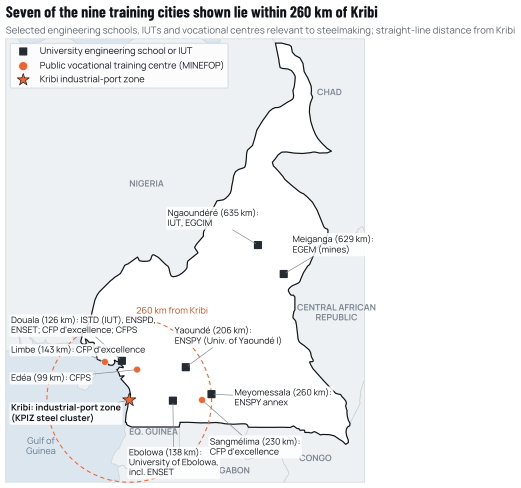
Source: Drawn by Cameroon Steel from Natural Earth admin-0 boundaries (public domain); institutions from ENSPY [S18], Université de Douala [S20], ISTD Douala [S21], Université de Ngaoundéré [S22], Université d’Ebolowa [S23], Business in Cameroon, 20 December 2016 [S24] and AFD [S25]. City locations from OpenStreetMap [S75]; distances are Cameroon Steel arithmetic.
3.2 Engineering schools and institutes of technology cover the core disciplines
ENSPY. The polytechnic engineering school of the University of Yaoundé I was created in 1971 and has trained engineers for more than five decades [S18]. Its departments include industrial and mechanical engineering (GIM), electrical engineering and telecommunications (GET), civil and urban engineering, computer engineering, and modelling and industrial applications [S18]. For the 2026 to 2027 academic year, ENSPY opened an entrance competition for an annex at Meyomessala, in the South Region [S18], the first polytechnic presence in the region that hosts Kribi.
University of Douala. Cameroon’s economic capital hosts three relevant schools: the École nationale supérieure polytechnique de Douala (ENSPD), the École normale supérieure d’enseignement technique (ENSET), which trains technical teachers, and the Institut supérieur de technologie (ISTD), formerly the university’s institute of technology [S20]. The ISTD’s departments include mechanical and production engineering (GMP), industrial engineering and maintenance (GIM), electrical engineering and industrial computing (GEII) and thermal engineering (GTE), and it reports more than 3,000 students [S21]. These four departments correspond almost exactly to the technician profiles of a steelworks’ maintenance, automation and reheating-furnace crews.
University of Ngaoundéré. Its institute of technology, opened in 1993, has departments of mechanical, electrical, energy, chemical and computer engineering and of food engineering and quality control [S22]. The university also runs the École de géologie et d’exploitation minière (EGEM) at Meiganga and the École de génie chimique et des industries minérales (EGCIM) at Ngaoundéré [S22], which form mining and mineral-processing engineers relevant to a future direct-reduction module using Cameroonian ore.
University of Ebolowa. Created by Decree No. 2022/009 of 6 January 2022 as one of three new State universities, with its seat at Ebolowa in the South Region, it installed its first rector and board chair in August 2022 [S23][S77]. Its establishments include faculties of medicine, law and science, an École normale supérieure d’enseignement technique (ENSET) that trains technical teachers, and a higher institute of agriculture, wood, water and environment (ISABEE) [S23]. It is the natural academic partner for Kribi: close to the site, technically oriented, and still shaping its programmes.
Table 3.1 Institutions relevant to a steel workforce, with steel-relevant programmes
| Institution | Location (distance from Kribi) | Tier | Programmes relevant to steelmaking | Source |
|---|---|---|---|---|
| ENSPY, University of Yaoundé I | Yaoundé (206 km); annex at Meyomessala (260 km) | Engineering school | Industrial and mechanical; electrical; civil; computer; industrial modelling | [S18] |
| ENSPD, University of Douala | Douala (126 km) | Engineering school | Engineering programmes of the Douala polytechnic | [S20] |
| ISTD (former IUT), University of Douala | Douala (126 km) | Institute of technology | Mechanical and production; industrial maintenance; electrical and industrial computing; thermal | [S21] |
| ENSET Douala, University of Douala | Douala (126 km) | Teacher-training school | Trains teachers for technical schools and centres | [S20] |
| IUT, University of Ngaoundéré | Ngaoundéré (635 km) | Institute of technology | Mechanical; electrical; energy; chemical; computer; quality control | [S22] |
| EGEM and EGCIM, University of Ngaoundéré | Meiganga (629 km); Ngaoundéré | Engineering schools | Mining, mineral processing, chemical engineering | [S22] |
| University of Ebolowa (incl. ENSET Ebolowa) | Ebolowa (138 km) | University | Technical teacher training (ENSET); agriculture, wood, water and environment (ISABEE) | [S23] |
| Centres de formation professionnelle d’excellence (MINEFOP) | Douala, Limbe (143 km), Sangmélima (230 km) | Vocational | 14 trades including mechanics and electricity and electronics | [S24] |
| Centres de formation professionnelle sectoriels (CFPS) | Douala; Edéa (99 km) | Vocational, employer-managed | Industrial maintenance; transport and logistics; agro-food | [S25] |
Source: as listed. Distances are straight-line from Kribi. The table is selective: it lists institutions verified for this paper, not every school in Cameroon.
3.3 No programme yet forms steelmakers
The departments listed above cover mechanical, electrical, chemical, mining and industrial engineering, but none of the institutions reviewed for this paper offers a programme dedicated to ferrous metallurgy, steelmaking or casting [S18][S21][S22]. Materials science is taught within mechanical and chemical programmes, and mining schools teach mineral processing up to the concentrate. The step that turns ore or scrap into liquid steel, refines it and solidifies it, the core of a melt shop, is not taught anywhere in the country as a discipline. This is consistent with Cameroon’s industrial history: its steel firms mainly re-roll imported billets, with only a few small melt shops [S08], so domestic demand for melt-shop engineers has been too small to justify a programme.
The gap is narrower than it looks. A good mechanical, chemical or materials engineer can become a competent steelmaking engineer within two to three years through a structured programme combining a specialised module, placement in an operating melt shop abroad and plant-specific training from equipment suppliers. What Cameroon needs is not a new university, but a steelmaking specialisation embedded in existing engineering and IUT programmes, taught partly by industry practitioners and linked to placements. Chapter 5 describes models that have done this elsewhere, and Chapter 10 proposes how to do it at ENSPY, ENSPD and the University of Ebolowa.
3.4 Vocational training is legally modern but under-equipped
Cameroon’s vocational training is governed by Law No. 2018/010 of 11 July 2018, a text of 55 articles in seven chapters [S26]. It provides for apprenticeship under a written contract between a master and an apprentice from the age of 14 (articles 22 and 23), for work-linked training ("formation par alternance") under agreements between training centres and enterprises (articles 24 to 26), for the validation of acquired experience as a right (articles 37 to 39) and for employers’ organisations to take part in designing and implementing training policy (articles 45 and 46) [S26]. Decree No. 2020/2592/PM of 9 June 2020 sets the rules for establishing, organising and running vocational training and learning centres [S27]. The legal basis for dual training with industry therefore exists; what has been missing is the industry.
Three recent investments show what modern provision looks like:
- Centres of excellence. Three Centres de formation professionnelle d’excellence, built with South Korean financing at a cost of about FCFA 24 billion, were commissioned in December 2016 in Douala, Limbe and Sangmélima. They train in 14 trades, including mechanics and electricity and electronics [S24].
- Employer-managed sectoral centres. The French Development Agency (AFD) financed a €15 million programme, from December 2014 to June 2020, to train skilled workers and technicians in growth trades, including industrial maintenance, through Centres de formation professionnelle sectoriels in the Douala and Edéa employment areas, managed by the private sector with the employers’ association GICAM. The design target was 1,200 initial trainees and 800 continuing-training trainees a year, with continuing modules of about ten days [S25].
- A financing instrument. Since the 2023 Finance Law, employers of foreign workers pay a levy on the work-contract visa equal to two months of gross salary for non-African workers, and to one month, at half rate, for African workers; the government has said the revenue will finance vocational training [S30][S31]. Collection reached about FCFA 5 billion in 2023, against an objective of FCFA 14 billion [S31].
The weaknesses are equally clear. MINEFOP’s own analysis, reported in January 2026, found 2,694 trainers in vocational centres without any professional diploma, and 60% of the trainers who do hold higher degrees working as temporary staff [S28]. In December 2024 the minister estimated that transforming a traditional training centre into a modern one costs FCFA 2 to 3 billion, that the ministry’s 2025 budget was FCFA 33.1 billion, and that existing resources covered less than 6% of the transformation objective [S29]. Survey data confirm the consequence: of the quarter of Cameroonians aged 14 and over who have followed vocational training, 39.3% learned on the job and only 18.9% in an institute or centre [S12].
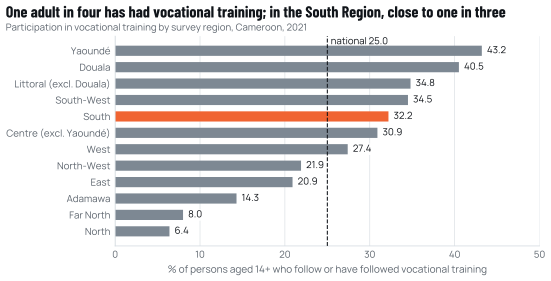
Source: INS, EESI3 Phase 1, main employment report, Table 2.9 [S12].
The South Region does relatively well on this measure: 32.2% of its adults have followed vocational training, against 25.0% nationally, and a larger share than elsewhere did so at secondary and post-secondary level [S12]. A Kribi employer can build on that base, and on the centre of excellence at Sangmélima, rather than start from nothing.
3.5 Secondary technical education is the base of the operator pipeline
Most of the operators and many of the technicians of a steelworks will enter with a secondary technical qualification or a vocational certificate. The breadth of that base matters. The gross enrolment ratio in secondary education was 44.8% in 2023, and 42.5% for girls [S16]. Among adults aged 25 and over, 14.3% had completed at least upper-secondary education and 6.4% held at least a bachelor’s degree or equivalent in 2018; adult literacy was 72.6% [S16]. The World Bank’s Human Capital Index, which estimates the productivity a child born today can expect to reach given education and health conditions, stood at 0.40 for Cameroon in 2020 [S14].
These figures argue for two design choices. First, selection for operator roles should rely on aptitude tests in reading, numeracy and mechanical reasoning, because diplomas vary widely in what they certify. Second, initial training must include a foundation module, covering technical reading, measurement, basic electricity and mechanics, safety and teamwork, before plant-specific content. Technical teachers trained at ENSET Douala and ENSET Ebolowa are the people best placed to deliver that module, if they themselves are given industrial placements [S20][S23].
Technical secondary schools also matter for the long term. The proportion of secondary pupils in technical and vocational streams, 21.6% in 2016 [S16], is the pool from which apprentices and IUT students will be drawn for each later phase of the works. Careers information in those schools, plant visits and scholarships for the best pupils, especially girls, would widen the pipeline at very low cost (Chapter 10).
3.6 Capacity is adequate in volume; relevance and practice are the constraints
Set against these institutions, the first-phase need of a steelworks is modest in volume: about 300 operators, 100 technicians and 50 engineers, plus support staff, recruited over two to three years [S11]. The ISTD alone enrols more than 3,000 students [S21]; ENSPY has graduated engineers for more than five decades [S18]; the three centres of excellence and the sectoral centres train in mechanics, electricity and industrial maintenance every year [S24][S25]. The issue is not whether Cameroon can produce enough graduates for one plant; it is whether those graduates arrive with the right content, enough hands-on practice and a recognised certificate.
Four constraints recur in the evidence:
- Content. No steelmaking or casting content; little high-temperature process control; limited exposure to industrial automation platforms of the type used in modern mills.
- Equipment. Workshops sized for teaching, not for industrial practice; no melt-shop or caster simulators; limited access to electrical and hydraulic test benches of industrial scale.
- Trainers. Many trainers lack diplomas or industrial experience, and many are temporary [S28]; the technical teacher-training schools (ENSET Douala and ENSET Ebolowa) are the lever to change this [S20][S23].
- Links with industry. Few formal employers offer placements, and the share of firms offering formal training fell to 24.0% in 2024 (Chapter 4) [S15].
The policy response follows from this diagnosis. Rather than building new institutions, a Kribi steel skills partnership should equip and staff existing ones: a steelmaking specialisation at the engineering schools, an industrial-maintenance and automation track with plant placements at the ISTD and the centres of excellence, a trainer-upskilling programme through ENSET, and a dual apprenticeship with the employer in the South Region. Chapter 4 identifies the precise skills to target; Chapter 5 shows how others have done it.
Sources cited in this chapter
Bracketed markers refer to these sources; the full list is in the annex. Full list of sources
- S16Education indicators (UNESCO Institute for Statistics) via World Development Indicators: enrolment, vocational share, graduates by field, attainment, spending. World Bank and UNESCO UIS, upd. 8 Oct 2026.api.worldbank.org/v2/country/CMR/indicator/SE.SEC.ENRL.VO.ZS?format=js…
- S18École nationale supérieure polytechnique de Yaoundé: presentation (created in 1971), departments and 2026 to 2027 entrance competition (Meyomessala annex). ENSPY.polytechnique.cm/
- S20Université de Douala: schools and institutes. Université de Douala.univ-douala.cm/
- S21Institut supérieur de technologie de Douala (ISTD): departments and key figures. ISTD, Université de Douala.iut-dla.cm/
- S22Établissements; Institut universitaire de technologie (identification sheet). Université de Ngaoundéré.univ-ndere.cm/fr/etablissements/
- S23Cameroun: les nouveaux responsables de l’université d’Ebolowa prennent fonctions. Journal du Cameroun, 23 Jul 2024.fr.journalducameroun.com/cameroun-les-nouveaux-responsables-de-luniver…
- S24Cameroon inaugurates 3 excellence training centres of FCFA 24 billion built by South Korea. Business in Cameroon, 20 Dec 2016.businessincameroon.com/cooperation/2012-6783-cameroon-inaugurates-3-ex…
- S25Former des ouvriers et techniciens qualifiés dans des métiers porteurs (project page). Agence française de développement.afd.fr/fr/projets/former-des-ouvriers-et-techniciens-qualifies-dans-de…
- S75OpenStreetMap place data for the ten cities of Figure 3.1, retrieved through the Nominatim geocoder (Open Database Licence). OpenStreetMap contributors.nominatim.openstreetmap.org/
- S77Université d’Ebolowa: le PCA et le recteur en fonction. Cameroon Tribune, 8 Aug 2022.cameroon-tribune.cm/article.html/50294/fr.html/details_2
- S08Production: les acteurs en présence. Cameroon Tribune, 11 May 2026.cameroon-tribune.cm/article.html/76600/fr.html/details_2
- S26Loi n° 2018/010 du 11 juillet 2018 régissant la formation professionnelle au Cameroun (text). Republic of Cameroon (reproduced by Cameroun24), 11 Jul 2018.cameroun24.net/article/46391-loi-n2018-010-du-11-juillet-2018-regissan…
- S27Decree No. 2020/2592/PM of 9 June 2020 to lay down procedures for the establishment, organisation and functioning of vocational training and learning centres. Prime Minister’s Office, Cameroon, 9 Jun 2020.spm.gov.cm/site/sites/default/files/decret_ndeg_2020_2592_en.pdf
- S30« Ces recettes vont assurer le financement de la formation professionnelle ». Cameroon Tribune, 25 Jan 2024.cameroon-tribune.cm/article.html/62720/fr.html/details_2
- S31Cameroun: en 2023, l’État n’a collecté que 5 milliards de recettes auprès des travailleurs étrangers. EcoMatin, 26 Jan 2024.ecomatin.net/cameroun-en-2023-letat-na-collecte-que-5-milliards-de-rec…
- S28Centres de formation professionnelle: 2 694 formateurs exercent sans diplôme au Cameroun. EcoMatin, 30 Jan 2026.ecomatin.net/centres-de-formation-professionnelle-2-694-formateurs-exe…
- S29Cameroun: vers la création d’un fonds national pour financer la formation professionnelle. EcoMatin, 10 Dec 2024.ecomatin.net/cameroun-vers-la-creation-dun-fonds-national-pour-finance…
- S12Troisième enquête sur l’emploi et le secteur informel (EESI3), phase 1: enquête emploi, rapport principal (2021 data; Tables 2.9, 3.7, 3.24 and 4.1 are cited). Institut national de la statistique (INS), Cameroon, Nov 2023 (file of Jul 2025).ins-cameroun.cm/wp-content/uploads/2025/07/EESI3_Rapport-principal_Emp…
- S14World Development Indicators, Cameroon: population by age, labour force, ILO modelled labour indicators, Human Capital Index. World Bank, upd. 8 Oct 2026.api.worldbank.org/v2/country/CMR/indicator/SL.UEM.TOTL.ZS?format=json
- S11Cameroon Steel reference configuration RC-1 (planning estimate), edition 10 October 2026 (RC-1.1). Cameroon Steel, 10 Oct 2026.Cited by title and date
- S15Enterprise Surveys indicator: firms offering formal training (% of firms), Cameroon and Sub-Saharan Africa. World Bank, upd. 8 Oct 2026.api.worldbank.org/v2/country/CMR/indicator/IC.FRM.TRNG.ZS?format=json
Cite this chapter
Cameroon Steel (2026). Cameroon can staff its steel industry if training starts before the furnace does. White paper 08, chapter 3: Cameroon has the schools a steel industry needs, but not yet the metallurgy, the workshops or the industrial links. CS-WP-08. https://www.cameroon-steel.com/en/library/skills-for-steel/technical-and-higher-education/
Source