White paper 08 · Chapter 9
An illustrative workforce plan: about 500 people trained before first steel, and a cascade that grows to 900 to 1,300
This chapter turns the analysis of the previous chapters into an illustrative workforce plan for Cameroon Steel’s phased EAF works at Mboro, in the Kribi industrial-port zone. It uses only the public planning figures of Cameroon Steel’s reference configuration, each labelled with its status: about 500 direct jobs for a first phase of 0.3 Mtpa nameplate capacity (planned), about 1,000 indirect jobs in that phase (planned), 900 to 1,300 direct jobs at the full design capacity of 1 Mtpa (indicative), a construction peak of 600 to 1,000 workers for the first phase (assumed), and an objective of about 90% Cameroonian nationals in operations by the fifth year (objective) [S11]. The central conclusion is a matter of timing: about half of the first-phase workforce, the melt-shop, caster, maintenance and engineering cadres, must be in training 18 to 36 months before first steel; the rest 6 to 18 months ahead. With first heat planned for the second half of 2030, the pipeline must open in 2027, before financial close, and every later phase should be staffed largely by people trained in the phase before it.
In this chapter (8)
- 9.1 The planning basis
- 9.2 Phase 1: about 500 people, 60% of them operators
- 9.3 The training pipeline opens three years before first steel
- 9.4 Localisation: from about three quarters to about nine in ten
- 9.5 Construction: 600 to 1,000 workers and a chance to certify trades
- 9.6 Phases 2 and 3: a training cascade
- 9.7 Retention, housing and transport
- 9.8 Indicators to track
9.1 The planning basis
Cameroon Steel is developing a steel complex at Mboro with a design capacity of 1 Mtpa, built in phases; the foundation stone was laid on 30 December 2024 by the Prime Minister, representing the Head of State [S09][S10]. Its public reference configuration, in its edition RC-1.1, describes three phases, all subject to engineering and financing [S11]. The first phase, of 0.3 Mtpa nameplate capacity with an expected sustained output of 270,000 to 300,000 t a year (planned), comprises an EAF melt shop of the 40 t class, a ladle furnace, a billet caster and a bar and rod mill. Its melt shop makes billets, and its output is flexible between rolled products (wire rod and reinforcing bar) and merchant billets for Cameroon’s re-rollers, which import about 60% of their charge; billet imports were 161,000 t in 2023 [S08][S76]. With rebar capacity already well above demand, Phase 1 tonnage is aimed at replacing imports and at exports within CEMAC (White papers 04 and 09). A second phase adds a second melt line and a light and medium sections mill of about 0.2 Mtpa, indicatively in 2032 to 2034, and a third phase adds heavier sections and melt capacity to reach about 1 Mtpa after 2034; a direct-reduction module for Cameroonian ore is held in reserve (all indicative) [S11].
Public reports of the foundation-stone ceremony referred to more than 2,000 direct and indirect jobs [S66], an order of magnitude consistent with the planning figures used here once construction, indirect and later-phase employment are counted. The workforce figures are planning values, not commitments, and they will change as engineering, automation choices and the make-or-buy decisions discussed in Chapter 1 are made. Their purpose here is to size the training effort and to show its timing. Figure 9.1 summarises them.
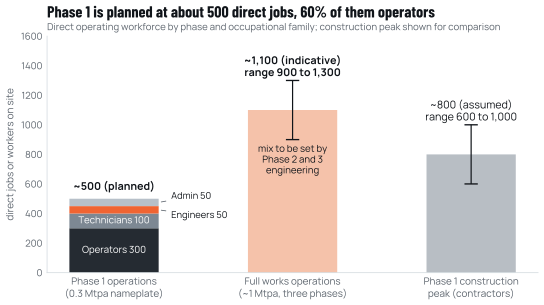
Source: Cameroon Steel reference configuration RC-1 (planning estimate), edition 10 October 2026 (RC-1.1): Phase 1 direct jobs and mix (planned); full-works direct jobs (indicative); construction peak (assumed) [S11].
9.2 Phase 1: about 500 people, 60% of them operators
The planned first-phase mix is about 300 operators, 100 technicians, 50 engineers and 50 administrative and support staff [S11]. Table 9.1 allocates these numbers across the process areas and functions of Figure 1.1, and adds for each group the likely recruitment source, the training route and the time at which training must start. The allocation within each family is illustrative; the family totals are the planned values.
Table 9.1 Illustrative Phase 1 staffing by area, recruitment source and training start
| Group | Indicative headcount | Main recruitment source | Training route | Training starts (months before first steel) |
|---|---|---|---|---|
| Operators, raw materials yard and cranes | 40 | South Region and Douala; technical baccalaureate, CAP, CQP | Crane licences; induction; simulator; mentored shifts | 9 to 12 |
| Operators, melt shop and ladle furnace | 70 | National; technical baccalaureate or DUT | Simulator; vendor training; placements in operating melt shops; mentored shifts | 24 to 30 |
| Operators, continuous caster | 40 | National; technical baccalaureate or DUT | Simulator; vendor training; placements; mentored shifts | 18 to 24 |
| Operators, reheating furnace and rolling mill | 100 | National, including experienced Douala mill workers; CAP or DUT | Vendor training; dual apprenticeship cohort; mentored shifts | 12 to 18 |
| Operators, finishing and dispatch | 50 | South Region; vocational certificates | Induction; on-the-job training | 6 to 9 |
| Technicians, mechanical maintenance | 45 | National; ISTD, IUT, CFP d’excellence graduates; dual apprentices | Dual apprenticeship or conversion programme; vendor modules | 24 to 30 |
| Technicians, electrical, automation and instrumentation | 35 | National; GEII and electrical graduates | Vendor PLC and drives training; electrical authorisations | 24 to 30 |
| Technicians, laboratory, quality and HSE | 20 | National; chemistry, materials and HSE graduates | Laboratory and standards training; ISO 45001-based HSE training | 12 to 18 |
| Engineers (process, metallurgy, maintenance, electrical, production, quality and HSE) | 50 | National engineering schools; Cameroonian engineers abroad; some expatriates at start | Graduate programme; placements abroad; vendor training | 30 to 36 |
| Administration and support (HR, finance, procurement and stores, IT, logistics planning, medical) | 50 | South Region and national | Systems and procedures training | 6 to 12 |
| Total direct workforce, Phase 1 (planned) | 500 |
Source: Cameroon Steel public planning figures for family totals (operators 300, technicians 100, engineers 50, administration 50) [S11]; allocation within families, recruitment sources and training timing are illustrative (Annex A).
Three features of the table drive the plan. First, the melt-shop and caster crews, about 110 people, and the maintenance and automation technicians, about 80, need the longest lead times; with the 50 engineers, these cadres make up about half of the workforce (240 of 500) and must be in training 18 to 36 months ahead, while the other 260 posts start 6 to 18 months ahead. Second, the engineering cadre needs to be recruited first, because its members will become the trainers, supervisors and successors to expatriate specialists. Third, about 140 posts in the yard, finishing, dispatch and support functions can be recruited and trained in the final year before first steel, and those are the posts where recruitment from the South Region can be highest at the start.
9.3 The training pipeline opens three years before first steel
Figure 9.2 shows the resulting timeline for the first phase, with the calendar dates that follow from the RC-1.1 schedule if first heat comes at the start of the second half of 2030. A skills partnership with schools and training centres is agreed about three and a half years before first steel (early 2027), so that curricula and dual-apprenticeship agreements are in place for the first intake. Graduate engineers are recruited about three years ahead (mid-2027) and spend much of the following period in placements at operating plants and with equipment suppliers. The first dual-apprenticeship cohort starts about two and a half years ahead (early 2028). Experienced technicians and welders are upskilled from two years ahead (mid-2028). Operators are recruited and trained on simulators from about 18 months ahead (early 2029, as works start), and join vendor training at supplier sites and on site in the final year. Cold commissioning, in the first half of 2030, is the first time the crews work on their own equipment, alongside the suppliers’ specialists.
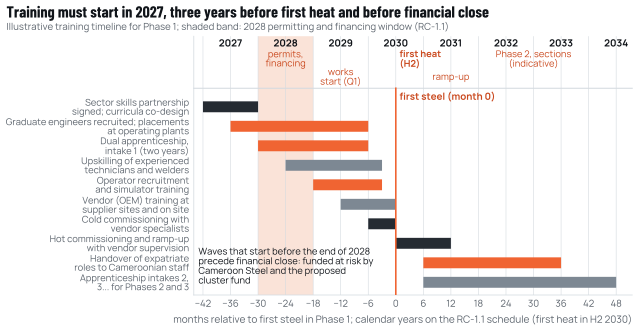
Source: Cameroon Steel proposal, based on the times to competence in Figure 5.2 (Annex A); project milestones from the Cameroon Steel reference configuration RC-1 (planning estimate), edition RC-1.1 [S11].
The timeline carries two risks that must be managed together. If training starts too late, the plant opens with an expatriate-heavy workforce and a slow handover. If it starts too early, or the project is delayed, trained people wait without work and some leave. The mitigation is to sequence training by lead time, to keep trainees productively employed (in other plants, in construction and commissioning, or in maintenance shops), and to tie the later waves, operator recruitment and vendor training, to firm project milestones such as financial close and the delivery of major equipment.
The earliest waves cannot wait for those milestones. Graduate recruitment and the first apprenticeship intake fall before financial close; they would be funded at risk by Cameroon Steel and the proposed cluster fund (Chapter 10), and sized to the RC-1.1 schedule: public hearings in the third quarter of 2028, the environmental certificate in the fourth quarter of 2028, financing in 2028, works from the first quarter of 2029, first heat in the second half of 2030 and ramp-up in 2031 towards the 0.3 Mtpa nameplate (expected sustained output 270,000 to 300,000 t a year) [S11]. Sizing them to that schedule limits the exposure: the first intakes are small (an engineering cadre of about 50 and a first apprenticeship cohort), they train in trades such as maintenance and electrical work that are needed across the Kribi cluster, and a delay of a year or two would leave Cameroon with certified technicians rather than stranded trainees. Table 9.2 sets the training milestones against the project schedule.
Table 9.2 Phase 1 project schedule (RC-1.1) and training milestones
| Date | Project milestone (RC-1.1) | Training milestone (illustrative; months relative to first steel) |
|---|---|---|
| Early 2027 | Skills partnership agreed; curricula co-design begins (month −42) | |
| Mid-2027 | Graduate engineers recruited and placed in operating plants (−36) | |
| Early 2028 | First dual-apprenticeship intake; melt-shop, maintenance and electrical cadres start training (−30) | |
| 2028 | Public hearings (third quarter); environmental certificate (fourth quarter); financing | Caster crews start training; experienced technicians and welders upskilled (−24 to −18) |
| First quarter of 2029 | Works start | Operator recruitment and simulator training; rolling-mill, laboratory and HSE crews start (−18) |
| Mid-2029 to early 2030 | Construction | Vendor training; yard, finishing, dispatch and support staff recruited (−12 to −6) |
| First half of 2030 | Construction completes | Cold commissioning with vendor specialists (−6 to 0) |
| Second half of 2030 | First heat | Hot commissioning with vendor supervision (from 0) |
| 2031 | Ramp-up towards 0.3 Mtpa nameplate | Handover of expatriate roles begins (from +6) |
| 2032 to 2034 | Phase 2, second melt line and sections mill (indicative) | Annual apprenticeship intakes sized to Phase 2 |
| After 2034 | Phase 3 (indicative) | Cascade training from Phases 1 and 2 |
Source: project milestones from the Cameroon Steel reference configuration RC-1 (planning estimate), edition RC-1.1 [S11]; training milestones illustrative (Figure 9.2; Annex A). Calendar dates assume first heat at the start of the second half of 2030; a later first heat moves every training date by the same interval.
9.4 Localisation: from about three quarters to about nine in ten
Cameroon Steel’s planning objective is that about 90% of its operating workforce, within a range of 85 to 95%, should be Cameroonian nationals by the fifth year of operation [S11]. Figure 9.3 breaks the objective down by occupational family and adds an illustrative starting point for the first year. Operators and support staff can be overwhelmingly Cameroonian from the start; the expatriate share is concentrated among melt-shop and caster supervisors, process metallurgists and commissioning specialists, and should fall as Cameroonian successors qualify.
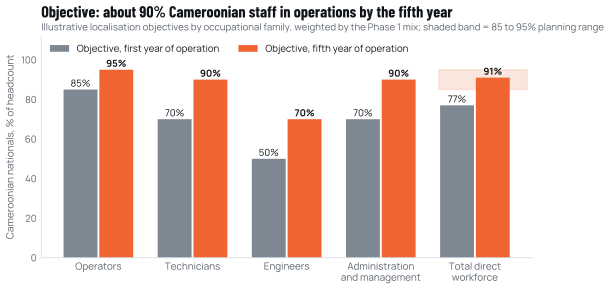
Source: Cameroon Steel planning objective of 0.90 (0.85 to 0.95) Cameroonian share of operating workforce by year 5 [S11]; family split and first-year values are illustrative objectives, not commitments.
Localisation will be achieved by design, not by attrition. Each expatriate post should be paired from the start with a named Cameroonian successor, a development plan and a target date, reviewed every six months. Cameroonian law reinforces the incentive: the employment contracts of foreign workers require a visa from the Minister of Labour before they take effect [S33], and since 2023 employers pay a levy equal to two months of gross salary for each non-African worker’s contract visa, revenue the government intends for vocational training [S31]. A localisation plan that shortens expatriate assignments therefore saves costs as well as building national capacity.
9.5 Construction: 600 to 1,000 workers and a chance to certify trades
The first-phase construction peak is assumed at about 800 workers, within a range of 600 to 1,000 [S11]. Most will be employed by civil, steel-erection, mechanical and electrical contractors, under the supervision of equipment suppliers. Construction offers the largest immediate opportunity for local employment and the first opportunity to build certified skills. Cameroon Steel proposes the following illustrative principles for its contractors, to be refined with KPIZ and the authorities:
- Local hiring. Priority to qualified Cameroonians at equal competence, with an objective that the large majority of construction workers be Cameroonian and that posts not requiring particular qualifications be filled from the South Region and surrounding areas first. The Mining Code’s rule reserving 95% of such posts in mining projects for Cameroonians [S35] is a useful benchmark, although it does not apply to a steelworks.
- Certification on site. Welders, electricians, scaffolders, riggers and crane operators tested and certified on site, so that each worker leaves with a recognised credential (Chapter 4).
- Safety induction and passport. Every worker inducted and issued a safety passport before starting work (Chapter 8).
- Worker accommodation and conduct. Accommodation, where provided, managed to the standard required by IFC Performance Standard 2 [S57], with a code of conduct and grievance channel applied to all contractors.
- Transition to operations. Construction electricians, mechanics and welders who perform well offered places in the maintenance conversion programme, so that some of the peak’s skills stay on site.
9.6 Phases 2 and 3: a training cascade
Moving from the first phase to the full works, with Phase 2 indicated for 2032 to 2034 and Phase 3 after 2034, adds, on the planning figures, about 400 to 800 direct jobs [S11]. Those jobs should be filled largely by people who have already been trained. Each phase can act as the training ground for the next:
- Promotion from within. Experienced operators and technicians from the first phase become supervisors, trainers and team leaders in the next; their places are filled by apprentices and new recruits.
- Annual apprenticeship intakes. Once the first phase operates, dual-apprenticeship intakes can run every year, sized to the next phase’s needs and to natural turnover.
- Cameroonian trainers. Trainers trained under the vendors’ train-the-trainer modules in the first phase teach the next phase’s crews, reducing the need for expatriate instructors.
- New disciplines. A sections mill and, later, a direct-reduction module bring new process roles; the engineering cadre formed in the first phase, with partners such as the mining and chemical engineering schools of the University of Ngaoundéré [S22], provides the base for them.
Indirect employment should grow with each phase, from about 1,000 planned for the first [S11], as supplier development (Chapter 6) brings more maintenance, machining, logistics and services work to Cameroonian firms.
9.7 Retention, housing and transport
A trained workforce is valuable to its competitors as well as to its employer. As the Kribi zone grows, port operators, power producers, cement plants and agro-industries will look for the same maintenance and electrical technicians, and some trained people will leave. Four measures limit that risk without wage escalation.
- Competitive pay and visible progression. Formal private-sector wages in Cameroon averaged 118,200 FCFA a month in 2021, with a median of 90,000 FCFA [S12]; a steelworks should pay at or above the formal-sector norm for comparable skills and link pay progression to certified competence, so that workers see a path up the ladders in Figure 4.2.
- Training agreements. Cameroon’s vocational training law allows an employer that finances training to require the trained worker to remain in its service for a set period [S26]. Used fairly, with periods proportionate to the cost of training, such agreements protect the employer’s investment without trapping workers.
- Housing and transport. A works at Mboro will recruit many people from outside Kribi. Affordable housing, developed with the municipality, KPIZ and private developers, and reliable shift transport, especially at night, will determine whether recruits settle in the area or leave after a few months.
- A shared training system. If every major employer of the zone trains to the same standards and contributes to the same fund (Chapter 10), the cost of losing a trained worker to a neighbour is shared rather than borne by one company alone.
9.8 Indicators to track
The plan should be monitored with a small set of indicators, reported publicly each year: direct headcount by occupational family and by nationality; the share of employees from the South Region; the number of apprentices, graduate trainees and placements abroad; certification rates (welders, electrical authorisations, competence cards); the number of expatriate posts and of named successors ready; training days per employee, against the worldsteel benchmark of about 7 to 9 days [S51]; women’s share by occupational family and the retention of women and men one and three years after hiring (Chapter 7); and lost-time and recordable injury frequency rates (Chapter 8). Publishing these indicators turns the objectives in this chapter into commitments that can be tested.
Sources cited in this chapter
Bracketed markers refer to these sources; the full list is in the annex. Full list of sources
- S09Kribi: le Premier ministre, chef du gouvernement est là. Cameroon Tribune, 30 Dec 2024.cameroon-tribune.cm/article.html/68499/fr.html/details_2
- S10Industrialisation: la voie royale de l’émergence. Cameroon Tribune, 2 Jan 2025.cameroon-tribune.cm/article.html/68558/fr.html/details_2
- S11Cameroon Steel reference configuration RC-1 (planning estimate), edition 10 October 2026 (RC-1.1). Cameroon Steel, 10 Oct 2026.Cited by title and date
- S08Production: les acteurs en présence. Cameroon Tribune, 11 May 2026.cameroon-tribune.cm/article.html/76600/fr.html/details_2
- S76UN Comtrade public API: Cameroon (reporter 120), imports of HS 7207 (semi-finished iron and steel, including billets), 2023. United Nations Statistics Division.comtradeapi.un.org/public/v1/preview/C/A/HS?reporterCode=120&period=20…
- S66Cameroun: Complexe moderne de sidérurgie de Kribi, le PM Joseph Dion Ngute effectue la pose de la première pierre. Camer.be, 5 Jan 2025.camer.be/87795/12:1/cameroun-complexe-moderne-de-siderurgie-de-kribi-l…
- S33Loi n° 92/007 du 14 août 1992 portant Code du travail. Republic of Cameroon (FAOLEX copy), 14 Aug 1992.faolex.fao.org/docs/pdf/cmr198304.pdf
- S31Cameroun: en 2023, l’État n’a collecté que 5 milliards de recettes auprès des travailleurs étrangers. EcoMatin, 26 Jan 2024.ecomatin.net/cameroun-en-2023-letat-na-collecte-que-5-milliards-de-rec…
- S35Loi n° 2023/014 du 19 décembre 2023 portant Code minier. Republic of Cameroon (FAOLEX copy), 19 Dec 2023.faolex.fao.org/docs/pdf/cmr223180.pdf
- S57Performance Standard 2: Labor and Working Conditions. International Finance Corporation, 1 Jan 2012.ifc.org/content/dam/ifc/doc/2010/2012-ifc-performance-standard-2-en.pd…
- S22Établissements; Institut universitaire de technologie (identification sheet). Université de Ngaoundéré.univ-ndere.cm/fr/etablissements/
- S12Troisième enquête sur l’emploi et le secteur informel (EESI3), phase 1: enquête emploi, rapport principal (2021 data; Tables 2.9, 3.7, 3.24 and 4.1 are cited). Institut national de la statistique (INS), Cameroon, Nov 2023 (file of Jul 2025).ins-cameroun.cm/wp-content/uploads/2025/07/EESI3_Rapport-principal_Emp…
- S26Loi n° 2018/010 du 11 juillet 2018 régissant la formation professionnelle au Cameroun (text). Republic of Cameroon (reproduced by Cameroun24), 11 Jul 2018.cameroun24.net/article/46391-loi-n2018-010-du-11-juillet-2018-regissan…
- S51Sustainability indicators (2025 report; 2022 to 2024 data). World Steel Association.worldsteel.org/wider-sustainability/sustainability-indicators/
Cite this chapter
Cameroon Steel (2026). Cameroon can staff its steel industry if training starts before the furnace does. White paper 08, chapter 9: An illustrative workforce plan: about 500 people trained before first steel, and a cascade that grows to 900 to 1,300. CS-WP-08. https://www.cameroon-steel.com/en/library/skills-for-steel/illustrative-workforce-plan/
Source