White paper 08 · Chapter 10
Twelve actions would put a trained Cameroonian workforce in place before the first heat
The evidence in this paper points to a simple conclusion: Cameroon has the young people, the institutions and the legal framework to staff a modern steel industry with its own citizens, but not yet the industry-specific content, the practical training capacity, the certification or the financing mechanisms to do so on time. None of the missing pieces requires a new institution or a large public budget. They require partnership between the State, schools, employers and equipment suppliers, organised around a clear timetable that starts about three years before first steel, that is in 2027 on the RC-1.1 schedule. This chapter sets out twelve actions, grouped under four headings: governance and financing, curricula and certification, inclusion and safety, and suppliers and information. For each, it names the lead, the partners and an indicator of success.
In this chapter (7)
10.1 Governance and financing
1. Create a Kribi steel and heavy-industry skills partnership. A standing partnership, chaired by the Ministry of Employment and Vocational Training (MINEFOP) with the ministries in charge of higher and secondary education (MINESUP, MINESEC) and of mines and industry (MINMIDT), KPIZ, employers of the zone, trade unions and the main training providers, would set competence standards, co-design curricula, allocate training places and report on results (Figure 10.1). Its added value is to turn one employer’s training needs into a cluster’s training system, so that skills built for steel also serve cement, aluminium, energy, port and agro-industrial employers, and so that employers share costs rather than poach each other’s trainees.
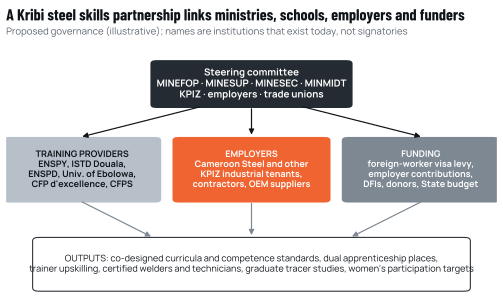
Source: Cameroon Steel proposal; institutions as described in Chapter 3 [S18][S20][S21][S23][S24][S25].
2. Establish a training fund with clear rules. Cameroon already has three potential sources of finance for industrial training: the levy on foreign workers’ contract visas introduced by the 2023 Finance Law, which the government has said will finance vocational training and which raised about FCFA 5 billion in its first year [S30][S31]; the national fund for vocational training proposed by the Minister of Employment and Vocational Training in December 2024 [S29]; and the development finance institutions that are financing the KPIZ zone [S39]. A cluster training fund should combine a share of these public resources with employer contributions, and should pay training providers partly on results: trainees certified and placed in jobs. Employers whose expatriates generate the levy would see part of it return as training for the Cameroonians who will replace them, which aligns the incentive with the policy objective. In its first two years, before the plant’s financial close in 2028, the fund and Cameroon Steel would carry at risk the cost of graduate recruitment and the first apprenticeship intake (Chapter 9).
3. Give apprenticeships a fiscal incentive. Law No. 2018/010 already provides for subsidies, donations and "particular tax incentives" to support vocational training [S26], and every formal employer pays 2.5% of its payroll to the housing-loan and employment funds [S32]. A simple, verifiable incentive would allow employers to deduct certified expenditure on apprentices’ stipends, tutors and training from taxable income at an enhanced rate, or to credit part of it against their employment-fund contribution. The test of eligibility should be output-based: apprentices registered under a written contract, trained to a recognised standard and assessed.
10.2 Curricula and certification
4. Co-design curricula with industry. Three programmes should be developed with the engineering schools and institutes named in Chapter 3, with industry practitioners teaching part of each:
- a steelmaking specialisation (ferrous metallurgy, EAF and secondary steelmaking, continuous casting, rolling) as a final-year option in mechanical, chemical and materials engineering at ENSPY and ENSPD, with a placement in an operating plant;
- an industrial maintenance and automation track with plant placements at the ISTD in Douala and the Centres de formation professionnelle d’excellence, focused on hydraulics, drives, PLCs and electrical authorisations;
- a technical-teacher programme with ENSET Douala and the University of Ebolowa to give vocational trainers industrial experience, addressing the shortage of qualified trainers documented by MINEFOP [S28].
5. Launch a dual apprenticeship programme. Under Law No. 2018/010 and Decree No. 2020/2592/PM [S26][S27], the employer and its partner centres should open a two-year dual apprenticeship for maintenance, electrical, mill and process trades, with written contracts, stipends, certified tutors and joint assessment (Figure 5.1). The first intake should start about 30 months before first steel, in early 2028 on the RC-1.1 schedule (Figure 9.2), with plant blocks in existing heavy-industry sites until the works’ own shops are available.
6. Write steel-occupation competence standards and build a test centre. MINEFOP and the partnership’s employers should write competence standards for the main steel occupations (melter, caster operator, mill operator, roll-shop machinist, maintenance and electrical technician, laboratory analyst) and map them to national diplomas and the CQP. A test and certification centre, operated with an internationally accredited certification body, should certify welders to ISO 9606-1 [S59] and assess competence cards. Because the International Institute of Welding allows organisations in a country without an IIW member to work with an Authorised Nominated Body of another country, such a centre could later serve the Central African region [S78].
7. Buy training with equipment. Every equipment contract for the works should specify the number of trainees by role, the content and duration of training at reference plants and on site, train-the-trainer modules for Cameroonian instructors, and acceptance tests linked to payment milestones (Chapter 5). Simulators for the melt shop, caster and cranes should be procured early, so that operator training can start 18 months or more before first steel.
10.3 Inclusion and safety
8. Open heavy-industry careers to women. The Ministry of Labour and Social Security, employers and unions should agree how women can work night shifts in continuous-process plants. Article 82 of the 1992 Labour Code prohibits night work by women in industry with limited exceptions [S33], as does ILO Convention No. 89, which Cameroon ratified in 1970 and which remains in force [S69][S73]. The quickest lawful route is to ratify the 1990 Protocol to that convention, which allows exemptions by national regulation after consulting the social partners and with maternity safeguards, and to adopt the regulation before operator recruitment starts in 2029 [S72]; ratifying the Night Work Convention, 1990 (No. 171), which protects all night workers, would complete it [S70]. Employers should adopt the measures in Table 7.1: scholarships for girls and women in technical programmes, facilities and protective equipment for women, gender-neutral recruitment, a code of conduct and grievance channel, and objectives for women in each apprenticeship and graduate intake.
9. Make safety a certified skill across the zone. KPIZ and its tenants should adopt a common safety passport recognised on all sites, require contractors to meet a common standard of induction, training and supervision, and design their management systems to ISO 45001 [S58]. Safety-critical authorisations (permits to work, lockout and tagout, confined-space entry, crane operation, electrical switching) should be granted only after training and practical assessment. A workforce health programme should address heat, noise and dust, and the regional priorities of HIV and malaria [S61].
10.4 Suppliers and information
10. Run supplier development at the scale of the zone. A single supplier portal, common qualification criteria and a shared programme of audits, coaching and certification for KPIZ tenants would spread costs and give Cameroonian firms a larger market (Chapter 6). Large employers should commit to payment terms that small suppliers can live with, and to pilot orders for firms on the development ladder. The partnership should publish an annual local-content report for the zone using four measures: spend with Cameroonian-registered suppliers, spend with Cameroonian-owned SMEs and South Region firms, estimated local value added, and supplier capability outcomes.
11. Reach young people before they choose a career. A careers outreach programme in secondary schools of the South Region, Douala and Yaoundé, run with MINESEC and the University of Ebolowa, should show what industrial careers involve, what they pay and how to enter them, with particular attention to girls in technical and science streams. Open days, plant visits once the works operates, and a simple online guide to the training routes in Table 4.1 would cost little and widen the recruitment pool. The new ENSPY annex at Meyomessala and the University of Ebolowa, both in the South Region [S18][S23], are natural partners.
12. Measure and publish. The partnership should commission a labour-market and skills survey of the Kribi area, where current population and workforce data are lacking (Chapter 11), run tracer studies of graduates of the programmes it supports, and publish the indicators listed at the end of Chapter 9 every year. Employers should report training days, certifications, localisation, women’s participation and safety performance on a common basis, as the best international companies do [S42][S51].
10.5 A roadmap
Table 10.1 sets out the twelve actions with their leads, partners, timing and indicators. Timing is expressed relative to the first steel of the first phase, because the critical path for skills is the critical path of the plant.
Table 10.1 Roadmap of recommended actions
| No. | Action | Lead | Main partners | Timing (months relative to first steel; calendar on RC-1.1) | Indicator of success |
|---|---|---|---|---|---|
| 1 | Kribi steel and heavy-industry skills partnership | MINEFOP | MINESUP, MINESEC, MINMIDT, KPIZ, employers, unions | From month −42 (early 2027) | Charter signed; work programme adopted |
| 2 | Cluster training fund | MINEFOP, Ministry of Finance | Employers, DFIs, KPIZ | From month −36 (mid-2027) | Fund rules published; first disbursements tied to results |
| 3 | Fiscal incentive for apprenticeships | Ministry of Finance | MINEFOP, employers’ associations | Next Finance Law | Measure enacted; number of registered apprentices |
| 4 | Co-designed curricula (steelmaking, maintenance and automation, technical teachers) | Engineering schools, ISTD, ENSET | Employers, equipment suppliers | From month −36 (mid-2027) | Programmes accredited; first cohorts enrolled |
| 5 | Dual apprenticeship programme | Employer and partner centres | MINEFOP, CFP d’excellence, CFPS | First intake at month −30 (early 2028) | Apprentices enrolled, retained and certified |
| 6 | Steel competence standards and test centre | MINEFOP | Employers, certification body | From month −30 (early 2028) | Standards published; welders and technicians certified |
| 7 | Vendor training clauses and simulators | Employer | Equipment suppliers | At contract award | Trainees trained to acceptance criteria |
| 8 | Women in heavy-industry careers | Ministry of Labour, employers | Unions, schools, MINESUP | From month −36 (mid-2027) | Protocol of 1990 to ILO Convention No. 89 ratified and regulation adopted; women’s share of intakes |
| 9 | Zone safety passport and contractor standard | KPIZ, employers | Contractors, Ministry of Labour | Before construction starts | Passports issued; injury frequency rates |
| 10 | Zone supplier-development programme and local-content report | KPIZ, employers | Chambers, banks, SME agencies | From month −24 (mid-2028) | Suppliers approved; local-content report published |
| 11 | Careers outreach | Employers, MINESEC | University of Ebolowa, ENSPY | From month −36 (mid-2027), annually | Applications received; share of women applicants |
| 12 | Skills survey, tracer studies and annual indicators | Skills partnership | INS, ONEFOP | From month −36 (mid-2027), annually | Survey published; indicators reported |
Source: Cameroon Steel proposals. Timing aligns with the illustrative training timeline in Figure 9.2; calendar dates assume first heat at the start of the second half of 2030 (Table 9.2).
10.6 Costs, risks and sequencing
The costs of the programme lie mainly in people and time rather than in buildings: stipends for apprentices and trainees, the time of tutors and trainers, placements abroad, vendor training, simulators and a test centre. Some of these costs belong in the plant’s capital budget (vendor training, simulators, initial placements), some in its operating budget (tutors, continuing training), and some in public or cluster budgets (curricula, trainer upskilling, the test centre, outreach). A clear split, agreed at the outset, prevents each party from waiting for another to pay.
Three risks deserve explicit management.
- Training ahead of a delayed project. If construction slips, trained people may wait without work. The waves that start after financial close should be tied to firm project milestones. The earlier ones, the partnership, graduate recruitment and the first apprenticeship intake, start before financial close in 2028; they are funded at risk by Cameroon Steel and the cluster fund, kept small and focused on skills used across the cluster, and their trainees are kept occupied in partner plants, construction and commissioning until the works needs them.
- Quality of providers. Results-based payments, independent assessment and published outcomes are the best protection against training that looks good on paper but does not produce competent workers.
- Capture and dispersion of funds. A cluster training fund must have transparent rules, independent audit and representation of employers and workers in its governance, so that resources go to the training that the zone needs.
Sequencing follows the critical path of the plant. The partnership, the fund and the incentive come first, because they make the rest possible; curricula, the dual apprenticeship and the graduate programme follow within a year; vendor training and simulators follow equipment contracts; and the indicators are published annually from the start, so that progress can be checked by everyone with an interest in it.
10.7 What each party can do now
The State can convene the partnership, open a lawful route to night work for women by ratifying the 1990 Protocol to ILO Convention No. 89, direct a share of the foreign-worker visa levy to industrial training in the zones where foreign workers are employed, and give apprenticeships a fiscal incentive in the next Finance Law. KPIZ can make skills and supplier development part of its zone offer, with a common safety passport and supplier portal for all tenants. Schools and training centres can open steelmaking and maintenance tracks with industry teachers and placements. Equipment suppliers can treat training as a contract deliverable and transfer their teaching capability to Cameroonian instructors. Cameroon Steel proposes to anchor the partnership as the first heavy-industry employer of the zone’s steel cluster, to open its training programmes to the cluster where practical, and to report its workforce indicators publicly once operations begin.
The return on this effort extends beyond one plant. Each melter, electrician, welder and supervisor trained for steel adds to the industrial capability that Cameroon’s development strategy seeks [S41], and that the Kribi zone needs to attract the next investor. Skills built ahead of the furnace are the most durable part of an industrial project: they remain in the country whatever happens to the market for steel.
Sources cited in this chapter
Bracketed markers refer to these sources; the full list is in the annex. Full list of sources
- S18École nationale supérieure polytechnique de Yaoundé: presentation (created in 1971), departments and 2026 to 2027 entrance competition (Meyomessala annex). ENSPY.polytechnique.cm/
- S20Université de Douala: schools and institutes. Université de Douala.univ-douala.cm/
- S21Institut supérieur de technologie de Douala (ISTD): departments and key figures. ISTD, Université de Douala.iut-dla.cm/
- S23Cameroun: les nouveaux responsables de l’université d’Ebolowa prennent fonctions. Journal du Cameroun, 23 Jul 2024.fr.journalducameroun.com/cameroun-les-nouveaux-responsables-de-luniver…
- S24Cameroon inaugurates 3 excellence training centres of FCFA 24 billion built by South Korea. Business in Cameroon, 20 Dec 2016.businessincameroon.com/cooperation/2012-6783-cameroon-inaugurates-3-ex…
- S25Former des ouvriers et techniciens qualifiés dans des métiers porteurs (project page). Agence française de développement.afd.fr/fr/projets/former-des-ouvriers-et-techniciens-qualifies-dans-de…
- S30« Ces recettes vont assurer le financement de la formation professionnelle ». Cameroon Tribune, 25 Jan 2024.cameroon-tribune.cm/article.html/62720/fr.html/details_2
- S31Cameroun: en 2023, l’État n’a collecté que 5 milliards de recettes auprès des travailleurs étrangers. EcoMatin, 26 Jan 2024.ecomatin.net/cameroun-en-2023-letat-na-collecte-que-5-milliards-de-rec…
- S29Cameroun: vers la création d’un fonds national pour financer la formation professionnelle. EcoMatin, 10 Dec 2024.ecomatin.net/cameroun-vers-la-creation-dun-fonds-national-pour-finance…
- S39Cameroon launches $860m Kribi industrial zone to process raw materials locally. Ecofin Agency, 27 Feb 2026.ecofinagency.com/news/2702-53326-cameroon-launches-860m-kribi-industri…
- S26Loi n° 2018/010 du 11 juillet 2018 régissant la formation professionnelle au Cameroun (text). Republic of Cameroon (reproduced by Cameroun24), 11 Jul 2018.cameroun24.net/article/46391-loi-n2018-010-du-11-juillet-2018-regissan…
- S32Republic of Cameroon: Corporate, Other taxes. PwC Worldwide Tax Summaries, reviewed 14 Aug 2026.taxsummaries.pwc.com/republic-of-cameroon/corporate/other-taxes
- S28Centres de formation professionnelle: 2 694 formateurs exercent sans diplôme au Cameroun. EcoMatin, 30 Jan 2026.ecomatin.net/centres-de-formation-professionnelle-2-694-formateurs-exe…
- S27Decree No. 2020/2592/PM of 9 June 2020 to lay down procedures for the establishment, organisation and functioning of vocational training and learning centres. Prime Minister’s Office, Cameroon, 9 Jun 2020.spm.gov.cm/site/sites/default/files/decret_ndeg_2020_2592_en.pdf
- S59ISO 9606-1:2012, Qualification testing of welders: fusion welding, Part 1: Steels. International Organization for Standardization, 2012.iso.org/standard/54936.html
- S78Become an IIW authorised body (Authorised Nominated Bodies and Approved Training Bodies). International Institute of Welding (IIW).iiwelding.org/become-an-iiw-authorised-body/
- S33Loi n° 92/007 du 14 août 1992 portant Code du travail. Republic of Cameroon (FAOLEX copy), 14 Aug 1992.faolex.fao.org/docs/pdf/cmr198304.pdf
- S69Night Work (Women) Convention (Revised), 1948 (No. 89): text and key information (interim status; may be denounced 27 Feb 2031 to 27 Feb 2032). International Labour Organization (ILO), NORMLEX.normlex.ilo.org/dyn/nrmlx_en/f?p=NORMLEXPUB:12100:0::NO::P12100_ILO_CO…
- S73Ratifications for Cameroon (51 conventions; No. 89 ratified 25 May 1970 and No. 155 ratified 1 Oct 2021, both in force). ILO, NORMLEX.normlex.ilo.org/dyn/nrmlx_en/f?p=NORMLEXPUB:11200:0::NO::P11200_COUNTR…
- S72Protocol of 1990 to the Night Work (Women) Convention (Revised), 1948. ILO, NORMLEX.normlex.ilo.org/dyn/nrmlx_en/f?p=NORMLEXPUB:12100:0::NO::P12100_ILO_CO…
- S70Night Work Convention, 1990 (No. 171): text and key information. ILO, NORMLEX.normlex.ilo.org/dyn/nrmlx_en/f?p=NORMLEXPUB:12100:0::NO::P12100_ILO_CO…
- S58ISO 45001:2018, Occupational health and safety management systems: requirements with guidance for use. International Organization for Standardization, Mar 2018.iso.org/standard/63787.html
- S61Enquête démographique et de santé du Cameroun 2018 (EDSC-V), final report FR360. INS and ICF (DHS Program), 2020.dhsprogram.com/pubs/pdf/FR360/FR360.pdf
- S42Annual Report and Accounts 2025. Dangote Cement Plc, Jun 2026.cement.dangote.com/wp-content/uploads/2026/06/Dangote-Cememt-Plc-2025-…
- S51Sustainability indicators (2025 report; 2022 to 2024 data). World Steel Association.worldsteel.org/wider-sustainability/sustainability-indicators/
- S41Stratégie nationale de développement 2020 to 2030 (SND30). Republic of Cameroon, MINEPAT (FAOLEX copy), 2020.faolex.fao.org/docs/pdf/cmr211554.pdf
Cite this chapter
Cameroon Steel (2026). Cameroon can staff its steel industry if training starts before the furnace does. White paper 08, chapter 10: Twelve actions would put a trained Cameroonian workforce in place before the first heat. CS-WP-08. https://www.cameroon-steel.com/en/library/skills-for-steel/recommendations/
Source