White paper 08 · Chapter 5
Training models that work combine school, plant and supplier, and start years before production
Industrial training succeeds where three parties share the work: a school that teaches the theory and the basic trade, an employer that provides real equipment, tutors and a job at the end, and an equipment supplier that knows the machines best. The strongest international models, from Germany’s dual apprenticeship system to the corporate academies of OCP in Morocco, Dangote in Nigeria and Tata Steel in India, all combine these three, and all treat training as an investment made years before the output it serves. For a Kribi steelworks the lesson is practical: begin dual apprenticeships and graduate programmes about three years before first steel, write training obligations into equipment contracts, use simulators to teach what cannot yet be practised on site, and build a shared academy for the cluster rather than a private one for a single plant.
In this chapter (9)
- 5.1 Five models, each with a role
- 5.2 Dual apprenticeship: the employer trains, the school certifies
- 5.3 Vendor training: write it into the equipment contract
- 5.4 Simulators teach what the plant cannot yet show
- 5.5 Placements and twinning: experience that cannot be taught
- 5.6 Training the trainers
- 5.7 Company academies: three examples from industrial groups
- 5.8 Time to competence sets the start date
- 5.9 Seven lessons for Cameroon
5.1 Five models, each with a role
Table 5.1 compares five training models that a heavy-industry employer can combine. None is sufficient alone. Dual apprenticeship builds the operator and technician base; vendor training transfers equipment-specific knowledge; simulators allow safe practice before the plant exists; placements in operating plants give experience that no school can; and an academy gives continuity once the plant runs.
Table 5.1 Training models for a heavy-industry workforce compared
| Model | Target group | Typical duration | What it does best | Main limitation | Cameroonian basis |
|---|---|---|---|---|---|
| Dual apprenticeship (school and plant alternating) | School leavers and young adults entering operator and technician trades | 2 to 3 years | Builds a broad base of practical, certified trades; integrates newcomers into plant culture | Needs a functioning plant or workshop and trained tutors | Law No. 2018/010, articles 22 to 26 [S26]; employer-managed CFPS model [S25] |
| Vendor (OEM) training in equipment contracts | Operators, maintainers and engineers of specific equipment | Weeks to months, before and during commissioning | Transfers equipment-specific know-how; certifies operators on the actual machines | Often narrow; quality depends on contract terms | Contract terms negotiated by the employer |
| Simulators and e-learning | All process roles, before and alongside plant training | Modules of hours to weeks | Safe repetition of rare or dangerous situations; training before the plant exists | Cannot replace hands-on experience; needs instructors | worldsteel steeluniversity offers EAF and casting simulations [S50] |
| Placements in operating plants abroad | Engineers, supervisors and key operators | 3 to 12 months | Experience of real production and incidents; mentoring by peers | Costly; selection and return conditions matter | To be arranged with technology partners and steel producers |
| Corporate or cluster academy | Whole workforce, continuously | Permanent | Continuity, leadership development, succession, links with universities | Fixed cost; risk of insularity if not shared | Dangote, OCP and Tata examples (Table 5.2) |
Source: Cameroon Steel analysis; legal and institutional references as cited.
5.2 Dual apprenticeship: the employer trains, the school certifies
Germany’s dual system is the reference model for industrial apprenticeship. Apprentices sign a contract with a company, work and learn there for most of the week, and attend a vocational school for the rest; at the end they sit a national examination. In 2022, 468,900 people in Germany concluded a new apprenticeship contract in the dual system, and about 1.21 million were in training, 35% of them women [S48]. The Federal Institute for Vocational Education and Training (BIBB) lists 324 state-recognised training occupations in 2026, each defined by a national training regulation that specifies the skills to be acquired [S65]. The system is driven by employers’ demand: in 2025, with a weaker economy, the number of training places fell and about 84,400 young people did not find one, according to BIBB [S49]. That sensitivity is the price of the system’s strength: apprenticeships exist where real jobs exist.
Cameroon’s legal framework already allows this model. Law No. 2018/010 provides for apprenticeship contracts and for work-linked training under agreements between training centres and enterprises, in which the enterprise undertakes to transmit professional knowledge and to give trainees the information and means they need [S26]. The AFD-financed sectoral centres in Douala and Edéa showed that employer management of a training centre is possible in Cameroon [S25]. What has been missing is an employer large enough, and with a long enough planning horizon, to anchor a dual programme in heavy-industry trades. A phased steelworks is such an employer.
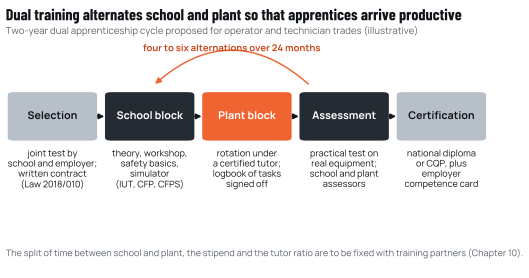
Source: Cameroon Steel proposal, drawing on the dual-system model [S48][S65] and on Law No. 2018/010 [S26].
The design choices that matter most are practical ones:
- Selection jointly by school and employer, on aptitude and attitude rather than on prior experience.
- A written contract and a stipend, so that apprentices can afford to stay the course and the employer has a commitment to honour.
- Certified tutors in the plant, chosen among experienced workers and paid for the role; the tutor ratio determines quality more than any classroom.
- A logbook of tasks signed off as the apprentice masters them, which becomes the basis for the competence card (Chapter 4).
- Assessment on real equipment, by assessors from both the school and the plant, leading to a national diploma or a CQP.
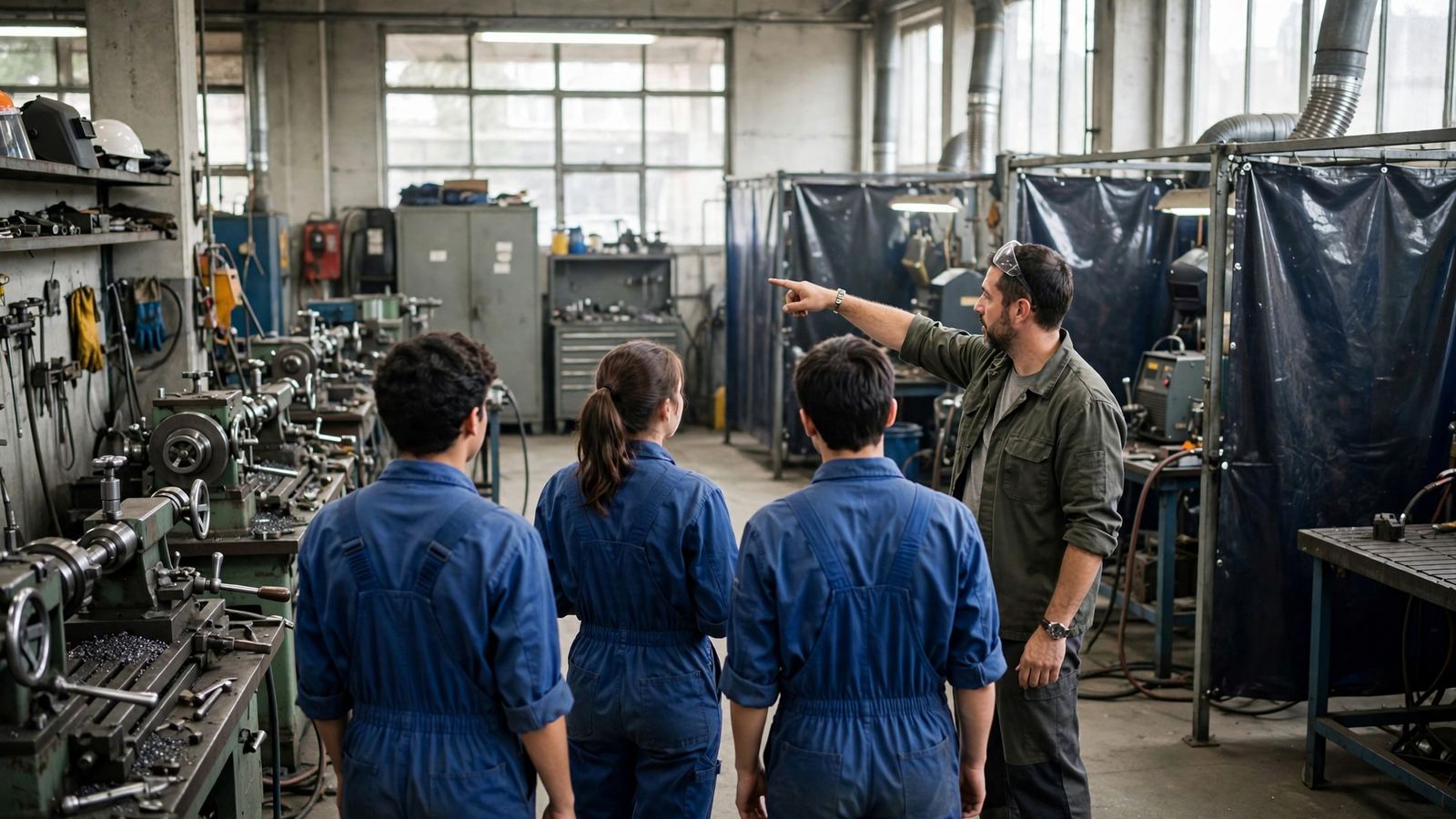
The difficulty for a new works is that it has no plant in which apprentices can learn during its first two years. The solution is to place the first cohort’s plant blocks in existing heavy-industry sites in Douala and Edéa, in vendor workshops abroad and in the works’ own maintenance shops as soon as they are built, and to start the dual programme in trades, such as maintenance and electrical work, that can be practised before the melt shop exists.
5.3 Vendor training: write it into the equipment contract
Every major equipment package for a steelworks (the furnace, the ladle furnace, the caster, the reheating furnace, the rolling mill, the power supply and the automation) comes with a supplier that knows the equipment better than anyone. Suppliers normally offer training as part of the contract: classroom modules on the process and the control system, practice at a reference plant, and on-site instruction during commissioning. Its value depends almost entirely on the contract terms.
Four terms make the difference. The contract should specify the number of trainees by role and the content and duration of each module; it should require hands-on time at a reference plant and on the actual equipment, not only observation; it should include train-the-trainer modules so that Cameroonian instructors can teach later cohorts; and it should define acceptance criteria, such as tests passed and tasks performed independently, linked to payment milestones. These conditions are routine in well-run projects but are easily traded away in price negotiations. Because they determine how quickly expatriate roles can be handed to Cameroonian staff, they should be treated as part of the plant’s performance, not as an extra.
5.4 Simulators teach what the plant cannot yet show
A melt shop is a dangerous place to learn. Water ingress into a furnace, a breakout at the caster or a cobble in the rolling mill are rare events that every operator must know how to handle but that no trainer wants to stage. Simulators allow operators to practise them safely and repeatedly. The World Steel Association’s learning platform, steeluniversity, offers simulations of steelmaking in the electric arc furnace, secondary steelmaking and continuous casting, e-learning courses on these processes, and 3D animated videos of the most common safety incidents at steel plants and how to avoid them [S50]. Equipment suppliers and specialist firms offer operator-training simulators for furnaces, cranes and control rooms.
For Cameroon, simulators solve a timing problem. They allow operator candidates to start learning the process 18 months or more before the furnace exists, at a training centre in Kribi or Douala, and to arrive at vendor training and commissioning already familiar with the logic of the process. They also allow training to continue during operation without stopping production. They do not replace mentored shifts on real equipment, and they need instructors who understand both the simulator and the plant.
5.5 Placements and twinning: experience that cannot be taught
Some competences can only be acquired by working in a running plant: judging the condition of a furnace from its sound and its off-gas, reacting to a breakout at the caster, leading a crew through a night shift with an equipment failure. For a country without an operating melt shop of comparable scale, placements in operating plants abroad are the only route to that experience before first steel. The engineers, the future shift supervisors and a core of senior operators should spend several months on shift in plants that use the same or similar equipment, with defined learning objectives, a mentor on each site and an obligation to return and train others.
Twinning arrangements between a new works and an established steel producer, often a technology partner or a supplier’s reference customer, make such placements easier to organise and continue after start-up, through exchanges of supervisors and joint problem-solving. Their value depends on three conditions: careful selection of the people sent, written learning objectives, and a contractual commitment from returning staff to remain with the employer for a defined period. Cameroon’s vocational training law allows employers to require trained workers to remain in their service for a set time after training [S26].
5.6 Training the trainers
Every model in Table 5.1 depends on trainers: tutors in the plant, instructors in schools and centres, simulator instructors and the engineers who will teach the next cohorts. Trainers are also the weakest link in Cameroon’s current vocational system, where many lack a professional diploma or industrial experience [S28]. A steel skills programme should therefore invest in trainers before trainees: select experienced workers as plant tutors and train them in instruction techniques; give school and centre instructors industrial placements; and require equipment suppliers to deliver train-the-trainer modules so that Cameroonian instructors can teach later cohorts. A trainer trained once teaches dozens of people over a career, which makes this the highest-return spending in any programme.
5.7 Company academies: three examples from industrial groups
Large industrial groups in emerging economies have built their own training institutions when the national system could not supply the skills they needed. Table 5.2 summarises three that are relevant to Cameroon: OCP in Morocco, Dangote in Nigeria and Tata Steel in India.
Table 5.2 Corporate training models in three industrial groups
| Group | Training institution or programme | What the evidence shows | Lesson for a Kribi steelworks |
|---|---|---|---|
| OCP Group (Morocco, phosphates and fertilisers) | Mohammed VI Polytechnic University (UM6P), owned by OCP through its foundation | Campus at Benguerir operating since 2015, with 2,182 students in 2021 [S47]; a ten-year programme with the Mastercard Foundation for 575 young African women scholars [S46] | Anchor higher education next to the industry, owned and financed for the long term |
| Dangote Cement (Nigeria and 10 other African countries, including Cameroon) | Dangote Academy; graduate trainee programme | Academy serves as a centre for leadership, technical and vocational training; graduate trainees rose from 81 (2023) to 141 (2025); training spending rose 50% to ₦2.05 billion in 2025; 455,639 training hours in 2025; expatriate roles transitioned to local professionals [S42] | Budget for training as a line of operating cost; track graduates and localisation explicitly |
| Tata Steel (India, integrated steel) | Technical institute founded in 1921, now the Shavak Nanavati Technical Institute; vocational training institute since 2015; scholarships for women engineering students | More than 75,000 graduates of the technical institute by 2021 and more than 5,000 vocational trainees placed in jobs [S43]; scholarship programmes for women in engineering colleges [S44]; first batch of women firefighter trainees in 2023 [S45] | Training and inclusion are long-term institutions; build them from the first year |
Source: as cited: company and institutional sources [S42][S43][S44][S45][S46]; World Bank Group, Multilateral Investment Guarantee Agency [S47].
Three common features stand out. First, each group treats training as a permanent function with its own budget, not as a project. Dangote Cement, for example, reports training expenditure, hours and graduate-trainee numbers in its annual report alongside its production figures [S42]. Second, each links its training to a university or a recognised qualification, so that what workers learn has value outside the company. Third, each uses training to replace expatriate staff with nationals over time, and reports on it. Dangote Cement’s Cameroonian subsidiary, for instance, employed 272 people in 2025, 84 of them women [S42]. That is a useful reminder that Cameroonian heavy-industry employers already run structured training at modest scale, and that a steel training effort can learn from them.
5.8 Time to competence sets the start date
The single most important planning variable for a skills programme is the time it takes to make a person competent in a role. Figure 5.2 sets out Cameroon Steel’s planning assumptions, from the start of initial training to independent work, for nine representative roles. A crane operator or production operator can be ready within a year. A certified welder needs 12 to 18 months from the start of a vocational course. An electrical and automation technician needs three to four years from entry into an IUT. A melter needs two to three and a half years even when recruited with a technical diploma, and a process metallurgist six to seven years from entry into engineering school. A shift manager who can run a melt shop and caster takes about nine to eleven years.
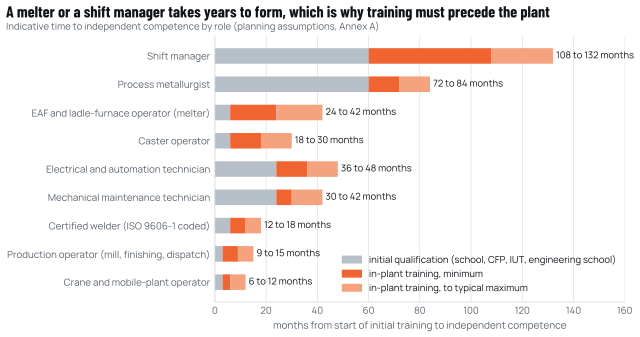
Source: Cameroon Steel planning assumptions (Annex A), based on typical durations of Cameroonian diplomas (CQP, DUT and BTS, engineering degree) and of in-plant training in EAF long-products works.
The arithmetic is unforgiving. If the first phase of a works is to start with Cameroonian melters, recruitment and training must begin two to three years before first steel; if it is to start with Cameroonian shift supervisors, they must be found among experienced workers in other heavy industries and converted, because none can be grown from scratch in time. The workforce plan in Chapter 9 is built on this logic.
5.9 Seven lessons for Cameroon
The evidence reviewed in this chapter suggests seven practical lessons:
- The employer leads, the school delivers. Training succeeds when employers define the competences, provide tutors and equipment and hire the graduates; schools and centres provide the teaching and the national certificate.
- Train ahead of the plant. The pipeline must open about three years before first steel for operators and technicians, and earlier for engineers and supervisors.
- Buy training with equipment. Vendor training should be specified, measured and paid for as a deliverable of each equipment contract, including train-the-trainer modules.
- Use simulators early. Process simulators allow training to start before the plant exists and to continue safely during operation.
- Place key people in operating plants. No substitute exists for months on shift in a working melt shop, under the supervision of experienced peers.
- Share the academy. A training centre serving all heavy-industry tenants of the Kribi zone would be cheaper per trainee and would reduce poaching between employers.
- Measure and publish. Graduate numbers, placement rates, certification rates and localisation should be tracked and reported, as the best corporate academies do.
Sources cited in this chapter
Bracketed markers refer to these sources; the full list is in the annex. Full list of sources
- S26Loi n° 2018/010 du 11 juillet 2018 régissant la formation professionnelle au Cameroun (text). Republic of Cameroon (reproduced by Cameroun24), 11 Jul 2018.cameroun24.net/article/46391-loi-n2018-010-du-11-juillet-2018-regissan…
- S25Former des ouvriers et techniciens qualifiés dans des métiers porteurs (project page). Agence française de développement.afd.fr/fr/projets/former-des-ouvriers-et-techniciens-qualifies-dans-de…
- S50steeluniversity: learning for the steel industry (simulations, courses, safety videos). World Steel Association.steeluniversity.org/
- S48Vocational training (theme page and press release of 12 April 2023 on new apprenticeship contracts in 2022). Federal Statistical Office of Germany (Destatis).destatis.de/EN/Themes/Society-Environment/Education-Research-Culture/V…
- S65Verzeichnis der anerkannten Ausbildungsberufe 2026 (directory of the 324 recognised training occupations). Federal Institute for Vocational Education and Training (BIBB), 2026.bibb.de/dienst/publikationen/de/21008
- S49The Training Market 2025 (publication summary). Federal Institute for Vocational Education and Training (BIBB).bibb.de/en/index.php
- S28Centres de formation professionnelle: 2 694 formateurs exercent sans diplôme au Cameroun. EcoMatin, 30 Jan 2026.ecomatin.net/centres-de-formation-professionnelle-2-694-formateurs-exe…
- S47OCP SA, UM6P Project (project summary: ownership, Benguerir campus, enrolment). Multilateral Investment Guarantee Agency (MIGA), World Bank Group, 2021.miga.org/project/ocp-sa-um6p-project
- S46Mastercard Foundation Scholars Program at UM6P (575 scholars over ten years). Université Mohammed VI Polytechnique (UM6P).um6p.ma/en/mastercard-foundation-scholars-program-um6p
- S42Annual Report and Accounts 2025. Dangote Cement Plc, Jun 2026.cement.dangote.com/wp-content/uploads/2026/06/Dangote-Cememt-Plc-2025-…
- S43Tata Steel’s SNTI celebrates century of skilling industrious workforce (press release). Tata Steel, 1 Nov 2021.tatasteel.com/newsroom/press-releases/india/2021/tata-steel-s-snti-cel…
- S44Diverse workforce (careers). Tata Steel.tatasteel.com/careers/culture-at-tata-steel/diverse-workforce/
- S45Tata Steel introduces first batch of women fire fighter trainees (The Avenue Mail). Tata Steel newsroom, 9 Sep 2023.tatasteel.com/media/newsroom/in-the-news/2023/tata-steel-introduces-fi…
Cite this chapter
Cameroon Steel (2026). Cameroon can staff its steel industry if training starts before the furnace does. White paper 08, chapter 5: Training models that work combine school, plant and supplier, and start years before production. CS-WP-08. https://www.cameroon-steel.com/en/library/skills-for-steel/training-models-that-work/
Source