White paper 09 · Economics
Domestic steel saves foreign exchange only when it competes at border prices
Producing iron, billets and sections locally can save foreign exchange and deepen industry, if output is competitive at border prices.
Derived Counted from the English manuscript when the site was generated; print equivalent = words ÷ 350.
You are reading the full English edition. Also online: Édition française complète中文摘要版
Executive summary
What the study shows
Read the full executive summarySteel and steel articles took 278 bn FCFA of imports in 2025, 13% of Cameroon’s trade deficit. Domestic iron units, billets and sections can recover much of that bill, deepen the industrial base and widen the tax base, provided the industry is competitive at import parity. Protection without competitiveness is a cost, not a strategy.
Source: white paper 09, executive summary; bracketed markers refer to the list of sources in the annex.
Main findings
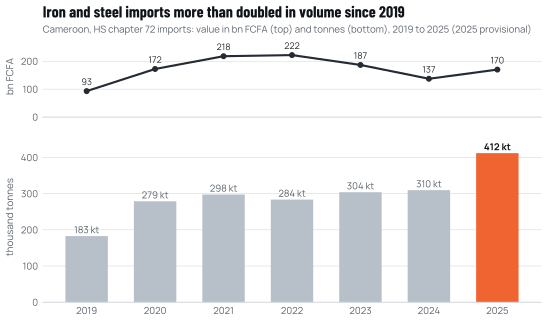
- Steel is a material and rising foreign-exchange cost. Chapter 72 imports rose to 412,049 tonnes and 170.1 bn FCFA in 2025; with chapter 73 articles, iron and steel imports reached 278.1 bn FCFA, 13.0% of a trade deficit that widened by 22.8% to 2,145.2 bn FCFA [C05]. CEMAC reserves fell to 4.2 months of imports, foreign-exchange transfers are rationed, and the IMF rates Cameroon at high risk of debt distress [P07][P10][P32]. A dollar of imports durably avoided is worth more than its face value in this setting (Chapter 1).
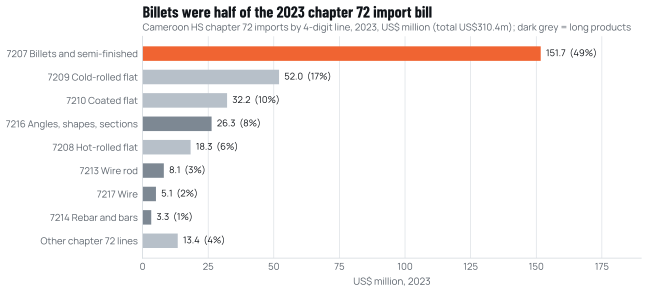
- The steel bill is an iron-unit bill. Billets were 49% of the 2023 chapter 72 bill, and 78% of them came from Indonesia [C06]. As domestic mills began rolling wire rod, wire-rod imports fell from 58 to 8 thousand tonnes between 2021 and 2023 while billet imports rose from 110 to 161 thousand tonnes: rolling at home moved the bill upstream rather than removing it [C06]. Rebar capacity is about 3.5 times rebar demand, mills run at about half capacity and local scrap covers about 40% of their needs [C30][C38]. Flat products and heavy sections are wholly imported (Chapter 2).
- Current protection shields rolling, not iron-making, and has kept prices above import parity. The common external tariff gives re-rolling billets into rebar an effective protection of about 60% on its value added, gives wire-rod rolling negative protection (minus 12%) and gives melting imported iron units into billets only 10%; melting domestic iron units receives more only if domestic scrap or DRI sells below duty-inclusive import parity [P24], derived. Under the rebar import prohibition and administered prices, the October 2023 homologated rebar price stood 3% to 40% above duty-paid import parity, depending on its VAT basis, an implied transfer of about 3 to 33 bn FCFA a year from builders [C44][G37], derived (Chapter 3).
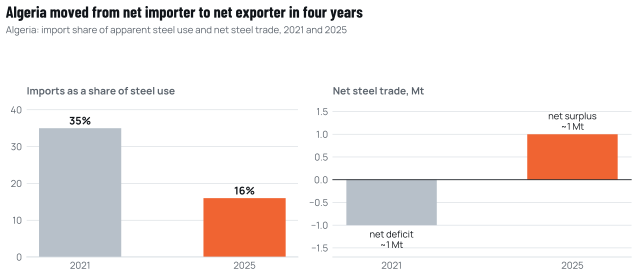
- International experience shows that discipline, not protection, decides success. Korea’s steel industry and heavy-industry drive succeeded under export and performance discipline, with benefits reaching downstream users [W04][W26]; Algeria cut the import share of its steel use from 35% to 16% in four years on the basis of competitive gas and direct reduction [A03][A04]; Nigeria’s Ajaokuta absorbed more than US$8 billion without producing steel commercially [W14]; South Africa’s main long-steel producer closed its long-products business in 2025 despite protection, citing energy and logistics costs [A13] (Chapter 3).
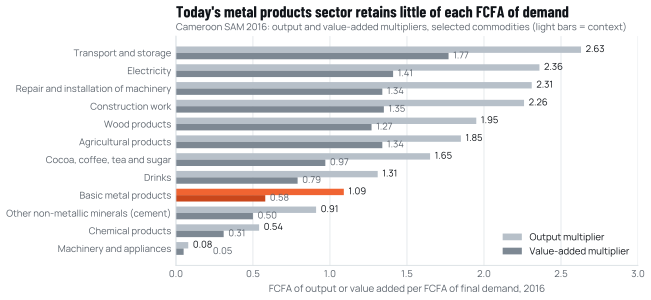
- About three-quarters of the value of rebar is iron, and that is where the multiplier lies. At October 2026 prices, the metallic charge accounts for about 75% of the delivered value of rebar [G34][W10][F], derived. In Cameroon’s 2016 social accounting matrix, each FCFA of demand for basic metal products generated 1.09 FCFA of output and 0.58 FCFA of value added, against 2.26 and 1.35 for construction, because the metal was imported [W02]. European and global steel multipliers of 3.5 or more are upper bounds for Cameroon until iron is made locally [P02][P01] (Chapter 4).
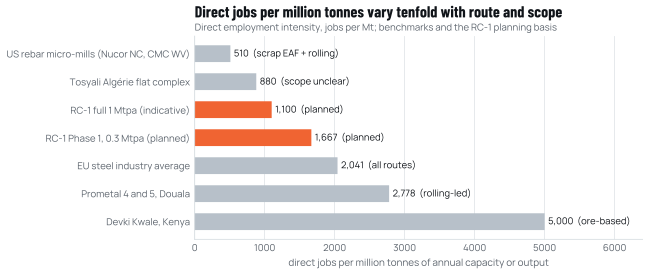
- Jobs: about 500 direct in Phase 1 and 1,100 at full capacity, with a wide range beyond. Cameroon Steel’s reference configuration plans about 500 direct jobs for Phase 1 (0.3 Mtpa), about 800 workers at the construction peak and an indicative 1,100 direct jobs at 1 Mtpa [F]. Published multipliers range from about 3 to 10 total jobs per direct job; using the low end and the European Type I value as an upper bound gives about 2,700 to 8,000 jobs supported at full capacity [F][P02], illustrative. Jobs are additional when the works supplies products and iron units the country lacks, rather than displacing existing re-rollers (Chapter 5).
- Fiscal effects: substitution moves revenue from the border to the domestic economy. Each 100,000 tonnes of domestic rebar that displaces re-rolled imported billets removes about 3.0 to 3.3 bn FCFA of customs duty; while iron units are imported, duty on them restores almost all of it, and with domestic iron the revenue must come from taxes on domestic value added [P24], illustrative. The 2025 incentive ordinance offers large projects a profit-tax credit of up to 75% of investment for five years (seven in economic zones), and its eligibility criteria favour national inputs, value added and exports [W08] (Chapter 6).
- On imported iron units, a Kribi works competes behind the tariff, not at the border. Imported billets cost about US$572 to 652 per tonne delivered and duty-paid, and imported rebar US$809 to 889 [G34][P24], derived. An illustrative cash cost for an electric arc furnace works melting imported scrap and HBI is US$591 to 783 per tonne of billet, the series’ comparison of White paper 04 (section 8.6), and US$657 to 933 per tonne of rebar, before capital charges [F][E15], illustrative. The price of power alone moves the cost of rebar by US$30 to 169 per tonne, because Cameroon has no published tariff for loads above 10 MW [E15][E17] (Chapter 7).
- The regional market is real but small nearby and contested further away. CEMAC imported about US$501 million of chapter 72 products in 2023, of which Cameroon 62%; regional rebar flows are tens of thousands of tonnes [C06][C07], derived. Duty-free regional trade requires 40% local materials or 30% local value added, close to what a mill using imported iron achieves; the AfCFTA rules for steel could not be verified [W11][P31]. Protection does not travel: beyond the border, only cost competitiveness sells (Chapter 8).
- The foreign-exchange gain of a phased 1 Mtpa works depends on its iron. At full utilisation and October 2026 prices, planned output would be worth 113 to 121 bn FCFA a year at border prices in Phase 1 and 390 to 455 bn FCFA at 1 Mtpa [F][G34], illustrative. The foreign exchange retained at 1 Mtpa would be about 40 to 154 bn FCFA a year with imported scrap and HBI, 48 to 160 bn FCFA with domestic scrap at the planning level of 30,000 tonnes a year (range 0 to 60,000) and 324 to 418 bn FCFA with domestic iron units, before capital service, against a 2025 chapter 72 bill of 170.1 bn FCFA [F][C42], illustrative. National scrap cannot close the gap: the only estimate of arising is 53,000 to 62,000 tonnes a year, so the large gain requires domestic DRI. Per tonne, a works on imported metallics saves about what a re-roller saves today (Chapter 9).
Contents
12 chapters, 4 annexes
Every chapter opens with its conclusion. The annexes set out the method, the glossary and the list of sources.
- SummaryExecutive summary11 min · 1 fig.
- Chapter 1Cameroon’s macro context: steady growth, a widening external gap and thin buffers11 min · 3 fig.
- Chapter 2The steel import bill: 170 bn FCFA a year, and half of it is billets11 min · 3 fig.
- Chapter 3Import substitution done right and wrong: discipline, not protection, decides the outcome14 min · 2 fig.
- Chapter 4Value added and linkages: the multiplier depends on making iron, not only on rolling it12 min · 3 fig.
- Chapter 5Employment: about 500 direct jobs in Phase 1 and 1,100 at full capacity, with a wide range beyond10 min · 2 fig.
- Chapter 6Fiscal effects: substitution moves revenue from the border to the domestic economy11 min · 1 fig.
- Chapter 7Competitiveness at border prices: a Kribi works on imported iron competes behind the tariff, not at the border13 min · 3 fig.
- Chapter 8The regional market and the AfCFTA: real but small nearby, larger but contested further away11 min · 2 fig.
- Chapter 9An illustrative footprint of a phased 1 Mtpa works: the foreign-exchange gain grows with domestic iron14 min · 3 fig.
- Chapter 10Policy recommendations: reward domestic iron and competitiveness, not rolling behind a closed border11 min · 2 fig.
- Chapter 11Evidence gaps: what is not yet known, and how it will be resolved7 min
Annexes
Go further
Related white papers
- WP04Cameroon’s steel gap lies in iron units, not in rebarMarket · 3.1 h
- WP01From ore to steel: Cameroon’s missing link is ironmaking, not rollingValue chain · 3 h
- WP08Cameroon can staff its steel industry if training starts before the furnace doesSkills · 2.7 h
Related Labs tools
- Import-substitution simulator
What share of steel imports could local production replace?
- Jobs impact
How many direct, indirect and induced jobs by phase?
- Value-chain explorer
How many tonnes go in and out at each stage, from ore to finished product?
Cite this white paper
CS-WP-09
Cameroon Steel (2026). Domestic steel saves foreign exchange only when it competes at border prices. White paper 09, CS-WP-09. https://www.cameroon-steel.com/en/library/economics-of-domestic-steel/
- Reference
- CS-WP-09
- Edition
- 10 October 2026
- Status
- First edition
- Classification
- Public