White paper 09 · Summary
Executive summary
Domestic production of iron units, billets and sections could save Cameroon a large part of the foreign exchange it spends on steel, deepen its industrial base and widen its tax base, but only if the industry is competitive at border prices and, above all, if it makes its own iron. In 2025, Cameroon imported 412,049 tonnes of iron and steel under HS chapter 72 for 170.1 bn FCFA, and steel and steel articles together accounted for 13% of the merchandise trade deficit, at a time when the reserves pooled by the six CEMAC states covered only 4.2 months of imports [C05][P07]. About half of that bill is billets, the iron units that local mills roll into rebar. The country already rolls more rebar than it uses; what it lacks is iron. A works that melts imported scrap and imported hot briquetted iron saves about as much foreign exchange per tonne as today’s re-rollers of imported billets. A works that uses domestic iron units could save more than the whole chapter 72 bill. Protection without competitiveness, by contrast, is a cost borne by builders and by the budget. This summary presents the ten findings and six recommendations of the paper.
In this chapter (5)
ES.1 Ten findings
- Steel is a material and rising foreign-exchange cost. Chapter 72 imports rose to 412,049 tonnes and 170.1 bn FCFA in 2025; with chapter 73 articles, iron and steel imports reached 278.1 bn FCFA, 13.0% of a trade deficit that widened by 22.8% to 2,145.2 bn FCFA [C05]. CEMAC reserves fell to 4.2 months of imports, foreign-exchange transfers are rationed, and the IMF rates Cameroon at high risk of debt distress [P07][P10][P32]. A dollar of imports durably avoided is worth more than its face value in this setting (Chapter 1).
- The steel bill is an iron-unit bill. Billets were 49% of the 2023 chapter 72 bill, and 78% of them came from Indonesia [C06]. As domestic mills began rolling wire rod, wire-rod imports fell from 58 to 8 thousand tonnes between 2021 and 2023 while billet imports rose from 110 to 161 thousand tonnes: rolling at home moved the bill upstream rather than removing it [C06]. Rebar capacity is about 3.5 times rebar demand, mills run at about half capacity and local scrap covers about 40% of their needs [C30][C38]. Flat products and heavy sections are wholly imported (Chapter 2).
- Current protection shields rolling, not iron-making, and has kept prices above import parity. The common external tariff gives re-rolling billets into rebar an effective protection of about 60% on its value added, gives wire-rod rolling negative protection (minus 12%) and gives melting imported iron units into billets only 10%; melting domestic iron units receives more only if domestic scrap or DRI sells below duty-inclusive import parity [P24], derived. Under the rebar import prohibition and administered prices, the October 2023 homologated rebar price stood 3% to 40% above duty-paid import parity, depending on its VAT basis, an implied transfer of about 3 to 33 bn FCFA a year from builders [C44][G37], derived (Chapter 3).
- International experience shows that discipline, not protection, decides success. Korea’s steel industry and heavy-industry drive succeeded under export and performance discipline, with benefits reaching downstream users [W04][W26]; Algeria cut the import share of its steel use from 35% to 16% in four years on the basis of competitive gas and direct reduction [A03][A04]; Nigeria’s Ajaokuta absorbed more than US$8 billion without producing steel commercially [W14]; South Africa’s main long-steel producer closed its long-products business in 2025 despite protection, citing energy and logistics costs [A13] (Chapter 3).
- About three-quarters of the value of rebar is iron, and that is where the multiplier lies. At October 2026 prices, the metallic charge accounts for about 75% of the delivered value of rebar [G34][W10][F], derived. In Cameroon’s 2016 social accounting matrix, each FCFA of demand for basic metal products generated 1.09 FCFA of output and 0.58 FCFA of value added, against 2.26 and 1.35 for construction, because the metal was imported [W02]. European and global steel multipliers of 3.5 or more are upper bounds for Cameroon until iron is made locally [P02][P01] (Chapter 4).
- Jobs: about 500 direct in Phase 1 and 1,100 at full capacity, with a wide range beyond. Cameroon Steel’s reference configuration plans about 500 direct jobs for Phase 1 (0.3 Mtpa), about 800 workers at the construction peak and an indicative 1,100 direct jobs at 1 Mtpa [F]. Published multipliers range from about 3 to 10 total jobs per direct job; using the low end and the European Type I value as an upper bound gives about 2,700 to 8,000 jobs supported at full capacity [F][P02], illustrative. Jobs are additional when the works supplies products and iron units the country lacks, rather than displacing existing re-rollers (Chapter 5).
- Fiscal effects: substitution moves revenue from the border to the domestic economy. Each 100,000 tonnes of domestic rebar that displaces re-rolled imported billets removes about 3.0 to 3.3 bn FCFA of customs duty; while iron units are imported, duty on them restores almost all of it, and with domestic iron the revenue must come from taxes on domestic value added [P24], illustrative. The 2025 incentive ordinance offers large projects a profit-tax credit of up to 75% of investment for five years (seven in economic zones), and its eligibility criteria favour national inputs, value added and exports [W08] (Chapter 6).
- On imported iron units, a Kribi works competes behind the tariff, not at the border. Imported billets cost about US$572 to 652 per tonne delivered and duty-paid, and imported rebar US$809 to 889 [G34][P24], derived. An illustrative cash cost for an electric arc furnace works melting imported scrap and HBI is US$591 to 783 per tonne of billet, the series’ comparison of White paper 04 (section 8.6), and US$657 to 933 per tonne of rebar, before capital charges [F][E15], illustrative. The price of power alone moves the cost of rebar by US$30 to 169 per tonne, because Cameroon has no published tariff for loads above 10 MW [E15][E17] (Chapter 7).
- The regional market is real but small nearby and contested further away. CEMAC imported about US$501 million of chapter 72 products in 2023, of which Cameroon 62%; regional rebar flows are tens of thousands of tonnes [C06][C07], derived. Duty-free regional trade requires 40% local materials or 30% local value added, close to what a mill using imported iron achieves; the AfCFTA rules for steel could not be verified [W11][P31]. Protection does not travel: beyond the border, only cost competitiveness sells (Chapter 8).
- The foreign-exchange gain of a phased 1 Mtpa works depends on its iron. At full utilisation and October 2026 prices, planned output would be worth 113 to 121 bn FCFA a year at border prices in Phase 1 and 390 to 455 bn FCFA at 1 Mtpa [F][G34], illustrative. The foreign exchange retained at 1 Mtpa would be about 40 to 154 bn FCFA a year with imported scrap and HBI, 48 to 160 bn FCFA with domestic scrap at the planning level of 30,000 tonnes a year (range 0 to 60,000) and 324 to 418 bn FCFA with domestic iron units, before capital service, against a 2025 chapter 72 bill of 170.1 bn FCFA [F][C42], illustrative. National scrap cannot close the gap: the only estimate of arising is 53,000 to 62,000 tonnes a year, so the large gain requires domestic DRI. Per tonne, a works on imported metallics saves about what a re-roller saves today (Chapter 9).
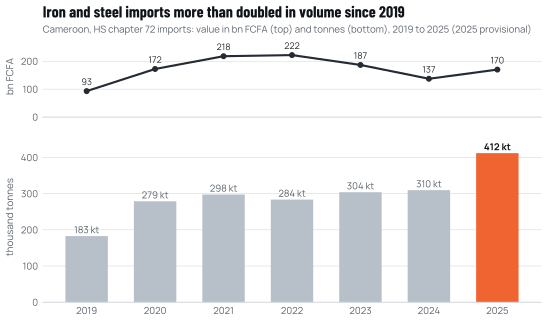
Source: INS, notes on foreign trade 2020 to 2025 (2025 provisional) [C01] to [C05].
ES.2 Six recommendations
The evidence supports a domestic steel policy, but one that rewards domestic iron and competitiveness rather than rolling behind a closed border (Chapter 10).
- Standards and procurement. Enforce the mandatory rebar standard for every supplier, domestic and imported, with third-party testing and published results; give public works a capped, tapering preference for domestic value added, modelled on India’s procurement policy for iron and steel products, with sections and structures on the list [C34][W17].
- Energy pricing. Publish a high-voltage framework tariff for loads above 10 MW, priced near the cost of generation and transmission (about 45 to 50 FCFA per kWh on published benchmarks), complete firm supply to the Kribi industrial zone, and clarify long-term gas supply and taxation [E15][E38][E11].
- Trade policy prudence. Replace the rebar prohibition with the tariff in steps once quality enforcement is in place; correct the tariff escalation in the new ECCAS-CEMAC external tariff so that iron units are not taxed like finished goods and wire-rod rolling is not penalised; and build a rules-based capacity for anti-dumping and safeguard investigations rather than relying on decrees [P23][P24][P26].
- Domestic iron units. Survey and formalise scrap collection; give the Mining Code’s minimum 15% local-transformation obligation a defined product, quality, price basis and timetable, so that it yields iron units; and coordinate ore, gas and port decisions so that direct reduction becomes feasible [C42][W09][O17].
- Financing without sovereign risk. Rely on development finance, export credit and African lenders rather than State guarantees; allow exporters to manage foreign-currency proceeds within CEMAC rules; and tie fiscal incentives to the ordinance’s performance criteria, publishing their cost [P32][C38][W08].
- A public scoreboard. Publish each year the domestic price of rebar and sections against import parity, the share of domestic iron units, imports, exports, quality compliance, jobs and taxes.
ES.3 The numbers in context
Three comparisons put the findings in proportion. First, the foreign exchange at stake is significant but not decisive on its own: the whole chapter 72 bill equals about 8% of the 2025 trade deficit and about 2.7% of CEMAC’s pooled reserves [C05][P07], derived. Second, the difference between iron-unit routes is larger than the difference between projects: per tonne of rebar, domestic iron units retain US$545 to 645 of foreign exchange, against US$47 to 181 for imported scrap and HBI and US$48 to 170 for today’s re-rolling of imported billets, illustrative. At 1 Mtpa with domestic iron, the saving would equal about 15% to 19% of the 2025 trade deficit; with imported iron, about 2% to 7%, illustrative. Third, the cost of getting protection wrong is of the same order as the gains: the transfer implied by rebar prices above import parity, 3 to 33 bn FCFA a year, compares with a foreign-exchange saving of 8 to 31 bn FCFA a year for a 0.3 Mtpa works on imported iron, illustrative. Policy design therefore matters as much as investment.
ES.4 What this means for a domestic steel project
Cameroon Steel is developing a phased steel complex at Mboro, in the Kribi industrial-port zone, with a design capacity of 1 Mtpa; the foundation stone was laid on 30 December 2024 by the Prime Minister, representing the Head of State [X01][X04]. Its first phase is planned around an electric arc furnace melt shop with a nameplate capacity of 0.3 Mtpa (expected sustained output 270,000 to 300,000 tonnes a year), with works from the first quarter of 2029 and a first heat in the second half of 2030 as targets; sections follow in Phase 2, indicative for 2032 to 2034, heavy sections in Phase 3, indicative after 2034, and a direct-reduction module for Cameroonian ore is indicative after 2034 [F]. Cameroon Steel’s sister company, Cameroon Mining Company, holds the Mbalam exploitation permit [X01]. The zone’s development plan lists steelmaking linked to mineral exports among its clusters [W31].
This paper applies the same test to that project as to the sector as a whole. Phase 1’s melt shop makes billets, and its output can move between rolled products (wire rod and rebar) and merchant billets sold to existing re-rollers, which today import about 60% of their charge (billet imports were 161,000 tonnes in 2023) [C06][C38]. Rebar is a saturated market, with capacity of about 627,000 tonnes against demand of about 180,000 tonnes [C30], so new rebar capacity alone closes no gap: Phase 1 tonnage has to displace imported billets and wire rod, replace non-compliant bars with certified rebar, or be exported to CEMAC neighbours. On imported iron units, Phase 1 would save about as much foreign exchange per tonne as today’s re-rollers. Its later phases would replace imports of sections that no domestic mill makes and open export markets, provided they are competitive at border prices. Its largest economic contribution would come with domestic iron units, in time through direct reduction of Cameroonian ore with Cameroonian gas, since national scrap is too small to supply a works of this scale. We publish this analysis because the policy choices it describes, on standards, procurement, power, tariffs and iron units, matter for every producer and for the country, and because we expect to be held to the same test.
ES.5 How to read this paper
Chapter 1 sets the macroeconomic context and Chapter 2 measures the steel import bill. Chapter 3 reviews import substitution in other countries and measures effective protection in Cameroon. Chapters 4, 5 and 6 examine value added, employment and fiscal effects. Chapter 7 tests competitiveness at border prices, and Chapter 8 the regional market and the AfCFTA. Chapter 9 combines these elements in an illustrative footprint of a phased 1 Mtpa works, and Chapter 10 sets out the recommendations. Chapter 11 lists the evidence gaps. Annex A explains the methods and lists every assumption with its range, Annex B is a glossary, Annex C lists all sources, and Annex D gives the values plotted in every chart.
Three conventions apply throughout. Every figure carries a source marker in square brackets that maps to Annex C; the marker [F] refers to Cameroon Steel’s reference configuration (RC-1), whose figures are planned or indicative, not commitments. Figures labelled derived are arithmetic on sourced inputs; figures labelled illustrative are scenario calculations whose assumptions are stated. And this paper contains no estimate of investment cost, financing or investment return: its subject is the economics of domestic steel for Cameroon, not the finances of any single project.
Statement of interest. This paper is published by Cameroon Steel, which is developing a steelworks at Kribi. It is written to inform public debate; its analysis is independent of any commercial offer, and every figure is sourced or labelled with its status.
Sources cited in this chapter
Bracketed markers refer to these sources; the full list is in the annex. Full list of sources
- C05Évolution du commerce extérieur en 2025 (version provisoire). INS Cameroun, Feb 2026 (posted 1 Apr 2026).ins-cameroun.cm/wp-content/uploads/2026/04/Note-sur-le-commerce-exteri…
- W13Euro foreign exchange reference rates, US dollar, monthly averages (series EXR.M.USD.EUR.SP00.A). European Central Bank.data-api.ecb.europa.eu/service/data/EXR/M.USD.EUR.SP00.A
- C06UN Comtrade public API: Cameroon (reporter 120), HS 72/73 and 6-digit lines, 2019-2023. UN Statistics Division.comtradeapi.un.org/public/v1/preview/C/A/HS?reporterCode=120&period=20…
- P07Zone Cémac: la BEAC annonce un ralentissement de croissance à 2,4%. AllAfrica (Les Dépêches de Brazzaville), 17 Dec 2025.fr.allafrica.com/stories/202512170629.html
- P102024 Investment Climate Statements: Cameroon. US Department of State, 2024.state.gov/reports/2024-investment-climate-statements/cameroon/
- P32IMF staff concludes Post-Financing Assessment mission to Cameroon (PR 26/314). IMF, 1 Oct 2026.imf.org/en/news/articles/2026/10/01/pr26314-imf-staff-concludes-assesm…
- C30Production: les acteurs en présence. Cameroon Tribune, 11 May 2026.cameroon-tribune.cm/article.html/76600/fr.html/details_2
- C38Cameroun: le groupe Prometal décroche 26 milliards FCFA auprès d’Afreximbank…. Sikafinance, 30 Sep 2026.sikafinance.com/marches/cameroun-le-groupe-prometal-decroche-26-millia…
- P24WITS TRAINS API: Cameroon reported MFN tariffs by HS6 (2023). World Bank / UNCTAD.wits.worldbank.org/API/V1/SDMX/V21/datasource/TRN/reporter/120/partner…
- C44Fer à béton: les producteurs acceptent une baisse des prix. EcoMatin, 23 Oct 2023.ecomatin.net/fer-a-beton-les-producteurs-acceptent-une-baisse-des-prix
- G37Weekly steel prices (archive 23160). AISU, 22 Oct 2023.aisusteel.org/en/archives/23160
- W04Manufacturing Revolutions: Industrial Policy and Industrialization in South Korea (N. Lane), Quarterly Journal of Economics 140(3), pp. 1683-1741. Oxford University Press, May 2025.doi.org/10.1093/qje/qjaf025
- W26Asia’s Next Giant: South Korea and Late Industrialization (A. H. Amsden). Oxford University Press, 1989 (online edition 1992).doi.org/10.1093/0195076036.001.0001
- A03Protecting the steel market: how it’s done in North Africa. GMK Center, 2 Sep 2026.gmk.center/en/posts/protecting-the-steel-market-how-it-s-done-in-north…
- A04Algeria’s steel industry: why is it growing. GMK Center, 28 Jul 2026.gmk.center/en/posts/algeria-s-steel-industry-why-is-it-growing/
- W14Ajaokuta Steel factory to begin production after 40 years. BusinessDay (Nigeria), 18 Jun 2018.businessday.ng/exclusives/article/ajaokuta-steel-factory-open-40-years…
- A13Update: Final wind-down decision relating to the Long Steel Business. ArcelorMittal South Africa, 28 Feb 2025.arcelormittalsa.com/Portals/0/NEWS%20RELEASE%20-%20UPDATE%20-%20FINAL%…
- G34Weekly steel prices (archive 40468). Arab Iron & Steel Union (AISU), 3 Oct 2026.aisusteel.org/en/archives/40468
- W10Global HBI market bullish amid tight supply, ex-Libya tender closure to give further direction. SteelOrbis, 15 May 2026.steelorbis.com/steel-prices/steel-prices-market-analyses/scrap-and-raw…
- FCameroon Steel reference configuration RC-1 (planning estimate), edition 10 October 2026 (RC-1.1). Cameroon Steel, 10 Oct 2026.Cited by title and date
- W02Environmental sustainability and job creation: a SAM-based approach for Cameroon (A. El Meligi, V. Ferreira, V. Nechifor, E. Ferrari). European Commission Joint Research Centre; GTAP resource 11157 via AgEcon Search, 2023.ageconsearch.umn.edu/record/333428
- P02European Steel in Figures 2025. EUROFER, Jun 2025.eurofer.eu/assets/publications/brochures-booklets-and-factsheets/europ…
- P01Economic and social impact of the global steel industry (infographic). worldsteel / Oxford Economics, May 2019.worldsteel.org/wp-content/uploads/Steel-social-and-economic-impact.pdf
- W08Ordonnance n° 2025/002 du 18 juillet 2025 fixant les incitations à l’investissement en République du Cameroun (certified copy). Presidency of the Republic, copy hosted by LEGECAM, 18 Jul 2025.legecam.cm/wp-content/uploads/2025/08/ordonnance_n_2025_002_du_18_07_2…
- E15Rapport d’activités 2025 de l’ARSEL. ARSEL (electricity regulator), 7 Sep 2026.arsel-cm.org/wp-content/uploads/2026/09/Rapport-ARSEL-2025.pdf
- E17Décision fixant le montant de la RMA ENEO au titre de l’exercice 2025 (réajustée). ARSEL, 19 Dec 2025.arsel-cm.org/wp-content/uploads/2026/01/Decision-fixant-le-Montant-de-…
- C07UN Comtrade public API: CEMAC & Nigeria (reporters 266 Gabon, 178 Congo, 140 CAR, 566 Nigeria; mirror partners 148 Chad, 226 Eq. Guinea). UN Statistics Division.comtradeapi.un.org/public/v1/preview/C/A/HS?reporterCode=266&period=20…
- W11Commerce sous-régional: plus de 1000 produits camerounais circulent en Afrique centrale en franchise de douane. EcoMatin, 14 Nov 2022.ecomatin.net/commerce-sous-regional-plus-de-1000-produits-camerounais-…
- P31AfCFTA e-Tariff Book. AfCFTA Secretariat, n.d..au-afcfta.org/etariff/
- C42Bidoung J., Fomethe A., Yantio G., Melo U., La récupération et le recyclage des déchets ferromagnétiques: analyse de la situation au Cameroun (Déchets, Revue francophone d’écologie industrielle n°48). ENSP Yaoundé / MIPROMALO, Q4 2007.eid.episciences.org/7942/pdf
- C01Commerce extérieur du Cameroun en 2020. INS Cameroun, Jul 2021.ins-cameroun.cm/wp-content/uploads/2025/07/Note-Commerce-exterieur-202…
- C34Cameroon rejects fresh push to revise rebar standard. Business in Cameroon, 26 Jan 2026.businessincameroon.com/construction/2601-15657-cameroon-rejects-fresh-…
- W17Policy for providing preference to domestically manufactured iron and steel products in government procurement (DMI&SP). Ministry of Steel, Government of India, 8 May 2017; revised 29 May 2019 and 31 Dec 2020.steel.gov.in/node/45
- E38Tarif transport et GRT (Décision 0000017D). ARSEL, 17 Jan 2025.arsel-cm.org/wp-content/uploads/2026/01/TARIF-TRANSPORT-ET-GRT-1.pdf
- E11Industrial gas: Cameroon suspends GDC’s 20% price hiking plan. Business in Cameroon, 18 Jul 2023.businessincameroon.com/energy/1807-13291-industrial-gas-cameroon-suspe…
- P23Cameroon applies CEEAC common external tariff from January 1, 2026. Business in Cameroon, 12 Jan 2026.businessincameroon.com/public-management/1201-15594-cameroon-applies-c…
- P26Tariff profile: Cameroon. WTO, n.d..wto.org/english/res_e/statis_e/daily_update_e/tariff_profiles/CM_e.pdf
- W09Loi n° 2023/014 du 19 décembre 2023 portant Code minier (Article 40(4), local transformation). Republic of Cameroon, copy on FAOLEX, 19 Dec 2023.faolex.fao.org/docs/pdf/cmr223180.pdf
- O17Cameroon Mining Company confirme l’entrée du projet Mbalam dans sa phase irréversible d’exécution. Camer.be via AllAfrica, 12 Dec 2025.fr.allafrica.com/stories/202512120475.html
- X01Kribi: le Premier ministre, chef du gouvernement est là. Cameroon Tribune, 30 Dec 2024.cameroon-tribune.cm/article.html/68499/fr.html/details_2
- X04Industrialisation: la voie royale de l’émergence. Cameroon Tribune, 2 Jan 2025.cameroon-tribune.cm/article.html/68558/fr.html/details_2
- W31Zone industrialo-portuaire de Kribi (KPIZ): jusqu’à +8 points de croissance et 150 000 emplois attendus sur 15 ans. Investir au Cameroun, 4 Mar 2026.investiraucameroun.com/gestion-publique/0403-23163-zone-industrialo-po…
Cite this chapter
Cameroon Steel (2026). Domestic steel saves foreign exchange only when it competes at border prices. White paper 09, Executive summary. CS-WP-09. https://www.cameroon-steel.com/en/library/economics-of-domestic-steel/executive-summary/
Source