White paper 09 · Chapter 8
The regional market and the AfCFTA: real but small nearby, larger but contested further away
A domestic works that grows beyond Cameroon’s own market must sell to its neighbours and beyond. The six CEMAC states imported about US$501 million of chapter 72 iron and steel in 2023, of which Cameroon itself accounted for 62%; the other five together imported about US$191 million, much of it flat products and goods for the oil and gas industry [C06][C07], derived. Regional rebar flows are measured in tens of thousands of tonnes: Gabon imported about 51,000 tonnes in 2023 and the Republic of Congo about 33,000 tonnes in 2024, while Cameroon exported about 31,000 tonnes of bars in 2025, mainly to Chad [C07][C05]. Intra-CEMAC trade is duty-free for products that qualify as originating, but the qualifying thresholds of 40% local materials or 30% local value added are close to what a mill rolling or melting imported iron can achieve, and the continental rules for steel under the African Continental Free Trade Area (AfCFTA) were not verifiable at the time of writing [W11][P31]. Neighbouring markets are also becoming more contested, with new mills in Gabon and West Africa. The regional market rewards the same thing as the domestic one: competitive, domestically made iron.
In this chapter (6)
- 8.1 CEMAC imports about US$0.5 billion of iron and steel a year, and Cameroon is most of it
- 8.2 A larger works must look beyond CEMAC, where competition is building
- 8.3 Intra-CEMAC trade is duty-free for originating products, but origin is not automatic
- 8.4 The AfCFTA opens the continent in principle; for steel, the schedules and rules are not yet clear
- 8.5 A regional strategy differs by product
- 8.6 What the regional market implies for a phased works
8.1 CEMAC imports about US$0.5 billion of iron and steel a year, and Cameroon is most of it
UN Comtrade data give the most consistent picture of the region, although not all members report every year. In 2023, Cameroon imported US$310.4 million of chapter 72 products; Gabon US$68.5 million; the Republic of Congo US$33.9 million; and the Central African Republic US$3.4 million [C06][C07]. For Chad and Equatorial Guinea, which do not report, the imports recorded by their trading partners give US$73.4 million and US$11.6 million respectively [C07]. The CEMAC total is therefore about US$501 million, of which Cameroon accounts for 62% [C06][C07], derived. Chad’s mirror data show that Cameroon was its second supplier, with US$26.5 million, after Benin [C07].
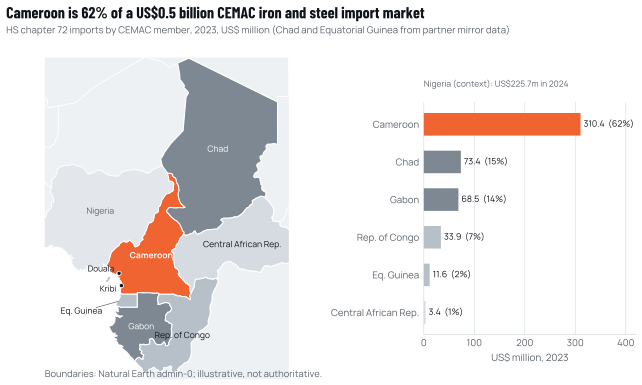
Source: UN Comtrade public API, reporters Cameroon, Gabon, Republic of Congo and Central African Republic; partner mirror data for Chad and Equatorial Guinea [C06][C07]; boundaries from Natural Earth. Totals and shares derived by Cameroon Steel.
The composition of neighbours’ imports differs from Cameroon’s. Gabon and Congo import large values of chapter 73 articles, US$235.3 million and US$437.6 million respectively in their latest years, much of it tubes, structures and equipment for the oil and gas industry [C07]. Their chapter 72 imports include rebar, which Cameroon prohibits but they do not: Gabon imported 50.7 thousand tonnes of rebar (US$44.1 million) in 2023 and Congo 32.8 thousand tonnes in 2024 [C07]. The Central African Republic imported about 1,000 tonnes [C07].
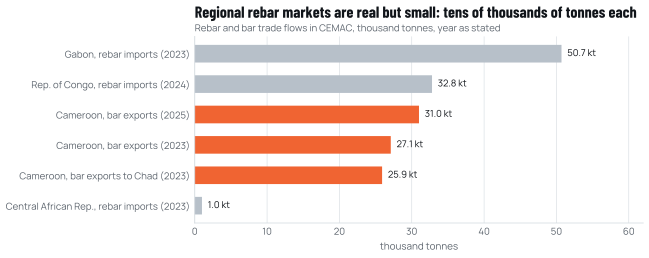
Source: UN Comtrade public API [C06][C07]; INS, foreign trade 2023 and 2025 (provisional) [C04][C05].
Prices are also higher in neighbouring markets. A 2023 comparison reported that Cameroonian rebar was about 10% cheaper than in Côte d’Ivoire and about 25% cheaper than in Gabon [C45]. Inland and landlocked markets such as Chad and the Central African Republic carry high transport costs from overseas suppliers, which is why Cameroonian mills already supply Chad by road [C06].
8.2 A larger works must look beyond CEMAC, where competition is building
The CEMAC market outside Cameroon is too small to absorb a 1 Mtpa works. Even if a Cameroonian producer captured all of the rebar imports of Gabon and Congo, the volume would be under 100,000 tonnes a year [C07]. Phase 3 of RC-1, with an indicative 500,000 tonnes of heavy sections [F], would need markets further afield.
Nigeria is the largest neighbouring market. Its chapter 72 imports fell from US$930.4 million in 2021 to US$225.7 million in 2024 after the devaluation of the naira, while chapter 73 imports remained large at US$754.8 million [C07]. Nigeria’s operating steel capacity in plants of 0.5 Mtpa or more is about 0.6 Mtpa [G18], and new projects such as a US$450 million hot-rolled coil plant are under way [A16]. Nigeria belongs to the Economic Community of West African States, not to CEMAC, so access depends on the AfCFTA.
West and East Africa are adding rolling capacity. Danieli announced orders in September 2026 for a 300,000-tonne bar and wire-rod mill for GSM in Tanzania and a similar mill for B5Plus in Abidjan, due in the third quarter of 2027 [A21][A22]. In Gabon, Prometal’s mill in the Nkok special economic zone was announced with a first phase of 120,000 tonnes of scrap-based rebar (other reports give 170,000 tonnes) [C39], and the Fokou group opened a scrap-processing unit at Port-Gentil [C53]. Gabon cut VAT on locally made rebar from 10% to 3% in July 2026 [C52]. Neighbouring governments are pursuing their own import substitution, so the regional market for commodity rebar will become more contested, not less.
Africa as a whole is the growth market. The continent’s apparent steel use rose by 10.4% to 45.0 Mt in 2025, and worldsteel forecasts growth of 3.8% in 2026 and 4.6% in 2027 [G09]. Africa used only 29.2 kg of steel per person in 2025, and 22.5 kg outside Egypt and South Africa, against 209 kg worldwide [G05]. Its steel imports reached 32.9 Mt in 2025 [G05]. Sub-Saharan Africa produced only 0.09 Mt of direct reduced iron in 2025 [T13]. Products that few African mills make, such as medium and heavy sections and, in time, iron units, have the widest market.
8.3 Intra-CEMAC trade is duty-free for originating products, but origin is not automatic
Goods that originate in a CEMAC member circulate in the community free of customs duties under the preferential tariff, and goods originating in the wider Economic Community of Central African States (ECCAS) have enjoyed zero duty since 1 January 2018 [P19]. Origin must be approved. Under the CEMAC rules, a manufactured product qualifies if it incorporates local raw materials worth at least 40% of its value, or if it embodies local value added of at least 30% [W11]. By November 2022, 761 Cameroonian products had CEMAC origin approval and 249 had ECCAS approval [W11].
For steel, the test bites. A mill that rolls imported billets, or melts imported scrap and HBI, adds value equal to its conversion margin. At world prices, that margin is about 19% of the delivered value of rebar for a re-roller and about 25% for an integrated works on imported metallics [G34][W10][F], derived (Table 3.2). Measured against ex-works prices that include domestic costs and margins, the share may reach or slightly exceed 30%, but it sits close to the threshold, and the outcome depends on valuation rules that this paper has not been able to verify. A works that uses domestic scrap or domestic DRI passes either test comfortably, because its main raw material is local. Rules of origin, in other words, reward domestic iron units in the same way as the foreign-exchange and fiscal arithmetic of the previous chapters.
8.4 The AfCFTA opens the continent in principle; for steel, the schedules and rules are not yet clear
Cameroon signed the Agreement establishing the AfCFTA on 21 March 2018, ratified it on 31 January 2020 and deposited its instrument on 1 December 2020 [P27]. Fifty ratifications had been deposited by September 2026 [P28]. Trading under the agreement requires published tariff schedules and agreed rules of origin. The AfCFTA Secretariat launched a Guided Trade Initiative in October 2022 to start trade among ready countries; Cameroon’s participation was not confirmed [P29]. In October 2026 the Secretary-General, having concluded the automotive rules of origin, urged a shift of focus to investment and jobs [P30].
For chapter 72 products, three facts could not be verified for this paper: the product-specific rule of origin, Cameroon’s liberalisation schedule for rebar and sections, and whether steel falls in the tariff lines liberalised early or late [P31]. Until they are clear, exports to Nigeria and beyond under AfCFTA preferences should be treated as an option, not a base case. The Cameroonian government has signalled interest: the strategic committee on mines-metallurgy integration set up by the Prime Minister in December 2025 was reported in April 2026 to be preparing steel exports to AfCFTA markets, after finding that domestic metallurgical capacity exceeds local demand [W29][W30].
Further afield, two regimes matter. Exports to the European Union enter under the Economic Partnership Agreement, whose ninth phase in August 2024 liberalised all of groups 1 and 2 and half of group 3; the group in which steel falls was not verified [P22]. Since January 2026 the EU’s Carbon Border Adjustment Mechanism (CBAM) applies in its definitive phase to chapter 72 products, including DRI, billets, rebar and wire rod, with certificates priced at €82.32 per tonne of CO2 in the third quarter of 2026 [D01][D05][D08]. The United Kingdom’s CBAM starts in January 2027 [D10]. RC-1’s planned emission intensity, about 0.32 tonnes of CO2 per tonne of product in Phase 1 for direct and power-related emissions (about 0.33 at full build-out) and about 0.58 including the upstream emissions of imported DRI [F], is well below the 2.34 tonnes of the blast-furnace route [T01], an advantage in markets that price carbon; on the CBAM basis (direct and precursor emissions, electricity excluded) it is about 0.36 t, which carries an estimated charge of about €24 per tonne in 2026 (White paper 06, Chapter 5).
Table 8.1 Market access for Cameroonian long steel products, by destination (status at 10 October 2026)
| Destination | Tariff faced by Cameroonian product | Origin requirement | Main uncertainty | Source |
|---|---|---|---|---|
| Cameroon | None (domestic); competing imports pay 10 to 20% CET; rebar imports prohibited | n/a | 2026 ECCAS-CEMAC steel-line rates unpublished | [P24][P23][C21] |
| Other CEMAC members | 0% for approved originating products | 40% local raw materials or 30% local value added | Valuation basis for steel; national preferences (Gabon VAT) | [W11][P19][C52] |
| Other ECCAS members | 0% since 2018 for originating products | ECCAS approval | Implementation by members | [P19][W11] |
| Nigeria and other AfCFTA parties | AfCFTA preference once schedules apply; otherwise partner’s external tariff | AfCFTA rules for chapter 72 not verified | Schedules, rules of origin, trading readiness | [P27][P29][P31] |
| European Union | EPA preference; steel’s liberalisation group not verified | EPA origin protocol | CBAM charge on embedded emissions from 2026 | [P22][D01][D05] |
| United Kingdom | UK-Cameroon EPA | EPA origin protocol | UK CBAM from January 2027 | [D10] |
Source: as cited in the table.
8.5 A regional strategy differs by product
The regional opportunity is not the same for every product, and a credible strategy follows the product.
Rebar and wire rod have the most immediate regional market but also the most competition. Chad and the Central African Republic depend on supply through Cameroon and already buy Cameroonian bars [C06]; Gabon and Congo import rebar by sea, but Gabon is building its own scrap-based capacity and has given local rebar a VAT preference [C07][C39][C52]. For a Cameroonian producer, the inland corridors are the natural market and the coastal neighbours a contested one.
Merchant billets could supply re-rollers in neighbouring countries as well as in Cameroon, but billets are a commodity traded on thin margins against Asian and Black Sea suppliers (Chapter 7) [G34]. They are attractive regionally only if made from low-cost domestic iron units.
Sections and structural steel face the least regional competition, because few mills in Central or West Africa roll medium and heavy sections, and they serve the large chapter 73 demand of the oil, gas, mining and port industries in Congo, Gabon and Cameroon [C06][C07]. They are also the products most exposed to quality and certification requirements, which favours a producer with certified quality systems.
Iron units (billets and, later, direct reduced iron) are the regional products with the widest market: Sub-Saharan Africa produced only 0.09 Mt of direct reduced iron in 2025, while Africa imported 32.9 Mt of steel [T13][G05]. A Central African supplier of iron units would serve re-rollers and electric furnaces in several countries, and in markets that price carbon its gas-based iron would carry a lower emissions burden than blast-furnace iron [T01][D05].
The ordering matches the economics of the earlier chapters: the products that save the most foreign exchange at home are also those with the most open markets abroad.
8.6 What the regional market implies for a phased works
Three implications follow for the economics of a phased works and for policy.
Phase 1 must find its tonnage in displaced imports and nearby exports. RC-1 Phase 1 has a nameplate capacity of 0.3 Mtpa, with an expected sustained output of 270,000 to 300,000 tonnes a year [F]. Its melt shop makes billets that can be rolled into rebar and wire rod or sold as merchant billets. Domestic rebar demand of about 180,000 tonnes is already covered by about 627,000 tonnes of rolling capacity [C30], so Phase 1 tonnage has to come from displacing imported billets (161,000 tonnes in 2023) and wire rod, from certified rebar replacing non-compliant product, and from exports to Chad and other CEMAC neighbours [C06][C05]. It does not depend on distant exports, but any rebar it sells at home competes with existing domestic mills (Chapter 5).
Later phases depend on export competitiveness at FOB prices. Products sold to Nigeria, West Africa or overseas earn the export price less freight, not the duty-paid import parity of the home market. The protection analysed in Chapter 3 does not travel. Only a works that is competitive at border prices (Chapter 7) can sell sections and billets abroad at a margin.
Regional sales save CEMAC reserves only when they displace imports from outside the union. Sales to Gabon or Chad that replace Turkish or Chinese steel save the union’s pooled reserves; sales that displace a Gabonese producer do not. The foreign-exchange estimates of Chapter 9 count regional sales accordingly.
Sources cited in this chapter
Bracketed markers refer to these sources; the full list is in the annex. Full list of sources
- C06UN Comtrade public API: Cameroon (reporter 120), HS 72/73 and 6-digit lines, 2019-2023. UN Statistics Division.comtradeapi.un.org/public/v1/preview/C/A/HS?reporterCode=120&period=20…
- C07UN Comtrade public API: CEMAC & Nigeria (reporters 266 Gabon, 178 Congo, 140 CAR, 566 Nigeria; mirror partners 148 Chad, 226 Eq. Guinea). UN Statistics Division.comtradeapi.un.org/public/v1/preview/C/A/HS?reporterCode=266&period=20…
- C04Évolution du commerce extérieur en 2024. INS Cameroun, Aug 2025.ins-cameroun.cm/wp-content/uploads/2025/12/Commext_2024_FR_Edite-final…
- C05Évolution du commerce extérieur en 2025 (version provisoire). INS Cameroun, Feb 2026 (posted 1 Apr 2026).ins-cameroun.cm/wp-content/uploads/2026/04/Note-sur-le-commerce-exteri…
- C45Métallurgie: les locaux battent le fer chaud. Cameroon Tribune, 17 Aug 2023.cameroon-tribune.cm/article.html/59491/fr.html/details_2
- FCameroon Steel reference configuration RC-1 (planning estimate), edition 10 October 2026 (RC-1.1). Cameroon Steel, 10 Oct 2026.Cited by title and date
- G18Pedal to the Metal 2026. Global Energy Monitor, May 2026.globalenergymonitor.org/sites/default/files/2026-05/Pedal%20to%20the%2…
- A16China’s Stellar Steel invests $450 million in a new steel plant in Nigeria. GMK Center, 27 Oct 2025.gmk.center/en/news/china-s-stellar-steel-invests-450-million-in-a-new-…
- A21GSM Tanzania selects Danieli for new rebar and wire-rod mill. Danieli, 14 Sep 2026.danieli.com/en/GSM-Tanzania-selects-Danieli-for-new-rebar-and-wirerod-…
- A22B5Plus Group awards Danieli bar and wire-rod mill project. Danieli, 23 Sep 2026.danieli.com/en/B5Plus-Group-awards-Danieli-bar-and-wirerod-mill-projec…
- C39Prometal obtient 26 milliards FCFA d’Afreximbank pour soutenir son expansion industrielle. EcoMatin, 30 Sep 2026.ecomatin.net/prometal-obtient-26-milliards-fcfa-dafreximbank-pour-sout…
- C53Gabon: le groupe Fokou lance une nouvelle unité d’acier à Port-Gentil. EcoMatin, 18 Sep 2026.ecomatin.net/gabon-le-groupe-fokou-lance-une-nouvelle-unite-dacier-a-p…
- C52Le Gabon réduit la TVA sur le fer à béton local. EcoMatin, 4 Aug 2026.ecomatin.net/le-gabon-reduit-la-tva-sur-le-fer-a-beton-local-pour-stim…
- G09worldsteel Short Range Outlook April 2026 (release + Table 1). worldsteel, 14 Apr 2026.worldsteel.org/media/press-releases/2026/worldsteel-short-range-outloo…
- G05World Steel in Figures 2026 (page and PDF). worldsteel, 4 Jun 2026.worldsteel.org/data/world-steel-in-figures/world-steel-in-figures-2026…
- T132025 World Direct Reduction Statistics. Midrex Technologies, Sep 2026.midrex.com/world-dri-statistics/world-dri-production-reaches-151-0-mt-…
- P19Cameroon, Republic of: Corporate, Other taxes. PwC Worldwide Tax Summaries, reviewed 14 Aug 2026.taxsummaries.pwc.com/republic-of-cameroon/corporate/other-taxes
- W11Commerce sous-régional: plus de 1000 produits camerounais circulent en Afrique centrale en franchise de douane. EcoMatin, 14 Nov 2022.ecomatin.net/commerce-sous-regional-plus-de-1000-produits-camerounais-…
- G34Weekly steel prices (archive 40468). Arab Iron & Steel Union (AISU), 3 Oct 2026.aisusteel.org/en/archives/40468
- W10Global HBI market bullish amid tight supply, ex-Libya tender closure to give further direction. SteelOrbis, 15 May 2026.steelorbis.com/steel-prices/steel-prices-market-analyses/scrap-and-raw…
- P31AfCFTA e-Tariff Book. AfCFTA Secretariat, n.d..au-afcfta.org/etariff/
- P23Cameroon applies CEEAC common external tariff from January 1, 2026. Business in Cameroon, 12 Jan 2026.businessincameroon.com/public-management/1201-15594-cameroon-applies-c…
- P27List of countries which have signed, ratified/acceded to the AfCFTA Agreement. African Union Commission, 22 May 2026.au.int/sites/default/files/treaties/36437-sl-AGREEMENT_ESTABLISHING_TH…
- P28Status of AfCFTA ratification. tralac, upd. 7 Sep 2026.tralac.org/resources/infographic/13795-status-of-afcfta-ratification.h…
- P29Guided Trade Initiative. AfCFTA Secretariat, n.d..au-afcfta.org/guided-trade-initiative/
- P30AfCFTA Secretary-General urges shift from automotive rules to investment and jobs. AfCFTA Secretariat, 2 Oct 2026.au-afcfta.org/2026/10/afcfta-secretary-general-urges-shift-from-automo…
- W29Le Cameroun prépare l’exportation de son acier vers les marchés de la ZLECAf (V. Bagal). EcoMatin, 16 Apr 2026.ecomatin.net/le-cameroun-prepare-lexportation-de-son-acier-vers-les-ma…
- W30Cameroon reviews metals industry to address supply and energy constraints. Business in Cameroon, 29 Apr 2026.businessincameroon.com/public-management/2904-16094-cameroon-reviews-m…
- P22Cameroon: Import Tariffs (Country Commercial Guide). US International Trade Administration, 10 Apr 2026.trade.gov/country-commercial-guides/cameroon-import-tariffs
- D01Carbon Border Adjustment Mechanism. European Commission (DG TAXUD), n.d..taxation-customs.ec.europa.eu/carbon-border-adjustment-mechanism_en
- D05Price of CBAM certificates. European Commission, 5 Oct 2026 (latest).taxation-customs.ec.europa.eu/carbon-border-adjustment-mechanism/price…
- D08Regulation (EU) 2023/956 (CBAM), Annex I. EUR-Lex (OJ L 130), 16 May 2023.eur-lex.europa.eu/legal-content/EN/TXT/PDF/?uri=CELEX:32023R0956
- D10Check if you’ll need to register for CBAM; Prepare for CBAM. HMRC / GOV.UK, upd. Jul-Sep 2026.gov.uk/government/collections/carbon-border-adjustment-mechanism
- T01Sustainability Indicators 2025 report. worldsteel, Nov 2025 (upd. Feb 2026).worldsteel.org/wider-sustainability/sustainability-indicators/sustaina…
- P24WITS TRAINS API: Cameroon reported MFN tariffs by HS6 (2023). World Bank / UNCTAD.wits.worldbank.org/API/V1/SDMX/V21/datasource/TRN/reporter/120/partner…
- C21Métallurgie: les importations du fer à béton interdites jusqu’à nouvel ordre. EcoMatin, 10 Apr 2023.ecomatin.net/metallurgie-les-importations-du-fer-a-beton-interdites-ju…
- C30Production: les acteurs en présence. Cameroon Tribune, 11 May 2026.cameroon-tribune.cm/article.html/76600/fr.html/details_2
Cite this chapter
Cameroon Steel (2026). Domestic steel saves foreign exchange only when it competes at border prices. White paper 09, chapter 8: The regional market and the AfCFTA: real but small nearby, larger but contested further away. CS-WP-09. https://www.cameroon-steel.com/en/library/economics-of-domestic-steel/regional-afcfta/
Source