White paper 09 · Chapter 7
Competitiveness at border prices: a Kribi works on imported iron competes behind the tariff, not at the border
At October 2026 prices, imported billets land in Douala at about US$570 to 650 per tonne after duty and imported rebar at about US$810 to 890 [G34][P24], derived. An illustrative cash-cost estimate for a Kribi electric arc furnace works melting imported scrap and hot briquetted iron gives about US$590 to 780 per tonne for merchant billets, the series’ comparison set out in White paper 04 (section 8.6), and US$660 to 930 per tonne for rebar, before any capital charge [F][G34][W10][E15], illustrative. In the central case, rebar from such a works would be competitive behind the 20% tariff but not at the border price before duty, and merchant billets would be competitive only in the low-cost case. Three variables decide the outcome: the cost of iron units, which is about two-thirds of the cash cost; the price of power, which can add anything from US$30 to US$169 per tonne of rebar; and the 10% duty on imported metallics. Competing at border prices requires domestic iron units, firm power priced near the cost of generation and transmission, and duty-neutral inputs for exports. This chapter sets out the comparison and its assumptions.
In this chapter (7)
- 7.1 Border prices set the ceiling: billets about US$470, rebar about US$625
- 7.2 Landed import parity: about US$600 for billets and US$850 for rebar
- 7.3 The cost structure of an electric arc furnace long-products works
- 7.4 Electricity is the swing factor, and Cameroon has no tariff for large industry
- 7.5 The illustrative comparison: competitive behind the tariff, not at the border
- 7.6 Sections, billets and rebar sit in different competitive positions
- 7.7 Five conditions for competing at border prices
7.1 Border prices set the ceiling: billets about US$470, rebar about US$625
International steel prices are set in a market with large and growing surplus capacity. The OECD estimates global excess steelmaking capacity at about 640 Mt in 2025, rising to 745 Mt by 2028 [G16]. China exported a record 119 Mt of steel in 2025 on its customs definition [G19], and its exports of semi-finished products, mainly billets, rose to 11.9 Mt in the first ten months of 2025, 2.6 times the level of a year earlier [G20]. As trade defence spreads (62 countries had implemented 207 restrictions on Chinese steel by October 2025 [G30]; the EU raised its out-of-quota duty to 50% from July 2026 [G10]), surplus steel is diverted to markets with little protection. Africa’s steel imports rose from 23.9 Mt in 2024 to 32.9 Mt in 2025, of which 19.4 Mt came from China [G05][G06]. China introduced export licensing for about 300 steel products from January 2026, which may moderate flows [G21].
For a Central African producer, these conditions set the price ceiling. On 3 October 2026, the Arab Iron and Steel Union’s weekly assessment quoted billets at US$465 to 470 per tonne free on board (FOB) from China and US$470 to 480 from Russia, rebar at US$620 to 630 FOB Türkiye, wire rod at US$650 to 660 FOB Türkiye and heavy melting scrap at US$403 per tonne delivered (CFR) to Türkiye [G34]. Hot briquetted iron sold for US$385 to 395 delivered to Mediterranean buyers in May 2026 [W10]. Rebar has traded between about US$545 and 630 FOB Türkiye since October 2023, and billets between about US$430 and 495 [G34] to [G38][G40].
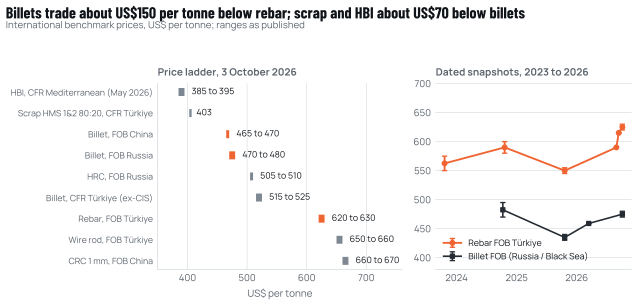
Source: AISU weekly price reports of 22 October 2023, 6 October 2024, 5 November 2024, 18 October 2025 and 3 October 2026 [G34] to [G38]; GMK Center [G39][G40]; SteelOrbis, 15 May 2026 [W10].
The spreads between these prices define the margins available at each stage of the chain. The rebar-billet spread of about US$150 per tonne is what a re-roller has to cover its rolling costs and capital; the billet-metallics spread of about US$60 to 80 per tonne is what a melt shop buying scrap or HBI has to cover the melting loss, power, electrodes, labour and capital [G34][W10]. These are thin margins by industrial standards. They explain why merchant melt shops that buy their iron units at international prices struggle everywhere, and why integrated producers with their own iron, or access to cheap domestic scrap, dominate.
7.2 Landed import parity: about US$600 for billets and US$850 for rebar
Imports reaching Cameroon pay freight, insurance, the common external tariff, the African Union levy, port charges and inland delivery. Figure 7.2 builds the landed, duty-paid cost at October 2026 prices. Freight and insurance from Asia, the Black Sea or Türkiye are taken at US$40 to 80 per tonne, an assumption consistent with UNCTAD’s estimate that African countries paid on average 11.4% of the value of their imports in international transport costs over 2005 to 2014 [W12]; port handling, clearance and delivery to a Douala or Kribi buyer at US$15 to 35 per tonne, also assumed.
On these assumptions, imported billets cost about US$572 to 652 per tonne delivered and duty-paid, wire rod US$741 to 814 and rebar US$809 to 889 [G34][P24][P19], derived. Before duty, the delivered cost of rebar (cost, insurance and freight, CIF) is US$660 to 710 per tonne. At the RC-1 planning rate of 600 FCFA per dollar used for the cost comparison, duty-paid parity is about 343,000 to 391,000 FCFA per tonne for billets and 485,000 to 533,000 FCFA for rebar, derived.
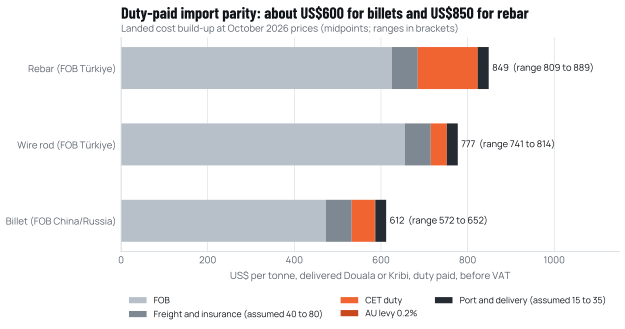
Source: AISU, 3 October 2026 [G34]; CET [P24]; AU levy [P19]; freight and port costs are assumptions (Annex A), freight cross-checked with UNCTAD [W12]. Derived by Cameroon Steel.
7.3 The cost structure of an electric arc furnace long-products works
An electric arc furnace (EAF) melts a metallic charge of scrap, direct reduced iron (DRI) or HBI with electric power; the liquid steel is refined in a ladle furnace, cast into billets and rolled into products. Cameroon Steel’s RC-1 Phase 1 uses one EAF of the 40 t class with a furnace transformer of the 30 to 33 MVA class, a ladle furnace, a billet caster, induction billet heating and rebar and wire-rod mills [F]. Its planning balance gives the physical inputs on which the cost comparison rests (Table 7.1).
Metallic charge. With a metallic yield of 0.88 tonnes of liquid steel per tonne of charge and a combined casting and rolling yield of 0.94, each tonne of finished product needs about 1.21 tonnes of metallics [F]; a tonne of billet needs about 1.15. In the illustrative calculation, imported metallics are priced at US$400 to 445 per tonne delivered, bracketing heavy melting scrap at US$403 delivered to Türkiye and HBI at US$385 to 395 delivered to the Mediterranean, plus a freight adjustment to Kribi [G34][W10], assumed. The RC-1 charge assumes about 30% DRI or HBI and 70% scrap [F].
Electricity. RC-1 Phase 1 consumes about 963 kWh per tonne of finished product, including the arc furnace (450 kWh per tonne of liquid steel, the RC-1 planning value, within the 347 to 500 kWh range in the IFC guidelines), induction billet heating, rolling and auxiliaries [F]; European melt shops use 404 to 748 kWh per tonne in the furnace alone [T08]. With 30% DRI or HBI in the charge the upper planning value is about 490 kWh, since each 10 points of DRI add about 14.5 kWh per tonne [T09]; the extra 40 kWh would add about US$1 to 7.5 per tonne of rebar across the three power prices of Table 7.1, derived. The comparison uses the series basis of White paper 04 (section 8.6): power converted at the RC-1 planning rate of 600 FCFA per US$, and 525 to 565 kWh per tonne of merchant billet.
Other inputs. Graphite electrodes (2 to 6 kg per tonne in European practice [T08]), refractories, ferro-alloys, lime and oxygen (about 35 Nm³ per tonne [F]) are grouped as consumables at US$35 to 75 per tonne, assumed. Labour is derived from the Phase 1 staffing of about 500 [F] with an assumed loaded cost of 4.5 to 9.0 million FCFA per employee per year. Maintenance, overheads and delivery to market are assumed.
Table 7.1 Assumptions for the illustrative cash-cost comparison (US$ per tonne unless stated)
| Item | Low | Central | High | Basis and source |
|---|---|---|---|---|
| Metallic charge, t per t (billet / rebar) | 1.15 / 1.21 | 1.15 / 1.21 | 1.15 / 1.21 | RC-1 yields 0.88 and 0.94 [F] |
| Imported metallics, delivered | 400 | 422.5 | 445 | Scrap US$403 CFR Türkiye; HBI US$385 to 395 CFR Mediterranean; freight adjustment assumed [G34][W10] |
| Customs duty and AU levy on imported metallics | 10.2% | 10.2% | 10.2% | CET 10% [P24] and African Union levy 0.2% [P19], as White paper 04 |
| Electricity, kWh per t (billet / rebar) | 525 / 963 | 545 / 963 | 565 / 963 | Billet: White paper 04, Table 8.2; rebar: RC-1 planning balance [F] |
| Power price, FCFA per kWh | 18.4 | 43.7 | 105.5 | Legacy HT average 2025 [E15]; 9 to 10 MW medium-voltage band 2026 [E37], as White paper 04; cost-reflective average 2025 [E17] |
| Consumables (billet / rebar) | 35 / 45 | 45 / 60 | 55 / 75 | Assumed; electrodes 2 to 6 kg per t [T08] |
| Labour (billet / rebar) | 8 / 13 | 11 / 19 | 15 / 26 | About 500 staff for 0.3 Mtpa [F]; loaded cost 4.5 to 9.0 m FCFA per year assumed |
| Maintenance and overheads (billet / rebar) | 15 / 25 | 22 / 35 | 30 / 45 | Assumed |
| Delivery to market (billet / rebar) | 10 / 12 | 15 / 18 | 20 / 25 | Assumed, Kribi to Douala or Yaoundé buyers |
| Exchange rate, FCFA per US$ | 600 | 600 | 600 | RC-1 planning rate [F], as White paper 04; market values elsewhere at 570 [W13] |
| Capital charges | excluded | excluded | excluded | Not estimated in this paper |
Source: as stated in each row; illustrative assumptions are listed with ranges in Annex A.
7.4 Electricity is the swing factor, and Cameroon has no tariff for large industry
No regulated electricity tariff exists in Cameroon for loads above 10 MW; large industrial users negotiate bilateral high-voltage contracts [E15]. Three published benchmarks bracket what such a contract might cost. The six legacy high-voltage customers paid on average about 18.4 FCFA per kWh in 2025 (969 GWh for 17.8 bn FCFA), on contracts dating from an era of surplus hydro [E15], derived. The utility bought power from the Memve’ele hydro plant at 43.93 FCFA per kWh [E15], and the transmission operator’s 2025 tariff adds about 2.7 FCFA per kWh for a 100 MW load at 80% load factor [E38], derived, giving a generation-and-transmission benchmark of about 46.6 FCFA per kWh. The regulator’s cost-reflective average for medium- and low-voltage customers was 105.46 FCFA per kWh in 2025, against 83.46 FCFA actually collected [E17]; it includes distribution costs that a high-voltage customer does not impose. The published medium-voltage tariff for the 9 to 10 MW band works out at about 43.7 FCFA per kWh in 2026 [E37], derived; close to the generation-and-transmission benchmark, it is the central case of the comparison, as in White paper 04.
Across these benchmarks, electricity costs US$30, US$70 or US$169 per tonne of rebar, 4% to 18% of the illustrative cash cost [F][E15][E38][E17], derived. The steel industry is sensitive to tariff changes: the existing producers protested in 2023 against expected rises for large accounts [E41], and Prometal’s electricity bill reached 8.37 bn FCFA in 2024 [C31]. The appropriate benchmark for a new high-voltage contract is the generation-and-transmission cost, not the legacy rate, which no new supply can match, nor the system average including distribution. Reliability matters as much as price: 150 MW of industrial demand was unmet in October 2026 pending a transmission line [E16].
7.5 The illustrative comparison: competitive behind the tariff, not at the border
Figure 7.3 sets the illustrative cash costs against the import parities of Figure 7.2.
Merchant billets. On the series basis of White paper 04 (section 8.6), the cash cost of a billet melted from imported scrap and HBI is about US$591 per tonne in the low case, US$668 in the central case and US$783 in the high case, against a duty-paid import parity of US$572 to 652, illustrative. Only the low case, with legacy-level power and the cheapest metallics, competes. The reason is visible in the cost stack: metallics and the duty on them account for about US$505 to 565 per tonne, leaving little room under a billet price of about US$600 for everything else.
Rebar and wire rod. The cash cost of rebar is about US$657, US$765 and US$933 per tonne in the three cases, illustrative. Against duty-paid parity of US$809 to 889, the low and central cases are competitive; the high case, with power at the cost-reflective system average, is not. Against the CIF price before duty, US$660 to 710, only the low case competes. In other words, a Kribi works on imported metallics would rely on the 20% tariff, not on cost advantage, to sell rebar in the domestic market. Wire rod, with a 5% tariff and duty-paid parity of US$741 to 814, sits in between.
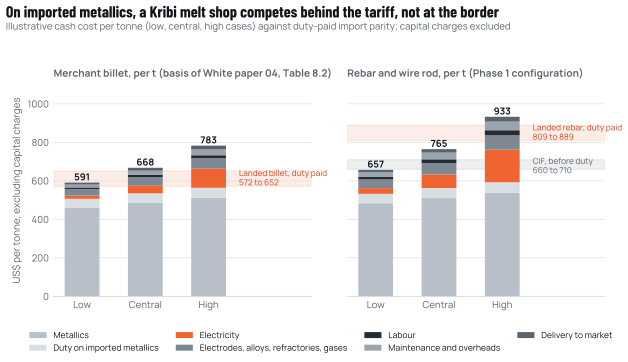
Source: illustrative calculation by Cameroon Steel; inputs as in Table 7.1 and Annex A; series basis of White paper 04, section 8.6; import parity from Figure 7.2.
What the comparison leaves out. It excludes capital charges, because this paper does not estimate investment costs. A full-cost comparison would add a capital recovery charge per tonne, which raises the bar further: a works that only matches import parity on cash cost is not competitive. It also excludes working capital, the cost of finance in a market where the central bank rate is 4.75% [P07], and ramp-up losses. On the other side, it ignores the advantage of supplying buyers close to the plant in smaller lots and with shorter lead times than imports allow, which matters most for sections.
7.6 Sections, billets and rebar sit in different competitive positions
The verdict differs by product.
Medium and heavy sections are not made in Cameroon and face only the 10% CET [C06][P24]. Comtrade unit values suggest that imported sections cost well above rebar: about US$966 per tonne in 2019 and US$1,113 in 2020, CIF [C06], derived (values to be treated with caution). A domestic section mill would not displace domestic producers, and proximity to buyers is a real advantage. The difficulty is scale: RC-1’s indicative 500,000 tonnes of heavy sections in Phase 3 [F] is many times Cameroon’s section imports (26.3 million US dollars of HS 7216 in 2023) [C06], so most of that output would need export markets (Chapter 8).
Merchant billets would relieve the binding constraint of Cameroon’s re-rollers, which import about 60% of their charge as billets (161,000 tonnes in 2023) [C06][C38] (Chapter 2), but, on imported iron units, compete only at low power prices. Because RC-1’s Phase 1 melt shop makes billets, its output can move between merchant billets and rolled products as relative prices change [F]. With domestic scrap priced below import parity, or with DRI made from domestic ore and gas, the economics change: the metallic cost, two-thirds of the total, falls, and the 10% duty on imported inputs disappears.
Rebar and wire rod are the most crowded segment. They are competitive behind the tariff but compete with domestic re-rollers whose effective protection is high (Table 3.2) and whose capacity, about 627,000 tonnes of rebar, already exceeds demand of about 180,000 tonnes [C30]. As Chapter 3 showed, the prohibition sets their price, not the tariff. New rebar capacity alone closes no gap: new rolled tonnes must replace imported wire rod or non-compliant bars, or be exported.
7.7 Five conditions for competing at border prices
The analysis points to five conditions under which a domestic long-products industry in Cameroon can compete at border prices rather than behind protection.
- Iron units below import parity. Domestic scrap collection at scale, and in time direct reduced iron made from Cameroonian ore with Cameroonian gas, are the only routes to a structural cost advantage. With gas at the 2025 prices paid by Cameroonian buyers, the gas cost of a tonne of DRI would be about US$29 to 51 [E04], derived; the quality of ore and the availability of gas are the open questions (Chapter 11).
- Firm power near generation-and-transmission cost. A high-voltage contract priced near 45 to 50 FCFA per kWh, with a capacity charge that rewards high load factor, and firm supply backed by the Kribi substation and gas-fired capacity [E15][E38][F].
- Duty-neutral inputs for exports. Inward processing and prompt VAT refunds on exported output, as the 2025 ordinance allows in economic zones [W08].
- Scale, yield and productivity. Metallic and rolling yields at or above the RC-1 planning values, and staffing close to the benchmarks of Figure 5.1 [F].
- Logistics. Bulk handling of metallics at Kribi and road and rail links to markets; the port’s 2025 traffic of 12.7 Mt and planned shared mineral terminal give a base [E44][O31].
Where these conditions are met, domestic steel saves foreign exchange and pays its way; where they are not, protection fills the gap at the expense of builders and the budget. That is the core finding of this paper.
Sources cited in this chapter
Bracketed markers refer to these sources; the full list is in the annex. Full list of sources
- G16OECD: global steel excess capacity set to reach 745 million mt by 2028. EUROMETAL (Platts), 5 Jun 2026.eurometal.net/oecd-global-steel-excess-capacity-set-to-reach-745-milli…
- G19China increased steel exports by 7.5% y/y in 2025. GMK Center, 14 Jan 2026.gmk.center/en/news/china-increased-steel-exports-by-7-5-y-y-in-2025/
- G20China’s rapidly growing steel exports will lose momentum from 2026 onwards. GMK Center, 24 Dec 2025.gmk.center/en/infographic/china-s-rapidly-growing-steel-exports-will-l…
- G3062 countries implemented 207 restrictions against steel products from China. GMK Center, 13 Oct 2025.gmk.center/en/infographic/62-countries-implemented-207-restrictions-ag…
- G10Regulation (EU) 2026/1384 (steel TRQ replacing the safeguard). EU, Official Journal L, 24 Jun 2026.eur-lex.europa.eu/eli/reg/2026/1384/oj/eng
- G05World Steel in Figures 2026 (page and PDF). worldsteel, 4 Jun 2026.worldsteel.org/data/world-steel-in-figures/world-steel-in-figures-2026…
- G06World Steel in Figures 2025. worldsteel, Jun 2025.worldsteel.org/data/world-steel-in-figures/world-steel-in-figures-2025…
- G21Licensing of steel exports from China should ease trade tensions. GMK Center, 19 Dec 2025.gmk.center/en/news/licensing-of-steel-exports-from-china-should-ease-t…
- G34Weekly steel prices (archive 40468). Arab Iron & Steel Union (AISU), 3 Oct 2026.aisusteel.org/en/archives/40468
- W10Global HBI market bullish amid tight supply, ex-Libya tender closure to give further direction. SteelOrbis, 15 May 2026.steelorbis.com/steel-prices/steel-prices-market-analyses/scrap-and-raw…
- G38Weekly steel prices (archive 29546). AISU, 6 Oct 2024.aisusteel.org/en/archives/29546
- G40Billet prices rose by $10-40 per ton in March in regional markets. GMK Center, 1 Apr 2026.gmk.center/en/news/billet-prices-rose-by-10-40-per-ton-in-march-in-reg…
- G39Key global markets are set for a rise in rebar prices. GMK Center, 17 Sep 2026.gmk.center/en/news/key-global-markets-are-set-for-a-rise-in-rebar-pric…
- W12At 11.4 per cent of the value of imports, African countries paid more for international transport than any other region (Review of Maritime Transport 2015). UNCTAD, 2015.unctad.org/press-material/114-cent-value-imports-african-countries-pai…
- P24WITS TRAINS API: Cameroon reported MFN tariffs by HS6 (2023). World Bank / UNCTAD.wits.worldbank.org/API/V1/SDMX/V21/datasource/TRN/reporter/120/partner…
- P19Cameroon, Republic of: Corporate, Other taxes. PwC Worldwide Tax Summaries, reviewed 14 Aug 2026.taxsummaries.pwc.com/republic-of-cameroon/corporate/other-taxes
- FCameroon Steel reference configuration RC-1 (planning estimate), edition 10 October 2026 (RC-1.1). Cameroon Steel, 10 Oct 2026.Cited by title and date
- T08Best Available Techniques Reference Document: Iron and Steel (EUR 25521). EC JRC, 2013.bureau-industrial-transformation.jrc.ec.europa.eu/sites/default/files/…
- T09ENERGIRON technology: DRI-EAF production route using natural gas or H2. European Commission, Innovation Centre for Industrial Transformation, ref. 12 Feb 2026.innovation-centre-for-industrial-transformation.ec.europa.eu/innovativ…
- E15Rapport d’activités 2025 de l’ARSEL. ARSEL (electricity regulator), 7 Sep 2026.arsel-cm.org/wp-content/uploads/2026/09/Rapport-ARSEL-2025.pdf
- E37Tableaux tarifaires, Décision ARSEL N°00000427 (MT 2023-2025). ARSEL, uploaded Jan 2026.arsel-cm.org/wp-content/uploads/2026/01/TABLEAUX-TARIFAIRES-decision-M…
- E17Décision fixant le montant de la RMA ENEO au titre de l’exercice 2025 (réajustée). ARSEL, 19 Dec 2025.arsel-cm.org/wp-content/uploads/2026/01/Decision-fixant-le-Montant-de-…
- W13Euro foreign exchange reference rates, US dollar, monthly averages (series EXR.M.USD.EUR.SP00.A). European Central Bank.data-api.ecb.europa.eu/service/data/EXR/M.USD.EUR.SP00.A
- E38Tarif transport et GRT (Décision 0000017D). ARSEL, 17 Jan 2025.arsel-cm.org/wp-content/uploads/2026/01/TARIF-TRANSPORT-ET-GRT-1.pdf
- E41Électricité: les aciéries s’insurgent contre la hausse des tarifs. EcoMatin, 10 Jan 2023.ecomatin.net/electricite-les-acieries-sinsurgent-contre-la-hausse-des-…
- C31Prometal, Acero Metal, Aciéries du Cameroun… qui est le plus gros consommateur d’électricité de la métallurgie camerounaise. EcoMatin, 15 Jul 2026.ecomatin.net/prometal-acero-metal-acieries-du-cameroun-qui-est-le-plus…
- E16Nachtigal power line delays leave 150 MW of industrial demand unmet. Business in Cameroon, 9 Oct 2026.businessincameroon.com/public-management/0910-16939-nachtigal-power-li…
- P07Zone Cémac: la BEAC annonce un ralentissement de croissance à 2,4%. AllAfrica (Les Dépêches de Brazzaville), 17 Dec 2025.fr.allafrica.com/stories/202512170629.html
- C06UN Comtrade public API: Cameroon (reporter 120), HS 72/73 and 6-digit lines, 2019-2023. UN Statistics Division.comtradeapi.un.org/public/v1/preview/C/A/HS?reporterCode=120&period=20…
- C38Cameroun: le groupe Prometal décroche 26 milliards FCFA auprès d’Afreximbank…. Sikafinance, 30 Sep 2026.sikafinance.com/marches/cameroun-le-groupe-prometal-decroche-26-millia…
- C30Production: les acteurs en présence. Cameroon Tribune, 11 May 2026.cameroon-tribune.cm/article.html/76600/fr.html/details_2
- E04Données pétrolières 2025. SNH, posted Jun 2026.snh.cm/wp-content/uploads/2026/06/Donnees-petrolieres-2025.pdf
- W08Ordonnance n° 2025/002 du 18 juillet 2025 fixant les incitations à l’investissement en République du Cameroun (certified copy). Presidency of the Republic, copy hosted by LEGECAM, 18 Jul 2025.legecam.cm/wp-content/uploads/2025/08/ordonnance_n_2025_002_du_18_07_2…
- E44Au Cameroun, le port de Kribi revendique la place de premier terminal à conteneurs. EcoMatin, 22 Apr 2026.ecomatin.net/au-cameroun-le-port-de-kribi-revendique-la-place-de-premi…
- O31CNPS, G-Stones join Kribi port mineral terminal project. Business in Cameroon, 7 Nov 2025.businessincameroon.com/mining/0711-15312-cnps-g-stones-join-kribi-port…
Cite this chapter
Cameroon Steel (2026). Domestic steel saves foreign exchange only when it competes at border prices. White paper 09, chapter 7: Competitiveness at border prices: a Kribi works on imported iron competes behind the tariff, not at the border. CS-WP-09. https://www.cameroon-steel.com/en/library/economics-of-domestic-steel/competitiveness/
Source