白皮书09 · 摘要 · 中文摘要
执行摘要
国内生产含铁原料(废钢、直接还原铁(DRI)、热压块铁(HBI)等)、钢坯和型材,可为喀麦隆节省其用于钢铁的大部分外汇,深化工业基础并拓宽税基,但前提是该产业能够在边境价格上具备竞争力,尤其是能够自行炼铁。2025年,喀麦隆进口协调制度第72章钢铁41.2万吨,金额1701亿中非法郎;钢铁及钢铁制品合计占商品贸易逆差的13%,而同期中部非洲经济与货币共同体(CEMAC)六个成员国的共同外汇储备仅可支付4.2个月的进口[C05][P07]。这笔进口支出中约一半是钢坯,即本地轧钢厂用于轧制钢筋的含铁原料。喀麦隆轧制的钢筋已超过其国内用量;它所缺少的是铁。以进口废钢和进口热压块铁为原料的钢厂,每吨所节省的外汇与当前以进口钢坯为原料的再轧企业大致相当;而使用国产含铁原料的钢厂,所节省的外汇可超过第72章进口的全部金额。相反,缺乏竞争力的保护是一种由建筑业者和国家财政承担的成本。本执行摘要介绍本白皮书的十项主要结论和六项政策建议。
本页为本章中文摘要;英文全文附于其后,可展开阅读。
ES.1 十项主要结论
- 钢铁是一项重大且不断上升的外汇成本。2025年,第72章进口增至41.2万吨、1701亿中非法郎;加上第73章钢铁制品,钢铁进口达2781亿中非法郎,占贸易逆差的13.0%,而贸易逆差扩大22.8%,达21452亿中非法郎[C05]。CEMAC外汇储备降至4.2个月进口额,对外汇转移实行配给,国际货币基金组织将喀麦隆的债务困境风险评为“高”[P07][P10][P32]。在此背景下,每持久减少1美元的进口,其价值都高于其面值(第1章)。
- 钢铁进口账单实质上是含铁原料账单。2023年,钢坯占第72章进口额的49%,其中78%来自印度尼西亚[C06]。随着国内轧钢厂开始轧制线材,2021年至2023年线材进口由5.8万吨降至8000吨,而钢坯进口由11万吨增至16.1万吨:在国内轧制使进口账单向上游转移,而非消除了这笔账单[C06]。钢筋产能约为钢筋需求的3.5倍,轧钢厂开工率约为一半,本地废钢约满足其需求的40%[C30][C38]。扁平材和重型型材全部依赖进口(第2章)。
- 现行保护措施保护的是轧制而非炼铁,并使价格维持在进口平价之上。共同对外关税使将钢坯再轧为钢筋的增加值获得约60%的有效保护,使线材轧制处于负保护(负12%),而将进口含铁原料熔炼为钢坯仅获得10%的保护;只有当国产废钢或直接还原铁以低于含关税进口平价的价格出售时,熔炼国产含铁原料才能获得更高的保护[P24](推算)。在钢筋进口禁令和行政定价之下,2023年10月的钢筋核定价格比完税进口平价高出3至40%(取决于其增值税计价基础),意味着每年约有30亿至330亿中非法郎从建筑业者转出[C44][G37](推算,第3章)。
- 国际经验表明,决定成败的是纪律而非保护。韩国钢铁工业及其重化工业推进计划在出口和绩效纪律下取得成功,其收益惠及下游用户[W04][W26];阿尔及利亚依托有竞争力的天然气和直接还原工艺,在四年内将钢材消费中的进口份额由35%降至16%[A03][A04];尼日利亚阿贾奥库塔(Ajaokuta)钢厂耗资逾80亿美元,却始终未实现商业化产钢[W14];南非主要长材生产商尽管受到保护,仍以能源和物流成本为由,于2025年关闭了其长材业务[A13](第3章)。
- 钢筋价值的约四分之三来自铁,乘数效应也正在于此。按2026年10月价格计算,金属炉料约占钢筋交货价值的75%[G34][W10][F](推算)。在喀麦隆2016年社会核算矩阵中,对基础金属产品每1中非法郎的需求产生1.09中非法郎的产出和0.58中非法郎的增加值,而建筑业分别为2.26和1.35,原因在于金属依赖进口[W02]。在喀麦隆实现本地炼铁之前,欧洲和全球钢铁业3.5或更高的乘数只能视为喀麦隆的上限[P02][P01](第4章)。
- 就业:一期约500个直接岗位,满产时约1100个,更广泛的带动就业以如实的区间表示。Cameroon Steel的参考配置计划一期(年产30万吨)提供约500个直接就业岗位,建设高峰期约需800名工人,年产100万吨时指示性直接就业岗位为1100个[F]。已发表的乘数约为每个直接岗位对应3至10个总就业岗位;采用低端值并以欧洲第一类乘数为上限,满产时可支撑约2700至8000个就业岗位[F][P02](示意性测算)。只有当钢厂供应国内短缺的产品和含铁原料、而非取代现有再轧企业时,这些就业才是新增的(第5章)。
- 财政效应:进口替代将财政收入从边境转向国内经济。每10万吨国产钢筋替代以进口钢坯再轧的产品,将减少约30亿至33亿中非法郎的关税;在含铁原料仍依赖进口期间,对其征收的关税几乎可全部弥补这部分收入;而在使用国产含铁原料后,财政收入须来自对国内增加值的征税[P24](示意性测算)。2025年投资激励法令为大型项目提供最高达投资额75%、为期五年(经济区内为七年)的公司所得税抵免,其资格标准向本国投入、增加值和出口倾斜[W08](第6章)。
- 使用进口含铁原料时,克里比钢厂依靠关税保护参与竞争,而非在边境价格上竞争。进口钢坯的完税到货成本约为每吨572至652美元,进口钢筋为每吨809至889美元[G34][P24](推算)。以进口废钢和热压块铁为原料的电弧炉钢厂,其示意性现金成本为每吨钢坯591至783美元(采用白皮书04第8.6节的系列比较)、每吨钢筋657至933美元,未计资本费用[F][E15](示意性测算)。仅电价一项即可使钢筋成本每吨变动30至169美元,原因是喀麦隆尚无针对10兆瓦以上负荷的公开电价[E15][E17](第7章)。
- 区域市场确实存在,但近处规模有限,远处竞争激烈。2023年,CEMAC进口第72章产品约5.01亿美元,其中喀麦隆占62%;区域钢筋贸易量仅为数万吨[C06][C07](推算)。区域内免税贸易要求40%的本地原材料或30%的本地增加值,与使用进口铁的钢厂所能达到的水平相近;非洲大陆自由贸易区(AfCFTA)的钢铁规则未能核实[W11][P31]。保护无法随产品出境:在国境之外,唯有成本竞争力才能赢得销路(第8章)。
- 拟分期建设的年产100万吨钢厂的外汇收益取决于其铁的来源。在满负荷运行和2026年10月价格下,按边境价格计算,计划产量的年产值一期为1130亿至1210亿中非法郎,年产100万吨时为3900亿至4550亿中非法郎[F][G34](示意性测算)。年产100万吨时,留存外汇每年约为:使用进口废钢和热压块铁时400亿至1540亿中非法郎,使用规划水平的国产废钢(每年3万吨,区间0至6万吨)时480亿至1600亿中非法郎,使用国产含铁原料时3240亿至4180亿中非法郎,均为资本偿付前数字,而2025年第72章进口额为1701亿中非法郎[F][C42](示意性测算)。国内废钢无法弥补这一差距:全国废钢产生量的唯一估算为每年5.3万至6.2万吨,因此大幅节省外汇需要国产直接还原铁。按每吨计算,使用进口金属炉料的钢厂所节省的外汇与当前再轧企业大致相当(第9章)。
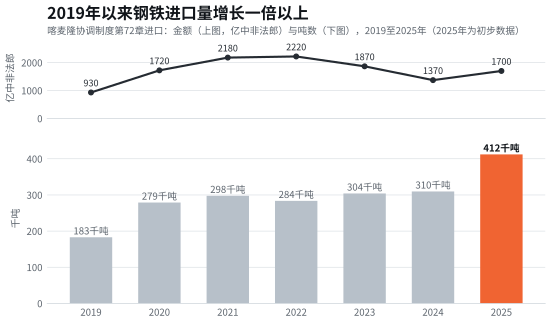
资料来源:喀麦隆国家统计局(INS),2020年至2025年对外贸易简报(2025年为初步数据)[C01]至[C05]。
ES.2 六项政策建议
现有证据支持实施国内钢铁政策,但这一政策应奖励国产铁和竞争力,而非在封闭的边境之后从事轧制(第10章)。
- 标准与政府采购。对所有供应商(无论国产或进口)严格执行钢筋强制性标准,实行第三方检测并公布结果;参照印度钢铁产品政府采购政策,在公共工程中对国内增加值给予设有上限并逐步递减的优先待遇,并将型材和钢结构纳入清单[C34][W17]。
- 能源定价。公布针对10兆瓦以上负荷的高压框架电价,定价接近发电和输电成本(按已公布的基准约为每千瓦时45至50中非法郎),完成对克里比工业区的稳定供电,并明确长期天然气供应及其税收安排[E15][E38][E11]。
- 审慎的贸易政策。在质量监管到位后,分步以关税取代钢筋进口禁令;纠正新的中部非洲国家经济共同体(ECCAS)与CEMAC统一对外关税中的关税升级问题,使含铁原料不再按制成品征税、线材轧制不再受到不利对待;建立基于规则的反倾销和保障措施调查能力,而非依赖政令[P23][P24][P26]。
- 国产含铁原料。调查并规范废钢回收;为矿业法规定的至少15%本地加工义务明确产品、质量、定价基础和时间表,使其切实产出含铁原料;协调铁矿石、天然气和港口决策,使直接还原工艺具备可行性[C42][W09][O17]。
- 不承担主权风险的融资。依靠开发性金融、出口信贷和非洲本土贷款机构,而非国家担保;允许出口企业在CEMAC规则框架内管理外币收入;将财政激励与法令规定的绩效标准挂钩,并公布其成本[P32][C38][W08]。
- 公开记分牌。每年公布钢筋和型材国内价格与进口平价的对比、国产含铁原料占比、进口、出口、质量合规情况、就业和税收。
ES.3 数字的比较视角
三组比较有助于衡量上述结论的分量。第一,所涉外汇规模可观,但其本身并不具有决定性:第72章进口总额约相当于2025年贸易逆差的8%,约相当于CEMAC共同外汇储备的2.7%[C05][P07](推算)。第二,不同含铁原料路线之间的差距大于不同项目之间的差距:每吨钢筋,使用国产含铁原料可留存外汇545至645美元,而使用进口废钢和热压块铁仅为47至181美元,当前以进口钢坯再轧为48至170美元(示意性测算)。年产100万吨且使用国产铁时,节省的外汇约相当于2025年贸易逆差的15至19%;使用进口铁时约为2至7%(示意性测算)。第三,保护政策失当的代价与收益处于同一量级:钢筋价格高于进口平价所隐含的转移为每年30亿至330亿中非法郎,而一座使用进口铁、年产30万吨的钢厂每年节省的外汇为80亿至310亿中非法郎(示意性测算)。因此,政策设计与投资同等重要。
ES.4 对国内钢铁项目的含义
Cameroon Steel正在克里比港综合工业区内的姆博罗(Mboro)筹建一座分期实施的钢铁综合体,设计产能为年产100万吨;2024年12月30日,总理代表国家元首为项目铺设奠基石[X01][X04]。其一期计划以电弧炉炼钢车间为核心,额定产能为年产30万吨(预计持续产量每年27万至30万吨),目标是2029年第一季度开工建设、2030年下半年首炉出钢;二期建设第二条熔炼线及轻中型型材轧机,指示性时间为2032年至2034年;三期建设重型型材产线,指示性安排在2034年以后;以喀麦隆铁矿石为原料的直接还原模块指示性安排在2034年以后[F]。Cameroon Steel的姊妹公司Cameroon Mining Company持有姆巴拉姆(Mbalam)矿区的开采许可证[X01]。该工业区的发展规划将与矿产品出口相衔接的钢铁冶炼列为其产业集群之一[W31]。
本白皮书对该项目采用与整个行业相同的检验标准。一期炼钢车间生产钢坯,其产品可在轧材(线材和钢筋)与商品钢坯之间灵活调整;商品钢坯可供应现有再轧企业,这些企业目前约60%的炉料依赖进口(2023年钢坯进口16.1万吨)[C06][C38]。钢筋市场已经饱和,产能约62.7万吨而需求约18万吨[C30],仅靠新增钢筋产能无法填补任何缺口:一期的产量须用于替代进口钢坯和线材、以合格认证钢筋取代不合格产品,或出口至CEMAC邻国。在使用进口含铁原料的情况下,一期每吨节省的外汇与当前再轧企业大致相当。后续各期将替代国内尚无钢厂生产的型材进口并开拓出口市场,前提是能够在边境价格上具备竞争力。项目最大的经济贡献将来自国产含铁原料,即在适当时候以喀麦隆天然气对喀麦隆铁矿石进行直接还原,因为国内废钢规模过小,无法满足如此规模钢厂的需要。我们公布这一分析,是因为其中所述的政策选择(涉及标准、政府采购、电力、关税和含铁原料)关系到每一家生产商和整个国家,也因为我们预期自身同样将接受这一检验。
ES.5 阅读说明
第1章阐述宏观经济背景,第2章测算钢铁进口账单。第3章回顾其他国家的进口替代经验,并测算喀麦隆的有效保护率。第4、5、6章分别考察增加值、就业和财政效应。第7章检验在边境价格上的竞争力,第8章分析区域市场和非洲大陆自由贸易区。第9章综合上述要素,对拟分期建设的年产100万吨钢厂的经济足迹进行示意性测算,第10章提出政策建议。第11章列出证据缺口。英文版和法文版全文的附录A说明研究方法并列出每项假设及其取值区间,附录B为术语表,附录C列出全部来源,附录D列出每张图表所用的数值。
全文遵循三项约定。第一,每个数字均附有方括号内的来源标记,对应英文版和法文版全文附录C中的来源清单;标记[F]指Cameroon Steel的参考配置RC-1,其中的数字属于计划性或指示性数据,并非承诺。第二,标注为“推算”的数字是基于注明来源的输入数据的算术结果;标注为“示意性测算”的数字是情景计算,其假设均已说明。第三,本白皮书不包含任何关于投资成本、融资或投资回报的估算:其主题是国内钢铁对喀麦隆的经济意义,而非任何单一项目的财务状况。
利益声明。本文由Cameroon Steel发布,该公司正在克里比筹建一座钢铁厂。本文旨在为公共讨论提供参考;其分析独立于任何商业要约,所有数据均注明来源或标明其状态。
英文全文 11分钟 · 2533词Executive summary
Domestic production of iron units, billets and sections could save Cameroon a large part of the foreign exchange it spends on steel, deepen its industrial base and widen its tax base, but only if the industry is competitive at border prices and, above all, if it makes its own iron. In 2025, Cameroon imported 412,049 tonnes of iron and steel under HS chapter 72 for 170.1 bn FCFA, and steel and steel articles together accounted for 13% of the merchandise trade deficit, at a time when the reserves pooled by the six CEMAC states covered only 4.2 months of imports [C05][P07]. About half of that bill is billets, the iron units that local mills roll into rebar. The country already rolls more rebar than it uses; what it lacks is iron. A works that melts imported scrap and imported hot briquetted iron saves about as much foreign exchange per tonne as today’s re-rollers of imported billets. A works that uses domestic iron units could save more than the whole chapter 72 bill. Protection without competitiveness, by contrast, is a cost borne by builders and by the budget. This summary presents the ten findings and six recommendations of the paper.
ES.1 Ten findings
- Steel is a material and rising foreign-exchange cost. Chapter 72 imports rose to 412,049 tonnes and 170.1 bn FCFA in 2025; with chapter 73 articles, iron and steel imports reached 278.1 bn FCFA, 13.0% of a trade deficit that widened by 22.8% to 2,145.2 bn FCFA [C05]. CEMAC reserves fell to 4.2 months of imports, foreign-exchange transfers are rationed, and the IMF rates Cameroon at high risk of debt distress [P07][P10][P32]. A dollar of imports durably avoided is worth more than its face value in this setting (Chapter 1).
- The steel bill is an iron-unit bill. Billets were 49% of the 2023 chapter 72 bill, and 78% of them came from Indonesia [C06]. As domestic mills began rolling wire rod, wire-rod imports fell from 58 to 8 thousand tonnes between 2021 and 2023 while billet imports rose from 110 to 161 thousand tonnes: rolling at home moved the bill upstream rather than removing it [C06]. Rebar capacity is about 3.5 times rebar demand, mills run at about half capacity and local scrap covers about 40% of their needs [C30][C38]. Flat products and heavy sections are wholly imported (Chapter 2).
- Current protection shields rolling, not iron-making, and has kept prices above import parity. The common external tariff gives re-rolling billets into rebar an effective protection of about 60% on its value added, gives wire-rod rolling negative protection (minus 12%) and gives melting imported iron units into billets only 10%; melting domestic iron units receives more only if domestic scrap or DRI sells below duty-inclusive import parity [P24], derived. Under the rebar import prohibition and administered prices, the October 2023 homologated rebar price stood 3% to 40% above duty-paid import parity, depending on its VAT basis, an implied transfer of about 3 to 33 bn FCFA a year from builders [C44][G37], derived (Chapter 3).
- International experience shows that discipline, not protection, decides success. Korea’s steel industry and heavy-industry drive succeeded under export and performance discipline, with benefits reaching downstream users [W04][W26]; Algeria cut the import share of its steel use from 35% to 16% in four years on the basis of competitive gas and direct reduction [A03][A04]; Nigeria’s Ajaokuta absorbed more than US$8 billion without producing steel commercially [W14]; South Africa’s main long-steel producer closed its long-products business in 2025 despite protection, citing energy and logistics costs [A13] (Chapter 3).
- About three-quarters of the value of rebar is iron, and that is where the multiplier lies. At October 2026 prices, the metallic charge accounts for about 75% of the delivered value of rebar [G34][W10][F], derived. In Cameroon’s 2016 social accounting matrix, each FCFA of demand for basic metal products generated 1.09 FCFA of output and 0.58 FCFA of value added, against 2.26 and 1.35 for construction, because the metal was imported [W02]. European and global steel multipliers of 3.5 or more are upper bounds for Cameroon until iron is made locally [P02][P01] (Chapter 4).
- Jobs: about 500 direct in Phase 1 and 1,100 at full capacity, with a wide range beyond. Cameroon Steel’s reference configuration plans about 500 direct jobs for Phase 1 (0.3 Mtpa), about 800 workers at the construction peak and an indicative 1,100 direct jobs at 1 Mtpa [F]. Published multipliers range from about 3 to 10 total jobs per direct job; using the low end and the European Type I value as an upper bound gives about 2,700 to 8,000 jobs supported at full capacity [F][P02], illustrative. Jobs are additional when the works supplies products and iron units the country lacks, rather than displacing existing re-rollers (Chapter 5).
- Fiscal effects: substitution moves revenue from the border to the domestic economy. Each 100,000 tonnes of domestic rebar that displaces re-rolled imported billets removes about 3.0 to 3.3 bn FCFA of customs duty; while iron units are imported, duty on them restores almost all of it, and with domestic iron the revenue must come from taxes on domestic value added [P24], illustrative. The 2025 incentive ordinance offers large projects a profit-tax credit of up to 75% of investment for five years (seven in economic zones), and its eligibility criteria favour national inputs, value added and exports [W08] (Chapter 6).
- On imported iron units, a Kribi works competes behind the tariff, not at the border. Imported billets cost about US$572 to 652 per tonne delivered and duty-paid, and imported rebar US$809 to 889 [G34][P24], derived. An illustrative cash cost for an electric arc furnace works melting imported scrap and HBI is US$591 to 783 per tonne of billet, the series’ comparison of White paper 04 (section 8.6), and US$657 to 933 per tonne of rebar, before capital charges [F][E15], illustrative. The price of power alone moves the cost of rebar by US$30 to 169 per tonne, because Cameroon has no published tariff for loads above 10 MW [E15][E17] (Chapter 7).
- The regional market is real but small nearby and contested further away. CEMAC imported about US$501 million of chapter 72 products in 2023, of which Cameroon 62%; regional rebar flows are tens of thousands of tonnes [C06][C07], derived. Duty-free regional trade requires 40% local materials or 30% local value added, close to what a mill using imported iron achieves; the AfCFTA rules for steel could not be verified [W11][P31]. Protection does not travel: beyond the border, only cost competitiveness sells (Chapter 8).
- The foreign-exchange gain of a phased 1 Mtpa works depends on its iron. At full utilisation and October 2026 prices, planned output would be worth 113 to 121 bn FCFA a year at border prices in Phase 1 and 390 to 455 bn FCFA at 1 Mtpa [F][G34], illustrative. The foreign exchange retained at 1 Mtpa would be about 40 to 154 bn FCFA a year with imported scrap and HBI, 48 to 160 bn FCFA with domestic scrap at the planning level of 30,000 tonnes a year (range 0 to 60,000) and 324 to 418 bn FCFA with domestic iron units, before capital service, against a 2025 chapter 72 bill of 170.1 bn FCFA [F][C42], illustrative. National scrap cannot close the gap: the only estimate of arising is 53,000 to 62,000 tonnes a year, so the large gain requires domestic DRI. Per tonne, a works on imported metallics saves about what a re-roller saves today (Chapter 9).
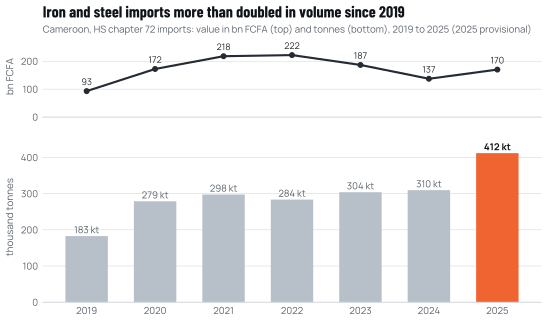
Source: INS, notes on foreign trade 2020 to 2025 (2025 provisional) [C01] to [C05].
ES.2 Six recommendations
The evidence supports a domestic steel policy, but one that rewards domestic iron and competitiveness rather than rolling behind a closed border (Chapter 10).
- Standards and procurement. Enforce the mandatory rebar standard for every supplier, domestic and imported, with third-party testing and published results; give public works a capped, tapering preference for domestic value added, modelled on India’s procurement policy for iron and steel products, with sections and structures on the list [C34][W17].
- Energy pricing. Publish a high-voltage framework tariff for loads above 10 MW, priced near the cost of generation and transmission (about 45 to 50 FCFA per kWh on published benchmarks), complete firm supply to the Kribi industrial zone, and clarify long-term gas supply and taxation [E15][E38][E11].
- Trade policy prudence. Replace the rebar prohibition with the tariff in steps once quality enforcement is in place; correct the tariff escalation in the new ECCAS-CEMAC external tariff so that iron units are not taxed like finished goods and wire-rod rolling is not penalised; and build a rules-based capacity for anti-dumping and safeguard investigations rather than relying on decrees [P23][P24][P26].
- Domestic iron units. Survey and formalise scrap collection; give the Mining Code’s minimum 15% local-transformation obligation a defined product, quality, price basis and timetable, so that it yields iron units; and coordinate ore, gas and port decisions so that direct reduction becomes feasible [C42][W09][O17].
- Financing without sovereign risk. Rely on development finance, export credit and African lenders rather than State guarantees; allow exporters to manage foreign-currency proceeds within CEMAC rules; and tie fiscal incentives to the ordinance’s performance criteria, publishing their cost [P32][C38][W08].
- A public scoreboard. Publish each year the domestic price of rebar and sections against import parity, the share of domestic iron units, imports, exports, quality compliance, jobs and taxes.
ES.3 The numbers in context
Three comparisons put the findings in proportion. First, the foreign exchange at stake is significant but not decisive on its own: the whole chapter 72 bill equals about 8% of the 2025 trade deficit and about 2.7% of CEMAC’s pooled reserves [C05][P07], derived. Second, the difference between iron-unit routes is larger than the difference between projects: per tonne of rebar, domestic iron units retain US$545 to 645 of foreign exchange, against US$47 to 181 for imported scrap and HBI and US$48 to 170 for today’s re-rolling of imported billets, illustrative. At 1 Mtpa with domestic iron, the saving would equal about 15% to 19% of the 2025 trade deficit; with imported iron, about 2% to 7%, illustrative. Third, the cost of getting protection wrong is of the same order as the gains: the transfer implied by rebar prices above import parity, 3 to 33 bn FCFA a year, compares with a foreign-exchange saving of 8 to 31 bn FCFA a year for a 0.3 Mtpa works on imported iron, illustrative. Policy design therefore matters as much as investment.
ES.4 What this means for a domestic steel project
Cameroon Steel is developing a phased steel complex at Mboro, in the Kribi industrial-port zone, with a design capacity of 1 Mtpa; the foundation stone was laid on 30 December 2024 by the Prime Minister, representing the Head of State [X01][X04]. Its first phase is planned around an electric arc furnace melt shop with a nameplate capacity of 0.3 Mtpa (expected sustained output 270,000 to 300,000 tonnes a year), with works from the first quarter of 2029 and a first heat in the second half of 2030 as targets; sections follow in Phase 2, indicative for 2032 to 2034, heavy sections in Phase 3, indicative after 2034, and a direct-reduction module for Cameroonian ore is indicative after 2034 [F]. Cameroon Steel’s sister company, Cameroon Mining Company, holds the Mbalam exploitation permit [X01]. The zone’s development plan lists steelmaking linked to mineral exports among its clusters [W31].
This paper applies the same test to that project as to the sector as a whole. Phase 1’s melt shop makes billets, and its output can move between rolled products (wire rod and rebar) and merchant billets sold to existing re-rollers, which today import about 60% of their charge (billet imports were 161,000 tonnes in 2023) [C06][C38]. Rebar is a saturated market, with capacity of about 627,000 tonnes against demand of about 180,000 tonnes [C30], so new rebar capacity alone closes no gap: Phase 1 tonnage has to displace imported billets and wire rod, replace non-compliant bars with certified rebar, or be exported to CEMAC neighbours. On imported iron units, Phase 1 would save about as much foreign exchange per tonne as today’s re-rollers. Its later phases would replace imports of sections that no domestic mill makes and open export markets, provided they are competitive at border prices. Its largest economic contribution would come with domestic iron units, in time through direct reduction of Cameroonian ore with Cameroonian gas, since national scrap is too small to supply a works of this scale. We publish this analysis because the policy choices it describes, on standards, procurement, power, tariffs and iron units, matter for every producer and for the country, and because we expect to be held to the same test.
ES.5 How to read this paper
Chapter 1 sets the macroeconomic context and Chapter 2 measures the steel import bill. Chapter 3 reviews import substitution in other countries and measures effective protection in Cameroon. Chapters 4, 5 and 6 examine value added, employment and fiscal effects. Chapter 7 tests competitiveness at border prices, and Chapter 8 the regional market and the AfCFTA. Chapter 9 combines these elements in an illustrative footprint of a phased 1 Mtpa works, and Chapter 10 sets out the recommendations. Chapter 11 lists the evidence gaps. Annex A explains the methods and lists every assumption with its range, Annex B is a glossary, Annex C lists all sources, and Annex D gives the values plotted in every chart.
Three conventions apply throughout. Every figure carries a source marker in square brackets that maps to Annex C; the marker [F] refers to Cameroon Steel’s reference configuration (RC-1), whose figures are planned or indicative, not commitments. Figures labelled derived are arithmetic on sourced inputs; figures labelled illustrative are scenario calculations whose assumptions are stated. And this paper contains no estimate of investment cost, financing or investment return: its subject is the economics of domestic steel for Cameroon, not the finances of any single project.
Statement of interest. This paper is published by Cameroon Steel, which is developing a steelworks at Kribi. It is written to inform public debate; its analysis is independent of any commercial offer, and every figure is sourced or labelled with its status.
本章引用的资料来源
方括号内的标记对应以下来源(按原文语言列出),完整列表见附录。 完整来源列表
- C05Évolution du commerce extérieur en 2025 (version provisoire). INS Cameroun,2026年2月(发布:2026年4月1日).ins-cameroun.cm/wp-content/uploads/2026/04/Note-sur-le-commerce-exteri…
- W13Euro foreign exchange reference rates, US dollar, monthly averages (series EXR.M.USD.EUR.SP00.A). European Central Bank.data-api.ecb.europa.eu/service/data/EXR/M.USD.EUR.SP00.A
- C06UN Comtrade public API: Cameroon (reporter 120), HS 72/73 and 6-digit lines, 2019-2023. UN Statistics Division.comtradeapi.un.org/public/v1/preview/C/A/HS?reporterCode=120&period=20…
- P07Zone Cémac: la BEAC annonce un ralentissement de croissance à 2,4%. AllAfrica (Les Dépêches de Brazzaville),2025年12月17日.fr.allafrica.com/stories/202512170629.html
- P102024 Investment Climate Statements: Cameroon. US Department of State,2024年.state.gov/reports/2024-investment-climate-statements/cameroon/
- P32IMF staff concludes Post-Financing Assessment mission to Cameroon (PR 26/314). IMF,2026年10月1日.imf.org/en/news/articles/2026/10/01/pr26314-imf-staff-concludes-assesm…
- C30Production: les acteurs en présence. Cameroon Tribune,2026年5月11日.cameroon-tribune.cm/article.html/76600/fr.html/details_2
- C38Cameroun: le groupe Prometal décroche 26 milliards FCFA auprès d’Afreximbank…. Sikafinance,2026年9月30日.sikafinance.com/marches/cameroun-le-groupe-prometal-decroche-26-millia…
- P24WITS TRAINS API: Cameroon reported MFN tariffs by HS6 (2023). World Bank / UNCTAD.wits.worldbank.org/API/V1/SDMX/V21/datasource/TRN/reporter/120/partner…
- C44Fer à béton: les producteurs acceptent une baisse des prix. EcoMatin,2023年10月23日.ecomatin.net/fer-a-beton-les-producteurs-acceptent-une-baisse-des-prix
- G37Weekly steel prices (archive 23160). AISU,2023年10月22日.aisusteel.org/en/archives/23160
- W04Manufacturing Revolutions: Industrial Policy and Industrialization in South Korea (N. Lane), Quarterly Journal of Economics 140(3), pp. 1683-1741. Oxford University Press,2025年5月.doi.org/10.1093/qje/qjaf025
- W26Asia’s Next Giant: South Korea and Late Industrialization (A. H. Amsden). Oxford University Press,1989年(1992年网络版).doi.org/10.1093/0195076036.001.0001
- A03Protecting the steel market: how it’s done in North Africa. GMK Center,2026年9月2日.gmk.center/en/posts/protecting-the-steel-market-how-it-s-done-in-north…
- A04Algeria’s steel industry: why is it growing. GMK Center,2026年7月28日.gmk.center/en/posts/algeria-s-steel-industry-why-is-it-growing/
- W14Ajaokuta Steel factory to begin production after 40 years. BusinessDay (Nigeria),2018年6月18日.businessday.ng/exclusives/article/ajaokuta-steel-factory-open-40-years…
- A13Update: Final wind-down decision relating to the Long Steel Business. ArcelorMittal South Africa,2025年2月28日.arcelormittalsa.com/Portals/0/NEWS%20RELEASE%20-%20UPDATE%20-%20FINAL%…
- G34Weekly steel prices (archive 40468). Arab Iron & Steel Union (AISU),2026年10月3日.aisusteel.org/en/archives/40468
- W10Global HBI market bullish amid tight supply, ex-Libya tender closure to give further direction. SteelOrbis,2026年5月15日.steelorbis.com/steel-prices/steel-prices-market-analyses/scrap-and-raw…
- FCameroon Steel reference configuration RC-1 (planning estimate), edition 10 October 2026 (RC-1.1). Cameroon Steel,2026年10月10日.按标题和日期引用
- W02Environmental sustainability and job creation: a SAM-based approach for Cameroon (A. El Meligi, V. Ferreira, V. Nechifor, E. Ferrari). European Commission Joint Research Centre;GTAP resource 11157 via AgEcon Search,2023年.ageconsearch.umn.edu/record/333428
- P02European Steel in Figures 2025. EUROFER,2025年6月.eurofer.eu/assets/publications/brochures-booklets-and-factsheets/europ…
- P01Economic and social impact of the global steel industry (infographic). worldsteel / Oxford Economics,2019年5月.worldsteel.org/wp-content/uploads/Steel-social-and-economic-impact.pdf
- W08Ordonnance n° 2025/002 du 18 juillet 2025 fixant les incitations à l’investissement en République du Cameroun (certified copy). Presidency of the Republic, copy hosted by LEGECAM,2025年7月18日.legecam.cm/wp-content/uploads/2025/08/ordonnance_n_2025_002_du_18_07_2…
- E15Rapport d’activités 2025 de l’ARSEL. ARSEL (electricity regulator),2026年9月7日.arsel-cm.org/wp-content/uploads/2026/09/Rapport-ARSEL-2025.pdf
- E17Décision fixant le montant de la RMA ENEO au titre de l’exercice 2025 (réajustée). ARSEL,2025年12月19日.arsel-cm.org/wp-content/uploads/2026/01/Decision-fixant-le-Montant-de-…
- C07UN Comtrade public API: CEMAC & Nigeria (reporters 266 Gabon, 178 Congo, 140 CAR, 566 Nigeria; mirror partners 148 Chad, 226 Eq. Guinea). UN Statistics Division.comtradeapi.un.org/public/v1/preview/C/A/HS?reporterCode=266&period=20…
- W11Commerce sous-régional: plus de 1000 produits camerounais circulent en Afrique centrale en franchise de douane. EcoMatin,2022年11月14日.ecomatin.net/commerce-sous-regional-plus-de-1000-produits-camerounais-…
- P31AfCFTA e-Tariff Book. AfCFTA Secretariat,n.d..au-afcfta.org/etariff/
- C42Bidoung J., Fomethe A., Yantio G., Melo U., La récupération et le recyclage des déchets ferromagnétiques: analyse de la situation au Cameroun (Déchets, Revue francophone d’écologie industrielle n°48). ENSP Yaoundé / MIPROMALO,2007年第四季度.eid.episciences.org/7942/pdf
- C01Commerce extérieur du Cameroun en 2020. INS Cameroun,2021年7月.ins-cameroun.cm/wp-content/uploads/2025/07/Note-Commerce-exterieur-202…
- C34Cameroon rejects fresh push to revise rebar standard. Business in Cameroon,2026年1月26日.businessincameroon.com/construction/2601-15657-cameroon-rejects-fresh-…
- W17Policy for providing preference to domestically manufactured iron and steel products in government procurement (DMI&SP). Ministry of Steel, Government of India,2017年5月8日;修订:2019年5月29日、2020年12月31日.steel.gov.in/node/45
- E38Tarif transport et GRT (Décision 0000017D). ARSEL,2025年1月17日.arsel-cm.org/wp-content/uploads/2026/01/TARIF-TRANSPORT-ET-GRT-1.pdf
- E11Industrial gas: Cameroon suspends GDC’s 20% price hiking plan. Business in Cameroon,2023年7月18日.businessincameroon.com/energy/1807-13291-industrial-gas-cameroon-suspe…
- P23Cameroon applies CEEAC common external tariff from January 1, 2026. Business in Cameroon,2026年1月12日.businessincameroon.com/public-management/1201-15594-cameroon-applies-c…
- P26Tariff profile: Cameroon. WTO,n.d..wto.org/english/res_e/statis_e/daily_update_e/tariff_profiles/CM_e.pdf
- W09Loi n° 2023/014 du 19 décembre 2023 portant Code minier (Article 40(4), local transformation). Republic of Cameroon, copy on FAOLEX,2023年12月19日.faolex.fao.org/docs/pdf/cmr223180.pdf
- O17Cameroon Mining Company confirme l’entrée du projet Mbalam dans sa phase irréversible d’exécution. Camer.be(经AllAfrica转载),2025年12月12日.fr.allafrica.com/stories/202512120475.html
- X01Kribi: le Premier ministre, chef du gouvernement est là. Cameroon Tribune,2024年12月30日.cameroon-tribune.cm/article.html/68499/fr.html/details_2
- X04Industrialisation: la voie royale de l’émergence. Cameroon Tribune,2025年1月2日.cameroon-tribune.cm/article.html/68558/fr.html/details_2
- W31Zone industrialo-portuaire de Kribi (KPIZ): jusqu’à +8 points de croissance et 150 000 emplois attendus sur 15 ans. Investir au Cameroun,2026年3月4日.investiraucameroun.com/gestion-publique/0403-23163-zone-industrialo-po…
引用本章
Cameroon Steel(2026)。只有在边境价格上具备竞争力,国内钢铁才能节省外汇(中文摘要版)。白皮书09,摘要:执行摘要。CS-WP-09。https://www.cameroon-steel.com/zh/library/economics-of-domestic-steel/executive-summary/
来源