白皮书09 · 第3章 · 中文摘要
进口替代的成败:决定结果的是纪律,而不是保护
国际经验表明,几乎所有产钢国都曾保护本国钢铁业,成败的关键在于保护是否临时、是否以可衡量的绩效为条件,并辅以有竞争力的能源和原料。喀麦隆现行制度培育了轧制能力,却没有培育炼铁能力。
本页为本章中文摘要;英文全文附于其后,可展开阅读。
本章目录(1)
韩国在出口和绩效纪律下发展钢铁和重化工业,收益惠及下游用户[W04][W26];阿尔及利亚依托天然气直接还原,四年内将钢材消费中的进口份额由35%降至16%[A03][A04];尼日利亚阿贾奥库塔钢厂耗资逾80亿美元却从未商业化产钢[W14]。按共同对外关税测算,将进口钢坯再轧为钢筋的有效保护率约为62%,线材轧制为负12%,而将进口含铁原料熔炼为钢坯仅为10%;若国产废钢或直接还原铁按不含关税的国际价格出售,熔炼国产含铁原料的有效保护率约为114%,但只要其按含关税的进口平价定价,则同样仅为10%[P24](推算)。
自2016年起,喀麦隆禁止进口钢筋并实行价格核定[C20][C21][C44]。2023年10月,杜阿拉12毫米FE500钢筋的核定价格折合每吨约63.34万中非法郎(约1020美元),而完税进口平价为每吨729至828美元;视核定价格是否含19.25%的增值税,国内价格高出进口平价3%至17%或23%至40%,按18万吨需求计算,每年隐含的转移约为30亿至330亿中非法郎[C44][G37][C30](推算)。由此得出六条设计原则:瞄准缺口而非过剩,以关税和采购优惠取代禁令,支持须有条件且有期限,纠正关税升级,先确保有竞争力的投入,规模适度并分期实施。
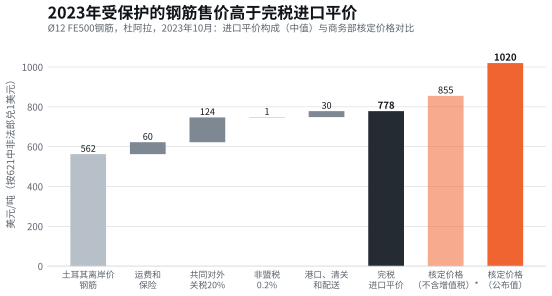
资料来源:AISU,2023年10月22日[G37];共同对外关税[P24];非盟税[P19];EcoMatin,2023年10月23日[C44];欧洲中央银行[W13];运费和港口费用为假设(全文版附录A)。由Cameroon Steel推算。
英文全文 14分钟 · 3148词Import substitution done right and wrong: discipline, not protection, decides the outcome
Import substitution in steel has built world-class industries and it has also produced some of the most expensive failures in development history. The difference has rarely been whether governments protected the industry, since almost all did, but how: protection that was temporary, conditional on measurable performance, paired with competitive energy and raw materials and subjected to export discipline worked (Korea from the 1970s; Algeria since 2021); protection that was open-ended, applied to oversized projects without secure inputs, or used to sustain domestic prices well above import parity drained budgets and consumers (Nigeria’s Ajaokuta; much of the post-war import-substitution era in Latin America and Africa) [W04][W26][A03][W14][W23]. Cameroon’s current regime, an import prohibition on rebar combined with administered prices, has built rolling capacity but not iron-making capacity, and on our estimates has kept rebar prices above duty-paid import parity. This chapter reviews the evidence and sets out the design rules that follow from it.
3.1 The evidence has moved from blanket scepticism to conditional support
The economics profession’s view of import substitution has changed twice in fifty years. From the 1970s, a large literature documented the costs of the strategy as it was practised in Latin America, South Asia and Africa: tariff and quota structures that protected inefficient producers indefinitely, overvalued currencies that penalised exports, and the diversion of entrepreneurial effort into lobbying for licences and quotas. Anne Krueger’s analysis of rent-seeking, published in 1974, showed how quantitative restrictions create scarcity rents that firms compete for, at real cost to the economy [W22]. Henry Bruton’s review in the Handbook of Development Economics (1989) found that the strategy’s early gains were often followed by stagnation where protection was not withdrawn and where the protected industries did not learn to export [W23].
Two analytical tools from that period remain essential. Bela Balassa (1965) and Max Corden (1966) developed the concept of the effective rate of protection, which measures the protection given to a producer’s value added rather than to the price of its product [W21][W20]. A 20% tariff on rebar combined with a 10% tariff on billets protects a re-roller’s value added by far more than 20%, because the re-roller’s own contribution is only a small part of the rebar price. Section 3.5 applies the tool to Cameroon.
Since the 2000s, the evidence has become more favourable to well-designed industrial policy. Dani Rodrik argued in 2004 that the question is not whether to pursue industrial policy but how to discipline it: with clear performance criteria, sunset clauses and a willingness to withdraw support from failures [W24]. A 2024 survey by Réka Juhász, Nathan Lane and Dani Rodrik in the Annual Review of Economics found that newer studies using better data and methods tend to find positive effects of targeted industrial policies, while stressing that effects depend on state capacity and design [W25]. The most rigorous study of steel-relevant policy, Nathan Lane’s analysis of South Korea’s heavy and chemical industry drive (1973 to 1979), published in the Quarterly Journal of Economics in 2025, found that the targeted industries expanded and gained comparative advantage, that downstream users of the targeted intermediates also benefited through the input-output network, and that the effects persisted after the policy ended [W04].
3.2 Asia: Korea and India built steel industries, but under different disciplines
Korea. Pohang Iron and Steel (POSCO) was incorporated in 1968. Its first stage, completed in 1973 ahead of schedule, comprised a blast furnace and converters of about one million tonnes a year [W16]. The World Bank and other lenders had judged the project premature, arguing that Korea could not master the technology and that the domestic market was too small; finance came largely from Japanese sources [W16]. Alice Amsden’s account of Korean industrialisation describes the bargain that made such projects work: subsidies and protection in exchange for performance standards, especially export targets, monitored by the State and enforced through access to credit [W26]. Lane’s study confirms that the heavy-industry drive raised output and exports in targeted sectors and in their downstream users [W04]. The relevant features for Cameroon are the export discipline, the focus on iron-making rather than only on finishing, and the willingness of the State to hold producers to performance.
India. India’s public steel industry began with Hindustan Steel Limited, created in 1954, and integrated plants built with Soviet, West German and British collaboration at Bhilai, Rourkela and Durgapur, the first two commissioned in 1959 [W19]. Decades of licensing and price control followed, before liberalisation from 1991. India produced 164.9 Mt of crude steel in 2025, second in the world [G01]. Its current support for domestic steel includes a procurement instrument directly relevant to Cameroon: the policy for preference to domestically manufactured iron and steel products in government procurement (DMI&SP), adopted in May 2017 and revised in 2019 and 2020, which applies to 49 products, requires minimum domestic value addition of 15% to 50% depending on the product, and provides waivers where grades or quantities are not available domestically [W17]. Chapter 10 draws on this model.
3.3 Latin America: State steel built capacity, and long protection built costs
Brazil’s Companhia Siderúrgica Nacional (CSN) was created as a State company in April 1941 and began operating at Volta Redonda in 1946 [W18]. It became the core of a State-led steel industry that served a protected domestic market for four decades. The broader Latin American experience with import substitution, reviewed by Bruton, combined rapid early industrial growth with persistent inefficiency where tariffs and quotas remained high and exchange rates overvalued [W23]. CSN was privatised through auctions in 1993 and early 1994 [W18]. The sequence is instructive: State-led entry created the industrial base; competitiveness came only when the industry faced market discipline. The lesson is not that the initial State role was wrong but that it lasted too long without performance conditions.
3.4 Africa: one turnaround, two warnings, and Cameroon’s own experiment
Algeria shows what protection plus competitive inputs can achieve. Algeria moved from a net steel deficit of about 1 Mt in 2021 to a net surplus of about 1 Mt in 2025, and the share of imports in its steel use fell from 35% to 16% [A03][A04]. Steel imports halved from 1.22 Mt in 2024 to 0.65 Mt in 2025 [A04]. Crude steel output rose to 5.5 Mt in 2025 [G05]. The industry is built on natural-gas-based direct reduction: Algeria produced 6.70 Mt of direct reduced iron in 2025 [T13], and the largest producer, Tosyali Algérie, has 6.2 Mtpa of capacity including an electric arc furnace of 2.7 Mtpa and a 4 Mtpa hot strip mill [A04]. Protection played a role, but so did cheap gas, a foreign investor with operating experience, and scale.
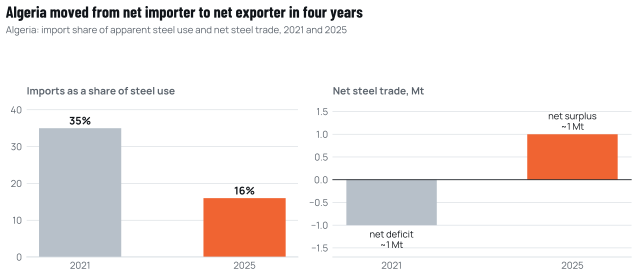
Source: GMK Center, Protecting the steel market: how it’s done in North Africa (2 September 2026) and Algeria’s steel industry: why is it growing (28 July 2026) [A03][A04].
Egypt shows the limits of protecting rolling capacity. Egypt imposed provisional duties of 16.2% on billets and 13.6% on hot-rolled coil in September 2025, later set at 13% on billets with a minimum of US$65 per tonne [A06][A07]. Its rolling capacity of about 20 Mt runs at roughly half of its potential [A07]. Duties on billets protect Egyptian melt shops but raise costs for its many independent re-rollers, a tension Cameroon will also face if it moves from protecting rebar to protecting billets.
Nigeria’s Ajaokuta is the cautionary tale. Construction began in 1979; the works was reported 98% complete by 1994, yet by 2018 it had cost the country more than US$8 billion and had never produced steel commercially [W14]. In 2026, the government was again in talks on a revival [W15]. Nigeria’s Delta Steel direct-reduction plant at Warri (1.02 Mt a year, 1982) is also idle [T13]. Oversized scale, unsecured raw materials, technology mismatch and governance failures compounded each other; no tariff could have made the project viable.
South Africa shows that protection cannot offset structural costs. ArcelorMittal South Africa wound down its long-steel business in 2025, citing energy costs, logistics, scrap policy and weak trade protection [A13]. A provisional 9% safeguard on hot-rolled coil introduced in 2024 lapsed [A08]. Where power and freight are expensive and unreliable, even an established producer struggles at border prices.
Cameroon’s own experiment has built rolling, not iron-making. Since 2016, Cameroon has prohibited rebar imports [C20][C21], applied a mandatory rebar standard (NC 236/2024/06) [C34] and homologated producer prices through the Ministry of Commerce [C44]. The result is ample rolling capacity, about 627 thousand tonnes for rebar against demand of about 180 thousand tonnes, running at about half its potential, and dependence on imported billets for about 60% of metallic needs [C30][C38]. The policy succeeded in localising rolling. It did not localise iron-making, and, as Section 3.5 shows, it appears to have kept domestic prices above import parity.
Table 3.1 Import substitution in steel: selected cases and their lessons
| Case | Instruments | Outcome | Lesson for Cameroon |
|---|---|---|---|
| Korea, POSCO and the heavy-industry drive (1968 to 1979) | State enterprise; credit and protection in exchange for export and performance targets | Integrated works on stream 1973; targeted and downstream industries expanded durably | Support conditional on exports and performance can work, and benefits reach downstream users [W16][W26][W04] |
| India (1954 onwards; DMI&SP since 2017) | Public plants with foreign partners; licensing; later, procurement preference with value-addition thresholds | Second-largest producer (164.9 Mt in 2025) | Procurement preference with value-addition tests and waivers is a lower-cost alternative to bans [W19][G01][W17] |
| Brazil, CSN (1941 to 1993) | State steel; long protection | Industrial base built; competitiveness came with privatisation and opening | State-led entry needs a planned exit to market discipline [W18][W23] |
| Algeria (2021 to 2025) | Protection, gas-based DRI, foreign operator, scale | Import share 35% to 16%; net exporter | Protection works when iron units and energy are competitive [A03][A04][T13] |
| Egypt (2025 to 2026) | Duties on billets and HRC | Melt shops protected; rolling at about half capacity | Protecting billets raises re-rollers’ costs; balance the chain [A06][A07] |
| Nigeria, Ajaokuta (1979 onwards) | State megaproject | More than US$8 billion spent; no commercial steel | Scale, inputs and governance must be secured before construction [W14][W15] |
| South Africa, AMSA longs (2025) | Mature producer; intermittent trade remedies | Long-steel business wound down | Protection cannot offset uncompetitive energy and logistics [A13][A08] |
| Cameroon (2016 onwards) | Rebar import ban; mandatory standard; homologated prices | Rolling capacity about 3.5 times rebar demand; billets imported | Protection localised rolling, not iron; prices above import parity [C20][C30][C44] |
Source: as cited in each row.
3.5 Effective protection: the tariff structure shields rolling far more than iron-making
The common external tariff (CET) of the Central African customs union sets 20% on rebar and bars, 5% on the most common wire-rod line (HS 7213.91), 10% on sections and billets, and 10% on all the raw materials of steelmaking: iron ore, direct reduced iron, scrap and coking coal [P24]. A new harmonised ECCAS-CEMAC tariff entered into force in Cameroon on 1 January 2026; its steel-line rates had not been published at the time of writing [P23]. Applying the Corden formula to the 2023 rates, with world prices at the Cameroonian border in October 2026, gives the effective rates of protection in Table 3.2.
Table 3.2 Effective rates of protection implied by the CEMAC common external tariff, long products (derived)
| Activity | Output tariff | Input tariff | Input share of output value at world prices | Value added at world prices (US$/t) | Effective rate of protection |
|---|---|---|---|---|---|
| Melting imported scrap and HBI into billets | 10% (7207) | 10% | 0.91 | about 47 | 10% |
| Melting domestic iron units bought at world price (no import duty) | 10% (7207) | 0% | 0.91 | about 47 | about 114% |
| Re-rolling imported billets into rebar | 20% (7214) | 10% | 0.81 | about 131 | 62% |
| Integrated rebar from imported scrap and HBI | 20% | 10% | 0.75 | about 174 | 49% |
| Re-rolling imported billets into wire rod | 5% (7213.91) | 10% | 0.77 | about 161 | minus 12% |
| Re-rolling imported billets into sections | 10% (7216) | 10% | 0.73 | about 205 | 10% |
| Rebar under the import prohibition | not tariff-bound | 10% | n/a | n/a | set by the domestic price gap (Figure 3.2) |
Source: CET rates from WITS/UNCTAD TRAINS [P24]; world prices from AISU, 3 October 2026 [G34] and SteelOrbis, 15 May 2026 [W10], on a CIF Cameroon basis (FOB midpoint plus US$60 freight); input coefficients from the RC-1 planning balance [F]. Formula: ERP = (t_o minus a × t_i) / (1 minus a). The first row also applies to domestic iron units when they sell at duty-inclusive import parity, as traded inputs usually do; the second row assumes that they sell at the world price, without the duty. Derived by Cameroon Steel; method in Annex A.
Three results stand out. First, re-rolling billets into rebar enjoys an effective protection of about 60% on its value added even before the import prohibition, because a 20% tariff on the product is earned on a small margin. Second, wire-rod rolling has negative effective protection: the 5% tariff on wire rod is lower than the 10% tariff on the billets it is made from, so the tariff structure penalises domestic processing. Third, and most important for this paper, melting imported iron units into billets receives only 10% effective protection, the same as sections. Melting domestic iron units, the activity that would reduce the import bill most, receives more only if domestic scrap or DRI sells below duty-inclusive import parity: priced at the world price, without the duty, its effective protection would be about 114% (0.10 / (1 minus 0.912), with the input share unrounded), derived. Domestic sellers of scrap or DRI normally price up to what the importer would pay, which brings the melt shop back to 10%. The tariff structure is escalated in favour of the finishing stage, which is the stage where Cameroon already has surplus capacity.
3.6 The rebar prohibition has kept domestic prices above duty-paid import parity
Where imports are prohibited, protection is no longer set by the tariff but by the gap between the domestic price and what an importer would pay. The Ministry of Commerce’s homologated producer price for a 12-metre, 12 mm FE500 bar in Douala was cut from 6,900 to 6,750 FCFA in October 2023 [C44]. At the nominal mass of 0.888 kg per metre, that equals about 633,400 FCFA per tonne, or about US$1,020 per tonne at the October 2023 exchange rate of 621 FCFA per dollar [C44][W13], derived. Street prices were higher still, about 7,500 FCFA per bar [C44].
The corresponding import parity is built up in Figure 3.2. Turkish rebar sold for US$550 to 575 per tonne free on board in October 2023 [G37]. Adding freight and insurance (US$40 to 80, an assumption cross-checked against UNCTAD’s estimate that African countries pay about 11.4% of import value in international transport costs [W12]), the 20% CET [P24], the 0.2% African Union levy [P19] and port, clearance and delivery costs (US$20 to 40, assumed) gives a duty-paid import parity of US$729 to 828 per tonne, or 453,000 to 514,000 FCFA [W13], derived.
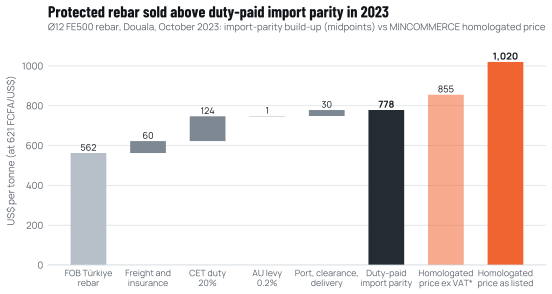
Source: AISU, 22 October 2023 [G37]; CET [P24]; AU levy [P19]; EcoMatin, 23 October 2023 [C44]; ECB [W13]; freight and port costs assumed (Annex A). Derived by Cameroon Steel.
The size of the gap depends on a detail the source does not settle: whether the homologated price includes value-added tax at 19.25%. If it excludes VAT, the domestic price was 23% to 40% above duty-paid import parity; if it includes VAT, the gap narrows to 3% to 17% [C44], derived. Applied to domestic rebar demand of about 180,000 tonnes [C30], the implied annual transfer from builders to producers lies between about 3 and 33 bn FCFA, derived. The range is wide, and the point estimate should not be over-interpreted. The direction, however, is consistent across all cases: the prohibition has allowed domestic prices to settle above what imports would cost after paying the full tariff. Consumer complaints about the quality and price of local rebar after the 2023 reaffirmation of the ban point the same way [C43], as does the regional comparison that found Cameroonian rebar cheaper than in Gabon and Côte d’Ivoire [C45], a reminder that neighbouring markets have their own frictions.
This is the cost of protection without competitiveness. It falls on households building homes and on the public works budget, and it does not buy the iron-making capacity that would reduce the import bill. A new entrant that relied on the same prohibition to sell rebar into a market already supplied at 50% utilisation would add to the cost without adding to the country’s capabilities.
3.7 Design rules that follow from the evidence
The cases reviewed point to six design rules, which Chapter 10 turns into recommendations.
- Target the gap, not the surplus. Support should go to activities the country does not perform (iron units, merchant billets, medium and heavy sections) rather than to rolling capacity already in excess [C30][C06].
- Prefer tariffs and procurement preferences to prohibitions. Tariffs cap the domestic price at duty-paid parity and generate revenue; prohibitions do neither. India’s procurement preference shows how to reward domestic value added without closing the border [W17].
- Make support conditional and temporary. Korea’s and Rodrik’s lesson: performance criteria (quality, price, exports) and a published sunset [W26][W24][W04].
- Fix the tariff escalation. The inverted protection on wire rod and the low protection on iron units should be corrected within the new ECCAS-CEMAC tariff [P23][P24].
- Secure competitive inputs first. Algeria’s success rests on gas; South Africa’s difficulties on energy and logistics. No protection compensates for uncompetitive power or unsecured iron units [A04][A13].
- Right-size and phase. Ajaokuta’s lesson is that scale, inputs and governance must be secured before construction, and capacity should follow the market [W14].
Other sources cited in the English text
- W22The Political Economy of the Rent-Seeking Society (A. O. Krueger), American Economic Review 64(3), pp. 291-303. American Economic Association, Jun 1974.jstor.org/stable/1808883
- W23Import substitution (H. J. Bruton), Handbook of Development Economics, vol. 2, chapter 30, pp. 1601-1644. Elsevier, 1989.doi.org/10.1016/S1573-4471(89
- W21Tariff Protection in Industrial Countries: An Evaluation (B. Balassa), Journal of Political Economy 73(6), pp. 573-594. University of Chicago Press, Dec 1965.doi.org/10.1086/259085
- W20The Structure of a Tariff System and the Effective Protective Rate (W. M. Corden), Journal of Political Economy 74(3), pp. 221-237. University of Chicago Press, Jun 1966.doi.org/10.1086/259151
- W24Industrial Policy for the Twenty-First Century (D. Rodrik), Faculty Research Working Paper RWP04-047. Harvard Kennedy School, 2004.hks.harvard.edu/publications/industrial-policy-twenty-first-century
- W25The New Economics of Industrial Policy (R. Juhász, N. Lane, D. Rodrik), Annual Review of Economics 16, pp. 213-242. Annual Reviews, Aug 2024.doi.org/10.1146/annurev-economics-081023-024638
- W16Men of steel: the founding history of POSCO (M. Breen). The Korea Times, 6 Feb 2011.koreatimes.co.kr/amp/southkorea/20110206/men-of-steel-the-founding-his…
- W19Steel Authority of India (tertiary source, used for dates only). Wikipedia.en.wikipedia.org/wiki/Steel_Authority_of_India
- G01December 2025 crude steel production and 2025 global totals. worldsteel, 23 Jan 2026.worldsteel.org/media/press-releases/2026/december-2025-crude-steel-pro…
- W17Policy for providing preference to domestically manufactured iron and steel products in government procurement (DMI&SP). Ministry of Steel, Government of India, 8 May 2017; revised 29 May 2019 and 31 Dec 2020.steel.gov.in/node/45
- W18Companhia Siderúrgica Nacional (tertiary source, used for dates only). Wikipedia, last edited 15 Aug 2026.en.wikipedia.org/wiki/Companhia_Sider%C3%BArgica_Nacional
- G05World Steel in Figures 2026 (page and PDF). worldsteel, 4 Jun 2026.worldsteel.org/data/world-steel-in-figures/world-steel-in-figures-2026…
- T132025 World Direct Reduction Statistics. Midrex Technologies, Sep 2026.midrex.com/world-dri-statistics/world-dri-production-reaches-151-0-mt-…
- A06Egypt has imposed a temporary duty on imports of HRC at 13.6%. GMK Center, 15 Sep 2025.gmk.center/en/news/egypt-has-imposed-a-temporary-duty-on-imports-of-ho…
- A07Egypt’s steel industry: protection from within. GMK Center, 23 Jul 2026.gmk.center/en/posts/egypt-s-steel-industry-protection-from-within/
- W15Nigeria in talks with Chinese firm over $2 billion Ajaokuta steel plant revival. Ecofin Agency, 2 Mar 2026.ecofinagency.com/news/0203-53385-nigeria-in-talks-with-chinese-firm-ov…
- A13Update: Final wind-down decision relating to the Long Steel Business. ArcelorMittal South Africa, 28 Feb 2025.arcelormittalsa.com/Portals/0/NEWS%20RELEASE%20-%20UPDATE%20-%20FINAL%…
- A08South Africa imposes safeguard duty on imports of hot-rolled steel. GMK Center, 1 Jul 2024.gmk.center/en/news/south-africa-imposes-safeguard-duty-on-imports-of-h…
- C34Cameroon rejects fresh push to revise rebar standard. Business in Cameroon, 26 Jan 2026.businessincameroon.com/construction/2601-15657-cameroon-rejects-fresh-…
- C38Cameroun: le groupe Prometal décroche 26 milliards FCFA auprès d’Afreximbank…. Sikafinance, 30 Sep 2026.sikafinance.com/marches/cameroun-le-groupe-prometal-decroche-26-millia…
- P23Cameroon applies CEEAC common external tariff from January 1, 2026. Business in Cameroon, 12 Jan 2026.businessincameroon.com/public-management/1201-15594-cameroon-applies-c…
- G34Weekly steel prices (archive 40468). Arab Iron & Steel Union (AISU), 3 Oct 2026.aisusteel.org/en/archives/40468
- W10Global HBI market bullish amid tight supply, ex-Libya tender closure to give further direction. SteelOrbis, 15 May 2026.steelorbis.com/steel-prices/steel-prices-market-analyses/scrap-and-raw…
- FCameroon Steel reference configuration RC-1 (planning estimate), edition 10 October 2026 (RC-1.1). Cameroon Steel, 10 Oct 2026.Cited by title and date
- W12At 11.4 per cent of the value of imports, African countries paid more for international transport than any other region (Review of Maritime Transport 2015). UNCTAD, 2015.unctad.org/press-material/114-cent-value-imports-african-countries-pai…
- C43Interdiction des importations du fer à béton: les consommateurs dénoncent la mauvaise qualité de la production locale. EcoMatin, 13 Apr 2023.ecomatin.net/interdiction-des-importations-du-fer-a-beton-les-consomma…
- C45Métallurgie: les locaux battent le fer chaud. Cameroon Tribune, 17 Aug 2023.cameroon-tribune.cm/article.html/59491/fr.html/details_2
- C06UN Comtrade public API: Cameroon (reporter 120), HS 72/73 and 6-digit lines, 2019-2023. UN Statistics Division.comtradeapi.un.org/public/v1/preview/C/A/HS?reporterCode=120&period=20…
本章引用的资料来源
方括号内的标记对应以下来源(按原文语言列出),完整列表见附录。 完整来源列表
- W04Manufacturing Revolutions: Industrial Policy and Industrialization in South Korea (N. Lane), Quarterly Journal of Economics 140(3), pp. 1683-1741. Oxford University Press,2025年5月.doi.org/10.1093/qje/qjaf025
- W26Asia’s Next Giant: South Korea and Late Industrialization (A. H. Amsden). Oxford University Press,1989年(1992年网络版).doi.org/10.1093/0195076036.001.0001
- A03Protecting the steel market: how it’s done in North Africa. GMK Center,2026年9月2日.gmk.center/en/posts/protecting-the-steel-market-how-it-s-done-in-north…
- A04Algeria’s steel industry: why is it growing. GMK Center,2026年7月28日.gmk.center/en/posts/algeria-s-steel-industry-why-is-it-growing/
- W14Ajaokuta Steel factory to begin production after 40 years. BusinessDay (Nigeria),2018年6月18日.businessday.ng/exclusives/article/ajaokuta-steel-factory-open-40-years…
- P24WITS TRAINS API: Cameroon reported MFN tariffs by HS6 (2023). World Bank / UNCTAD.wits.worldbank.org/API/V1/SDMX/V21/datasource/TRN/reporter/120/partner…
- C20Press report of the sealing by customs of more than 7,300 t of imported reinforcing bar, December 2020 (headline and address not reproduced: they name the importer). Business in Cameroon,2020年12月16日.按标题和日期引用
- C21Métallurgie: les importations du fer à béton interdites jusqu’à nouvel ordre. EcoMatin,2023年4月10日.ecomatin.net/metallurgie-les-importations-du-fer-a-beton-interdites-ju…
- C44Fer à béton: les producteurs acceptent une baisse des prix. EcoMatin,2023年10月23日.ecomatin.net/fer-a-beton-les-producteurs-acceptent-une-baisse-des-prix
- G37Weekly steel prices (archive 23160). AISU,2023年10月22日.aisusteel.org/en/archives/23160
- C30Production: les acteurs en présence. Cameroon Tribune,2026年5月11日.cameroon-tribune.cm/article.html/76600/fr.html/details_2
- P19Cameroon, Republic of: Corporate, Other taxes. PwC Worldwide Tax Summaries,审阅:2026年8月14日.taxsummaries.pwc.com/republic-of-cameroon/corporate/other-taxes
- W13Euro foreign exchange reference rates, US dollar, monthly averages (series EXR.M.USD.EUR.SP00.A). European Central Bank.data-api.ecb.europa.eu/service/data/EXR/M.USD.EUR.SP00.A
引用本章
Cameroon Steel(2026)。只有在边境价格上具备竞争力,国内钢铁才能节省外汇(中文摘要版)。白皮书09,第3章:进口替代的成败:决定结果的是纪律,而不是保护。CS-WP-09。https://www.cameroon-steel.com/zh/library/economics-of-domestic-steel/import-substitution/
来源