白皮书09 · 第4章 · 中文摘要
增加值与产业关联:乘数取决于炼铁,而不仅是轧制
一吨钢筋约四分之三的价值是铁。再轧进口钢坯只能在国内留住约四分之一的价值,而使用国产含铁原料则能留住大部分价值,乘数效应也随之提高。
本页为本章中文摘要;英文全文附于其后,可展开阅读。
本章目录(1)
按2026年10月价格,到达喀麦隆的一吨钢筋价值约685美元,所含约1.21吨金属炉料价值约511美元,约占75%;按国际价格,购入含铁原料的熔炼环节仅增值约47美元/吨,轧制约131美元/吨[G34][W10][F](推算)。在喀麦隆2016年社会核算矩阵中,基础金属产品每1中非法郎最终需求仅带动1.09中非法郎产出和0.58中非法郎增加值,而建筑业为2.26和1.35,原因在于金属依赖进口[W02]。欧盟钢铁业第一类和第二类增加值乘数分别为3.5和4.5,对喀麦隆只能视为上限[P02]。
后向关联十分显著:满产时,参考配置RC-1年用电约753吉瓦时,平均负荷约94兆瓦,相当于2025年全国发电量的9.3%;进港散货约124万吨(一期约35万吨),相当于克里比港2025年吞吐量的9.8%(一期为2.8%)[F][E15][E44](推算)。前向关联主要是建筑和钢结构加工,但只有在价格接近进口平价时才是正面效应。矿业法规定至少15%的本地加工义务,是将铁矿石转化为国产含铁原料的法律基础[W09][O17]。
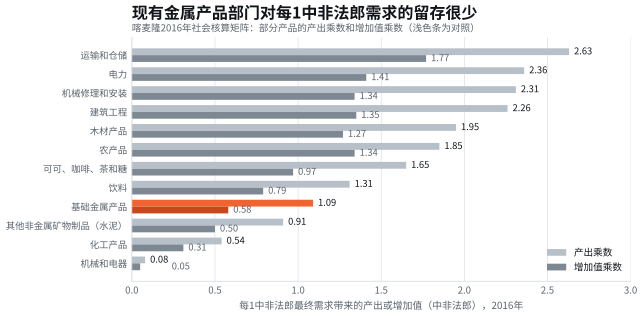
资料来源:El Meligi、Ferreira、Nechifor和Ferrari,《Environmental sustainability and job creation: a SAM-based approach for Cameroon》(欧盟委员会联合研究中心,2023年),表2[W02]。
英文全文 12分钟 · 2791词Value added and linkages: the multiplier depends on making iron, not only on rolling it
A steelworks creates value inside its fence and draws on power, gas, ports, transport, services and consumables outside it, while supplying construction and fabrication downstream. How much of that activity stays in Cameroon depends on one thing above all: whether the iron is made locally. In Cameroon’s 2016 social accounting matrix, each FCFA of final demand for basic metal products generated only 1.09 FCFA of output and 0.58 FCFA of value added across the economy, against 2.26 and 1.35 for construction, because most of the metal was imported [W02]. In deep steel economies the picture is reversed: in the European Union, each euro of steel value added supports a further 2.5 euros through suppliers, and 3.5 euros once household spending is included [P02]. Those figures are upper bounds for Cameroon. The policy lever that moves Cameroon from the bottom of that range towards the top is domestic iron units, which is where about three-quarters of the value of a tonne of rebar lies.
4.1 Three-quarters of the value of a tonne of rebar is iron
The economic value of long steel is created in steps: mining ore, making iron (by direct reduction or blast furnace), melting it into steel and casting billets, and rolling billets into products. International prices show where value accumulates. In September and October 2026, iron ore of 62% iron content sold for about US$97 to 98 per dry tonne delivered to China [G32][G34]; hot briquetted iron (HBI), a form of direct reduced iron, for US$385 to 395 per tonne delivered to Mediterranean buyers [W10]; heavy melting scrap for about US$403 per tonne delivered to Türkiye [G34]; billets for US$465 to 480 per tonne free on board from China and Russia; and rebar for US$620 to 630 per tonne free on board from Türkiye [G34].
On a common basis, delivered to Cameroon, a tonne of rebar worth about US$685 contains about 1.21 tonnes of metallic charge (scrap, DRI or HBI) worth about US$511 at October 2026 prices, or about 75% of the product value [G34][W10][F], derived. Melting adds only about US$47 per tonne of value at world prices when the iron units are bought in, and rolling about US$131 [G34][F], derived (Table 3.2). The step from ore to iron is where the large increment lies: a tonne of direct reduced iron sells for roughly four times the price of a tonne of 62% iron ore, although direct reduction requires higher-grade pelletised feed, natural gas and substantial capital [G32][W10]. For an economy, this arithmetic has a simple implication. A domestic industry that melts imported iron units or rolls imported billets retains about a quarter of the product value; one that makes its own iron from domestic ore and gas can retain most of it.
4.2 Today’s metal sector retains little of each FCFA of demand
The most recent economy-wide model for Cameroon is the social accounting matrix (SAM) for 2016 built by researchers at the European Commission’s Joint Research Centre from INS national accounts and household and labour surveys [W02]. Its multipliers measure how much output, value added and employment the whole economy generates when final demand for a commodity rises by one unit, taking into account that part of the demand is met by imports.
For basic metal products and articles of metal, the SAM gives an output multiplier of 1.09, a value-added multiplier of 0.58 and an employment multiplier of 0.54 jobs per million FCFA of final demand [W02]. These values sit near the bottom of the table. Construction work scores 2.26, 1.35 and 1.13; electricity 2.36 and 1.41 for output and value added; transport and storage 2.63 and 1.77 [W02]. Commodities that Cameroon almost entirely imports, such as machinery and electrical appliances (0.08) or transport equipment (0.07), score lowest of all [W02]. Non-metallic mineral products, which include cement made largely from imported clinker, score 0.91 [W02]; clinker imports rose by 20.5% to 3,107 thousand tonnes in 2025 [C05].
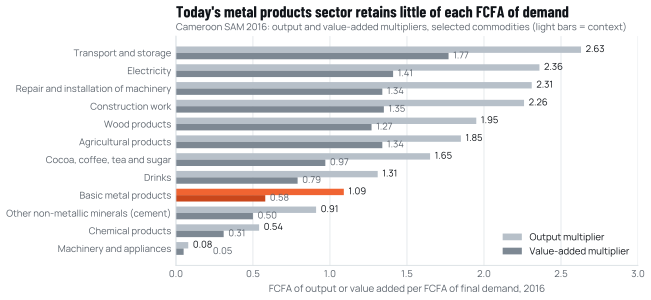
Source: El Meligi, Ferreira, Nechifor and Ferrari, Environmental sustainability and job creation: a SAM-based approach for Cameroon (European Commission JRC, 2023), Table 2 [W02].
The reason is structural. When a builder buys rebar rolled in Douala from Indonesian billets, most of the price leaves the country to pay for the billets, and only the rolling margin, the wages and the local services stay. The SAM captures this leakage. The 2016 matrix predates the expansion of domestic wire-rod rolling (Chapter 2), but that expansion replaced imports of wire rod with imports of billets, so the structure of the leakage has not fundamentally changed [C06].
The SAM multipliers are not a forecast for a new works. They describe the average structure of an existing sector. They do, however, show the baseline against which any claim of economic benefit should be measured, and they show that the problem is the import content of the iron, not a lack of rolling capacity.
4.3 In deep steel economies, each unit of steel value added supports several more
Multipliers estimated for mature steel economies show what becomes possible when supply chains are domestic. They are summarised in Table 4.1 and should be read as upper bounds for Cameroon.
European Union. The European steel association EUROFER estimates that the EU steel industry’s direct gross value added of about €39 billion supported €177 billion in total in 2024, a Type I value-added multiplier of 3.5 and a Type II multiplier of 4.5 [P02].
World. worldsteel and Oxford Economics estimated that each US dollar of value added in steelmaking supported a further US$2.50 of value added in the steel supply chain in 2017, and that steel supported or facilitated US$2.9 trillion of value added, 3.8% of world GDP, once steel-using sectors are included [P01].
United States. The Economic Policy Institute’s 2019 update of employment multipliers estimates that US$1 million of final demand for the products of iron and steel mills supports 0.81 direct jobs, 5.01 jobs at suppliers and 2.47 induced jobs [W01]. Chapter 5 discusses the job multipliers in detail.
Table 4.1 Value-added and output multiplier evidence for steel, and its applicability to Cameroon
| Source | Economy, year | Measure | Value | Applicability to Cameroon |
|---|---|---|---|---|
| JRC SAM 2016 [W02] | Cameroon, 2016 | Output / value-added multiplier, basic metal products | 1.09 / 0.58 | Current baseline; reflects imported iron units |
| JRC SAM 2016 [W02] | Cameroon, 2016 | Output / value-added multiplier, construction | 2.26 / 1.35 | Downstream sector; high domestic content |
| EUROFER [P02] | EU, 2024 | Gross value-added multiplier, Type I / Type II | 3.5 / 4.5 | Upper bound; deep supplier base |
| worldsteel / Oxford Economics [P01] | World, 2017 | Supply-chain value added per unit of steel value added | 2.5 | Upper bound; global average incl. integrated works |
| EPI [W01] | United States, 2019 | Direct + supplier + induced jobs per US$1 m of final demand, iron and steel mills | 0.81 + 5.01 + 2.47 | Upper bound; high-wage economy |
| This paper (Chapter 9) | Cameroon, illustrative | Share of rebar value retained domestically: imported iron units / domestic iron units | about 7 to 26% / about 83 to 91% | Illustrative range, by iron-unit route |
Source: as cited; the last row is derived by Cameroon Steel (Chapter 9 and Annex A).
The gap between the first and the other rows is the economic case for domestic iron units. It is also a warning: a project that cites European or global multipliers for a works that melts imported scrap and HBI in Cameroon would overstate its effects several times over.
4.4 Backward linkages: power, gas, ports and iron units
A long-products works is one of the largest single customers an economy can host. Using Cameroon Steel’s reference configuration (RC-1), Table 4.2 sets out the planned or indicative quantities of the main inputs at each phase, and compares them with national benchmarks.
Power. At full capacity of 1 Mtpa, RC-1 would draw about 753 GWh a year, an average load of about 94 MW, equal to 9.3% of Cameroon’s 2025 electricity generation of 8,119.9 GWh and about 7.4% of the 2025 peak demand of 1,278 MW [F][E15], derived. Phase 1 alone would draw about 289 GWh (36 MW on average) [F]. These figures use the RC-1 planning value of 450 kWh per tonne of liquid steel in the furnace; with 30% DRI or HBI in the charge the upper planning value is about 490 kWh, which would add about 13 GWh a year in Phase 1 and 43 GWh at full capacity [F][T09], derived. The 225 kV line and substation that the Port Autonome de Kribi is building to serve the industrial zone are designed for 100 MW initially and 330 to 400 MW later [Z43]. A steelworks with a high load factor is an anchor customer: in 2025 the Kribi gas-fired plant delivered 559.7 GWh against a plan of 1,031.2 GWh, a capacity factor of about 30%, while 150 MW of industrial demand remained unmet because of transmission delays [E15][E16]. At 43.7 FCFA per kWh, the central power price of the series (Chapter 7), full-capacity consumption would be worth about 33 bn FCFA a year to the power sector, derived.
Gas. Phases 2 and 3 use gas-fired reheating furnaces for sections: about 0.26 PJ a year rising to 0.91 PJ at full capacity, equal to about 0.83 billion cubic feet, or 1.1% of Cameroon’s 2025 gas production of 75.5 billion cubic feet [F][E04], derived. A direct-reduction module for Cameroonian ore, which RC-1 reserves as an indicative step after 2034, would need about 9 billion cubic feet a year for 1 Mt of DRI, about 12% of 2025 production [F][E04], derived. Since the floating LNG vessel that took about 95% of 2025 output left in July 2026, domestic industrial demand is the main way to monetise Sanaga Sud gas [E04][E09].
Port and logistics. RC-1 implies about 0.35 Mt a year of inbound bulk and break-bulk cargo in Phase 1 (351,000 tonnes), about 0.60 Mt after Phase 2 and about 1.24 Mt at full capacity (1,239,000 tonnes), plus 0.3 to 1.0 Mt of outbound products [F]. Inbound cargo would equal 2.8% to 9.8% of Kribi port’s 2025 traffic of 12.7 Mt [E44], derived, and the works would generate 74 to 245 truck loads a day before any rail siding is built [F].
Iron units. Every tonne of finished product needs about 1.21 tonnes of metallic charge [F]. Domestic scrap collection is the first local source. The only quantified study of scrap arising in Cameroon, now dated, estimated 53,000 to 62,000 tonnes a year in 2006 [C42], and the existing mills already compete for it [C40]. RC-1 therefore plans on 30,000 tonnes a year of domestic scrap, within a range of 0 to 60,000 tonnes, at every phase; the rest of the charge is imported [F], assumed. The second source is Cameroonian ore. The 2023 Mining Code requires each mining convention to fix a share of production for local transformation, with a minimum of 15% (Article 40(4)) [W09]. Cameroon Steel’s sister company, Cameroon Mining Company, holds the Mbalam exploitation permit [X01]. Its convention is reported to oblige it to transform 15% of its production locally, and the same source presents Cameroon Steel as the national steel hub of that programme [O17]. Turning that obligation into iron units requires direct-reduction-grade concentrate, pelletising and gas, which are later-phase questions examined in other papers of this series.
Table 4.2 Backward linkages of a phased 1 Mtpa EAF long-products works (RC-1 planning balance)
| Input | Phase 1 (0.3 Mtpa) | Phases 1+2 (0.5 Mtpa) | Full (1 Mtpa) | National benchmark | Full as share of benchmark |
|---|---|---|---|---|---|
| Electricity, GWh/yr (average MW) | 289 (36) | 422 (53) | 753 (94) | Generation 8,119.9 GWh; peak 1,278 MW (2025) [E15] | 9.3% of generation; 7.4% of peak |
| Gas for reheating, PJ/yr (bcf) | 0 | 0.26 (0.24) | 0.91 (0.83) | Production 75.5 bcf (2025) [E04] | 1.1% |
| Metallic charge, kt/yr (of which DRI/HBI) | 363 (109) | 604 (181) | 1,209 (363) | Chapter 72 imports 412 kt (2025) [C05] | 2.9 times |
| Inbound port cargo, kt/yr | 351 | 604 | 1,239 | Kribi port traffic 12.7 Mt (2025) [E44] | 9.8% |
| Outbound products, kt/yr | 300 | 500 | 1,000 | Apparent steel use about 450 kt [C40] | 2.2 times |
| Truck loads per day (road only) | 74 | 123 | 245 | n/a | n/a |
| Water make-up, million m³/yr | 0.6 | 1.0 | 2.0 | n/a | n/a |
| Steel slag (by-product), kt/yr | 45 | 74 | 149 | n/a | n/a |
Source: Cameroon Steel RC-1 reference configuration, planning balance, edition 10 October 2026 [F] (status: planned for Phase 1, indicative for later phases; derived from capacities and benchmarks); national benchmarks as cited. Average MW is annual energy divided by 8,000 operating hours.
4.5 Forward linkages: construction, fabrication and by-products
On the output side, long steel feeds a few large sectors. Construction, with 1,991 bn FCFA of value added in 2025 [C09], is the main user of rebar and wire products; the average cost of building in Cameroon was about 1.04 million FCFA per square metre in 2024 [C15]. Sections and beams feed fabrication of industrial buildings, warehouses, bridges, pylons and port structures, much of which is now imported as finished structures (HS 7308, US$58.0 million in 2023) [C06]. Wire rod feeds wire drawing, nails and mesh.
Forward linkages are where the quality of import substitution shows. Lane’s study of Korea found that downstream users of the targeted intermediates benefited, because the policy expanded supply and, over time, lowered the relative price of the inputs they bought [W04]. The opposite also holds: if domestic steel is sold above import parity, every builder and fabricator pays a tax that reduces their own competitiveness. The cost of protection estimated in Chapter 3 is a negative forward linkage. Availability of medium and heavy sections close to the user, with shorter lead times and smaller lot sizes than imports allow, is a positive one, provided prices are close to import parity.
Steelmaking also produces by-products with local uses. RC-1 projects 45 to 149 thousand tonnes a year of electric arc furnace slag, which, once processed, can be used as aggregate in road construction, and about 6 to 20 thousand tonnes of mill scale [F]. Using them locally avoids disposal and supplies a construction input.
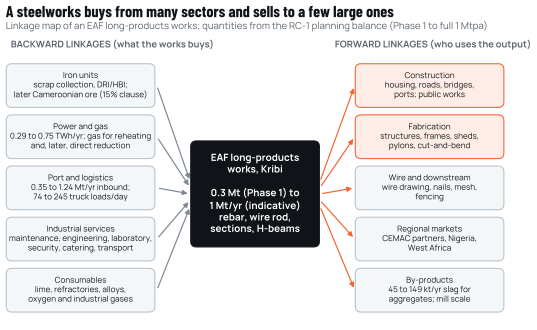
Source: Cameroon Steel RC-1 reference configuration [F]; Mining Code, Article 40(4) [W09]; Mbalam convention as reported [O17].
4.6 Domestic iron units are the lever that raises the multiplier
The evidence of this chapter can be summarised in one comparison. Re-rolling imported billets, which is what Cameroon’s industry does today, retains about one-fifth to one-quarter of the value of a tonne of rebar in the domestic economy. Melting imported scrap and HBI retains a similar share, because the iron units are still bought abroad. Melting domestically collected scrap, and later direct reduced iron made from Cameroonian ore and gas, retains most of it, and adds the linkages to mining, gas production, rail and port that the SAM multipliers for transport, electricity and services show to be strong [W02]. Chapter 9 quantifies this comparison in foreign-exchange terms.
The policy implication is not that every phase must start with domestic iron. A phased works can begin with imported iron units, build skills, markets and logistics, and add domestic scrap collection and direct reduction as ore, gas and finance allow. But the economic case should be stated honestly at each phase: the early phases create jobs, skills and a regional supply of products not made locally; the large gains in value added and foreign exchange come with domestic iron.
Other sources cited in the English text
- G32Pink Sheet, October 2026. World Bank, 2 Oct 2026.thedocs.worldbank.org/en/doc/74e8be41ceb20fa0da750cda2f6b9e4e-00500120…
- W28The Strategy of Economic Development (A. O. Hirschman). Yale University Press, 1958.search.worldcat.org/search?q=ti%3AThe+Strategy+of+Economic+Development…
- W27Input-Output Analysis: Foundations and Extensions, 2nd edition (R. E. Miller, P. D. Blair). Cambridge University Press, 2009.doi.org/10.1017/CBO9780511626982
- C05Évolution du commerce extérieur en 2025 (version provisoire). INS Cameroun, Feb 2026 (posted 1 Apr 2026).ins-cameroun.cm/wp-content/uploads/2026/04/Note-sur-le-commerce-exteri…
- C06UN Comtrade public API: Cameroon (reporter 120), HS 72/73 and 6-digit lines, 2019-2023. UN Statistics Division.comtradeapi.un.org/public/v1/preview/C/A/HS?reporterCode=120&period=20…
- P01Economic and social impact of the global steel industry (infographic). worldsteel / Oxford Economics, May 2019.worldsteel.org/wp-content/uploads/Steel-social-and-economic-impact.pdf
- W01Updated employment multipliers for the U.S. economy (J. Bivens). Economic Policy Institute, 23 Jan 2019.epi.org/publication/updated-employment-multipliers-for-the-u-s-economy…
- T09ENERGIRON technology: DRI-EAF production route using natural gas or H2. European Commission, Innovation Centre for Industrial Transformation, ref. 12 Feb 2026.innovation-centre-for-industrial-transformation.ec.europa.eu/innovativ…
- Z43Kribi franchit la ligne électrique 225 kV. Port Autonome de Kribi (PAK), 6 Aug 2025.Cited by title and date
- E16Nachtigal power line delays leave 150 MW of industrial demand unmet. Business in Cameroon, 9 Oct 2026.businessincameroon.com/public-management/0910-16939-nachtigal-power-li…
- E04Données pétrolières 2025. SNH, posted Jun 2026.snh.cm/wp-content/uploads/2026/06/Donnees-petrolieres-2025.pdf
- E09Le navire usine quitte le Cameroun, le gaz s’arrête. Camer.be, 9 Jul 2026.camer.be/93911/12:1/le-navire-usine-quitte-le-cameroun-le-gaz-sarrete-…
- C42Bidoung J., Fomethe A., Yantio G., Melo U., La récupération et le recyclage des déchets ferromagnétiques: analyse de la situation au Cameroun (Déchets, Revue francophone d’écologie industrielle n°48). ENSP Yaoundé / MIPROMALO, Q4 2007.eid.episciences.org/7942/pdf
- C40Cameroun: Prometal décroche 26,2 milliards FCFA d’Afreximbank. Camer.be, 1 Oct 2026.camer.be/actualites/economie/cameroun-prometal-decroche-262-milliards-…
- X01Kribi: le Premier ministre, chef du gouvernement est là. Cameroon Tribune, 30 Dec 2024.cameroon-tribune.cm/article.html/68499/fr.html/details_2
- C09Les Comptes Nationaux de 2025. INS Cameroun, Aug 2026 (posted 2 Sep 2026).ins-cameroun.cm/wp-content/uploads/2026/09/Comptes_Nationaux_2025_FR_V…
- C152024 Housing Finance Yearbook: Cameroon profile. Centre for Affordable Housing Finance in Africa (CAHF), Jan 2024 (PDF Mar 2025).housingfinanceafrica.org/wp-content/uploads/2025/03/CAMEROON.pdf
- W04Manufacturing Revolutions: Industrial Policy and Industrialization in South Korea (N. Lane), Quarterly Journal of Economics 140(3), pp. 1683-1741. Oxford University Press, May 2025.doi.org/10.1093/qje/qjaf025
本章引用的资料来源
方括号内的标记对应以下来源(按原文语言列出),完整列表见附录。 完整来源列表
- G34Weekly steel prices (archive 40468). Arab Iron & Steel Union (AISU),2026年10月3日.aisusteel.org/en/archives/40468
- W10Global HBI market bullish amid tight supply, ex-Libya tender closure to give further direction. SteelOrbis,2026年5月15日.steelorbis.com/steel-prices/steel-prices-market-analyses/scrap-and-raw…
- FCameroon Steel reference configuration RC-1 (planning estimate), edition 10 October 2026 (RC-1.1). Cameroon Steel,2026年10月10日.按标题和日期引用
- W02Environmental sustainability and job creation: a SAM-based approach for Cameroon (A. El Meligi, V. Ferreira, V. Nechifor, E. Ferrari). European Commission Joint Research Centre;GTAP resource 11157 via AgEcon Search,2023年.ageconsearch.umn.edu/record/333428
- P02European Steel in Figures 2025. EUROFER,2025年6月.eurofer.eu/assets/publications/brochures-booklets-and-factsheets/europ…
- E15Rapport d’activités 2025 de l’ARSEL. ARSEL (electricity regulator),2026年9月7日.arsel-cm.org/wp-content/uploads/2026/09/Rapport-ARSEL-2025.pdf
- E44Au Cameroun, le port de Kribi revendique la place de premier terminal à conteneurs. EcoMatin,2026年4月22日.ecomatin.net/au-cameroun-le-port-de-kribi-revendique-la-place-de-premi…
- W09Loi n° 2023/014 du 19 décembre 2023 portant Code minier (Article 40(4), local transformation). Republic of Cameroon, copy on FAOLEX,2023年12月19日.faolex.fao.org/docs/pdf/cmr223180.pdf
- O17Cameroon Mining Company confirme l’entrée du projet Mbalam dans sa phase irréversible d’exécution. Camer.be(经AllAfrica转载),2025年12月12日.fr.allafrica.com/stories/202512120475.html
引用本章
Cameroon Steel(2026)。只有在边境价格上具备竞争力,国内钢铁才能节省外汇(中文摘要版)。白皮书09,第4章:增加值与产业关联:乘数取决于炼铁,而不仅是轧制。CS-WP-09。https://www.cameroon-steel.com/zh/library/economics-of-domestic-steel/value-added-linkages/
来源