白皮书09 · 第2章 · 中文摘要
钢铁进口账单:每年1700亿中非法郎,其中一半是钢坯
钢铁进口账单实质上是含铁原料账单。国内轧制能力的扩张并未减少这笔账单,而是将其从成品转移到了上游的钢坯。
本页为本章中文摘要;英文全文附于其后,可展开阅读。
2025年,喀麦隆协调制度第72章钢铁进口达41.2万吨、1701亿中非法郎(约3亿美元),进口量较2019年增长125%[C05][C01][W13]。按最新的2023年明细,钢坯(HS 7207)进口1.517亿美元,占第72章进口额的48.9%,其中78%来自印度尼西亚[C06]。2021年至2023年,随着国内开始轧制线材,线材进口由5.81万吨降至0.78万吨,而钢坯进口由11.05万吨增至16.14万吨[C06]。钢筋轧制产能约62.7万吨,而国内需求仅约18万吨,行业开工率约50%,本地废钢仅能满足约40%的金属原料需求[C30][C38]。
扁平材和中重型型材仍全部依赖进口。长材钢厂原则上可替代的税目(钢坯、线材、钢筋和型材)在2023年合计1.894亿美元,占第72章进口的61%;计入钢结构则为2.474亿美元[C06](推算)。可替代金额不等于外汇节省:只有当含铁原料本身实现国产,节省才会显著。喀麦隆每年还向乍得等邻国出口约3万吨棒材,表明区域市场已经存在,但规模以万吨计[C05][C06]。
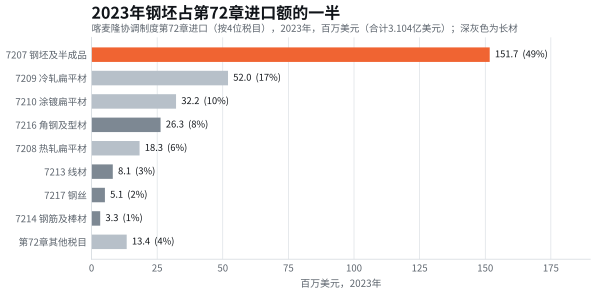
资料来源:UN Comtrade公共API,申报国喀麦隆(120),进口,2023年[C06];百分比由Cameroon Steel计算。
英文全文 11分钟 · 2467词The steel import bill: 170 bn FCFA a year, and half of it is billets
Cameroon imported 412,049 tonnes of iron and steel under HS chapter 72 in 2025, a third more than in 2024 and more than twice the 2019 volume, at a cost of 170.1 bn FCFA, about US$300 million [C05][C01][W13]. The composition of the bill matters more than its size. Semi-finished billets, the iron units that local mills roll into rebar and wire rod, were the largest single line, at about half of chapter 72 value in 2023, and 78% of them came from one country [C06]. Rolling capacity at home has grown, but because the country does not make its own iron, every new rolling mill has moved the import bill upstream rather than removing it. Flat products and heavy sections remain wholly imported. This chapter measures the bill by product, origin and trend, and identifies the part that a domestic long-products works could address.
2.1 Chapter 72 imports more than doubled in volume between 2019 and 2025
The INS publishes customs data on Cameroon’s foreign trade each year. Its notes show chapter 72 imports rising from 182,890 tonnes in 2019 to 304,062 tonnes in 2023, 309,682 tonnes in 2024 and 412,049 tonnes in 2025, the last figure provisional [C01][C03][C04][C05]. Over six years, volume grew by 125%; in 2025 alone it grew by 33% [C05]. Value followed world prices more than volume (Figure ES.1). It rose from 93.0 bn FCFA in 2019 to a peak of 222.1 bn FCFA in 2022, fell to 137.2 bn FCFA in 2024 and recovered to 170.1 bn FCFA in 2025 [C01][C02][C04][C05].
The divergence between volume and value is visible in the average unit value, which Cameroon Steel calculates from the INS totals. It rose from 509 FCFA per kilogram in 2019 to 783 FCFA in 2022, during the post-pandemic price spike, and then fell to 614 FCFA in 2023, 443 FCFA in 2024 and 413 FCFA in 2025 [C01] to [C05], derived. At 413 FCFA per kilogram, the 2025 average equals about €630 per tonne at the fixed euro peg, or about US$725 per tonne at 570 FCFA per dollar [W13]. Two forces lie behind the fall: world steel prices declined from their 2021 to 2022 peak, and the mix shifted towards cheaper semi-finished products. A third force is the exchange rate: the euro, and therefore the FCFA, strengthened against the dollar in 2025, which lowers the FCFA cost of dollar-priced steel [W13].
The volatility itself has a cost. The bill nearly doubled between 2019 and 2021 and then fell by 38% between 2022 and 2024, with little change in the quantity needed [C01][C02][C04]. For a country that rations foreign exchange (Chapter 1), these swings complicate reserve management and expose builders to sudden price changes. Domestic production does not remove price risk, because domestic prices tend to follow import parity, but it does reduce the share of the bill that must be paid in foreign currency.
2.2 Billets were half of the 2023 import bill, and one origin supplied 78% of them
Cameroon has not yet reported its 2024 and 2025 trade to the United Nations Comtrade database, so the most recent detailed breakdown by product and origin is for 2023 [C06]. In that year, Comtrade recorded US$310.4 million of chapter 72 imports. Semi-finished products of iron or non-alloy steel (HS 7207), mainly billets, accounted for US$151.7 million, or 48.9% of the total, for 161.4 thousand tonnes [C06]. Cold-rolled flat products (HS 7209) followed with US$52.0 million and coated flat products (HS 7210) with US$32.2 million. Angles, shapes and sections (HS 7216) accounted for US$26.3 million and hot-rolled coil (HS 7208) for US$18.3 million. Wire rod (HS 7213) was down to US$8.1 million and rebar (HS 7214) to US$3.3 million [C06].
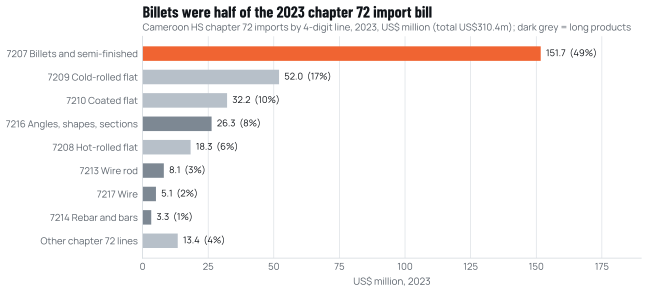
Source: UN Comtrade public API, reporter Cameroon (120), imports, 2023 [C06]; percentages calculated by Cameroon Steel.
Two cautions apply to these values. Comtrade’s implied unit value for HS 7207 was about US$940 per tonne in 2023 and US$1,274 per tonne in 2022, above the international billet prices of the time; tonnages are more reliable than values for this line [C06], derived. And Comtrade values are in US dollars at the reporting country’s conversion, so they do not add up exactly to INS values in FCFA. The conclusions drawn here rest on shares and orders of magnitude, which are robust to both cautions.
The origin of the billets is concentrated. Indonesia supplied 125.5 thousand tonnes (78% of the 2023 total, US$119.3 million), followed by Qatar (20.8 thousand tonnes), South Africa (9.8), the United Arab Emirates (3.0) and the Republic of Congo (2.3) [C06]. Across all of chapter 72, China (US$125.5 million) and Indonesia (US$119.3 million) together supplied about four-fifths of the value, ahead of Qatar, South Africa and Türkiye [C06]. Dependence on a single supplier country for most of the iron units that feed national rebar production is a supply-security issue as well as a foreign-exchange one: a change in that country’s export policy or freight conditions would reach Cameroonian building sites within weeks.
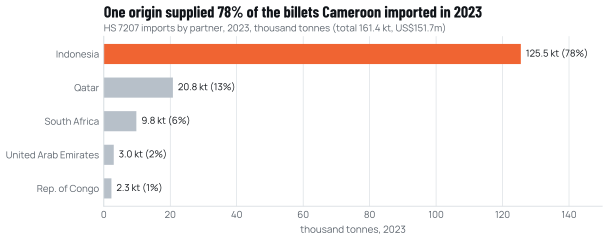
Source: UN Comtrade public API, reporter Cameroon, partner detail, 2023 [C06].
2.3 Rolling at home moved the bill upstream rather than removing it
Cameroon already rolls most of the long steel it uses. The country’s steel transformation capacity is about 1.2 million tonnes a year, operating at about 50% [C38][C40]. The industry association Ocitram puts rebar rolling capacity at about 627 thousand tonnes against domestic rebar demand of about 180 thousand tonnes [C30]. The largest group, Prometal, inaugurated its Prometal 4 and 5 plants in Douala in January 2024, with about 360 thousand tonnes a year of finished-product capacity and 1,000 direct jobs for an investment reported at 57 bn FCFA [C25]. Prometal also operates an electric arc furnace, described in 2023 as the first of its kind in Central Africa [C27].
Imports of rebar have been prohibited since a letter from the Prime Minister’s office of 31 May 2016, a prohibition re-affirmed by the Director-General of Customs on 3 April 2023 on the instruction of the Head of State [C20][C21]. Recorded rebar imports have since been residual, between 3 and 14 thousand tonnes a year [C06]. Wire rod imports, which were still 58.1 thousand tonnes in 2021, collapsed to 7.8 thousand tonnes in 2023 as domestic wire-rod rolling started [C06][C25].
The effect on the foreign-exchange bill was smaller than these figures suggest. Between 2021 and 2023, the value of wire-rod and rebar imports fell by about US$72 million, from US$83.2 million to US$11.4 million, but billet imports rose from 110.5 to 161.4 thousand tonnes over the same period [C06]. Rolling replaced the import of finished products with the import of semi-finished ones. The saving per tonne was the rolling margin, the difference between the price of rebar or wire rod and the price of the billet needed to make it, about one-fifth of the product value at international prices (Chapter 7) [G34]. The bulk of the value, the iron itself, is still bought abroad.
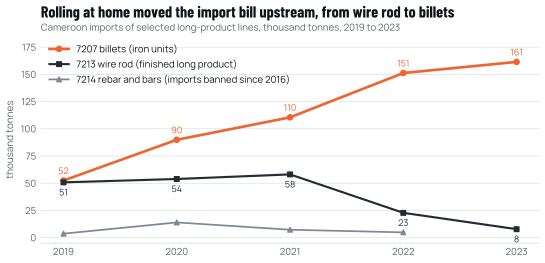
Source: UN Comtrade public API, reporter Cameroon [C06].
The industry’s own statements confirm the diagnosis. Local scrap covers only about 40% of the mills’ metallic needs, the rest being imported billets [C30][C38]. Scrap purchase prices rose by about 30% in 2026 [C40]. On 28 September 2026, Prometal signed a €40 million (26.2 bn FCFA) revolving facility with Afreximbank to finance billet imports [C38][C39][C40]. Unsold stock in the sector was reported at more than 30 bn FCFA in September 2026 [C41]. The binding constraint on Cameroon’s steel industry is not rolling capacity but iron units.
2.4 Flat products and heavy sections remain wholly imported
About a third of the chapter 72 bill in 2023 consisted of flat products: cold-rolled sheet (US$52.0 million, 47.5 thousand tonnes, of which 43.9 thousand tonnes from China), coated sheet such as galvanised and painted roofing (US$32.2 million, 30.5 thousand tonnes) and hot-rolled coil (US$18.3 million) [C06]. Cameroon has no flat-rolling mill. Small-scale sheet processing exists, with Ocitram reporting 43 thousand tonnes of sheet capacity against 21 thousand tonnes of demand [C30], but the substrate is imported. Flat products require a hot strip mill that is economic only at much larger scale; they are outside the scope of the long-products works discussed in this paper.
Sections are a different case. Angles, shapes and sections (HS 7216) cost US$26.3 million in 2023, and fabricated structures (HS 7308, in chapter 73) a further US$58.0 million for 25.7 thousand tonnes [C06]. Light angles and flats are rolled locally in small quantities, but medium and heavy sections, including the H-beams and I-beams used in industrial buildings, bridges and port works, are not produced in Cameroon [C06][C30]. Unlike rebar, they face no import prohibition and are subject to a 10% common external tariff [P24]. They are a genuine import-substitution opportunity that does not compete with existing domestic producers.
Chapter 73, articles of iron or steel, added 84,008 tonnes and 108.0 bn FCFA in 2025 [C05]. Beyond structures, it includes welded tubes (HS 7306, US$26.0 million in 2023), seamless tubes (HS 7304, US$14.6 million) and a wide range of fabricated goods [C06]. Much of this demand comes from energy, mining and construction projects. Domestic fabrication from domestic sections could address part of it; tubes and specialised goods would remain imported.
2.5 Cameroon is already a small exporter of rebar, mainly to Chad
Cameroon’s trade in steel is not one-way. The INS records exports of bars and rods (HS 7214) of about 31 thousand tonnes a year since 2021: 33,437 tonnes in 2021, 27,103 tonnes in 2023 and 31,033 tonnes (16.3 bn FCFA) in 2025 [C02][C04][C05]. Comtrade shows that Chad took 25.9 thousand tonnes in 2023, with small quantities to Equatorial Guinea and the Central African Republic [C06]. These exports, worth about a tenth of chapter 72 imports, show that Cameroonian rolled products can compete in neighbouring markets where transport costs from overseas suppliers are high. Recorded scrap exports, by contrast, fell from 3,675 tonnes in 2019 to almost nothing from 2020, consistent with a de facto restriction for which no legal text was found [C06][C58].
Table 2.1 Cameroon imports of selected chapter 72 lines, thousand tonnes and US$ million, 2019 to 2023
| HS line | 2019 kt / US$m | 2020 kt / US$m | 2021 kt / US$m | 2022 kt / US$m | 2023 kt / US$m | Made in Cameroon? |
|---|---|---|---|---|---|---|
| 7207 Billets and semi-finished | 52.5 / 42.3 | 89.9 / 94.4 | 110.5 / 137.1 | 151.2 / 192.7 | 161.4 / 151.7 | Partly (one melt shop); mostly imported |
| 7208 Hot-rolled flat | 9.4 / 8.4 | 12.3 / 14.4 | 13.6 / 29.2 | 18.0 / 22.5 | n/r / 18.3 | No |
| 7209 Cold-rolled flat | 18.0 / 15.4 | n/r / 46.3 | 42.7 / 57.1 | 21.3 / 27.9 | 47.5 / 52.0 | No |
| 7210 Coated flat | 20.3 / 19.2 | 24.3 / 29.4 | 21.3 / 25.2 | 30.5 / 35.7 | 30.5 / 32.2 | Processing only |
| 7213 Wire rod | 50.8 / 40.6 | 53.9 / 55.6 | 58.1 / 74.0 | 22.8 / 26.6 | 7.8 / 8.1 | Yes (since about 2022) |
| 7214 Rebar and bars | 3.7 / 3.7 | 14.0 / 12.5 | 7.3 / 9.2 | 4.9 / 6.9 | n/r / 3.3 | Yes; imports banned |
| 7216 Angles, shapes, sections | 17.4 / 16.8 | 26.6 / 29.6 | n/r / 29.1 | n/r / 26.2 | n/r / 26.3 | Light only; no heavy sections |
| 7217 Wire | 2.3 / 2.8 | 3.1 / 4.0 | 4.3 / 5.3 | 4.9 / 6.3 | 3.6 / 5.1 | Partly |
| Chapter 72 total (US$m) | 158.7 | 300.4 | 392.8 | 358.5 | 310.4 | |
| 7308 Structures (chapter 73) | 22.4 / 70.9 | 18.6 / 47.6 | 17.2 / 68.0 | 13.6 / 57.4 | 25.7 / 58.0 | Fabrication partly local |
Source: UN Comtrade public API, reporter Cameroon [C06]; production status from Cameroon Tribune (11 May 2026) [C30] and Journal du Cameroun (19 January 2024) [C25]. n/r: quantity not reported.
2.6 What the bill costs in foreign exchange, and what a long-products works can address
In 2025 Cameroon spent 170.1 bn FCFA on chapter 72 imports and 278.1 bn FCFA on chapters 72 and 73 together [C05]. At the fixed peg these equal about €259 million and €424 million; at 570 FCFA per dollar, about US$299 million and US$488 million [W13]. Against pooled CEMAC reserves of 6,377 bn FCFA at the end of 2025 [P07], the annual chapter 72 bill alone equals about 2.7% of the union’s reserves, derived.
Not all of this bill is addressable by a long-products works. Using the 2023 composition, the lines that an electric arc furnace with bar, wire-rod and section mills could in principle supply (billets, wire rod, rebar and sections) amounted to US$189.4 million, or 61% of chapter 72 imports; adding fabricated structures brings the addressable total to US$247.4 million [C06], derived. Flat products, worth about US$102 million, are outside reach [C06].
The addressable bill is not the same as the saving. A domestic works that replaces imported billets with billets melted from imported scrap and imported HBI still pays foreign currency for its iron units. Chapter 9 shows that the net saving per tonne then falls to a fraction of the product value. The saving becomes large only when the iron units themselves are domestic: collected scrap, and eventually direct reduced iron made from Cameroonian ore and gas.
Three conclusions carry forward. First, the foreign-exchange problem in steel is an iron-unit problem: about half the chapter 72 bill is billets, and domestic rolling has increased rather than reduced that dependence. Second, sections and fabricated structures, about US$85 million a year, are imported because no one makes them locally, not because local production was displaced; they are the cleanest import-substitution opportunity. Third, the recorded rebar exports to Chad show that a regional market for Cameroonian long products already exists, but at a scale of tens of thousands of tonnes, not hundreds (Chapter 8).
Other sources cited in the English text
- C03Commerce extérieur du Cameroun en 2023. INS Cameroun, Apr 2024.ins-cameroun.cm/wp-content/uploads/2025/07/Note-sur-le-Commerce-Exteri…
- C04Évolution du commerce extérieur en 2024. INS Cameroun, Aug 2025.ins-cameroun.cm/wp-content/uploads/2025/12/Commext_2024_FR_Edite-final…
- C02Note sur le commerce extérieur 2022. INS Cameroun, Dec 2023 (rev. 13 Feb 2024).ins-cameroun.cm/wp-content/uploads/2025/07/Note-sur-le-Commerce-Exteri…
- C40Cameroun: Prometal décroche 26,2 milliards FCFA d’Afreximbank. Camer.be, 1 Oct 2026.camer.be/actualites/economie/cameroun-prometal-decroche-262-milliards-…
- C25Prometal inaugure deux usines évaluées à 57 milliards F. Journal du Cameroun, 19 Jan 2024.fr.journalducameroun.com/prometal-inaugure-deux-usines-evaluees-a-57-m…
- C27Matériaux de construction: l’offensive locale. Cameroon Tribune, 24 Apr 2023.cameroon-tribune.cm/article.html/56766/en.html/details_2
- C20Press report of the sealing by customs of more than 7,300 t of imported reinforcing bar, December 2020 (headline and address not reproduced: they name the importer). Business in Cameroon, 16 Dec 2020.Cited by title and date
- C21Métallurgie: les importations du fer à béton interdites jusqu’à nouvel ordre. EcoMatin, 10 Apr 2023.ecomatin.net/metallurgie-les-importations-du-fer-a-beton-interdites-ju…
- G34Weekly steel prices (archive 40468). Arab Iron & Steel Union (AISU), 3 Oct 2026.aisusteel.org/en/archives/40468
- C39Prometal obtient 26 milliards FCFA d’Afreximbank pour soutenir son expansion industrielle. EcoMatin, 30 Sep 2026.ecomatin.net/prometal-obtient-26-milliards-fcfa-dafreximbank-pour-sout…
- C4140 millions d’euros d’Afreximbank: Prometal sécurise ses billettes d’acier alors que la ferraille camerounaise s’épuise. Cameroun24, 10 Oct 2026.cameroun24.net/article/76267-40-millions-d-euros-d-afreximbank-prometa…
- P24WITS TRAINS API: Cameroon reported MFN tariffs by HS6 (2023). World Bank / UNCTAD.wits.worldbank.org/API/V1/SDMX/V21/datasource/TRN/reporter/120/partner…
- C58Lutte contre la vie chère: le Cameroun limite les exportations de certains produits. EcoMatin, 27 Apr 2022.ecomatin.net/lutte-contre-la-vie-chere-le-cameroun-limite-les-exportat…
- P07Zone Cémac: la BEAC annonce un ralentissement de croissance à 2,4%. AllAfrica (Les Dépêches de Brazzaville), 17 Dec 2025.fr.allafrica.com/stories/202512170629.html
本章引用的资料来源
方括号内的标记对应以下来源(按原文语言列出),完整列表见附录。 完整来源列表
- C05Évolution du commerce extérieur en 2025 (version provisoire). INS Cameroun,2026年2月(发布:2026年4月1日).ins-cameroun.cm/wp-content/uploads/2026/04/Note-sur-le-commerce-exteri…
- C01Commerce extérieur du Cameroun en 2020. INS Cameroun,2021年7月.ins-cameroun.cm/wp-content/uploads/2025/07/Note-Commerce-exterieur-202…
- W13Euro foreign exchange reference rates, US dollar, monthly averages (series EXR.M.USD.EUR.SP00.A). European Central Bank.data-api.ecb.europa.eu/service/data/EXR/M.USD.EUR.SP00.A
- C06UN Comtrade public API: Cameroon (reporter 120), HS 72/73 and 6-digit lines, 2019-2023. UN Statistics Division.comtradeapi.un.org/public/v1/preview/C/A/HS?reporterCode=120&period=20…
- C30Production: les acteurs en présence. Cameroon Tribune,2026年5月11日.cameroon-tribune.cm/article.html/76600/fr.html/details_2
- C38Cameroun: le groupe Prometal décroche 26 milliards FCFA auprès d’Afreximbank…. Sikafinance,2026年9月30日.sikafinance.com/marches/cameroun-le-groupe-prometal-decroche-26-millia…
引用本章
Cameroon Steel(2026)。只有在边境价格上具备竞争力,国内钢铁才能节省外汇(中文摘要版)。白皮书09,第2章:钢铁进口账单:每年1700亿中非法郎,其中一半是钢坯。CS-WP-09。https://www.cameroon-steel.com/zh/library/economics-of-domestic-steel/steel-import-bill/
来源