白皮书09 · 第10章 · 中文摘要
政策建议:奖励国产铁和竞争力,而非在封闭边境之后从事轧制
现行制度保护的是喀麦隆已经过剩的轧制环节,而其缺少的炼铁环节受到的保护最少。本白皮书提出六项面向整个行业的改革,组织原则是:支持应当是临时的、以可衡量的绩效为条件,并以边境价格作为衡量基准。
本页为本章中文摘要;英文全文附于其后,可展开阅读。
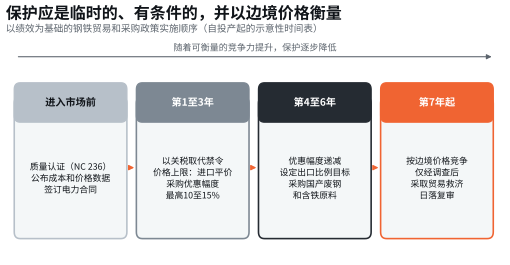
第一,对所有供应商严格执行钢筋强制性标准NC 236/2024/06,实行第三方检测;参照印度钢铁产品政府采购政策(按产品设定15%至50%的国内增加值门槛),在公共工程中给予约10%至15%、逐步递减的采购优惠,并从一开始纳入型材和钢结构[C34][W17]。第二,由电力监管机构公布10兆瓦以上负荷的高压框架电价,按发电和输电成本定价,约为每千瓦时45至50中非法郎,同时确保克里比工业区的稳定供电和长期天然气供应[E15][E38]。第三,在质量监管到位后分步以20%关税取代钢筋进口禁令,纠正线材关税(5%)低于钢坯(10%)的倒挂,并建立符合世贸组织规则的反倾销和保障措施调查能力[P23][P24][P26]。第四,开展全国废钢普查并规范回收,明确矿业法15%本地加工义务的产品、质量、定价和时间表[C42][W09][O17]。第五,依靠开发性金融和出口信贷,不增加主权风险,并公布税式支出[P32][W08]。第六,每年公布对照边境价格的钢铁记分牌。
英文全文 11分钟 · 2556词Policy recommendations: reward domestic iron and competitiveness, not rolling behind a closed border
The evidence of this paper supports a domestic steel policy for Cameroon, but a different one from the policy in force. Today’s regime protects the stage the country already has in surplus, rolling, through an import prohibition and administered prices, while the stage it lacks, iron, receives the least protection and depends on imports [C20][C44][P24]. We recommend six changes: enforce quality standards for all suppliers and give public procurement a capped, value-added-based preference; set a transparent high-voltage tariff for large industry priced near the cost of generation and transmission; replace prohibitions with tariffs and evidence-based trade defence, and correct the tariff escalation; make domestic iron units the priority of industrial policy; finance the industry without new sovereign risk; and publish a scoreboard that measures progress against border prices. Each recommendation applies to the sector as a whole, not to any single company. Together they would let domestic steel save foreign exchange at a cost the economy can afford.
10.1 The organising principle: support conditional on measured competitiveness
The six recommendations, numbered 1 to 6 in the order of sections 10.2 to 10.7 and in Table 10.1, share one principle drawn from the evidence of Chapter 3: support for a domestic industry should be temporary, conditional on measurable performance, and measured against border prices [W24][W25][W04]. A domestic producer that sells at or below duty-paid import parity, meets the national standard and exports a growing share of its output deserves support while it learns. A producer that needs a prohibition to sell, or prices well above import parity, imposes a cost on builders and on the budget that a country with thin reserves and high debt-distress risk should not carry indefinitely (Chapter 1) [P07][P32].
Figure 10.1 sets out an illustrative sequence. Before entry, the conditions are quality certification, published price and cost information, and a signed power contract. In the first years, protection takes the form of a tariff, a cap at import parity and a modest procurement preference. As the industry matures, preference margins taper, export and domestic-sourcing targets rise, and from about the seventh year the industry faces border prices, with trade defence available only after an investigation. The timetable is indicative; the direction is what matters.
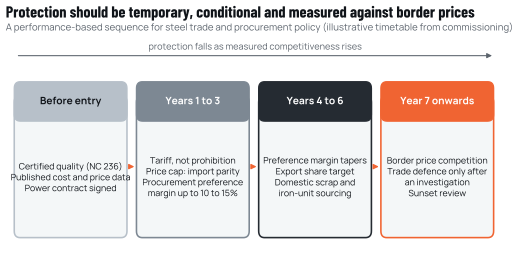
Source: Cameroon Steel analysis, drawing on the design rules of Chapter 3 [W24][W25][W04][W17].
10.2 Standards and public procurement: buy domestic when it meets the standard and the price
Enforce the standard for every supplier. Cameroon’s rebar standard NC 236/2024/06 has been mandatory since the decrees of April 2022, and the government refused in January 2026 to revise it to admit a lower grade [C34][C35]. Consumer complaints about counterfeit and substandard rebar, and sanctions against a producer for non-compliant bars, show that enforcement is uneven [C29][C35]. Systematic third-party testing at mills and at points of sale, published results, and the same rules for imports and domestic production would protect buyers and reward producers that invest in quality. Quality is the cheapest form of protection, because it excludes only products that should not be used.
Give public works a capped preference for domestic value added. Public investment of 2,026.3 bn FCFA in 2026 [C16] makes the State the largest single buyer of steel-intensive construction. The 2025 Finance Law already removes customs facilities from imported goods with local equivalents [P18]. A better-targeted instrument would follow India’s policy for domestically manufactured iron and steel in government procurement: a list of products, a minimum domestic value-addition threshold per product (15% to 50% in India), a preference applied in tender evaluation, and waivers where grades or quantities are not available domestically [W17]. In Cameroon, a preference margin of the order of 10% to 15% of the import-parity price, tapering over time, would reward domestic value added without allowing domestic prices to drift far above import parity. Sections and fabricated structures, which are not made locally today, should be on the list from the start.
Make value added, not location, the test. The preference should reward the share of value created in Cameroon, verified by the investment agency or customs, so that products made from domestic iron units earn more preference than products rolled from imported billets. This aligns procurement with the criteria of the 2025 investment ordinance, which already favours national natural-resource inputs and value added [W08].
10.3 Energy pricing: a transparent high-voltage tariff for large industry
Publish a framework tariff above 10 MW. No regulated tariff exists today for loads above 10 MW; contracts are bilateral and legacy prices vary widely [E15]. The regulator, ARSEL, should publish a high-voltage framework for large industrial loads with a capacity charge, an energy charge and an indexation formula, set by reference to the cost of generation and transmission rather than to the system average including distribution. The published benchmarks suggest a level near 45 to 50 FCFA per kWh (Chapter 7) [E15][E38][E17]. A high-load-factor steelworks then pays its full share of system costs and the utility gains a creditworthy anchor customer.
Make supply firm before tariffs are tested. In October 2026, 150 MW of industrial demand was unmet pending a transmission line [E16], and the Kribi gas-fired plant operated at about 30% of capacity in 2025 [E15]. Completion of the 225 kV line and substation serving the Kribi industrial zone, designed for 100 MW initially and 330 to 400 MW later [Z43], and clear rules for schedulable load, under which a melt shop times its heats around the evening peak, would matter as much as the price. An arc furnace offers that flexibility; it is not an interruptible load, because its output depends on running most hours of the year.
Clarify gas allocation and taxation. Gas-fired reheating, and any later direct-reduction module, need long-term gas supply. After the departure of the floating LNG vessel in July 2026, Sanaga Sud gas needs domestic buyers [E09][E04]. A published audit of remaining reserves, a framework for long-term supply agreements with industrial users, and a ruling on whether the special tax of 70 FCFA per cubic metre applies to industrial gas [E11] would let investors and the State plan.
10.4 Trade policy prudence: tariffs, not prohibitions; investigations, not decrees
Replace the rebar prohibition with a tariff, in steps. The prohibition has localised rolling but has kept prices above duty-paid import parity (Chapter 3) [C44]. Once quality enforcement is in place, a phased return to the 20% CET for rebar, with transparent monitoring of domestic prices against import parity, would cap the cost to builders, restore customs revenue and keep effective protection for re-rollers at a high but bounded level (about 60%, Table 3.2).
Correct the tariff escalation in the new external tariff. The harmonised ECCAS-CEMAC tariff applied since January 2026 is the opportunity to remove the inversion that gives wire-rod rolling negative effective protection (5% on wire rod against 10% on billets) and to avoid taxing the iron units that a domestic industry needs at the same rate as finished products [P23][P24]. Cameroon should argue in the customs union for a low rate on iron ore, DRI and scrap, a moderate rate on billets and a uniform rate on finished long products.
Use trade defence only on evidence. Global excess capacity of about 640 Mt in 2025, rising to 745 Mt by 2028, and record Chinese exports create a real risk of dumping into unprotected markets [G16][G19]. The right response is a capacity to investigate and impose anti-dumping or safeguard duties under WTO rules when injury is proven, not standing prohibitions. Cameroon’s non-agricultural tariffs are almost entirely unbound at the WTO (binding coverage of 0.2%), which gives legal room, but rules-based investigation is what makes such measures credible and temporary [P26].
Phase out administered prices as competition returns. Homologated prices were introduced to protect consumers in a closed market [C44]. With the border open to tariffed imports, the market price is capped by import parity, and homologation can give way to price monitoring.
10.5 Iron units: make domestic iron the priority of industrial policy
Organise scrap. The only quantified study of scrap arising in Cameroon dates from 2006 [C42]. A new survey, licensing and formalisation of collectors, weighbridge and payment standards, and a clear and stable policy on scrap exports, for which no legal text was found [C58], would raise the domestic share of iron units for the whole industry. The gain is real but bounded: national arising was estimated at 53,000 to 62,000 tonnes a year in 2006, and existing mills already depend on it [C42][C38]. Chapter 9 shows that 30,000 tonnes a year of domestic scrap, the planning level for a new works, adds about 7 bn FCFA a year of foreign exchange retained, and that scrap collection can raise the saving per tonne, but the national pool is far too small to supply a works of 1 Mtpa, where the large gain requires domestic DRI, illustrative.
Turn the local-transformation obligation into iron units. The 2023 Mining Code requires each mining convention to fix a share of production for local transformation, with a minimum of 15% [W09], and the Mbalam convention is reported to commit its holder to transform 15% of production locally; the same source presents Cameroon Steel as the national steel hub of that programme [O17]. The obligation should specify the form of the transformed product (concentrate, pellets or direct reduced iron), its quality, arm’s-length pricing and the timetable, so that it creates a usable supply of iron units rather than a symbolic quota. The strategic committee on mines-metallurgy integration set up by the Prime Minister in December 2025, whose mandate includes a reliable ore supply for local steelmakers [W30], is the natural forum.
Plan the direct-reduction step as public infrastructure, not only as a project. Direct reduction needs ore of suitable quality, pelletising, gas and port handling. Sub-Saharan Africa produced only 0.09 Mt of direct reduced iron in 2025 [T13]. Coordinating ore, gas and port decisions so that a direct-reduction module becomes feasible after the first phases is a task for the State as much as for investors.
10.6 Financing and foreign exchange: finance the industry without new sovereign risk
Use development and export-credit finance, not the budget. With a high risk of debt distress, the State should avoid guarantees and equity commitments that add to public liabilities [P32][C12]. Development finance institutions, export-credit agencies and African lenders are active in the sector: Afreximbank’s €40 million facility to Prometal in September 2026 is one example [C38]. Their standards on environmental and social performance, procurement and governance also raise the quality of projects.
Let exporters manage foreign exchange within CEMAC rules. The 2025 ordinance allows investors to hold accounts in foreign currency and transfer income, subject to the CEMAC exchange regulation [W08][P10]. For exporting industries, clear and predictable rules on retaining export proceeds to service foreign-currency debt reduce financing costs without weakening the pooled reserves.
Tie fiscal incentives to performance and publish their cost. The operating-phase incentives of the 2025 ordinance are substantial (Chapter 6) [W08]. Granting them against the Article 7 criteria, monitoring compliance annually and publishing each convention’s tax expenditure would answer the IMF’s concern about tax expenditures and protect the regime’s credibility [P09].
10.7 Measurement: a public scoreboard against border prices
Policy conditional on performance needs measurement. A short annual scoreboard, published by the ministry in charge of industry with data from customs, the INS and producers, would track: the domestic price of rebar and sections against duty-paid import parity; the share of domestic iron units in national steel production; steel imports by product and origin; exports by destination; quality compliance rates; formal employment; and taxes paid. Chapter 11 sets out the data gaps that such a scoreboard would close.

Table 10.1 Recommendations matrix
| # | Recommendation | Objective | Design rule | Lead institution (indicative) | Timing |
|---|---|---|---|---|---|
| 1a | Enforce NC 236 for all suppliers | Quality; fair competition | Third-party testing at mills, ports and points of sale; published results | ANOR; MINCOMMERCE; Customs | Immediate |
| 1b | Capped procurement preference | Domestic value added in public works | Product list; value-addition thresholds; preference margin of about 10 to 15%, tapering; waivers | MINMAP; MINTP; MINMIDT | 2027 tenders onwards |
| 2a | High-voltage framework tariff above 10 MW | Competitive, cost-reflective power | Capacity plus energy charge at generation-and-transmission cost; indexation | ARSEL; MINEE | 2027 |
| 2b | Firm supply and gas framework | Reliability; domestic gas use | Kribi 225 kV completion; reserve audit; long-term gas agreements; gas-tax ruling | MINEE; SNH; SONATREL | 2026 to 2028 |
| 3a | Rebar: from prohibition to tariff | Cap cost of protection | Phased return to 20% CET after quality enforcement; price monitoring | MINFI (Customs); MINCOMMERCE | 2027 to 2029 |
| 3b | Correct tariff escalation | Protect iron-making, not only rolling | Low duty on ore, DRI, scrap; moderate on billets; uniform on finished long products | MINFI; CEMAC / ECCAS | Next CET review |
| 3c | Evidence-based trade defence | Respond to dumping lawfully | Investigating authority; WTO-consistent anti-dumping and safeguards | MINCOMMERCE | 2027 |
| 4a | National scrap programme | Domestic iron units | Survey; licensing; stable export policy | MINMIDT; MINEPDED | 2027 |
| 4b | Local transformation of ore | Domestic iron units from ore | Specify product, quality, pricing and timetable in conventions | MINMIDT; mines-metallurgy committee | With each convention |
| 5a | Non-sovereign finance | Avoid new public liabilities | DFI and ECA finance; no State guarantees | MINFI; investors | Ongoing |
| 5b | Performance-linked incentives | Value for tax expenditure | Article 7 criteria; annual review; published tax expenditure | API; MINFI | From 2027 |
| 6 | Annual steel scoreboard | Accountability | Prices vs parity; iron-unit share; exports; quality; jobs; taxes | MINMIDT; INS | First edition 2027 |
Source: Cameroon Steel recommendations, based on Chapters 1 to 9. Institutions are indicative: ANOR (standards agency), MINCOMMERCE (commerce), MINMAP (public procurement), MINTP (public works), MINMIDT (mines, industry and technological development), ARSEL (electricity regulator), MINEE (water and energy), SNH (national hydrocarbons company), SONATREL (transmission operator), MINFI (finance), MINEPDED (environment), API (investment promotion agency), INS (statistics).
These recommendations are deliberately sector-wide. They would apply to every existing and future producer, and they would make the case for any new works, including Cameroon Steel’s, depend on what it adds to the country’s iron-making capability, its supply of products not made locally and its competitiveness at border prices. That is the test this paper proposes, and the test we expect our own project to meet.
Other sources cited in the English text
- P07Zone Cémac: la BEAC annonce un ralentissement de croissance à 2,4%. AllAfrica (Les Dépêches de Brazzaville), 17 Dec 2025.fr.allafrica.com/stories/202512170629.html
- C35Cameroun: le gouvernement rejette une demande de révision de la norme du fer à béton. EcoMatin, 5 Feb 2026.ecomatin.net/cameroun-le-gouvernement-rejette-une-demande-de-revision-…
- C29Métallurgie: les industriels dénoncent la présence du fer à béton contrefait. EcoMatin, 22 Jun 2023.ecomatin.net/metallurgie-les-industriels-du-secteur-denoncent-la-prese…
- C16Budget 2026: 8 816,4 milliards FCFA…. MINFI, 26 Nov 2025.minfi.gov.cm/budget-2026-8-8164-milliards-fcfa-pour-consolider-la-stab…
- P18Innovations douanières de la Loi de Finances 2025. MINFI, Direction Générale des Douanes, Jan 2025.minfi.gov.cm/wp-content/uploads/2025/01/EXPOSE_DGD_LF_2025.pdf
- E17Décision fixant le montant de la RMA ENEO au titre de l’exercice 2025 (réajustée). ARSEL, 19 Dec 2025.arsel-cm.org/wp-content/uploads/2026/01/Decision-fixant-le-Montant-de-…
- E16Nachtigal power line delays leave 150 MW of industrial demand unmet. Business in Cameroon, 9 Oct 2026.businessincameroon.com/public-management/0910-16939-nachtigal-power-li…
- Z43Kribi franchit la ligne électrique 225 kV. Port Autonome de Kribi (PAK), 6 Aug 2025.Cited by title and date
- E09Le navire usine quitte le Cameroun, le gaz s’arrête. Camer.be, 9 Jul 2026.camer.be/93911/12:1/le-navire-usine-quitte-le-cameroun-le-gaz-sarrete-…
- E04Données pétrolières 2025. SNH, posted Jun 2026.snh.cm/wp-content/uploads/2026/06/Donnees-petrolieres-2025.pdf
- E11Industrial gas: Cameroon suspends GDC’s 20% price hiking plan. Business in Cameroon, 18 Jul 2023.businessincameroon.com/energy/1807-13291-industrial-gas-cameroon-suspe…
- C44Fer à béton: les producteurs acceptent une baisse des prix. EcoMatin, 23 Oct 2023.ecomatin.net/fer-a-beton-les-producteurs-acceptent-une-baisse-des-prix
- G16OECD: global steel excess capacity set to reach 745 million mt by 2028. EUROMETAL (Platts), 5 Jun 2026.eurometal.net/oecd-global-steel-excess-capacity-set-to-reach-745-milli…
- G19China increased steel exports by 7.5% y/y in 2025. GMK Center, 14 Jan 2026.gmk.center/en/news/china-increased-steel-exports-by-7-5-y-y-in-2025/
- C58Lutte contre la vie chère: le Cameroun limite les exportations de certains produits. EcoMatin, 27 Apr 2022.ecomatin.net/lutte-contre-la-vie-chere-le-cameroun-limite-les-exportat…
- C38Cameroun: le groupe Prometal décroche 26 milliards FCFA auprès d’Afreximbank…. Sikafinance, 30 Sep 2026.sikafinance.com/marches/cameroun-le-groupe-prometal-decroche-26-millia…
- W30Cameroon reviews metals industry to address supply and energy constraints. Business in Cameroon, 29 Apr 2026.businessincameroon.com/public-management/2904-16094-cameroon-reviews-m…
- T132025 World Direct Reduction Statistics. Midrex Technologies, Sep 2026.midrex.com/world-dri-statistics/world-dri-production-reaches-151-0-mt-…
- C12Cameroon Overview. World Bank, updated Sep 2026.worldbank.org/en/country/cameroon/overview
- P102024 Investment Climate Statements: Cameroon. US Department of State, 2024.state.gov/reports/2024-investment-climate-statements/cameroon/
- P09IMF Executive Board concludes 2026 Article IV consultation with Cameroon (PR 26/096). IMF, 30 Mar 2026.imf.org/en/news/articles/2026/03/30/pr-26096-cameroon-imf-executive-bo…
- C20Press report of the sealing by customs of more than 7,300 t of imported reinforcing bar, December 2020 (headline and address not reproduced: they name the importer). Business in Cameroon, 16 Dec 2020.Cited by title and date
本章引用的资料来源
方括号内的标记对应以下来源(按原文语言列出),完整列表见附录。 完整来源列表
- C34Cameroon rejects fresh push to revise rebar standard. Business in Cameroon,2026年1月26日.businessincameroon.com/construction/2601-15657-cameroon-rejects-fresh-…
- W17Policy for providing preference to domestically manufactured iron and steel products in government procurement (DMI&SP). Ministry of Steel, Government of India,2017年5月8日;修订:2019年5月29日、2020年12月31日.steel.gov.in/node/45
- E15Rapport d’activités 2025 de l’ARSEL. ARSEL (electricity regulator),2026年9月7日.arsel-cm.org/wp-content/uploads/2026/09/Rapport-ARSEL-2025.pdf
- E38Tarif transport et GRT (Décision 0000017D). ARSEL,2025年1月17日.arsel-cm.org/wp-content/uploads/2026/01/TARIF-TRANSPORT-ET-GRT-1.pdf
- P23Cameroon applies CEEAC common external tariff from January 1, 2026. Business in Cameroon,2026年1月12日.businessincameroon.com/public-management/1201-15594-cameroon-applies-c…
- P24WITS TRAINS API: Cameroon reported MFN tariffs by HS6 (2023). World Bank / UNCTAD.wits.worldbank.org/API/V1/SDMX/V21/datasource/TRN/reporter/120/partner…
- P26Tariff profile: Cameroon. WTO,n.d..wto.org/english/res_e/statis_e/daily_update_e/tariff_profiles/CM_e.pdf
- C42Bidoung J., Fomethe A., Yantio G., Melo U., La récupération et le recyclage des déchets ferromagnétiques: analyse de la situation au Cameroun (Déchets, Revue francophone d’écologie industrielle n°48). ENSP Yaoundé / MIPROMALO,2007年第四季度.eid.episciences.org/7942/pdf
- W09Loi n° 2023/014 du 19 décembre 2023 portant Code minier (Article 40(4), local transformation). Republic of Cameroon, copy on FAOLEX,2023年12月19日.faolex.fao.org/docs/pdf/cmr223180.pdf
- O17Cameroon Mining Company confirme l’entrée du projet Mbalam dans sa phase irréversible d’exécution. Camer.be(经AllAfrica转载),2025年12月12日.fr.allafrica.com/stories/202512120475.html
- P32IMF staff concludes Post-Financing Assessment mission to Cameroon (PR 26/314). IMF,2026年10月1日.imf.org/en/news/articles/2026/10/01/pr26314-imf-staff-concludes-assesm…
- W08Ordonnance n° 2025/002 du 18 juillet 2025 fixant les incitations à l’investissement en République du Cameroun (certified copy). Presidency of the Republic, copy hosted by LEGECAM,2025年7月18日.legecam.cm/wp-content/uploads/2025/08/ordonnance_n_2025_002_du_18_07_2…
- W24Industrial Policy for the Twenty-First Century (D. Rodrik), Faculty Research Working Paper RWP04-047. Harvard Kennedy School,2004年.hks.harvard.edu/publications/industrial-policy-twenty-first-century
- W25The New Economics of Industrial Policy (R. Juhász, N. Lane, D. Rodrik), Annual Review of Economics 16, pp. 213-242. Annual Reviews,2024年8月.doi.org/10.1146/annurev-economics-081023-024638
- W04Manufacturing Revolutions: Industrial Policy and Industrialization in South Korea (N. Lane), Quarterly Journal of Economics 140(3), pp. 1683-1741. Oxford University Press,2025年5月.doi.org/10.1093/qje/qjaf025
引用本章
Cameroon Steel(2026)。只有在边境价格上具备竞争力,国内钢铁才能节省外汇(中文摘要版)。白皮书09,第10章:政策建议:奖励国产铁和竞争力,而非在封闭边境之后从事轧制。CS-WP-09。https://www.cameroon-steel.com/zh/library/economics-of-domestic-steel/policy-recommendations/
来源