White paper 04 · Market
Cameroon’s steel gap lies in iron units, not in rebar
Rebar is saturated; the deficit lies in billets, iron units, flat products and heavy sections.
Derived Counted from the English manuscript when the site was generated; print equivalent = words ÷ 350.
You are reading the full English edition. Also online: Édition française complète中文摘要版
Executive summary
What the study shows
Read the full executive summarySteel demand in Cameroon and CEMAC, 2026 to 2040. A market of about 450,000 tonnes that could double, fed by imported billets, flat steel and sections while domestic mills can roll more bars than the country uses.
Source: white paper 04, executive summary; bracketed markers refer to the list of sources in the annex.
Main findings
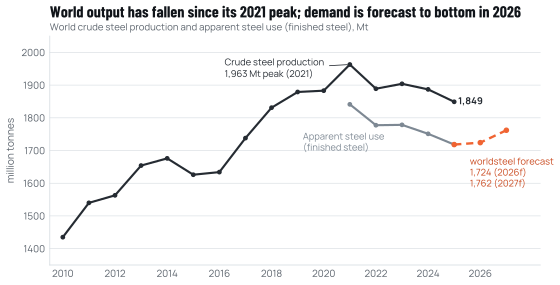
- The world is long in steel and short of defences in Africa. World output fell to 1,849.4 Mt in 2025, OECD-estimated excess capacity is heading from 640 Mt to 745 Mt by 2028, and China exported a record 119 Mt. Large markets have raised barriers, with 207 restrictions in 62 countries; Central Africa has almost none outside Cameroon’s rebar ban [S08][S09][S10][S11].
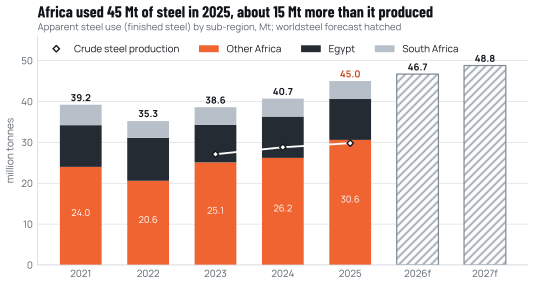
- Africa is the growth exception, and imports fill it. African steel use rose 10.4% to 45.0 Mt in 2025 against production of 29.8 Mt; imports jumped from 23.9 Mt to 32.9 Mt in a year, 59% from China. Sub-Saharan Africa’s shaft-furnace DR plants made only 0.09 Mt of direct-reduced iron (Midrex plant data); worldsteel estimates about 2.7 Mt more, mostly coal-based, in East Africa [S02][S12][S13].
- Cameroon’s market is about 450 kt and 15 kg per person. On the provisional census count of 22.7 million people the figure is about 20 kg; on any count it is below the 22.5 kg average of Africa outside Egypt and South Africa [S01][S14][S15][S02].
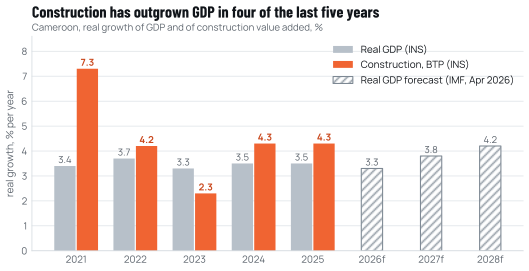
- The drivers of growth are in place. Construction grew 4.3% in 2024 and 2025 against GDP growth of 3.5%; the 2026 budget includes 2,026.3 bn FCFA of public investment; and the population is projected to reach 42.2 million by 2040, with 8 million more urban residents [S16][S17][S18].
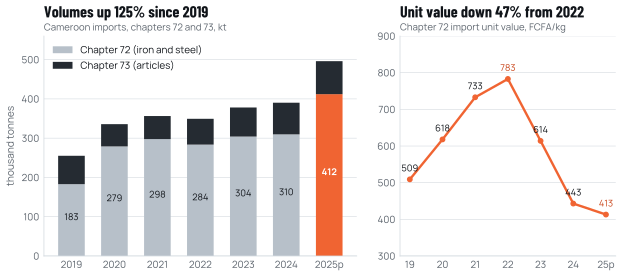
- Imports are iron units and flat steel, not bars. Chapter 72 imports rose 125% from 2019 to 412 kt in 2025. In 2023 billets cost US$151.7m, 49% of the chapter 72 bill; bars and rebar cost US$3.3m, about 1% [S19][S07][S05].
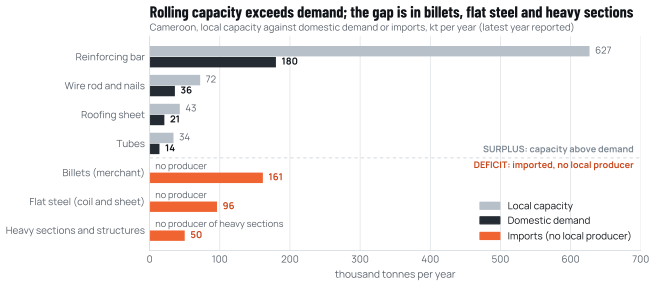
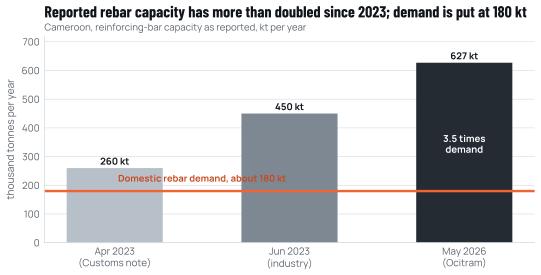
- The domestic industry can roll more than it can feed. Installed transformation capacity is about 1.2 Mt at about 50% utilisation; rebar capacity is 627 kt (as read; section 5.2) against 180 kt of demand; local scrap covers about 40% of the mills’ needs and imported billets about 60% [S20][S01][S03].
- The largest producer is financing imported billets. On 28 September 2026 the Prometal group signed a €40m revolving facility with Afreximbank to import billets, a clear signal that metal, not mill capacity, limits output [S20][S21].
- Demand reaches 0.7 to 1.2 Mt by 2040, and the iron-unit gap widens in every scenario. In the base case demand is about 920 kt in 2040; sections and flat steel grow fastest; and the iron units needed beyond domestic scrap rise from about 170 kt to between 225 kt and 520 kt a year. Even in the high case, rebar demand stays below today’s capacity.
- Cheap billets set the benchmark, and on imported iron a Kribi billet matches it only at the low end. Billets were quoted at US$465 to 480 per tonne FOB from China and Russia on 3 October 2026 and land in Douala or Kribi at about US$570 to 650 duty-paid. An indicative cash cost for a billet melted at Kribi from imported scrap and hot-briquetted iron is about US$590 to 780, before capital charges; the 10% duty on imported metallics is about as large as the central gap. Rebar, by contrast, is priced administratively, at about 633,000 FCFA per tonne in October 2023 [S22][S23][S24] (section 8.6).
- Policy should move protection upstream and towards quality. Rules-based trade instruments, standards extended to structural steel, procurement that requires certified products and pays on time, and incentives for melting and section rolling would serve SND30’s goals better than an open-ended ban on one finished product [S25][S23][S26].
Contents
12 chapters, 4 annexes
Every chapter opens with its conclusion. The annexes set out the method, the glossary and the list of sources.
- SummaryExecutive summary: the gap is upstream11 min · 1 fig.
- Chapter 1A world long in steel is sending its surplus to markets without defences12 min · 3 fig.
- Chapter 2Africa is the one region where steel demand is rising fast, and imports fill most of it13 min · 3 fig.
- Chapter 3Construction, infrastructure and urban growth will lift Cameroon’s steel demand14 min · 3 fig.
- Chapter 4Cameroon imports iron units and flat steel, not reinforcing bar11 min · 3 fig.
- Chapter 5Cameroon’s mills can roll more than the market needs but cannot source enough iron11 min · 2 fig.
- Chapter 6CEMAC adds a regional market of half a billion dollars, but neighbours are building their own mills11 min · 3 fig.
- Chapter 7Demand could reach 0.7 to 1.2 Mt by 2040, and in every scenario the iron-unit gap widens12 min · 3 fig.
- Chapter 8Prices reward re-rolling today; a new producer must win on the cost of iron, not on the rebar price19 min · 4 fig.
- Chapter 9A new producer adds most value by supplying iron units, sections and certified quality15 min · 1 fig.
- Chapter 10Policy should move protection from finished bars to quality, iron units and fair trade13 min · 2 fig.
- Chapter 11What we do not yet know, and how it will be resolved5 min
Annexes
Go further
Related white papers
- WP09Domestic steel saves foreign exchange only when it competes at border pricesEconomics · 2.9 h
- WP01From ore to steel: Cameroon’s missing link is ironmaking, not rollingValue chain · 3 h
- WP10Safer buildings need rebar that meets its declared gradeQuality · 2.8 h
Related Labs tools
- Import-substitution simulator
What share of steel imports could local production replace?
- Rebar estimator
How much steel does my building need, and in which bar sizes?
- Value-chain explorer
How many tonnes go in and out at each stage, from ore to finished product?
Cite this white paper
CS-WP-04
Cameroon Steel (2026). Cameroon’s steel gap lies in iron units, not in rebar. White paper 04, CS-WP-04. https://www.cameroon-steel.com/en/library/market-outlook/
- Reference
- CS-WP-04
- Edition
- 10 October 2026
- Status
- First edition
- Classification
- Public