White paper 04 · Chapter 8
Prices reward re-rolling today; a new producer must win on the cost of iron, not on the rebar price
International steel prices in October 2026 combine cheap semi-finished steel with firmer finished products. On 3 October 2026 billets were quoted at US$465 to 480 per tonne free on board from China and Russia, and Turkish reinforcing bar for export at US$620 to 630 [S22]. Iron ore averaged US$100.2 per dry tonne in 2025 and the World Bank expects US$97 in 2026 and US$95 in 2027 [S58][S59]. In Cameroon, reinforcing bar is a homologated product: the Ministry of Commerce sets producer prices per bar, and the October 2023 list implies about 633,000 FCFA per tonne for 12 mm FE500 bar, about €965 [S24]. That level sits well above both international rebar and billet prices, a gap that pays for freight, duties, conversion, power and margin and that is sustained by the import ban. For a new producer, the lesson is that the rebar price is administered and exposed, while the competitive benchmark that will not go away is the delivered cost of imported billets: about US$570 to 650 per tonne landed duty-paid in October 2026, against an indicative US$590 to 780 for a billet made at Kribi from imported scrap and hot-briquetted iron, before capital charges (section 8.6).
In this chapter (9)
- 8.1 Iron ore: easing towards US$95 a tonne
- 8.2 Billets and reinforcing bar: a wide spread
- 8.3 Douala’s rebar price is set administratively
- 8.4 The price ladder
- 8.5 Scrap, power and gas: the costs of making iron locally
- 8.6 Indicative cost of a Kribi billet against a delivered import
- 8.7 From world price to Douala price: duties and taxes
- 8.8 Carbon prices: relevant for exports to Europe only
- 8.9 What prices mean for a new producer
8.1 Iron ore: easing towards US$95 a tonne
Iron ore with 62% iron content, delivered to China, averaged US$120.6 per dry metric tonne in 2023, US$109.4 in 2024 and US$100.2 in 2025, according to the World Bank [S58]. In 2026 the quarterly averages were US$102.9 (first quarter), US$105.2 (second) and US$97.4 (third), and the September monthly price was US$97.7 [S144]. The World Bank’s April 2026 Commodity Markets Outlook forecasts US$97 for 2026 and US$95 for 2027, slightly higher than its October 2025 forecasts of US$94 and US$90 [S59].
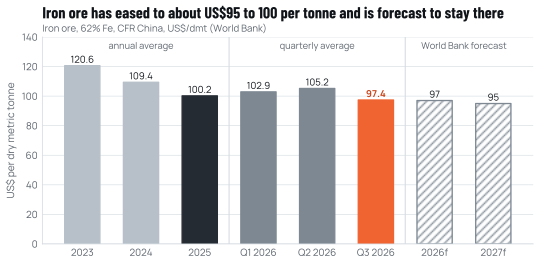
Source: World Bank, Commodity Markets Outlook historical data and Pink Sheet (October 2026); forecasts from the April 2026 outlook [S58][S144][S59].
New supply points to continued moderation. Simandou in Guinea, with design capacity of up to 120 Mtpa of high-grade ore, began shipping in December 2025 and could ship more than 20 Mt in 2026 [S69][S70][S71]. Lower ore prices reduce the cost of primary iron worldwide and therefore the price of billets made from ore; they also reduce the value of iron-ore exports for producing countries such as Cameroon. For a producer that might eventually make its own iron from Cameroonian ore, the relevant comparison is not the export price of ore but the delivered cost of the iron units it would replace.
8.2 Billets and reinforcing bar: a wide spread
There is no free public series of annual average billet and rebar prices, so this paper uses dated weekly snapshots from the Arab Iron and Steel Union and market reports [S22][S145][S146][S147][S148][S149][S150][S151]. Turkish rebar for export was quoted at US$550 to 575 per tonne in October 2023, US$580 to 600 in late October 2024, US$545 to 555 in October 2025, US$590 at the end of August 2026, US$615 on 11 September 2026 and US$620 to 630 on 3 October 2026 [S147][S146][S145][S149][S22].
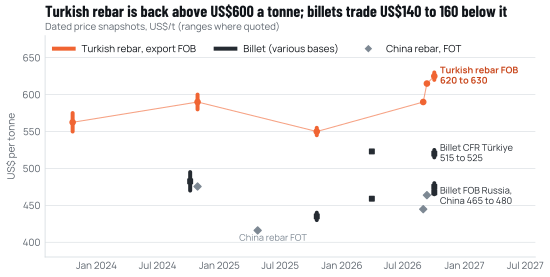
Source: Arab Iron and Steel Union weekly prices (October 2023 to October 2026) and GMK Center market reports [S22][S145][S146][S147][S148][S149][S150][S151]. Dated snapshots, not averages.
Billet prices were lower and more varied by origin. Quotations included US$470 to 495 per tonne in October 2024; US$430 to 440 FOB from Russia in October 2025; US$459 FOB in the Black Sea and US$523 delivered to the Persian Gulf in March 2026; and, on 3 October 2026, US$470 to 480 FOB from Russia, US$465 to 470 FOB from China and US$515 to 525 delivered to Türkiye from CIS suppliers [S148][S145][S150][S22]. Chinese domestic rebar was cheaper still, at an average of US$444.76 per tonne free on truck in August 2026 and US$463.75 on 11 September 2026; the Shanghai rebar futures contract stood at 3,099 yuan per tonne on 9 October 2026 [S149][S152].
The spread between finished and semi-finished steel is the margin available to a re-roller. On 3 October 2026, Turkish export rebar was US$140 to 165 per tonne above Chinese and Russian billets on a free-on-board basis (derived) [S22]. In protected markets the gap between local finished-steel prices and international semis is much wider. The average ex-works price of rebar in the United States Midwest was US$1,022.3 per tonne in August 2026, and United States hot-rolled coil futures traded at US$1,316 per short ton on 9 October 2026, 61.7% higher than a year earlier, under a 50% tariff [S149][S153][S47]. Italian rebar was quoted at €680 per tonne ex-works in September 2026 [S149].
8.3 Douala’s rebar price is set administratively
In Cameroon, reinforcing bar is subject to price homologation by the Ministry of Commerce. Prices are fixed per bar, by diameter and grade; the published list does not state the bar length, and this paper assumes 12 m, the standard commercial length. In October 2023, following negotiations, producers accepted a reduction of about 2% across the range, made public on 21 October 2023 [S24].
Table 8.1 derivedHomologated producer prices of reinforcing bar, Douala, before and after 21 October 2023
| Diameter and grade | Old price (FCFA per 12 m bar) | New price (FCFA per 12 m bar) | Change | Nominal mass of a 12 m bar (kg) | Implied price (FCFA per tonne) |
|---|---|---|---|---|---|
| 6 mm | 1,555 | 1,532 | −1.5% | 2.66 | about 575,000 |
| 8 mm FE400 | 2,965 | 2,900 | −2.2% | 4.74 | about 612,000 |
| 8 mm FE500 | 3,135 | 3,070 | −2.1% | 4.74 | about 648,000 |
| 10 mm FE400 | 4,560 | 4,460 | −2.2% | 7.40 | about 602,000 |
| 10 mm FE500 | 4,805 | 4,700 | −2.2% | 7.40 | about 635,000 |
| 12 mm FE400 | 6,545 | 6,400 | −2.2% | 10.66 | about 601,000 |
| 12 mm FE500 | 6,900 | 6,750 | −2.2% | 10.66 | about 633,000 (about €965) |
Source: EcoMatin, 23 October 2023, reporting the Ministry of Commerce list made public on 21 October [S24]. Bar length of 12 m assumed (the list does not state it). Nominal masses from bar cross-section and a steel density of 7,850 kg per cubic metre; implied prices and changes derived. Euro conversion at 655.957 FCFA per euro.
The implied prices, between about 575,000 and 648,000 FCFA per tonne, are the reference prices of the domestic market. Street prices can be higher: the same report found 12 mm bars selling at 7,500 FCFA, 11% above the homologated price [S24]. Retail prices observed in April 2023 ranged from 6,000 to 6,500 FCFA for a 12 mm bar [S111]. No homologated list for 2024 to 2026 was found in public sources; it is listed as an evidence gap in Chapter 11. A 2023 comparison put Cameroonian rebar about 10% cheaper than in Côte d’Ivoire and about 25% cheaper than in Gabon [S133].
From 1 January 2026 the Finance Law added an environmental tax of 5,000 FCFA per tonne on reinforcing bar, payable by local producers and importers, which is under 1% of the homologated price (derived) [S124].
8.4 The price ladder
Putting the series side by side shows the structure of the market, with the caveat that the Douala price dates from October 2023 while the international quotes date from October 2026.
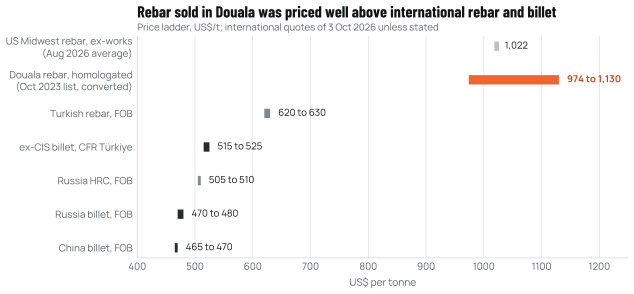
Source: Arab Iron and Steel Union and GMK Center (October 2026) [S22][S149]; Douala price from the homologated list of October 2023 [S24], converted at a planning range of 560 to 650 FCFA per US dollar (central 600) [S33]. Dates differ; comparison indicative.
At a planning rate of 600 FCFA per US dollar, billets at US$465 to 480 per tonne FOB are worth about 279,000 to 288,000 FCFA per tonne before freight, insurance, port charges and a 10% import duty; Turkish rebar at US$620 to 630 is worth about 372,000 to 378,000 FCFA (derived) [S23]. The homologated Douala price of about 633,000 FCFA per tonne leaves room, between the billet price and the bar price, for delivery costs, duties, the conversion cost of reheating and rolling, and a margin. Data on re-rolling costs in Cameroon are not public, so this paper does not estimate the re-roller’s margin; section 8.6 estimates instead the cost of making the billet itself. The direction is clear, however: the import ban and homologation together sustain a domestic bar price well above import parity, and that is why rolling capacity has grown faster than demand.
The same gap is also a vulnerability. If the ban were lifted, or derogations widened for large contractors, imported rebar would compete on the basis of export quotes such as US$620 to 630 per tonne FOB plus freight, the 20% duty and port costs, and domestic prices would fall [S22][S23]. If the Ministry of Commerce reduced homologated prices further, margins would compress. Both possibilities are discussed in Chapter 9 as market risks.
8.5 Scrap, power and gas: the costs of making iron locally
A producer that melts its own steel rather than buying billets faces three further price exposures.
Scrap is the first. Industry sources report that scrap purchase prices in Cameroon have risen by about 30% as mills compete for limited arisings [S01][S116]. Africa as a whole is a net importer of scrap, with imports of 3.4 Mt against exports of 1.2 Mt in 2025 [S02]. There is no public price series for Cameroonian scrap.
Power is the second. An electric arc furnace needs about 450 kWh per tonne of liquid steel on the planning value used in this series, within the 347 to 500 kWh range of the IFC guidelines, and up to about 490 kWh when 30% of the charge is direct-reduced or hot-briquetted iron; European plants report 404 to 748 kWh [S125][S126][S33]. Cameroon has no published industrial tariff above 10 MW; large consumers negotiate bilateral high-voltage contracts. Legacy high-voltage contracts realised an average of 18.4 FCFA per kWh in 2025, the published medium-voltage band for 9 to 10 MW implies about 43.7 FCFA per kWh in 2026, and the regulator’s cost-reflective average is 105.46 FCFA per kWh [S93][S154][S155]. At 450 to 490 kWh per tonne, furnace electricity alone would cost about 19,700 to 21,400 FCFA per tonne of liquid steel at 43.7 FCFA per kWh, and about 47,500 to 51,700 FCFA at the cost-reflective level (derived). White paper 05, Chapters 2 and 3, analyses the power system and these benchmarks; the tariff that a new melt shop can secure is one of the decisive variables of section 8.6.
Gas is the third, for a producer that eventually makes direct-reduced iron from ore. The national hydrocarbons company SNH sold gas in 2025 to an industrial buyer at 3,135 FCFA per thousand cubic feet, about US$5.2 at the planning rate of 600 FCFA per US dollar, and to the Kribi power plant at about 1,810 to 1,858 FCFA, about US$3.0 to 3.1 [S84]. A gas-based direct reduction plant uses about 9.2 to 10 GJ of gas per tonne of iron [S156][S157]; at the 2025 SNH prices this corresponds to about US$27 to 51 per tonne of direct-reduced iron (derived in White paper 05, Chapter 7, at SNH’s quarterly exchange rates of 561 to 625 FCFA per US dollar; about US$25 to 48 at the planning rate of 600 FCFA). These figures are indicators of order of magnitude, not offers.
8.6 Indicative cost of a Kribi billet against a delivered import
The central commercial question for a melt shop in Cameroon is whether it can make a billet for less than a re-roller pays for an imported one. This section answers it with ranges built only from public benchmarks and stated assumptions. It is indicative: it compares cash costs at October 2026 prices, excludes capital charges and makes no statement about the investment or returns of any project.
The imported billet. A Chinese or Russian billet quoted at US$465 to 480 per tonne FOB on 3 October 2026 [S22] pays ocean freight and insurance, taken here at US$40 to 80 per tonne (assumed, and consistent with UNCTAD’s estimate that African countries paid on average 11.4% of the value of their imports in international transport costs (2005 to 2014 average) [S158]); the 10% common external tariff on billets and the 0.2% African Union levy, both on the value including freight and insurance [S23][S124]; and port handling, clearance and delivery to a Douala or Kribi mill of US$15 to 35 (assumed). It lands at about US$570 to 650 per tonne, US$612 in the central case (derived).
The Kribi billet. A tonne of billet needs about 1.15 t of metallic charge, on the RC-1 planning metallic yield of 0.88 and a caster yield of about 0.99 [S33]. Imported metallics, a blend of about 70% heavy melting scrap and 30% hot-briquetted iron, are priced at US$400 to 445 per tonne delivered to Kribi. The benchmarks are heavy melting scrap at US$403 per tonne CFR Türkiye on 3 October 2026, hot-briquetted iron at US$340 to 370 CFR Italy in March 2026 and US$385 to 395 CFR Mediterranean in May 2026, and Brazilian pig iron at about US$445 FOB in September 2026; a freight adjustment and port handling are added (assumed) [S22][S159][S160][S161]. These metallics pay the same 10% duty and 0.2% levy as billets [S23][S124]. Electricity is 525 to 565 kWh per tonne of billet: 450 kWh per tonne of liquid steel in the furnace on the series planning value, about 490 kWh with 30% hot-briquetted iron in the charge, plus about 70 kWh for the ladle furnace, caster and utilities [S125][S33]. It is priced at the three benchmarks of section 8.5: 18.4, 43.7 and 105.46 FCFA per kWh [S93][S154][S155]. Electrodes, refractories, alloys, lime and oxygen, labour, maintenance and overheads, and road delivery to a Douala re-roller are assumed ranges, the same as those used in White paper 09, Chapter 7. Table 8.2 lists every input with its status and source.
Table 8.2 illustrativeInputs to the indicative billet cost comparison, October 2026 prices
| Input | Low | Central | High | Basis and source | Status |
|---|---|---|---|---|---|
| Billet price, FOB China or Russia (US$/t) | 465 | 472.5 | 480 | Quotations of 3 October 2026 [S22] | Sourced |
| Freight and insurance to Cameroon (US$/t) | 40 | 60 | 80 | Cross-checked with UNCTAD’s 11.4% average transport cost of African imports [S158] | Assumed |
| Duty and levy on billets and on metallics | 10.2% | 10.2% | 10.2% | Common external tariff of 10% [S23] and African Union levy of 0.2% [S124], on the value including freight | Sourced |
| Port, clearance and delivery to the mill (US$/t) | 15 | 25 | 35 | Douala or Kribi re-roller | Assumed |
| Imported billet, landed duty-paid (US$/t) | 572 | 612 | 652 | Sum of the four rows above | Derived |
| Metallic charge per tonne of billet (t) | 1.15 | 1.15 | 1.15 | RC-1 metallic yield 0.88 (0.85 to 0.91) and caster yield about 0.99 [S33] | Assumed |
| Metallics delivered to Kribi, about 70% scrap and 30% HBI (US$/t) | 400 | 422.5 | 445 | Scrap US$403 CFR Türkiye [S22]; HBI US$340 to 395 CFR Mediterranean [S159][S160]; pig iron about US$445 FOB Brazil [S161]; freight adjustment assumed | Assumed |
| Electricity (kWh per tonne of billet) | 525 | 545 | 565 | Furnace 450 kWh/t of liquid steel, about 490 with 30% HBI, plus about 70 kWh of auxiliaries [S125][S33] | Assumed |
| Power price (FCFA/kWh) | 18.4 | 43.7 | 105.46 | Legacy high-voltage average 2025; medium-voltage 9 to 10 MW band 2026; cost-reflective average 2025 [S93][S154][S155] | Sourced |
| Electrodes, refractories, alloys, lime, oxygen (US$/t) | 35 | 45 | 55 | Electrodes 2 to 6 kg/t in European plants [S126]; as White paper 09 | Assumed |
| Labour (US$/t) | 8 | 11 | 15 | About 500 direct jobs in Phase 1 [S33]; loaded cost and melt-shop share assumed, as White paper 09 | Assumed |
| Maintenance and overheads (US$/t) | 15 | 22 | 30 | As White paper 09 | Assumed |
| Delivery to a Douala re-roller (US$/t) | 10 | 15 | 20 | Road from Kribi via Edéa; as White paper 09 | Assumed |
| Kribi billet, cash cost delivered (US$/t) | 591 | 668 | 783 | Sum of the metallics with duty and the conversion rows; capital charges excluded | Illustrative |
Source: as listed in each row; prices of 3 October 2026 unless stated. US dollars at the planning rate of 600 FCFA (range 560 to 650) [S33]. Derivations in Annex A; plotted values in Annex D.
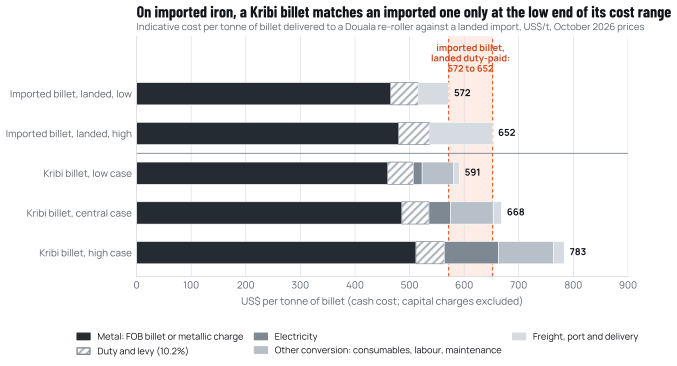
Source: Cameroon Steel calculation from the inputs of Table 8.2 [S22][S23][S124][S93][S154][S155][S33]. Cash costs at October 2026 prices; capital charges excluded.
What the comparison shows. Four results stand out.
First, on imported iron units a Kribi billet is at best level with an imported one. In the central case it costs about US$668 per tonne against US$612 for the import, about US$56, or 9%, more. Only the low case, which combines the cheapest metallics with the legacy high-voltage price that a new contract is unlikely to obtain, falls within the range of landed import costs.
Second, iron units decide the result. The metallic charge and the duty on it account for about US$505 to 565 per tonne, 72% to 86% of the cash cost, and each US$10 per tonne on the price of scrap or hot-briquetted iron moves the cost of a billet by about US$13. Put another way, a melt shop needs a spread of about US$85 to 220 per tonne, US$133 in the central case, between the delivered price of a billet and the cost of its metallic charge including duty to cover its cash conversion costs; at October 2026 prices that spread was about US$76 in the central case (derived).
Third, the 10% duty on imported metallics, about US$47 to 52 per tonne of billet, is roughly the size of the central gap. An imported billet pays the same rate on a value that already includes the conversion, so the tariff gives a melt shop that works on imported scrap and hot-briquetted iron no protection against imported billets. Removing the duty on iron units used for melting, a correction discussed in Chapter 10, would bring the central case to about US$620, level with the central import.
Fourth, power is the swing factor. Between the legacy and the cost-reflective prices, electricity moves the cost of a billet by about US$80 per tonne, and each 10 FCFA per kWh adds about US$9. A contract near the indicative cost of firm high-voltage supply, about 49 FCFA per kWh before the cost of firmness (White paper 05, Chapter 3), would add about US$5 to the central case.
What the comparison leaves out. It excludes capital charges, which a full-cost comparison would add, so a melt shop that only matches import parity on cash cost would not recover its investment. It also excludes working capital, ramp-up losses and the advantages a domestic supplier can offer re-rollers: shorter lead times, smaller lots and less stock to finance (Chapter 9). RC-1’s planned use of about 30 kt a year of domestic scrap, which may cost less than imported metallics, is priced here at import parity [S33]. The exchange rate matters at the margin: at 570 FCFA per US dollar instead of 600, electricity adds about US$1 to 5 per tonne.
What would change the result. Three conditions would turn parity into an advantage: duty-free iron units for melting; a firm power contract priced near the cost of generation and transmission; and, in time, iron made from Cameroonian ore and gas, whose gas cost of about US$27 to 51 per tonne of direct-reduced iron (section 8.5) is a small part of the price of traded hot-briquetted iron, although the cost of direct-reduction-grade pellets is not yet known for Cameroonian ore (Chapter 11). The conclusion, stated with its uncertainty, is that on October 2026 prices and imported iron units a merchant billet from Kribi is competitive only when power and metallics are cheap; its case rests on the cost of iron units, which policy and, later, domestic iron can change. White paper 09, Chapter 7, sets the same comparison in the wider context of rebar and border prices.
8.7 From world price to Douala price: duties and taxes
International quotations are free on board at the port of export. To arrive at the cost of an imported tonne in Cameroon, a buyer adds ocean freight and insurance, port and handling charges, inland transport, customs duty and other levies. Under the 2023 CEMAC tariff, billets, iron ore, direct-reduced iron and scrap paid 10%, wire rod 5%, reinforcing bar 20% and galvanised sheet 30% [S23]. Value-added tax is 19.25% and an African Union integration levy of 0.2% applies to imports from outside the Union [S124]. The harmonised CEEAC-CEMAC tariff applied from January 2026 may change some of these rates; its steel lines had not been published at the research cut-off [S131].
Duties matter for the competitive position of each product. A domestic billet competes against an imported billet that pays a 10% duty, but if it is melted from imported scrap or hot-briquetted iron it pays the same 10% on its own iron units (section 8.6); a domestic section against an imported section that pays 10%; domestic rebar is protected by a ban and, were the ban lifted, by a 20% duty. The inverted structure, in which wire rod pays less than the billets it is made from, is discussed in Chapter 10.
Freight and port costs are not published systematically for Cameroon; section 8.6 uses assumed ranges of US$40 to 80 per tonne for freight and insurance and US$15 to 35 for port handling, clearance and delivery. They are significant for bulky, low-value products such as billets and reinforcing bar, and they rise with congestion: import dwell time at Kribi’s container terminal reached 25.28 days in 2026 [S143]. A domestic supplier avoids these costs and the working capital they tie up, which is part of the case for local iron units developed in Chapter 9.
8.8 Carbon prices: relevant for exports to Europe only
The European Union’s carbon border adjustment mechanism entered its definitive phase on 1 January 2026; certificates will be sold from 1 February 2027, and the price for the third quarter of 2026 was €82.32 per tonne of CO₂ equivalent [S162][S163][S164]. It covers chapter 72 products, including billets, reinforcing bar, wire rod and direct-reduced iron, as well as iron-ore pellets [S165]. The United Kingdom’s mechanism applies from 1 January 2027 [S166]. These charges affect only exports to those markets. For a producer selling in Cameroon and CEMAC, they matter mainly as a signal of where carbon costs are heading and as a factor in any future export of iron units to Europe; White paper 06, Chapter 5, examines them in detail.
8.9 What prices mean for a new producer
Four conclusions follow.
The benchmark is the imported billet. At US$465 to 480 per tonne FOB in October 2026, about US$570 to 650 landed duty-paid, it sets the price that any domestic iron unit must beat or match, delivered to a Douala or Kribi mill [S22]. A melt shop’s case rests on its cost of iron units, power and conversion relative to that benchmark, not on the homologated rebar price; on imported iron units, section 8.6 puts a Kribi billet at about US$590 to 780 per tonne, competitive only at the low end.
The rebar price is administered and exposed. It reflects a policy choice, the ban and homologation, rather than a market equilibrium, and it can change with policy. A strategy that depends on today’s rebar margin depends on today’s policy.
Products without local competition price closer to import parity plus logistics. For heavy sections, structures and flat steel, which Cameroon imports, the price a domestic producer could obtain is set by the delivered cost of imports. That cost includes ocean freight, port charges, inland transport and duties of 10% to 30%, plus the working capital and lead time of ordering from distant mills [S23]. These are real advantages for a local supplier, and they do not depend on a ban.
Input costs are the variables to manage. Power tariffs, gas prices, scrap prices and the duty on imported iron units are local, negotiable and partly policy-driven. They, rather than the world steel price, will decide whether domestic iron-making in Cameroon is competitive.
Sources cited in this chapter
Bracketed markers refer to these sources; the full list is in the annex. Full list of sources
- S58Commodity Markets Outlook, Historical Data, Annual (xlsx). World Bank, 2 Sep 2026.thedocs.worldbank.org/en/doc/74e8be41ceb20fa0da750cda2f6b9e4e-00500120…
- S144Pink Sheet, October 2026. World Bank, 2 Oct 2026.thedocs.worldbank.org/en/doc/74e8be41ceb20fa0da750cda2f6b9e4e-00500120…
- S59Commodity Markets Outlook April 2026, Forecasts (Table 1). World Bank, Apr 2026.thedocs.worldbank.org/en/doc/f3138644a1e8e2bb631399ae11d6c408-00500120…
- S69Simandou partners celebrate start of operations. Rio Tinto, 11 Nov 2025.riotinto.com/en/news/releases/2025/simandou-partners-celebrate-start-o…
- S70The first commercial shipment of iron ore from Simandou has departed for China. GMK Center, 3 Dec 2025.gmk.center/en/news/the-first-commercial-shipment-of-iron-ore-from-sima…
- S71Ore shipments from Simandou could exceed 20 million tonnes in 2026. GMK Center, 9 Jun 2026.gmk.center/en/news/ore-shipments-from-simandou-could-exceed-20-million…
- S22Weekly steel prices (archive 40468). Arab Iron & Steel Union (AISU), 3 Oct 2026.aisusteel.org/en/archives/40468
- S145Weekly steel prices (archive 36573). AISU, 18 Oct 2025.aisusteel.org/en/archives/36573
- S146Weekly steel prices (archive 30176). AISU, 5 Nov 2024.aisusteel.org/en/archives/30176
- S147Weekly steel prices (archive 23160). AISU, 22 Oct 2023.aisusteel.org/en/archives/23160
- S148Weekly steel prices (archive 29546). AISU, 6 Oct 2024.aisusteel.org/en/archives/29546
- S149Key global markets are set for a rise in rebar prices. GMK Center, 17 Sep 2026.gmk.center/en/news/key-global-markets-are-set-for-a-rise-in-rebar-pric…
- S150Billet prices rose by $10-40 per ton in March in regional markets. GMK Center, 1 Apr 2026.gmk.center/en/news/billet-prices-rose-by-10-40-per-ton-in-march-in-reg…
- S151Turkish rebar prices declined in the second half of April. GMK Center, 25 Apr 2025.gmk.center/en/news/turkish-rebar-prices-declined-in-the-second-half-of…
- S152Steel (rebar) commodity page. Trading Economics.tradingeconomics.com/commodity/steel
- S153HRC Steel commodity page. Trading Economics.tradingeconomics.com/commodity/hrc-steel
- S47Adjusting Imports of Aluminum and Steel into the United States. The White House, 3 Jun 2025.whitehouse.gov/presidential-actions/2025/06/adjusting-imports-of-alumi…
- S09OECD: global steel excess capacity set to reach 745 million mt by 2028. EUROMETAL (Platts), 5 Jun 2026.eurometal.net/oecd-global-steel-excess-capacity-set-to-reach-745-milli…
- S37China’s rapidly growing steel exports will lose momentum from 2026 onwards. GMK Center, 24 Dec 2025.gmk.center/en/infographic/china-s-rapidly-growing-steel-exports-will-l…
- S45Licensing of steel exports from China should ease trade tensions. GMK Center, 19 Dec 2025.gmk.center/en/news/licensing-of-steel-exports-from-china-should-ease-t…
- S24Fer à béton: les producteurs acceptent une baisse des prix. EcoMatin, 23 Oct 2023.ecomatin.net/fer-a-beton-les-producteurs-acceptent-une-baisse-des-prix
- S111Interdiction des importations du fer à béton: les consommateurs dénoncent la mauvaise qualité de la production locale. EcoMatin, 13 Apr 2023.ecomatin.net/interdiction-des-importations-du-fer-a-beton-les-consomma…
- S133Métallurgie: les locaux battent le fer chaud. Cameroon Tribune, 17 Aug 2023.cameroon-tribune.cm/article.html/59491/fr.html/details_2
- S124Cameroon, Republic of: Corporate, Other taxes. PwC Worldwide Tax Summaries, reviewed 14 Aug 2026.taxsummaries.pwc.com/republic-of-cameroon/corporate/other-taxes
- S33Cameroon Steel reference configuration RC-1 (planning estimate), edition 10 October 2026. Cameroon Steel, 10 Oct 2026.Cited by title and date
- S23WITS TRAINS API, Cameroon reported MFN tariffs by HS6 (2023). World Bank / UNCTAD.wits.worldbank.org/API/V1/SDMX/V21/datasource/TRN/reporter/120/partner…
- S01Cameroun: Prometal décroche 26,2 milliards FCFA d’Afreximbank. Camer.be, 1 Oct 2026.camer.be/actualites/economie/cameroun-prometal-decroche-262-milliards-…
- S11640 millions d’euros d’Afreximbank: Prometal sécurise ses billettes d’acier alors que la ferraille camerounaise s’épuise. Cameroun24, 10 Oct 2026.cameroun24.net/article/76267-40-millions-d-euros-d-afreximbank-prometa…
- S02World Steel in Figures 2026 (page and PDF). worldsteel, 4 Jun 2026.worldsteel.org/data/world-steel-in-figures/world-steel-in-figures-2026…
- S125Environmental, Health, and Safety Guidelines for Integrated Steel Mills. IFC / World Bank Group, 30 Apr 2007.ifc.org/content/dam/ifc/doc/2000/2007-integrated-steel-mills-ehs-guide…
- S126Best Available Techniques Reference Document, Iron and Steel (EUR 25521). EC JRC, 2013.bureau-industrial-transformation.jrc.ec.europa.eu/sites/default/files/…
- S93Rapport d’activités 2025 de l’ARSEL. ARSEL (electricity regulator), 7 Sep 2026.arsel-cm.org/wp-content/uploads/2026/09/Rapport-ARSEL-2025.pdf
- S154Tableaux tarifaires, Décision ARSEL N°00000427 (MT 2023-2025). ARSEL, uploaded Jan 2026.arsel-cm.org/wp-content/uploads/2026/01/TABLEAUX-TARIFAIRES-decision-M…
- S155Décision fixant le montant de la RMA ENEO au titre de l’exercice 2025 (réajustée). ARSEL, 19 Dec 2025.arsel-cm.org/wp-content/uploads/2026/01/Decision-fixant-le-Montant-de-…
- S84Données pétrolières 2025. SNH, posted Jun 2026.snh.cm/wp-content/uploads/2026/06/Donnees-petrolieres-2025.pdf
- S156ENERGIRON technology (DRI-EAF with natural gas or H₂). EC ICIT, ref. 12 Feb 2026.innovation-centre-for-industrial-transformation.ec.europa.eu/innovativ…
- S157Suez Steel sets new benchmark in energy consumption for DRI production. Danieli, 16 Apr 2026.danieli.com/en/news-media/news/suez-steel-sets-new-benchmark-energy-co…
- S158At 11.4 per cent of the value of imports, African countries paid more for international transport than any other region (Review of Maritime Transport 2015). UNCTAD, 2015.unctad.org/press-material/114-cent-value-imports-african-countries-pai…
- S159European buyers uninterested in BPI and HBI purchases, prices up nominally due to freight. SteelOrbis, 16 Mar 2026.steelorbis.com/steel-prices/steel-prices-market-analyses/scrap-and-raw…
- S160Global HBI market bullish amid tight supply, ex-Libya tender closure to give further direction. SteelOrbis, 15 May 2026.steelorbis.com/steel-prices/steel-prices-market-analyses/scrap-and-raw…
- S161Average prices for Brazilian pig iron fell by $20/t in September. GMK Center, 4 Oct 2026.gmk.center/?p=129748
- S131Cameroon applies CEEAC common external tariff from January 1, 2026. Business in Cameroon, 12 Jan 2026.businessincameroon.com/public-management/1201-15594-cameroon-applies-c…
- S143Port de Kribi: l’explosion du trafic commence à saturer le terminal à conteneurs. EcoMatin, 5 Oct 2026.ecomatin.net/port-de-kribi-lexplosion-du-trafic-commence-a-saturer-le-…
- S162Carbon Border Adjustment Mechanism. European Commission (DG TAXUD), n.d..taxation-customs.ec.europa.eu/carbon-border-adjustment-mechanism_en
- S163EU adopts CBAM Omnibus Regulation. EY, 22 Oct 2025.ey.com/en_gl/technical/tax-alerts/eu-adopts-cbam-omnibus-regulation
- S164Price of CBAM certificates. European Commission, 5 Oct 2026 (latest).taxation-customs.ec.europa.eu/carbon-border-adjustment-mechanism/price…
- S165Regulation (EU) 2023/956 (CBAM), Annex I. EUR-Lex (OJ L 130), 16 May 2023.eur-lex.europa.eu/legal-content/EN/TXT/PDF/?uri=CELEX:32023R0956
- S166Check if you’ll need to register for CBAM; Prepare for CBAM. HMRC / GOV.UK, upd. Jul-Sep 2026.gov.uk/government/collections/carbon-border-adjustment-mechanism
Cite this chapter
Cameroon Steel (2026). Cameroon’s steel gap lies in iron units, not in rebar. White paper 04, chapter 8: Prices reward re-rolling today; a new producer must win on the cost of iron, not on the rebar price. CS-WP-04. https://www.cameroon-steel.com/en/library/market-outlook/prices/
Source