White paper 04 · Chapter 5
Cameroon’s mills can roll more than the market needs but cannot source enough iron
Cameroon’s steel industry is a cluster of re-rolling mills and small melt shops around Douala that convert imported billets and local scrap into reinforcing bar, wire rod, light sections, wire and nails. Its installed transformation capacity is about 1.2 Mt a year, running at about 50% utilisation, with more than 30 bn FCFA of unsold stock reported in September 2026 [S20][S01][S116]. Reinforcing-bar capacity alone is put at 627 kt a year against domestic demand of about 180 kt [S03]. The binding constraint is feedstock: local scrap covers about 40% of the mills’ needs and imported billets the rest, and scrap purchase prices have risen by about 30% [S03][S01][S116]. The sector’s largest producer signed a €40m facility with Afreximbank on 28 September 2026 to finance billet imports [S20][S21]. Protection, through the 2016 rebar import ban, a mandatory standard and administered prices, has built rolling capacity; it has not built iron-making.
In this chapter (8)
- 5.1 Structure: re-rollers, small melt shops and two industry groups
- 5.2 Capacity has grown much faster than the market
- 5.3 Feedstock: 40% local scrap, 60% imported billets
- 5.4 The financing of billet imports
- 5.5 Protection and regulation
- 5.6 Energy, safety and quality
- 5.7 Employment and economic weight
- 5.8 Diagnosis
5.1 Structure: re-rollers, small melt shops and two industry groups
The industry is concentrated in and around Douala, close to the port through which billets arrive. Its members are organised in two associations. One, Ocitram, brings together Aciéries du Cameroun, Metafrique Steel, Prometal, and the aluminium companies Proalu and Alucam; it reports about 5,000 jobs, about 500 bn FCFA of turnover and a market share of about 95% for its members, figures that include aluminium [S03]. A second association groups other producers [S110].
Table 5.1 sourcedPrincipal steel producers in Cameroon, as publicly reported
| Producer | Location | Reported capacity | Products and process | Investment and financing on the public record | Source |
|---|---|---|---|---|---|
| Prometal group | Douala-Bassa; 7 sites | About 360 kt a year of finished steel products; electric arc furnace of about 200 kt a year | Prometal 4 rolling mill (SMS group): wire rod, beams, angles, flats, reinforcing bar; Prometal 5; electric arc furnace described as the first of its kind in Central Africa | Prometal 4 and 5 inaugurated 19 Jan 2024 (57 bn FCFA; 1,000 direct jobs); €40m Afreximbank revolving facility for billet imports signed 28 Sep 2026 | [S117][S118][S120][S20][S21] |
| Aciéries du Cameroun | Douala | 250 kt a year, all products (2021) | Reinforcing bar and other long products | n.a.; member of Ocitram | [S120][S03] |
| Metafrique Steel | Douala | 60 kt a year (2021) | Scrap-based reinforcing bar; Indian group | n.a.; member of Ocitram | [S120][S03] |
| Quifeurou / LP Industrie | Douala | Not disclosed | New scrap-based reinforcing-bar plant | BDEAC loan of 8.95 bn FCFA (2025) | [S121] |
| Others | Douala | Not disclosed | Other mills (Acero Metal, Harjaapp, STE Sarjeet) | n.a. | [S80][S122] |
Source: as listed. Capacities are as reported by the companies or the press and use different definitions; they should not be added together. n.a.: none reported in the sources consulted.
Prometal is by some distance the largest operator. Its two newest plants, inaugurated in January 2024, represented an investment of 57 bn FCFA and about 1,000 direct jobs for about 360 kt a year of products [S117]. Its rolling mill, supplied by SMS group, produces wire rod, beams, angles, flats and reinforcing bar [S117][S118]. In April 2023 the national daily described its electric arc furnace, with about 200 kt a year of reinforcing-bar capacity, as the first of its kind in Central Africa [S120]. Electricity bills illustrate the relative scale of the mills: in 2024 Prometal paid 8.37 bn FCFA for power, Metafrique Steel 3.81 bn FCFA, Acero Metal 3.11 bn FCFA and Aciéries du Cameroun 1.61 bn FCFA [S122]. Prometal’s bill was 3.90 bn FCFA in 2021 [S122].
5.2 Capacity has grown much faster than the market
Reported reinforcing-bar capacity has risen quickly. When the Director General of Customs reaffirmed the rebar import ban in April 2023, the note cited local capacity of 260 kt against demand of 180 kt [S56]. In June 2023 industry sources cited installed capacity of 450 kt, production of about 260 kt in 2022 and demand of about 180 kt [S80]. In May 2026 Ocitram reported reinforcing-bar capacity of 627 kt against demand of 180 kt; the source prints "627 tonnes", which is read here as thousand tonnes in line with the other figures [S03].
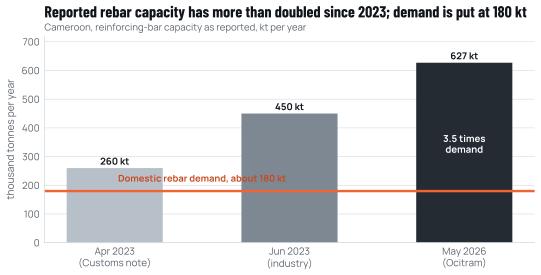
Source: Customs note of 3 April 2023 as reported by EcoMatin [S56]; EcoMatin, June 2023 [S80]; Cameroon Tribune, 11 May 2026 [S03]. Definitions differ by source.
The same pattern holds for other rolled products. Ocitram’s May 2026 figures show capacity of 72 kt for wire rod and nails against demand of 36 kt, 43 kt for roofing sheet against 21 kt, 34 kt for tubes against 14 kt and 2.8 kt for annealed wire against 1.8 kt [S03]. In every product line the industry reports capacity of roughly two to three and a half times domestic demand.
Across all products, industry and press sources in September and October 2026 put installed steel transformation capacity at about 1.2 Mt a year, with plants running at about 50%, and reported more than 30 bn FCFA of unsold stock [S20][S01][S116]. These figures are not fully consistent with each other, and they combine different products and definitions, but they all describe the same situation: a domestic market that cannot absorb the output of the rolling capacity already built.
5.3 Feedstock: 40% local scrap, 60% imported billets
A re-rolling mill needs billets. It can buy them, or it can make them by melting scrap or other iron units in an electric arc furnace or induction furnace and casting the liquid steel. Cameroon’s mills do both. Industry sources state that local scrap covers about 40% of the mills’ needs and imported billets about 60%, and that scrap purchase prices have risen by about 30% [S03][S01][S116].
These shares can be combined with the trade data to estimate the industry’s iron-unit balance. If the 161.4 kt of billets imported in 2023 represented about 60% of the mills’ iron units, the total was about 269 kt, of which about 108 kt came from local scrap (derived) [S05][S20]. The total is consistent with reported domestic production of about 260 kt in 2022 [S80], allowing for melting and rolling losses.
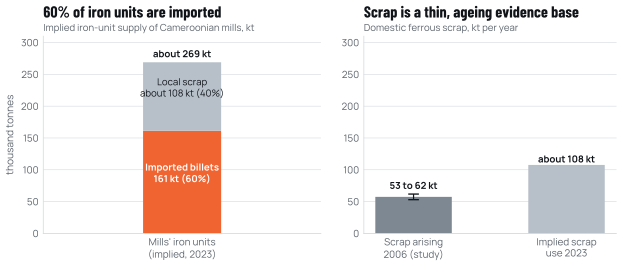
Source: derived from UN Comtrade billet imports for 2023 [S05] and the 40/60 split reported by industry [S03][S20][S01]; scrap arising from Bidoung et al. (2007), data for 2006 [S27].
The evidence on scrap is thin and dated. The only quantified study, by researchers at the national polytechnic school and the local materials promotion agency, estimated domestic ferrous scrap arising at 53,000 to 61,833 t a year in 2006, collected 53% by recyclers, 29% by informal dismantlers and 15% by exporters [S27]. Arisings have certainly grown since then with the country’s steel stock, but no recent estimate exists. Recorded scrap exports fell from 3,675 t in 2019 to near zero from 2020 [S05]; this is consistent with an informal restriction, but no legal text banning scrap exports was found, and the April 2022 export suspension covered food products and cement only [S123]. Rising scrap prices suggest that the mills are already competing for a limited resource [S01][S116].
5.4 The financing of billet imports
On 28 September 2026, in Cairo, the Prometal group signed a revolving facility of €40m (26.2 bn FCFA) with the African Export-Import Bank (Afreximbank) to finance imports of steel billets, according to press reports in Cameroon [S20][S21][S01]. Reports linked the facility to the group’s production plans and to growing scarcity of domestic scrap [S116]. The facility is a normal commercial arrangement for a re-roller and is cited here only for what it shows about the market: the country’s largest producer has chosen to secure imported billets, rather than domestic iron, to keep its mills supplied. In a market where local mills run at about half their capacity, the availability and cost of billets, not the rolling capacity, determine output.
5.5 Protection and regulation
The industry operates under three layers of protection and regulation.
The first is the suspension of reinforcing-bar imports. A letter from the Prime Minister’s office dated 31 May 2016 suspended rebar imports until further notice [S04]. The Director General of Customs reaffirmed in a note of 3 April 2023 that imports "remain prohibited until further notice", on the very high instruction of the President of the Republic conveyed in a letter of 13 March 2023 [S56]. No document lifting the suspension was found [S26]. Enforcement has been tested: in December 2020 customs sealed more than 7,300 t of rebar imported for the Kribi port works [S04].
The second is the mandatory standard. Reinforcing bar must comply with standard NC 236/2024/06, under ministerial orders of 20 April 2022 that made a set of construction standards mandatory [S26][S110]. The Fe450 grade is not in the standard’s catalogue; ANOR, the standards agency, sanctioned a producer in October 2024 over Fe450 bars, and a request by one group of producers on 28 November 2025 to revise the standard was refused by the Prime Minister’s office on 19 January 2026, which considered a revision inappropriate in the current context of a fast-growing sector [S26][S110]. Consumer complaints about the quality of locally made bars were reported in April 2023 and producers have denounced counterfeit bars on the market [S111][S80].
The third is price regulation. The Ministry of Commerce homologates producer prices for reinforcing bar, per bar, by diameter and grade. In October 2023 producers accepted reductions, for example from 6,900 to 6,750 FCFA for a 12 mm FE500 bar [S24]. Chapter 8 analyses these prices. A new environmental tax of 5,000 FCFA per tonne on reinforcing bar, payable by local producers and importers alike, applies from 1 January 2026 [S124].
5.6 Energy, safety and quality
Steel mills are among the largest electricity consumers in Cameroon. Prometal’s load is about 40 MW, expected to reach about 90 MW once its aluminium affiliate Proalu runs, and the group has moved to a high-voltage supply through an access contract with the transmission company SONATREL and a dedicated 50 MVA transformer [S122][S93]. In October 2026 about 150 MW of industrial demand remained unmet pending completion of the Nachtigal evacuation line [S92]. Power cost and availability are therefore part of the feedstock problem: an electric arc furnace that melts scrap or direct-reduced iron needs about 450 kWh per tonne of liquid steel on the planning value used in this series (347 to 500 kWh in the IFC guidelines, 404 to 748 kWh in European plants), while a re-rolling mill that buys billets needs only reheating and rolling energy [S125][S126][S127]. White paper 05, Chapters 2 and 3, analyses the power system and the prices available to large users.
Fires and explosions are a recognised melt-shop hazard. Together with the disputes over grades and the reports of counterfeit bars, they show that safety and quality systems have to keep pace with a sector whose capacity has grown quickly. Certified quality, traceability and safety are not only regulatory requirements; in a market with surplus rolling capacity they are the main ways for a producer to differentiate.
5.7 Employment and economic weight
The steel and metals industry is a significant employer in Douala. Ocitram reports about 5,000 jobs and about 500 bn FCFA of turnover for its members, including the aluminium companies [S03]. Prometal alone reported about 1,000 direct jobs for its two newest plants [S117]. These figures can be compared with international benchmarks of direct employment per million tonnes of capacity, which vary widely with the process: about 500 jobs per Mt in highly automated United States scrap-based micro-mills, about 2,800 for Prometal’s plants and about 5,000 at Devki’s ore-based plant in Kenya (derived) [S128][S117][S63].
The indirect effects are larger than the direct ones. worldsteel estimates that for every two jobs in the steel sector, thirteen more are supported in its supply chain [S129]. In the European Union, the industry’s employment multipliers are 6.2 including supply-chain effects and 8.6 including induced spending [S130]. Such multipliers are upper bounds for Cameroon, where supply chains are thinner and many inputs are imported, but they indicate why steel features among the priority sub-sectors of the national development strategy [S25].
The same comparison explains why the type of capacity matters. A re-rolling mill employs people in reheating, rolling, finishing and maintenance. A melt shop adds furnace, casting, refractory and laboratory work. Ore-based iron-making adds still more, in raw-material handling, reduction and utilities. Moving upstream, from rolling to melting and eventually to iron-making, increases the domestic value added and employment attached to each tonne of steel used in Cameroon, as well as reducing the import bill.
5.8 Diagnosis
The domestic industry has three strengths: a large installed base of rolling capacity, experienced operators, and protection at the finished-bar stage. It has four weaknesses: dependence on imported billets from a narrow set of origins, limited and costly domestic scrap, high exposure to electricity availability, and a market too small to absorb the capacity already built. The result is low utilisation and price pressure inside a protected market.
For a new producer, the diagnosis points away from adding another rolling mill for reinforcing bar and towards the bottleneck: iron units, and the products the existing mills cannot make. A merchant supply of billets from a domestic melt shop, priced competitively against imports, would serve mills that already exist. Heavy sections and other products that are imported today would serve customers that domestic mills cannot. Chapter 9 develops these options.
Sources cited in this chapter
Bracketed markers refer to these sources; the full list is in the annex. Full list of sources
- S03Production: les acteurs en présence. Cameroon Tribune, 11 May 2026.cameroon-tribune.cm/article.html/76600/fr.html/details_2
- S110Cameroun: le gouvernement rejette une demande de révision de la norme du fer à béton. EcoMatin, 5 Feb 2026.ecomatin.net/cameroun-le-gouvernement-rejette-une-demande-de-revision-…
- S117Prometal inaugure deux usines évaluées à 57 milliards F. Journal du Cameroun, 19 Jan 2024.fr.journalducameroun.com/prometal-inaugure-deux-usines-evaluees-a-57-m…
- S118Cameroun: Prometal (Hayssam El Jammal) se dote de deux nouvelles usines de production d’aciers. EcoMatin, 19 Jan 2024.ecomatin.net/cameroun-prometal-hayssam-el-jammal-se-dote-de-deux-nouve…
- S120Matériaux de construction: l’offensive locale. Cameroon Tribune, 24 Apr 2023.cameroon-tribune.cm/article.html/56766/en.html/details_2
- S20Cameroun: le groupe Prometal décroche 26 milliards FCFA auprès d’Afreximbank…. Sikafinance, 30 Sep 2026.sikafinance.com/marches/cameroun-le-groupe-prometal-decroche-26-millia…
- S21Prometal obtient 26 milliards FCFA d’Afreximbank pour soutenir son expansion industrielle. EcoMatin, 30 Sep 2026.ecomatin.net/prometal-obtient-26-milliards-fcfa-dafreximbank-pour-sout…
- S121Cameroun: Quifeurou obtient un prêt de 9 milliards FCFA pour une usine de fer à béton à Douala. EcoMatin, 26 Aug 2025.ecomatin.net/cameroun-quifeurou-obtient-un-pret-de-9-milliards-fcfa-po…
- S80Métallurgie: les industriels dénoncent la présence du fer à béton contrefait. EcoMatin, 22 Jun 2023.ecomatin.net/metallurgie-les-industriels-du-secteur-denoncent-la-prese…
- S122Prometal, Acero Metal, Aciéries du Cameroun… qui est le plus gros consommateur d’électricité de la métallurgie camerounaise. EcoMatin, 15 Jul 2026.ecomatin.net/prometal-acero-metal-acieries-du-cameroun-qui-est-le-plus…
- S56Métallurgie: les importations du fer à béton interdites jusqu’à nouvel ordre. EcoMatin, 10 Apr 2023.ecomatin.net/metallurgie-les-importations-du-fer-a-beton-interdites-ju…
- S01Cameroun: Prometal décroche 26,2 milliards FCFA d’Afreximbank. Camer.be, 1 Oct 2026.camer.be/actualites/economie/cameroun-prometal-decroche-262-milliards-…
- S11640 millions d’euros d’Afreximbank: Prometal sécurise ses billettes d’acier alors que la ferraille camerounaise s’épuise. Cameroun24, 10 Oct 2026.cameroun24.net/article/76267-40-millions-d-euros-d-afreximbank-prometa…
- S05UN Comtrade public API, Cameroon (reporter 120), HS 72/73 and 6-digit lines, 2019-2023. UN Statistics Division.comtradeapi.un.org/public/v1/preview/C/A/HS?reporterCode=120&period=20…
- S27Bidoung J., Fomethe A., Yantio G., Melo U., La récupération et le recyclage des déchets ferromagnétiques: analyse de la situation au Cameroun (Déchets, Revue francophone d’écologie industrielle n°48). ENSP Yaoundé / MIPROMALO, Q4 2007.eid.episciences.org/7942/pdf
- S123Lutte contre la vie chère: le Cameroun limite les exportations de certains produits. EcoMatin, 27 Apr 2022.ecomatin.net/lutte-contre-la-vie-chere-le-cameroun-limite-les-exportat…
- S04Press report of the sealing by customs of more than 7,300 t of imported reinforcing bar, December 2020 (headline and address not reproduced: they name the importer). Business in Cameroon, 16 Dec 2020.Cited by title and date
- S26Cameroon rejects fresh push to revise rebar standard. Business in Cameroon, 26 Jan 2026.businessincameroon.com/construction/2601-15657-cameroon-rejects-fresh-…
- S111Interdiction des importations du fer à béton: les consommateurs dénoncent la mauvaise qualité de la production locale. EcoMatin, 13 Apr 2023.ecomatin.net/interdiction-des-importations-du-fer-a-beton-les-consomma…
- S24Fer à béton: les producteurs acceptent une baisse des prix. EcoMatin, 23 Oct 2023.ecomatin.net/fer-a-beton-les-producteurs-acceptent-une-baisse-des-prix
- S124Cameroon, Republic of: Corporate, Other taxes. PwC Worldwide Tax Summaries, reviewed 14 Aug 2026.taxsummaries.pwc.com/republic-of-cameroon/corporate/other-taxes
- S93Rapport d’activités 2025 de l’ARSEL. ARSEL (electricity regulator), 7 Sep 2026.arsel-cm.org/wp-content/uploads/2026/09/Rapport-ARSEL-2025.pdf
- S92Nachtigal power line delays leave 150 MW of industrial demand unmet. Business in Cameroon, 9 Oct 2026.businessincameroon.com/public-management/0910-16939-nachtigal-power-li…
- S125Environmental, Health, and Safety Guidelines for Integrated Steel Mills. IFC / World Bank Group, 30 Apr 2007.ifc.org/content/dam/ifc/doc/2000/2007-integrated-steel-mills-ehs-guide…
- S126Best Available Techniques Reference Document, Iron and Steel (EUR 25521). EC JRC, 2013.bureau-industrial-transformation.jrc.ec.europa.eu/sites/default/files/…
- S127Commission Implementing Decision (EU) 2022/2110, BAT conclusions, ferrous metals processing. European Commission (OJ L 284), 11 Oct 2022.eur-lex.europa.eu/legal-content/EN/TXT/PDF/?uri=CELEX:32022D2110
- S128Nucor to build new rebar micro mill in North Carolina. Nucor Corp., 7 Apr 2022.nucor.com/news-release/nucor-to-build-new-rebar-micro-mill-in-north-ca…
- S63Devki opens Sh50bn steel plant in Kwale. Capital FM Kenya, 20 Nov 2022.capitalfm.africa/devki-opens-sh50bn-steel-plant-in-kwale/
- S129Economic and social impact of the global steel industry (infographic). worldsteel / Oxford Economics, May 2019.worldsteel.org/wp-content/uploads/Steel-social-and-economic-impact.pdf
- S130European Steel in Figures 2025. EUROFER, Jun 2025.eurofer.eu/assets/publications/brochures-booklets-and-factsheets/europ…
- S25Stratégie Nationale de Développement 2020-2030 (SND30). Republic of Cameroon / MINEPAT (hosted by FAOLEX), 2020.faolex.fao.org/docs/pdf/cmr211554.pdf
Cite this chapter
Cameroon Steel (2026). Cameroon’s steel gap lies in iron units, not in rebar. White paper 04, chapter 5: Cameroon’s mills can roll more than the market needs but cannot source enough iron. CS-WP-04. https://www.cameroon-steel.com/en/library/market-outlook/domestic-industry/
Source