White paper 04 · Chapter 9
A new producer adds most value by supplying iron units, sections and certified quality
The market evidence in this paper points to a clear order of priorities for any new steel producer in Cameroon. First, iron units: merchant billets today, and ore-based iron in the longer term, to serve a gap of about 170 kt a year that grows to between 225 kt and 520 kt by 2040 (Chapter 7). Second, heavy sections, beams and structures, a fully imported segment of about 50 kt a year that grows fastest of all products in the scenarios. Third, reinforcing bar and wire rod only where they can be differentiated by certified quality, consistent supply and regional reach, because domestic rolling capacity is already about 3.5 times domestic demand [S03]. Flat steel is a real gap but requires a scale of investment that the Cameroonian market alone does not justify. This chapter sets out the reasoning, screens each segment, and illustrates the analysis with the publicly reported configuration of Cameroon Steel’s planned complex at Kribi, including where its first-phase output could go. It also lists the market risks that any producer must manage.
In this chapter (9)
9.1 Screening the segments
Figure 9.1 places each product segment according to two measures: the size of its market in Cameroon, and the extent to which local capacity already covers it. Segments below the line, where local capacity covers less than the market, are open; those above it are saturated.
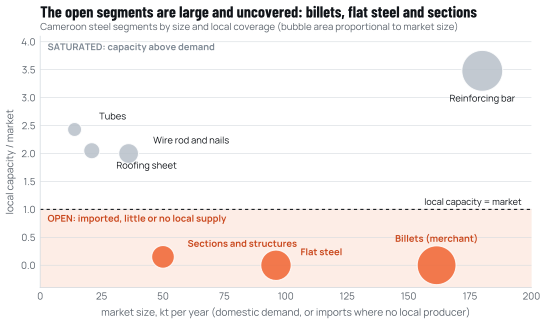
Source: Cameroon Steel analysis of Ocitram capacity and demand data (May 2026) [S03] and UN Comtrade import tonnages (2023) [S05]. Coverage for sections is indicative and reflects light sections only.
Table 9.1 adds the factors that the chart cannot show: competition, barriers to entry and the direction of demand.
Table 9.1 derivedSegment screen for a new producer in Cameroon
| Segment | Market today | Local supply | Competition | Barriers to entry | Demand to 2040 (base) | Assessment |
|---|---|---|---|---|---|---|
| Merchant billets | About 161 kt imported (2023); implied gap about 174 kt (2025) | No merchant producer | Indonesian, Chinese, Russian and Gulf billets at US$465 to 480 FOB, about US$570 to 650 landed | Melt shop; secure iron units (scrap, DRI, HBI, pig iron); power | Gap of about 353 kt (about 225 to 520) | First priority; on imported iron units at cost parity only in the low case (section 8.6) |
| Ore-based iron (DRI, HBI) | Sub-Saharan shaft-furnace DRI 0.09 Mt (2025, Midrex); about 2.7 Mt coal-based in East Africa (estimate) | None | North African and Middle Eastern merchant DRI and HBI | Gas supply, DR-grade pellets, scale | Rises with the iron-unit gap | Long-term option linked to Cameroonian ore |
| Heavy sections, beams, structures | About 50 kt imported | Light sections only | Asian, Turkish and European mills | Section mill; product certification | About 120 kt | Second priority; also regional |
| Light sections (angles, channels) | Part of the 50 kt | Rolled locally | Domestic mills | Low | Grows with construction | Contested |
| Flat steel (coil, sheet) | About 96 kt imported | None (processing only) | Chinese and other flat mills | Hot strip mill at multi-Mt scale | About 203 kt | Not a near-term option for a single-market producer |
| Reinforcing bar | About 180 kt demand | 627 kt capacity | Domestic mills; imports banned | Low for rolling; quality certification | About 341 kt | Saturated; only certified, differentiated or exported tonnes |
| Wire rod, wire and nails | About 36 to 38 kt demand | 72 kt capacity | Domestic mills | Low | About 74 kt | Saturated |
| Tubes | About 14 kt local demand plus imported tubular goods | 34 kt capacity (from imported coil) | Domestic and imported | Coil supply; for oil-country goods, certification | About 55 kt | Saturated locally; specialised tubes imported |
Source: Cameroon Steel analysis based on Chapters 4 to 8 [S05][S03][S20][S13][S22]. DRI: direct-reduced iron. HBI: hot-briquetted iron.
9.2 Iron units first
Iron units are the bottleneck of the Cameroonian industry and of Sub-Saharan Africa more broadly (Chapters 2 and 5). Existing mills already have the rolling capacity to serve domestic demand for long products to 2040; what they lack is metal. They import about 60% of their iron units as billets from a narrow set of origins, and the largest of them has just arranged dedicated financing to keep doing so [S03][S20][S21]. A domestic supplier of billets would therefore sell into an existing market with identified buyers rather than into a market it must create.
Three conditions determine whether that supply is viable.
The first is cost. A domestic billet must reach a Douala or Kribi mill at a cost comparable to imports, which on 3 October 2026 were quoted at US$465 to 480 per tonne FOB from China and Russia and land at about US$570 to 650 after freight, port charges and the 10% duty [S22][S23]. Section 8.6 puts the cash cost of a Kribi billet made from imported scrap and hot-briquetted iron at about US$590 to 780 per tonne, level with imports only when power and metallics are cheap. The decisive local variables are the price of iron units and the duty paid on them, the tariff for electricity and the efficiency of the melt shop.
The second is reliability. Re-rollers value consistent chemistry and on-time delivery because their mills run continuously and their own customers buy against homologated prices. A local supplier can offer shorter lead times and smaller lot sizes than an ocean shipment, which reduces the working capital tied up in imported billets.
The third is feedstock. Domestic scrap is limited and already contested; its purchase price has risen by about 30% [S01][S116]. A melt shop sized for merchant billets must therefore plan from the outset for imported or domestically produced direct-reduced iron, hot-briquetted iron or pig iron. In the longer term, ore-based iron from Cameroon’s deposits is the logical source, and the government’s 2026 to 2030 iron-ore programme makes that possibility more concrete [S72][S31].
9.3 Sections second
Sections and structural steel are the fastest-growing segment in the scenarios, from about 50 kt to about 120 kt in the base case by 2040 (Chapter 7). They are used in industrial buildings, warehouses, bridges, transmission and telecommunications towers, port facilities, mines and the frames of commercial buildings. Cameroon rolls light angles, channels and flats, but imports its heavy sections, beams and fabricated structures [S05][S117].
Three features make sections attractive. Heavy sections and beams are fully imported, so a domestic producer replaces imports rather than competing with local mills. They are not homologated, so their price is set by import parity plus logistics, which includes the lead times and working capital costs that a local supplier avoids. And the infrastructure pipeline described in Chapter 3, including railways, port terminals, power lines and mines, is shifting demand towards them. Neighbouring CEMAC states, which have no section mills, offer an additional market.
The barriers are real. A section mill needs billets or blooms of suitable size, which reinforces the case for a melt shop. Sections are sold to engineers and contractors who require certified products to recognised standards, test certificates and reliable dimensions. Cameroon’s mandatory standards cover reinforcing bar; standards for structural sections would need to be applied and enforced in public procurement for local producers to compete on equal terms with certified imports (Chapter 10).
9.4 Certified reinforcing bar, and only certified
Reinforcing bar is the largest single product in the market and will remain so, but it is saturated: 627 kt of reported capacity against about 180 kt of demand [S03]. Even in the high scenario, rebar demand in 2040 stays below today’s capacity (Chapter 7). A new producer cannot expect to win market share on volume or price in a market where existing mills run at about half capacity and prices are administered.
There are, however, three ways in which new rebar tonnes can add value rather than merely add capacity. The first is certified quality. The market has seen disputes about grades, regulatory action over a grade outside the standard, consumer complaints about quality and reports of counterfeit bars [S80][S26][S110][S111]. A producer that guarantees compliance with NC 236/2024/06, offers traceable mill test certificates and supplies high-ductility grades for engineered structures can serve demanding customers, such as public works, foreign-financed projects and large private developers, who today rely on project derogations or accept uncertainty. The second is integration: bars rolled from the producer’s own billets are insulated from billet-price shocks that affect re-rollers. The third is regional reach: Chad, Gabon, Congo and the Central African Republic import reinforcing bar, though Gabon’s new mills and VAT preference make that market more contested (Chapter 6) [S29].
9.5 What customers need from a new producer
Each customer group in the Cameroonian market values something different, and a new producer’s offer should be designed around those needs rather than around its own product list.
Re-rolling mills, the potential buyers of merchant billets, need consistent chemistry, the right section size for their mills and reliable delivery. The bar mill ordered by GSM in Tanzania in 2026, for example, is designed for 150 mm billets [S67]. Re-rollers also need credit terms that reflect the homologated price at which they sell. A domestic supplier can offer smaller and more frequent deliveries than an ocean shipment, reducing the stock that each mill must finance.
Contractors and engineers, the buyers of sections and structural steel, need certified products with test certificates, dimensional accuracy and availability on the project schedule. For publicly funded and foreign-financed projects, compliance with international standards is often a contract requirement. Delivered price matters, but so does the cost of delay.
Distributors and hardware merchants, who sell most reinforcing bar to households and small builders, need a full range of diameters, steady supply and margins compatible with homologated prices. They are the channel through which quality certification reaches the self-built housing market.
Regional buyers in Chad, Gabon, Congo and the Central African Republic need reliable logistics and payment in CFA francs, which a Cameroonian supplier can offer (Chapter 6).
9.6 Scale and phasing
The size of the market argues for phased capacity. The iron-unit gap of about 170 kt today and the sections market of about 50 kt are of the same order as a single modern melt shop or section mill, not several. New bar and wire-rod mills ordered for Africa in 2026 are sized at about 300 kt a year [S67][S68], and modern United States micro-mills at 0.39 to 0.45 Mt (430,000 to 500,000 short tons) [S128][S167][S168]. Direct reduction modules have become smaller: an Energiron micro-module of 0.25 Mt a year entered service in Bolivia in October 2025, alongside single modules of up to 2.5 Mt a year such as Tosyali’s in Algeria [S13][S169]. A producer can therefore match capacity to the market in steps, adding melting, rolling and eventually iron-making as demand and feedstock allow, rather than committing to a full-scale complex at once.
9.7 Flat steel: a gap that scale does not yet justify
Flat steel is the second-largest import gap, about 96 kt in 2023, and it grows to about 203 kt by 2040 in the base case (Chapters 4 and 7). But flat steel is made on hot strip mills that are normally built for several million tonnes a year; Tosyali’s flat-products complex in Algeria, for example, has a capacity of 2.5 Mt a year [S119]. A Cameroonian flat mill would need to export most of its output from the start, into a world market with large surplus capacity in flat products. The realistic near-term role for a local producer in flat steel lies downstream, in coil processing, roofing sheet and tubes, where Cameroon already has more capacity than domestic demand [S03]. A flat-rolling project would make sense only as part of a regional strategy at much larger scale.
9.8 Cameroon Steel’s project as a worked example
Cameroon Steel’s own project illustrates how these market priorities translate into a plant. The public record is as follows. Cameroon Steel is developing a steel complex at Mboro, in the Kribi industrial-port zone; the foundation stone was laid on 30 December 2024 by the Prime Minister, representing the Head of State [S170]. Its design capacity was reported in January 2025 as 1 Mt of steel a year, to be built in phases [S32]. Its sister company, Cameroon Mining Company, holds the exploitation permit for the Mbalam iron-ore deposit [S170]. The Kribi industrial-port zone lists "steelmaking linked to mineral exports" among its development clusters [S91].
Cameroon Steel’s reference configuration RC-1, a planning estimate, divides the complex into three phases and a reserve [S33]:
- Phase 1 (planned): an electric arc furnace melt shop with ladle furnace and billet caster, feeding a reinforcing-bar mill and a high-speed wire-rod mill (bars of 8 to 32 mm and wire rod of 5.5 to 12 mm). Nameplate capacity is 0.3 Mtpa of finished products and expected sustained output about 270 to 300 kt a year. On the planning schedule, works start in 2029, the first heat follows in the second half of 2030 and ramp-up runs through 2031.
- Phase 2 (indicative): a second melt line and a light and medium sections mill, for about 150 to 200 kt a year of angles, channels and flats.
- Phase 3 (indicative): melt-shop expansion and a heavy sections mill for H-beams and I-beams, for about 500 kt a year, bringing the complex to about 1 Mtpa.
- Reserve: a direct-reduction module that would turn Cameroonian ore into iron units, subject to ore quality and gas supply.
Read against the evidence of this paper, the configuration has three features worth noting. The melt shop is the element of Phase 1 that addresses the country’s real deficit, because it produces billets. Its output is flexible: billets can be rolled in-house into wire rod and reinforcing bar, or sold as merchant billets to re-rollers that import about 60% of their charge, whenever that is worth more than rolling them [S03][S05]. The later phases target sections, beams and heavy structures, which are the fastest-growing imported products in the scenarios. And the rolled output of Phase 1 enters the most saturated segment of the domestic market, where rebar capacity is about 627 kt against demand of about 180 kt [S03]. New rebar capacity therefore closes no gap on its own: Phase 1 tonnage has to go to import displacement, of billets first and wire rod second, and to regional exports. White paper 03, Chapter 9, sets out the phased pathway in engineering terms.
Table 9.2 shows two illustrative ways of placing Phase 1’s sustained output. In a billet-led mix about half of it leaves the plant as merchant billets, and domestic rebar sales grow roughly with the market, which adds about 55 kt of rebar demand between 2025 and 2031 in the base case. In a rolled-led mix Phase 1 would have to sell 150 to 170 kt of rebar in Cameroon, about two-thirds of the base-case market in 2031, which it could do only by taking volume from mills that already run at about half their capacity.
Table 9.2 illustrativeIllustrative placement of Phase 1 sustained output (RC-1), kt a year
| Outlet | Market evidence | Billet-led mix | Rolled-led mix | What it requires |
|---|---|---|---|---|
| Merchant billets to Cameroonian re-rollers | 161 kt imported in 2023; iron-unit gap about 174 kt in 2025 and about 195 to 275 kt in 2031 (Chapter 7) | 120 to 150 | 0 to 30 | Delivered cost at or below imported billets (section 8.6); billet sizes and chemistry to suit each mill; offtake agreements |
| Wire rod for wire and nail makers | Demand about 36 to 38 kt against 72 kt of capacity; imports 7.8 kt in 2023 | 10 to 20 | 25 to 35 | Quality and service that match existing rod mills |
| Certified reinforcing bar, Cameroon | Demand about 180 kt (about 235 kt in 2031, base case) against 627 kt of capacity; residual imports 4 to 14 kt a year | 60 to 70 | 150 to 170 | Compliance with NC 236/2024/06 and high-ductility grades; beyond market growth, volume taken from existing mills |
| Exports to CEMAC and neighbours | Cameroon exports about 31 kt of rebar a year, mostly to Chad; Gabon imports about 51 kt and Congo about 33 kt of rebar | 60 to 80 | 70 to 90 | Logistics, payment in FCFA and origin rules; contested by new mills in Gabon (Chapter 6) |
| Total placed | Phase 1 sustained output about 270 to 300 kt a year [S33] | 250 to 320 | 245 to 325 |
Source: Cameroon Steel illustration; market evidence from Chapters 4 to 7 [S05][S03][S07][S06]; Phase 1 output from RC-1, a planning estimate [S33]. A tonne of billet sold replaces about 0.95 t of rolled output; tonnages are rounded.
The billet-led mix is the one consistent with the market evidence, but its viability depends on cost: at October 2026 prices and on imported iron units, a Kribi billet is level with an imported one only in the low case of section 8.6. Phase 1 would also bring in about 351 kt a year of scrap, hot-briquetted iron and consumables through Kribi, against about 30 kt of domestic scrap, so on its own it would shift the country’s dependence from imported billets to imported iron units rather than remove it [S33]. The configuration is therefore most valuable as the first step towards iron units made in Cameroon, and the evidence argues for selling billets whenever they are worth more than bars. White paper 09, Chapter 7, examines the same competitiveness question for reinforcing bar.
The configuration is indicative and will be refined through engineering and market work. Nothing in this section is an offer, a forecast of the project’s output or a commitment.
9.9 Market risks
Any producer entering this market faces risks that can be identified from the evidence. Table 9.3 summarises them with an indicative rating and the main mitigations. The ratings are judgements, not measurements.
Table 9.3 derivedPrincipal market risks for a new steel producer in Cameroon
| Risk | Evidence | Likelihood | Impact | Mitigation |
|---|---|---|---|---|
| Surplus imports at low prices | Global excess capacity 640 Mt rising to 745 Mt; billets at US$465 to 480 FOB; little trade defence in CEMAC | High | High | Compete on delivered cost and service; seek transparent trade-defence capacity (Chapter 10) |
| Domestic overcapacity in long products | Rebar capacity 627 kt against 180 kt demand; industry at about 50% utilisation; over 30 bn FCFA of unsold stock | High | High | Avoid adding commodity rebar capacity; prioritise billets and sections; offtake agreements with re-rollers |
| Policy reversal | Rebar ban rests on administrative letters; derogations granted to contractors | Medium | High | Do not depend on the ban; certify products to compete with imports |
| Price regulation | Rebar prices homologated; producers accepted cuts in October 2023 | Medium | Medium | Focus on non-homologated products; transparent cost-based pricing |
| Feedstock cost and availability | Scrap covers 40% of needs; scrap prices up about 30%; billet origins concentrated; 10% duty on imported metallics (section 8.6) | High | High | Plan for DRI, HBI or pig iron; long-term supply contracts; scrap collection |
| Power availability and tariff | 150 MW of industrial demand unmet in 2026; no published tariff above 10 MW | High | High | Dedicated high-voltage supply; negotiated tariff; melt scheduling around peak hours; contracted generation |
| Demand shortfall | Fiscal pressure, contractor arrears, high debt-distress risk | Medium | Medium | Phase capacity; diversify to private and regional customers |
| Regional competition | New scrap-based mills in Gabon; VAT preference; new mills in Tanzania and Côte d’Ivoire | Medium | Medium | Target products neighbours do not make; supply billets to regional mills |
| Foreign exchange and finance | CEMAC reserves at 4.2 months of imports; transfers above 50m FCFA need central-bank approval | Medium | High | Export revenues in hard currency; development-finance structures |
| Quality and reputation | Fires and explosions are a recognised melt-shop hazard; non-compliant and counterfeit bars reported | Medium | Medium | Certified quality systems; safety management from the start |
Source: Cameroon Steel analysis of evidence in Chapters 1 to 8 [S09][S22][S03][S20][S01][S116][S04][S24][S92][S36][S113][S142][S21][S29][S67][S68]. Ratings are analyst judgements.
The risks interact. Low import prices and domestic overcapacity are two sides of the same surplus; feedstock and power determine whether domestic iron can compete with imports at all; and policy decides how much of the market is open to imports. The mitigation common to most of them is to position a new producer where the market is short, iron units and sections, and to compete on cost, quality and service rather than on protection.
Sources cited in this chapter
Bracketed markers refer to these sources; the full list is in the annex. Full list of sources
- S03Production: les acteurs en présence. Cameroon Tribune, 11 May 2026.cameroon-tribune.cm/article.html/76600/fr.html/details_2
- S05UN Comtrade public API, Cameroon (reporter 120), HS 72/73 and 6-digit lines, 2019-2023. UN Statistics Division.comtradeapi.un.org/public/v1/preview/C/A/HS?reporterCode=120&period=20…
- S20Cameroun: le groupe Prometal décroche 26 milliards FCFA auprès d’Afreximbank…. Sikafinance, 30 Sep 2026.sikafinance.com/marches/cameroun-le-groupe-prometal-decroche-26-millia…
- S132025 World Direct Reduction Statistics. Midrex Technologies, Sep 2026.midrex.com/world-dri-statistics/world-dri-production-reaches-151-0-mt-…
- S22Weekly steel prices (archive 40468). Arab Iron & Steel Union (AISU), 3 Oct 2026.aisusteel.org/en/archives/40468
- S21Prometal obtient 26 milliards FCFA d’Afreximbank pour soutenir son expansion industrielle. EcoMatin, 30 Sep 2026.ecomatin.net/prometal-obtient-26-milliards-fcfa-dafreximbank-pour-sout…
- S23WITS TRAINS API, Cameroon reported MFN tariffs by HS6 (2023). World Bank / UNCTAD.wits.worldbank.org/API/V1/SDMX/V21/datasource/TRN/reporter/120/partner…
- S01Cameroun: Prometal décroche 26,2 milliards FCFA d’Afreximbank. Camer.be, 1 Oct 2026.camer.be/actualites/economie/cameroun-prometal-decroche-262-milliards-…
- S11640 millions d’euros d’Afreximbank: Prometal sécurise ses billettes d’acier alors que la ferraille camerounaise s’épuise. Cameroun24, 10 Oct 2026.cameroun24.net/article/76267-40-millions-d-euros-d-afreximbank-prometa…
- S72Cameroon plans $3.1B iron ore push starting 2026. Daba Finance (republished by AllAfrica), 14 Feb 2026.dabafinance.com/en/news/cameroon-mining-investment-2026-2030
- S31Pedal to the Metal 2026. Global Energy Monitor, May 2026.globalenergymonitor.org/sites/default/files/2026-05/Pedal%20to%20the%2…
- S117Prometal inaugure deux usines évaluées à 57 milliards F. Journal du Cameroun, 19 Jan 2024.fr.journalducameroun.com/prometal-inaugure-deux-usines-evaluees-a-57-m…
- S80Métallurgie: les industriels dénoncent la présence du fer à béton contrefait. EcoMatin, 22 Jun 2023.ecomatin.net/metallurgie-les-industriels-du-secteur-denoncent-la-prese…
- S26Cameroon rejects fresh push to revise rebar standard. Business in Cameroon, 26 Jan 2026.businessincameroon.com/construction/2601-15657-cameroon-rejects-fresh-…
- S110Cameroun: le gouvernement rejette une demande de révision de la norme du fer à béton. EcoMatin, 5 Feb 2026.ecomatin.net/cameroun-le-gouvernement-rejette-une-demande-de-revision-…
- S111Interdiction des importations du fer à béton: les consommateurs dénoncent la mauvaise qualité de la production locale. EcoMatin, 13 Apr 2023.ecomatin.net/interdiction-des-importations-du-fer-a-beton-les-consomma…
- S29Le Gabon réduit la TVA sur le fer à béton local. EcoMatin, 4 Aug 2026.ecomatin.net/le-gabon-reduit-la-tva-sur-le-fer-a-beton-local-pour-stim…
- S67GSM Tanzania selects Danieli for new rebar and wire-rod mill. Danieli, 14 Sep 2026.danieli.com/en/GSM-Tanzania-selects-Danieli-for-new-rebar-and-wirerod-…
- S68B5Plus Group awards Danieli bar and wire-rod mill project. Danieli, 23 Sep 2026.danieli.com/en/B5Plus-Group-awards-Danieli-bar-and-wirerod-mill-projec…
- S128Nucor to build new rebar micro mill in North Carolina. Nucor Corp., 7 Apr 2022.nucor.com/news-release/nucor-to-build-new-rebar-micro-mill-in-north-ca…
- S167Commercial Metals Company to invest $300 million in its third micro mill. Steel Technology, n.d..steel-technology.com/projects/commercial-metals-company-to-invest-300-…
- S168West Virginia announces CMC to build $450 million micro mill in Berkeley County. WV Press, 8 Dec 2022.wvpress.org/breaking-news/west-virginia-announces-commercial-metals-co…
- S169Midrex history. Midrex Technologies, n.d..midrex.com/history/
- S119Tosyali Algérie: mise en service du complexe des tôles d’acier plat (2,5 Mt). Algérie Eco, 28 Nov 2024.algerie-eco.com/2024/11/28/tosyali-algerie-mise-en-service-du-complexe…
- S170Kribi: le Premier ministre, chef du gouvernement est là. Cameroon Tribune, 30 Dec 2024.cameroon-tribune.cm/article.html/68499/fr.html/details_2
- S32Industrialisation: la voie royale de l’émergence. Cameroon Tribune, 2 Jan 2025.cameroon-tribune.cm/article.html/68558/fr.html/details_2
- S91Zone industrialo-portuaire de Kribi (KPIZ): jusqu’à +8 points de croissance et 150 000 emplois attendus sur 15 ans. Investir au Cameroun, 4 Mar 2026.investiraucameroun.com/gestion-publique/0403-23163-zone-industrialo-po…
- S33Cameroon Steel reference configuration RC-1 (planning estimate), edition 10 October 2026. Cameroon Steel, 10 Oct 2026.Cited by title and date
- S07Évolution du commerce extérieur en 2025 (version provisoire). INS Cameroun, Feb 2026 (posted 1 Apr 2026).ins-cameroun.cm/wp-content/uploads/2026/04/Note-sur-le-commerce-exteri…
- S06UN Comtrade public API, CEMAC & Nigeria (reporters 266 Gabon, 178 Congo, 140 CAR, 566 Nigeria; mirror partners 148 Chad, 226 Eq. Guinea). UN Statistics Division.comtradeapi.un.org/public/v1/preview/C/A/HS?reporterCode=266&period=20…
- S09OECD: global steel excess capacity set to reach 745 million mt by 2028. EUROMETAL (Platts), 5 Jun 2026.eurometal.net/oecd-global-steel-excess-capacity-set-to-reach-745-milli…
- S04Press report of the sealing by customs of more than 7,300 t of imported reinforcing bar, December 2020 (headline and address not reproduced: they name the importer). Business in Cameroon, 16 Dec 2020.Cited by title and date
- S24Fer à béton: les producteurs acceptent une baisse des prix. EcoMatin, 23 Oct 2023.ecomatin.net/fer-a-beton-les-producteurs-acceptent-une-baisse-des-prix
- S92Nachtigal power line delays leave 150 MW of industrial demand unmet. Business in Cameroon, 9 Oct 2026.businessincameroon.com/public-management/0910-16939-nachtigal-power-li…
- S36IMF staff concludes Post-Financing Assessment mission to Cameroon (PR 26/314). IMF, 1 Oct 2026.imf.org/en/news/articles/2026/10/01/pr26314-imf-staff-concludes-assesm…
- S113Zone Cémac: la BEAC annonce un ralentissement de croissance à 2,4%. AllAfrica (Les Dépêches de Brazzaville), 17 Dec 2025.fr.allafrica.com/stories/202512170629.html
- S1422024 Investment Climate Statements: Cameroon. US Department of State, 2024.state.gov/reports/2024-investment-climate-statements/cameroon/
Cite this chapter
Cameroon Steel (2026). Cameroon’s steel gap lies in iron units, not in rebar. White paper 04, chapter 9: A new producer adds most value by supplying iron units, sections and certified quality. CS-WP-04. https://www.cameroon-steel.com/en/library/market-outlook/implications/
Source