White paper 04 · Chapter 3
Construction, infrastructure and urban growth will lift Cameroon’s steel demand
Cameroon uses about 450,000 t of finished steel a year, roughly 15 kg per person, and the forces that raise steel use are all present [S01][S14]. Construction has grown faster than the economy in four of the last five years, at 4.3% in both 2024 and 2025 against GDP growth of 3.5% [S16]. The 2026 budget allocates 2,026.3 bn FCFA to public investment, the Ministry of Public Works plans about 476 km of new roads in 2026, and the second phase of the Yaoundé-Douala motorway, 141 km costed at 1,072 bn FCFA, is due by 2028 [S17][S76][S77]. The population is projected to grow from 29.9 million in 2025 to 42.2 million in 2040, with 8 million more people in towns and cities, against a housing deficit put at 1.8 to 2.5 million units [S18][S78][S79]. Demand will grow. The constraints are fiscal, not physical: payment arrears, a high risk of debt distress and thin foreign-exchange reserves will decide how fast.
In this chapter (8)
- 3.1 The market today: about 450,000 tonnes and 15 kg per person
- 3.2 The economy grows at about 3.5%, and construction faster
- 3.3 Public investment and the road programme
- 3.4 Ports, industrial zones and agriculture add industrial demand
- 3.5 Cement confirms the building cycle
- 3.6 Population, towns and housing
- 3.7 How construction translates into steel demand
- 3.8 What could slow demand
3.1 The market today: about 450,000 tonnes and 15 kg per person
There is no official series of apparent steel use for Cameroon. The best current estimate, reported by industry sources in October 2026 in connection with the financing of the country’s largest producer, is about 450,000 t a year [S01]. That figure is consistent with the other evidence. Domestic mills produced about 260,000 t in 2022 [S80]; imports of finished products, chiefly flat steel, sections, structures, tubes and wire rod, amounted to roughly 170,000 to 200,000 t in 2023 (Chapter 4); and Cameroon exports about 31,000 t of reinforcing bar a year, mainly to Chad [S07]. Production plus finished imports minus exports gives roughly 400,000 to 430,000 t on 2022 to 2023 data, close to 450,000 t once growth since then is allowed for (derived).
A bottom-up check on 2025 data gives a wider range. Domestic production of about 260,000 to 300,000 t, plus finished chapter 72 imports of roughly 160,000 to 250,000 t (the 412,049 t total less a billet share that has not yet been published), plus the tubes and other finished steel within the 84,008 t of chapter 73 imports, taken at 20,000 to 50,000 t, less about 31,000 t of rebar exports, gives roughly 410,000 to 570,000 t [S80][S07][S05] (derived). The industry estimate of 450,000 t sits in the lower half of that range. This paper keeps it as a conservative starting point; if apparent use were nearer 520,000 t, every scenario in Chapter 7 would be about 15% higher.
Divided by the World Bank population estimate of 29.88 million, 450,000 t gives about 15 kg per person in 2025 [S14]. The provisional results of the 2026 census, which counted 22.7 million people, would raise this to about 20 kg [S15]. Both values are low by any comparison: Africa used 29.2 kg per person in 2025 and the rest of Africa outside Egypt and South Africa 22.5 kg [S02].
3.2 The economy grows at about 3.5%, and construction faster
Cameroon’s real GDP grew 3.4% in 2021, 3.7% in 2022, 3.3% in 2023, 3.5% in 2024 and 3.5% in 2025 according to the national statistics institute (INS) [S16]. The IMF’s April 2026 projections are 3.3% for 2026, 3.8% for 2027 and 4.2% for 2028, and the Fund expects medium-term growth of 4.6% "as mining diversification materializes" [S81][S82]. The World Bank projects an average of 3.7% for 2026 to 2028 [S83]. GDP at current prices was 34,474.0 bn FCFA in 2025, about US$59.3bn on the IMF’s dollar estimate, which implies about 581 FCFA per US dollar; conversions elsewhere in this paper use the planning rate of 600 FCFA per US dollar (Annex A) [S16][S81].
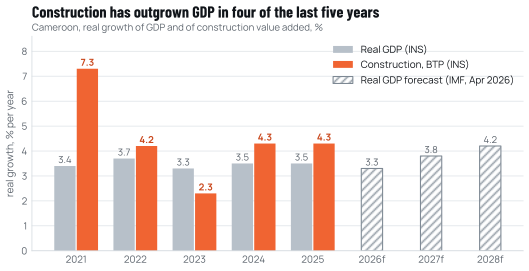
Source: INS, Les Comptes Nationaux de 2025 (August 2026) [S16]; IMF, World Economic Outlook, April 2026 [S81].
Construction, which the national accounts call bâtiment et travaux publics (BTP), is the sector that matters most for steel. Its real growth was 6.7% in 2020, 7.3% in 2021, 4.2% in 2022, 2.3% in 2023, 4.3% in 2024 and 4.3% in 2025 [S16]. In 2025 its value added was 1,991.1 bn FCFA, or 5.8% of GDP [S16]. Construction has therefore grown faster than GDP in four of the last five years, the exception being 2023. Gross fixed capital formation rose only 1.9% in 2025, with private investment leading and public investment slowing [S16].
The near-term outlook carries risks. In October 2026 the IMF noted that prospects "are weakening for 2026", largely because of hydrocarbons, and confirmed its assessment of a high overall risk of debt distress [S36]. Gas revenue is under pressure after the floating liquefaction vessel that took about 95% of Cameroon’s gas output left Kribi in July 2026 [S84][S85]; White paper 05, Chapter 6, examines the gas balance. Inflation, 7.4% in 2023 on the IMF’s earlier series, eased to about 3.4% in 2025 [S81].
3.3 Public investment and the road programme
The 2026 State budget totals 8,816.4 bn FCFA, 14% more than in 2025, and includes 2,026.3 bn FCFA of public investment, on a growth assumption of 4.3% [S17]. Most of the steel-relevant spending runs through the Ministry of Public Works, whose 2026 budget is set at 740 bn FCFA [S76]. More than 92% of that budget is allocated to the construction, rehabilitation and maintenance of the road network, with targets of nearly 650 km of paved roads and more than 1,300 m of engineering structures such as bridges [S86]. The minister’s 2026 roadmap lists about 475.9 km of newly built roads, 852 km of paved-road maintenance and the delivery of six modular steel bridges, and names the projects to be launched or accelerated [S76].
Table 3.1 sourcedInfrastructure and building programmes that drive steel demand, 2025 to 2030
| Programme | Scope | Cost or budget | Timing | Main steel products | Source |
|---|---|---|---|---|---|
| Yaoundé-Douala motorway, phase II | 141.1 km of motorway plus 40 km of interchange roads, Bibodi to Douala | 1,072 bn FCFA | Works from H2 2025; completion targeted 2028 | Rebar, bridge sections, guard rails | [S77] |
| Ebolowa-Kribi road | 170 km | n.a. | Launch planned 2026 | Rebar, culverts, bridges | [S76] |
| Ngaoundéré-Garoua corridor | 242 km rehabilitation | n.a. | Launch planned 2026 | Rebar, bridges | [S76] |
| Edéa-Kribi road | Reconstruction of 110.05 km | n.a. | Tender signed 24 Feb 2025 | Rebar, bridges | [S87] |
| Public Works 2026 programme | 475.9 km of new roads; six modular steel bridges; over 1,300 m of engineering structures | 740 bn FCFA ministry budget | 2026 | Rebar, sections, plate | [S76][S86] |
| Edéa-Kribi-Lolabé-Campo railway | About 185 km; memorandum on feasibility, design, financing, construction and operation | n.a. | MoU signed 4 Jun 2026 | Rail, sections, rebar | [S88] |
| Kribi port, next phase | Mineral terminal of 125 Mt a year (memorandum of understanding of 4 November 2025) and a hydrocarbons terminal | About US$2bn reported for the mineral terminal | Completion targeted within five to six years of March 2026 | Sheet piles, sections, rebar | [S89][S90][S91] |
| Power transmission | 400 kV Nachtigal evacuation line, 1,500 MW transfer capacity | n.a. | Due November 2026 | Towers, conductors, structures | [S92][S93] |
| Hydropower | Kikot-Mbebe 500 MW; energy compact target of 3,000 MW by 2030 | n.a. | Commissioning expected 2031 to 2033 | Penstocks, gates, rebar | [S94][S95][S96] |
| Iron-ore projects | Kribi-Lobé, Mbalam, Bipindi-Grand Zambi programme | about 1,748 bn FCFA, 2026 to 2030 | 2026 to 2030 | Structures, rail, plate | [S72] |
| Social housing | SIC programme of 3,000 units (2024 to 2026); national target of 10,000 high-standard and 30,000 social units by 2035 | n.a. | 2024 to 2035 | Rebar, wire, roofing sheet | [S97] |
Source: as listed. n.a.: not stated in the sources consulted. Products are indicative of typical steel content.
The pipeline is large relative to the steel market. Phase II of the Yaoundé-Douala motorway alone is costed at 1,072 bn FCFA, more than six times the value of Cameroon’s chapter 72 iron and steel imports in 2025 [S77][S07]. The steel content of road projects is concentrated in bridges, interchanges, culverts and safety equipment rather than the carriageway itself; rail, port, power and mining infrastructure use proportionally more sections, plate and fabricated structures. That difference matters for the product mix examined in Chapter 7: as the pipeline moves from roads towards railways, ports, power and mines, demand shifts towards products Cameroon does not make today.
The pipeline also carries execution risk. The Minister of Public Works acknowledged in February 2026 "cash flow tensions affecting payment of works executed by companies" [S76]. Large projects are also slow: the State first sought a partner for phase II of the Yaoundé-Douala motorway in 2020, when the project description already included bridges of 250 m over the Dibamba and 500 m over the Sanaga [S98], and works were only launched in the second half of 2025 [S77]. Steel demand from public works will follow cash disbursement, not budget announcements.
3.4 Ports, industrial zones and agriculture add industrial demand
Beyond roads and housing, Cameroon’s industrial infrastructure is expanding, and it uses steel in structures, sheet piles, cranes, warehouses and pipework. Kribi port handled 12.7 Mt of traffic in 2025, 19% more than in 2024, and container traffic rose 82.4% in the year after the second container terminal opened in May 2025 [S99][S100]. The port authority’s next phase includes a mineral terminal, the subject of a memorandum of understanding signed on 4 November 2025, and a hydrocarbons terminal, both targeted for completion within five to six years of March 2026 [S89][S91]; in October 2026 it announced a 50 bn FCFA agricultural terminal on 9.2 ha, with construction planned from 2027 and operations from 2029 [S101][S102]. The company developing the Kribi industrial-port zone, KPIZ, plans phased development by sector clusters, including steelmaking linked to mineral exports, wood processing, agro-industry, petrochemicals and construction materials [S91].
Industrial zones generate a particular kind of steel demand: pre-engineered buildings, crane girders, racking, conveyors and tanks, much of it in sections, plate and coated sheet rather than reinforcing bar. Their development therefore reinforces the shift in product mix discussed below. The same is true of the cement industry’s own expansion, with new capacity announced by several producers [S103][S104], and of the energy sector, where hydropower plants, substations and transmission lines are steel-intensive.
Mining is the largest potential source of industrial steel demand. The government’s 2026 to 2030 programme covers three iron-ore projects with a combined budget line of about 1,748 bn FCFA [S72]. Ore projects need railways or heavy-haul roads, processing plants, conveyors, stockyards and port facilities; even where most equipment is imported, the structural steel, rebar for foundations and fabricated items offer a market for domestic suppliers. The timing of these projects is uncertain, as Chapter 7 notes, and none is assumed in the base scenario as a separate driver.
3.5 Cement confirms the building cycle
Cement is the best available proxy for construction activity in Cameroon, because it is used in every reinforced-concrete structure and its trade is well recorded. Cement demand was about 6.8 Mt in 2025 against production of about 4.7 Mt by the country’s six plants, although the ministry in charge of industry has cited demand of 8 Mt [S103][S105][S106]. The demand figures exceed reported output by 2.1 to 3.3 Mt and are not reconciled in the sources; this paper treats them as indicative. Clinker imports, the main input of grinding plants, rose from 2,577 kt in 2024 to 3,107 kt in 2025, an increase of 20.5% [S107][S07]. Dangote Cement, one of the main producers, sold 1.2 Mt in Cameroon in 2025 and plans to raise capacity to 3 Mt a year by 2028, with an additional 1.5 Mt plant at Yaoundé [S108][S104].
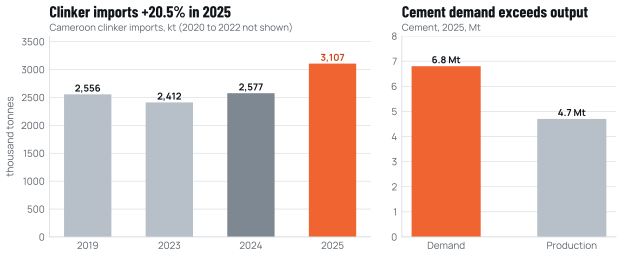
Source: INS foreign trade notes for 2020, 2024 and 2025 [S19][S107][S07]; EcoMatin (August and September 2025) [S103][S105].
Per person, Cameroon used about 157 to 167 kg of cement in 2025 (derived from production of 4.7 to 5.0 Mt and 29.88 million people) [S105][S14]. Against steel use of about 450,000 t, that is 10 to 15 t of cement per tonne of steel, depending on whether output or reported demand is used, far above the world ratio of about 2.2 (3.8 Gt of cement against 1.72 Gt of finished steel in 2025) [S109][S02] (derived). The ratio is unresolved: it may mean that cement demand is overstated, that steel use is understated, or both (Chapters 7 and 11). Reinforced concrete combines cement and reinforcing bar in broadly stable proportions for a given building type, so the growth of cement demand is a reasonable indicator of the direction, though not the exact rate, of rebar demand. Cement and steel both face the same constraint: imported inputs, clinker for one and billets for the other.
3.6 Population, towns and housing
The World Bank estimates Cameroon’s population at 29.9 million in 2025 and projects 33.8 million in 2030, 37.9 million in 2035 and 42.2 million in 2040, a gain of about 12.3 million [S18]. The urban share is projected to rise from 55.7% to 58.6% over the same period, which adds about 8.1 million urban residents (derived) [S18][S14]. Towns are where steel is used: in multi-storey buildings, markets, schools, hospitals, water and power networks.
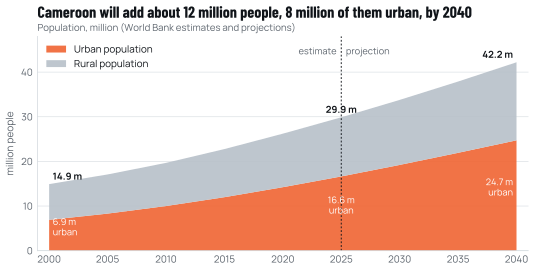
Source: World Bank, population estimates and projections (updated July 2026) and World Development Indicators [S18][S14]. Urban population derived from the projected urban share. The provisional 2026 census counted 22.7 million people [S15].
Housing is the largest unmet need. The Centre for Affordable Housing Finance in Africa estimates a deficit of 1.8 to 2.0 million units, with demand of about 300,000 units a year against about 150,000 supplied, at an average construction cost of 1,037,051 FCFA per square metre [S78]. Government sources put the deficit at 2.5 million units [S97]. Formal social housing has lagged: the mid-term evaluation of the national development strategy found that the stock of new social housing rose from 2,500 units in 2020 to 3,600 in 2025, 21.2% of the target of 17,000 units [S79]. The State housing company SIC has a programme of 3,000 units for 2024 to 2026, including 538 units at Garoua and 432 at Maroua, and the government aims for 10,000 high-standard and 30,000 social units by 2035, supported by an industrial base for prefabricated components at Mbankomo near Yaoundé [S97].
Formal programmes supply a small fraction of the roughly 150,000 units built each year [S78][S79]; the rest is built by households and small developers, typically in reinforced concrete for foundations, columns and slabs. Its steel demand is spread across thousands of small purchases of 6 mm to 12 mm bars, which is why reinforcing bar dominates the domestic market and why its price is politically sensitive (Chapter 8).
3.7 How construction translates into steel demand
Steel demand does not grow one-for-one with construction. Three mechanisms shape the relationship.
The first is the mix of construction. Residential and commercial buildings use mainly reinforcing bar and wire; roads use relatively little steel per unit of value, concentrated in structures; railways, ports, power plants, transmission lines and mines use more sections, plate, rail and fabricated steel per unit of value. The Cameroonian pipeline in Table 3.1 is shifting towards the second group, through the Kribi port’s next phases, new rail projects, hydropower and iron-ore developments.
The second is the substitution of imported finished steel by local production, or the reverse. Cameroon already makes most of its reinforcing bar and wire rod (Chapter 5); new demand for those products will be met locally if feedstock is available. New demand for heavy sections, flat products and large tubes will be met by imports unless new capacity is built.
The third is the quality of construction. The mandatory reinforcing-bar standard, NC 236/2024/06, and enforcement by the standards agency ANOR raise the steel content and quality of buildings over time, and public concerns about substandard bars have been raised repeatedly since 2023 [S26][S110][S111]. Better building codes generally raise steel use per square metre.
3.8 What could slow demand
Demand growth is likely, but its pace is uncertain. Four constraints deserve attention.
Fiscal space is limited. The IMF assesses a high overall risk of debt distress and found that the 2025 non-oil primary deficit reached 2.6% of GDP against a target of 1.4% [S36][S82]. Public investment will be rationed, and contractors’ arrears slow projects.
Foreign exchange is scarce. CEMAC’s reserves fell from 7,295 bn FCFA at the end of 2024 to 6,377.3 bn FCFA at the end of 2025, equivalent to 4.2 months of imports, and the regional central bank raised its policy rate to 4.75% in December 2025 [S112][S113]. Steel imports draw on these reserves; Chapter 10 shows that iron and steel absorbed 13% of the merchandise trade deficit in 2025.
Population data are being revised. If the final census confirms a population near 22.7 million, per-capita indicators rise by about a third, although tonnage-based estimates such as the 450,000 t of steel use do not change [S15].
Energy constrains industry. About 150 MW of industrial demand could not be served in 2026 pending completion of the Nachtigal evacuation line, now due in November 2026 [S92]; White paper 05, Chapter 2, describes the power system. Steel mills and cement grinders are among the largest industrial loads.
Sources cited in this chapter
Bracketed markers refer to these sources; the full list is in the annex. Full list of sources
- S01Cameroun: Prometal décroche 26,2 milliards FCFA d’Afreximbank. Camer.be, 1 Oct 2026.camer.be/actualites/economie/cameroun-prometal-decroche-262-milliards-…
- S80Métallurgie: les industriels dénoncent la présence du fer à béton contrefait. EcoMatin, 22 Jun 2023.ecomatin.net/metallurgie-les-industriels-du-secteur-denoncent-la-prese…
- S07Évolution du commerce extérieur en 2025 (version provisoire). INS Cameroun, Feb 2026 (posted 1 Apr 2026).ins-cameroun.cm/wp-content/uploads/2026/04/Note-sur-le-commerce-exteri…
- S05UN Comtrade public API, Cameroon (reporter 120), HS 72/73 and 6-digit lines, 2019-2023. UN Statistics Division.comtradeapi.un.org/public/v1/preview/C/A/HS?reporterCode=120&period=20…
- S02World Steel in Figures 2026 (page and PDF). worldsteel, 4 Jun 2026.worldsteel.org/data/world-steel-in-figures/world-steel-in-figures-2026…
- S14WDI API: SP.POP.TOTL; SP.URB.TOTL.IN.ZS (CMR). World Bank, updated 8 Oct 2026.api.worldbank.org/v2/country/CMR/indicator/SP.POP.TOTL?format=json
- S15Cameroun: bouclage du 4e RGPH, 22,7 millions d’habitants recensés. Journal du Cameroun, 5 Oct 2026.fr.journalducameroun.com/cameroun-bouclage-du-4e-rgph-227-millions-dha…
- S16Les Comptes Nationaux de 2025. INS Cameroun, Aug 2026 (posted 2 Sep 2026).ins-cameroun.cm/wp-content/uploads/2026/09/Comptes_Nationaux_2025_FR_V…
- S81World Economic Outlook DataMapper API (NGDP_RPCH, NGDPD, PCPIPCH, CMR). IMF, Apr 2026 WEO.imf.org/external/datamapper/api/v1/NGDP_RPCH/CMR
- S82IMF Executive Board concludes 2026 Article IV consultation with Cameroon (PR 26/096). IMF, 30 Mar 2026.imf.org/en/news/articles/2026/03/30/pr-26096-cameroon-imf-executive-bo…
- S83Cameroon Overview. World Bank, updated Sep 2026.worldbank.org/en/country/cameroon/overview
- S36IMF staff concludes Post-Financing Assessment mission to Cameroon (PR 26/314). IMF, 1 Oct 2026.imf.org/en/news/articles/2026/10/01/pr26314-imf-staff-concludes-assesm…
- S84Données pétrolières 2025. SNH, posted Jun 2026.snh.cm/wp-content/uploads/2026/06/Donnees-petrolieres-2025.pdf
- S85Le navire usine quitte le Cameroun, le gaz s’arrête. Camer.be, 9 Jul 2026.camer.be/93911/12:1/le-navire-usine-quitte-le-cameroun-le-gaz-sarrete-…
- S17Budget 2026-8 816,4 milliards FCFA…. MINFI, 26 Nov 2025.minfi.gov.cm/budget-2026-8-8164-milliards-fcfa-pour-consolider-la-stab…
- S76Cameroon targets 476 km of new roads in 2026 infrastructure plan. Business in Cameroon, 16 Feb 2026.businessincameroon.com/construction/1602-15761-cameroon-targets-476-km…
- S86Cameroon to allocate 92% of 2026 public works budget to road construction and maintenance. Ecofin Agency, 12 Nov 2025.ecofinagency.com/news-infrastructures/1211-50392-cameroon-to-allocate-…
- S77Autoroute Yaoundé-Douala phase II: 1 072 milliards F pour 141 km à livrer en 2028. Journal du Cameroun, 17 Apr 2025.fr.journalducameroun.com/autoroute-yaounde-douala-phase-ii-1072-millia…
- S87Bilan et perspectives: les voyants sont au vert. Port Autonome de Kribi (PAK), 13 Mar 2025.Cited by title and date
- S88Ligne ferroviaire Edéa-Kribi-Lolabé-Campo: une nouvelle étape pour la connectivité du port de Kribi. Port Autonome de Kribi (PAK), 4 Jun 2026.Cited by title and date
- S89Port de Kribi: un terminal minéralier d’avenir. Port Autonome de Kribi (PAK), 4 Nov 2025.Cited by title and date
- S90Kribi Deep Sea Port, investors partner to construct 125-million-tonne mineral terminal worth $2 billion. Business in Cameroon, 5 Nov 2025.businessincameroon.com/transport/0511-15300-kribi-deep-sea-port-invest…
- S91Zone industrialo-portuaire de Kribi (KPIZ): jusqu’à +8 points de croissance et 150 000 emplois attendus sur 15 ans. Investir au Cameroun, 4 Mar 2026.investiraucameroun.com/gestion-publique/0403-23163-zone-industrialo-po…
- S92Nachtigal power line delays leave 150 MW of industrial demand unmet. Business in Cameroon, 9 Oct 2026.businessincameroon.com/public-management/0910-16939-nachtigal-power-li…
- S93Rapport d’activités 2025 de l’ARSEL. ARSEL (electricity regulator), 7 Sep 2026.arsel-cm.org/wp-content/uploads/2026/09/Rapport-ARSEL-2025.pdf
- S94Kikot-Mbebe hydroelectric scheme. EDF Cameroun.cameroun.edf.com/en/our-activities/hydropower/kikot-mbebe-hydroelectri…
- S95Government, EDF push to deliver hydro promises as Cameroon moves to diversify energy sources. Business in Cameroon, 4 Dec 2025.businessincameroon.com/energy/0412-15443-government-edf-push-to-delive…
- S96Cameroon, Energy (Country Commercial Guide). US International Trade Administration, 13 Apr 2026.trade.gov/country-commercial-guides/cameroon-energy
- S72Cameroon plans $3.1B iron ore push starting 2026. Daba Finance (republished by AllAfrica), 14 Feb 2026.dabafinance.com/en/news/cameroon-mining-investment-2026-2030
- S97Cameroun: logements sociaux, l’État veut lancer une base industrielle. Journal du Cameroun, 27 May 2024.fr.journalducameroun.com/cameroun-logement-sociaux-letat-veut-lancer-u…
- S98Autoroute Yaoundé-Douala: l’État recherche un partenaire pour la phase II. EcoMatin, 30 Mar 2020.ecomatin.net/autoroute-yaounde-douala-letat-recherche-un-partenaire-po…
- S99Au Cameroun, le port de Kribi revendique la place de premier terminal à conteneurs. EcoMatin, 22 Apr 2026.ecomatin.net/au-cameroun-le-port-de-kribi-revendique-la-place-de-premi…
- S100Port de Kribi: le trafic conteneurisé bondit de 82% un an après la mise en service du 2e terminal. EcoMatin, 14 May 2026.ecomatin.net/port-de-kribi-le-trafic-conteneurise-bondit-de-82-un-an-a…
- S101La Lettre du PAK n°254. Port Autonome de Kribi, May 2025.Cited by title and date
- S102Cameroon’s Kribi port plans CFA50 billion agricultural terminal. Business in Cameroon, 9 Oct 2026.businessincameroon.com/public-management/0910-16938-cameroon-s-kribi-p…
- S103Cameroun: le ghanéen Empire Cement veut implanter une cimenterie d’1 Mt à Douala. EcoMatin, 6 Aug 2025.ecomatin.net/cameroun-le-ghaneen-empire-cement-veut-implanter-une-cime…
- S104Dangote Cement to double production capacity in Cameroon. Global Cement, 26 Jun 2026.globalcement.com/news/20920-dangote-cement-to-double-production-capaci…
- S105L’industrie camerounaise du ciment face à des défis structurels. EcoMatin, 29 Sep 2025.ecomatin.net/lindustrie-camerounaise-du-ciment-face-a-des-defis-struct…
- S106Cameroun: l’État ambitionne doper sa production de ciment de plus de 50% en 2025. EcoMatin, 19 Mar 2025.ecomatin.net/cameroun-letat-ambitionne-doper-sa-production-de-ciment-d…
- S107Évolution du commerce extérieur en 2024. INS Cameroun, Aug 2025.ins-cameroun.cm/wp-content/uploads/2025/12/Commext_2024_FR_Edite-final…
- S108Dangote exported 1Mt of clinker from Nigeria to Cameroon and Ghana in 2025. Global Cement, 27 Mar 2026.globalcement.com/news/20591-dangote-exported-1mt-of-clinker-from-niger…
- S19Commerce extérieur du Cameroun en 2020. INS Cameroun, Jul 2021.ins-cameroun.cm/wp-content/uploads/2025/07/Note-Commerce-exterieur-202…
- S109Mineral Commodity Summaries 2026: Cement. U.S. Geological Survey, Jan 2026.pubs.usgs.gov/periodicals/mcs2026/mcs2026-cement.pdf
- S18Population estimates and projections (source 40): SP.POP.TOTL and SP.URB.TOTL.IN.ZS, 2025 to 2040. World Bank, updated 1 Jul 2026.api.worldbank.org/v2/country/CMR/indicator/SP.POP.TOTL?source=40&forma…
- S782024 Housing Finance Yearbook, Cameroon profile. Centre for Affordable Housing Finance in Africa (CAHF), Jan 2024 (PDF Mar 2025).housingfinanceafrica.org/wp-content/uploads/2025/03/CAMEROON.pdf
- S79Cameroun: 3 600 logements sociaux construits en 5 ans, soit 21,2% de l’objectif (SND30 mid-term evaluation). EcoMatin, 29 Jan 2026.ecomatin.net/cameroun-3-600-logements-sociaux-construits-en-5-ans-soit…
- S26Cameroon rejects fresh push to revise rebar standard. Business in Cameroon, 26 Jan 2026.businessincameroon.com/construction/2601-15657-cameroon-rejects-fresh-…
- S110Cameroun: le gouvernement rejette une demande de révision de la norme du fer à béton. EcoMatin, 5 Feb 2026.ecomatin.net/cameroun-le-gouvernement-rejette-une-demande-de-revision-…
- S111Interdiction des importations du fer à béton: les consommateurs dénoncent la mauvaise qualité de la production locale. EcoMatin, 13 Apr 2023.ecomatin.net/interdiction-des-importations-du-fer-a-beton-les-consomma…
- S112CEMAC: après le repli de 2025, la BEAC table sur un redressement progressif des réserves de change. Gabon Media Time, 2 Jan 2026.gabonmediatime.com/cemac-apres-le-repli-de-2025-la-beac-table-sur-un-r…
- S113Zone Cémac: la BEAC annonce un ralentissement de croissance à 2,4%. AllAfrica (Les Dépêches de Brazzaville), 17 Dec 2025.fr.allafrica.com/stories/202512170629.html
Cite this chapter
Cameroon Steel (2026). Cameroon’s steel gap lies in iron units, not in rebar. White paper 04, chapter 3: Construction, infrastructure and urban growth will lift Cameroon’s steel demand. CS-WP-04. https://www.cameroon-steel.com/en/library/market-outlook/cameroon-demand/
Source