White paper 04 · Summary
Executive summary: the gap is upstream
Cameroon’s steel market is small, growing and widely misread. The country uses about 450,000 t of finished steel a year, roughly 15 kg per person, half the African average and 7% of the world’s [S01][S02]. Demand will grow with construction, infrastructure and towns, to between about 0.7 Mt and 1.2 Mt by 2040 in our scenarios. But the gap that a new producer can fill is not in reinforcing bar. Domestic rolling capacity for rebar is about 3.5 times domestic demand, and rebar imports have been suspended since 2016 [S03][S04]. The gap is in iron units, the billets and other metal that feed the mills, which were Cameroon’s largest steel import at 161 kt in 2023, 78% of them from Indonesia, and in flat steel and heavy sections, which are not made in the country at all [S05]. The regional market of CEMAC, worth about US$0.5bn a year in chapter 72 imports, adds scale for the same products [S05][S06].
In this chapter (8)
ES.1 Ten findings
- The world is long in steel and short of defences in Africa. World output fell to 1,849.4 Mt in 2025, OECD-estimated excess capacity is heading from 640 Mt to 745 Mt by 2028, and China exported a record 119 Mt. Large markets have raised barriers, with 207 restrictions in 62 countries; Central Africa has almost none outside Cameroon’s rebar ban [S08][S09][S10][S11].
- Africa is the growth exception, and imports fill it. African steel use rose 10.4% to 45.0 Mt in 2025 against production of 29.8 Mt; imports jumped from 23.9 Mt to 32.9 Mt in a year, 59% from China. Sub-Saharan Africa’s shaft-furnace DR plants made only 0.09 Mt of direct-reduced iron (Midrex plant data); worldsteel estimates about 2.7 Mt more, mostly coal-based, in East Africa [S02][S12][S13].
- Cameroon’s market is about 450 kt and 15 kg per person. On the provisional census count of 22.7 million people the figure is about 20 kg; on any count it is below the 22.5 kg average of Africa outside Egypt and South Africa [S01][S14][S15][S02].
- The drivers of growth are in place. Construction grew 4.3% in 2024 and 2025 against GDP growth of 3.5%; the 2026 budget includes 2,026.3 bn FCFA of public investment; and the population is projected to reach 42.2 million by 2040, with 8 million more urban residents [S16][S17][S18].
- Imports are iron units and flat steel, not bars. Chapter 72 imports rose 125% from 2019 to 412 kt in 2025. In 2023 billets cost US$151.7m, 49% of the chapter 72 bill; bars and rebar cost US$3.3m, about 1% [S19][S07][S05].
- The domestic industry can roll more than it can feed. Installed transformation capacity is about 1.2 Mt at about 50% utilisation; rebar capacity is 627 kt (as read; section 5.2) against 180 kt of demand; local scrap covers about 40% of the mills’ needs and imported billets about 60% [S20][S01][S03].
- The largest producer is financing imported billets. On 28 September 2026 the Prometal group signed a €40m revolving facility with Afreximbank to import billets, a clear signal that metal, not mill capacity, limits output [S20][S21].
- Demand reaches 0.7 to 1.2 Mt by 2040, and the iron-unit gap widens in every scenario. In the base case demand is about 920 kt in 2040; sections and flat steel grow fastest; and the iron units needed beyond domestic scrap rise from about 170 kt to between 225 kt and 520 kt a year. Even in the high case, rebar demand stays below today’s capacity.
- Cheap billets set the benchmark, and on imported iron a Kribi billet matches it only at the low end. Billets were quoted at US$465 to 480 per tonne FOB from China and Russia on 3 October 2026 and land in Douala or Kribi at about US$570 to 650 duty-paid. An indicative cash cost for a billet melted at Kribi from imported scrap and hot-briquetted iron is about US$590 to 780, before capital charges; the 10% duty on imported metallics is about as large as the central gap. Rebar, by contrast, is priced administratively, at about 633,000 FCFA per tonne in October 2023 [S22][S23][S24] (section 8.6).
- Policy should move protection upstream and towards quality. Rules-based trade instruments, standards extended to structural steel, procurement that requires certified products and pays on time, and incentives for melting and section rolling would serve SND30’s goals better than an open-ended ban on one finished product [S25][S23][S26].
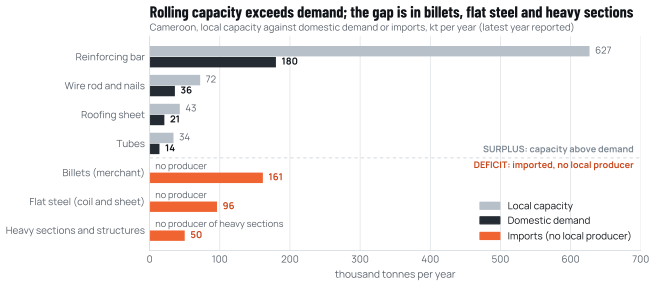
Source: Ocitram capacity and demand data as reported by Cameroon Tribune, 11 May 2026 [S03]; UN Comtrade import tonnages for 2023 (hot-rolled flat 2022) [S05]. Sections (HS 7216) tonnage derived from value.
ES.2 What the market is
Cameroon’s steel market is concentrated in construction. Reinforcing bar alone accounts for about 180 kt of the 450 kt of annual demand, and wire rod, wire and nails for about 38 kt [S03]. The rest is flat steel for roofing, tubes and appliances, sections and structures for industrial buildings and infrastructure, and a range of other products (Chapter 3). Domestic mills, clustered around Douala, produce most of the long products the country uses and export about 31 kt of reinforcing bar a year, mainly to Chad [S07][S05]. Flat steel and heavy sections are imported.
The country’s steel statistics are incomplete. There is no official apparent-use series, product-level trade data stop in 2023, and the population base is under revision after the provisional census [S05][S15]. This paper therefore states its sources and status for every number, publishes the data behind every chart, and lists its evidence gaps in Chapter 11.
ES.3 Where the gap really is
The import record is the clearest evidence. Chapter 72 imports more than doubled between 2019 and 2025, from 182,890 t to 412,049 t, while average unit values fell 47% from their 2022 peak [S19][S07]. In 2023, the latest year with product detail, billets accounted for about half of the chapter 72 import bill, flat products for about a third and sections for about 8% [S05]. Wire-rod imports collapsed from 58.1 kt in 2021 to 7.8 kt in 2023 as local rolling came on stream, and rebar imports have been marginal since the 2016 ban [S05][S04].
The pattern is consistent: where Cameroon has rolling capacity and protection, imports of the finished product disappear and imports of the semi-finished input rise. Billet imports grew from 52.5 kt in 2019 to 161.4 kt in 2023 [S05]. Domestic scrap cannot fill the gap: the only quantified study found arising of 53 to 62 kt a year in 2006, industry reports that scrap covers about 40% of needs, and scrap prices have risen by about 30% [S27][S03][S01]. The country’s dependence on foreign steel has moved upstream, from bars to the iron that makes them.
ES.4 How demand could grow to 2040
The scenarios in Chapter 7 multiply the World Bank’s population projection by three paths for steel use per person. In the low case use per person barely moves and demand reaches about 685 kt by 2040. In the base case it rises to 21.8 kg, close to today’s average for Africa outside Egypt and South Africa, and demand reaches about 920 kt. In the high case it rises to 29.1 kg, today’s average for Africa as a whole, and demand reaches about 1,230 kt [S18][S02]. These are illustrative scenarios, not forecasts; their method is set out in Annex A.
Three results are common to all scenarios. Reinforcing bar remains the largest product but grows more slowly than sections and flat steel, as infrastructure shifts towards railways, ports, power and mines. Rebar demand stays below today’s installed capacity of 627 kt even in the high case. And the iron-unit gap, the metal that domestic long-product mills need beyond local scrap, widens from about 170 kt to between 225 kt and 520 kt a year. Adding the other CEMAC states, whose chapter 72 imports were about US$191m in 2023, raises the regional market to roughly 1.4 Mt by 2040 in the base case, an indicative figure [S06].
ES.5 Prices and competition
Prices confirm the structure. On 3 October 2026 billets were quoted at US$465 to 480 per tonne FOB from China and Russia, and at US$515 to 525 delivered (CFR) to Türkiye; Turkish export rebar was quoted at US$620 to 630 FOB [S22]. In Cameroon, rebar prices are homologated by the Ministry of Commerce, and the October 2023 list implies about 633,000 FCFA per tonne for 12 mm FE500 bar, about €965 [S24]. That premium over import parity is sustained by the import ban and is exposed to any change in policy. For a new producer, the durable benchmark is the delivered cost of imported billets, about US$570 to 650 per tonne landed and duty-paid at October 2026 prices (derived). Section 8.6 sets it against an indicative cost of making a billet at Kribi from imported scrap and hot-briquetted iron, about US$590 to 780 per tonne before capital charges: the ranges overlap only at the low end, where power is bought at legacy high-voltage prices. The decisive local variables are therefore the cost of iron units and the duty paid on them, the price of power and, in time, iron made from Cameroonian ore and gas (Chapter 8).
Competition will come from surplus Asian and Russian billets, North African producers with gas-based iron, new mills in Gabon supported by a VAT preference, and Cameroon’s own under-used rolling capacity [S22][S28][S29][S20]. Neighbouring markets for reinforcing bar, such as Gabon’s 51 kt and Congo’s 33 kt of imports, are closing from inside [S06][S21][S30].
ES.6 What it means for a new producer
The evidence sets a clear order of priorities (Chapter 9). First, iron units: merchant billets that domestic re-rollers would otherwise import, and in the longer term ore-based iron linked to Cameroon’s iron-ore projects, which form 9% of the world’s pipeline of iron-ore mine capacity in development [S31]. Second, heavy sections, beams and structures, a fully imported segment that grows fastest in every scenario. Third, reinforcing bar and wire rod only where they can be differentiated by certified quality, integration and regional reach. Flat steel is a real gap but requires a scale that the market alone does not yet justify.
Cameroon Steel’s planned complex at Mboro, in the Kribi industrial-port zone, is used in this paper as a worked example. Its design capacity was reported in January 2025 as 1 Mt a year, built in phases [S32]. In the reference configuration RC-1, a planning estimate, Phase 1 is an electric arc furnace melt shop with a billet caster, a reinforcing-bar mill and a wire-rod mill, with a nameplate of 0.3 Mtpa and an expected sustained output of about 270 to 300 kt a year; later phases add sections and heavy beams [S33]. Read against the evidence, Phase 1’s melt shop makes billets, and its output is flexible between rolled products and merchant billets for re-rollers that import about 60% of their charge. Because rebar is saturated, Phase 1 tonnage has to go to import displacement, of billets first and wire rod second, and to CEMAC exports; new rebar capacity on its own closes no gap (section 9.8 and Table 9.2). Whether merchant billets can be sold at a margin depends on the cost comparison of section 8.6.
The main market risks are surplus imports at low prices, domestic overcapacity in long products, the possibility of policy reversal, administered prices, the cost and availability of feedstock and power, and foreign-exchange constraints. Their common mitigation is to position where the market is short and to compete on cost, quality and service rather than on protection.
ES.7 What policy can do
Cameroon’s policy has protected the last stage of production, finished bars, and left the iron units that feed it, the flat steel it does not make and the sections it imports exposed. The 2023 tariff even charged 5% on wire rod and 10% on the billets it is rolled from [S23]. Iron and steel imports absorbed 13% of the merchandise trade deficit in 2025 [S07]. Chapter 10 sets out a sequenced agenda: an annual national steel balance; publication of the steel lines of the harmonised CEEAC-CEMAC tariff and correction of inverted escalation; transparent, time-bound trade instruments in place of an open-ended ban; mandatory certification extended from rebar to structural steel; procurement that specifies certified steel and pays contractors on time; relief of the duty on iron units used for melting; incentives focused on melting, direct reduction and section rolling; and practical arrangements for the local-transformation clauses already written into mining conventions [S34][S35]. Each lever is compatible with tight fiscal space, which the IMF rates as carrying a high risk of debt distress [S36].
ES.8 How to read this paper
Chapters 1 and 2 set the global and African context. Chapters 3 to 6 analyse Cameroon’s demand drivers, imports, domestic industry and the CEMAC region. Chapter 7 presents the demand scenarios, Chapter 8 prices, Chapter 9 the implications for a new producer and Chapter 10 the policy levers. Chapter 11 lists the evidence gaps. Annex A sets out the method and assumptions, Annex B the glossary, Annex C every source cited, with its date and address, and Annex D the values plotted in every figure. Source markers such as [S12] refer to Annex C. Figures and tables carry a status chip: sourced, derived, assumed or illustrative. Companion papers in this series treat the production route and the phasing of RC-1 (White paper 03), power and gas (White paper 05), carbon (White paper 06) and the wider economics (White paper 09).
Statement of interest. This paper is published by Cameroon Steel, which is developing a steelworks at Kribi. It is written to inform public debate; its analysis is independent of any commercial offer, and every figure is sourced or labelled with its status.
Sources cited in this chapter
Bracketed markers refer to these sources; the full list is in the annex. Full list of sources
- S01Cameroun: Prometal décroche 26,2 milliards FCFA d’Afreximbank. Camer.be, 1 Oct 2026.camer.be/actualites/economie/cameroun-prometal-decroche-262-milliards-…
- S02World Steel in Figures 2026 (page and PDF). worldsteel, 4 Jun 2026.worldsteel.org/data/world-steel-in-figures/world-steel-in-figures-2026…
- S07Évolution du commerce extérieur en 2025 (version provisoire). INS Cameroun, Feb 2026 (posted 1 Apr 2026).ins-cameroun.cm/wp-content/uploads/2026/04/Note-sur-le-commerce-exteri…
- S05UN Comtrade public API, Cameroon (reporter 120), HS 72/73 and 6-digit lines, 2019-2023. UN Statistics Division.comtradeapi.un.org/public/v1/preview/C/A/HS?reporterCode=120&period=20…
- S03Production: les acteurs en présence. Cameroon Tribune, 11 May 2026.cameroon-tribune.cm/article.html/76600/fr.html/details_2
- S08December 2025 crude steel production and 2025 global totals. worldsteel, 23 Jan 2026.worldsteel.org/media/press-releases/2026/december-2025-crude-steel-pro…
- S09OECD: global steel excess capacity set to reach 745 million mt by 2028. EUROMETAL (Platts), 5 Jun 2026.eurometal.net/oecd-global-steel-excess-capacity-set-to-reach-745-milli…
- S10China increased steel exports by 7.5% y/y in 2025. GMK Center, 14 Jan 2026.gmk.center/en/news/china-increased-steel-exports-by-7-5-y-y-in-2025/
- S1162 countries implemented 207 restrictions against steel products from China. GMK Center, 13 Oct 2025.gmk.center/en/infographic/62-countries-implemented-207-restrictions-ag…
- S12World Steel in Figures 2025. worldsteel, Jun 2025.worldsteel.org/data/world-steel-in-figures/world-steel-in-figures-2025…
- S132025 World Direct Reduction Statistics. Midrex Technologies, Sep 2026.midrex.com/world-dri-statistics/world-dri-production-reaches-151-0-mt-…
- S14WDI API: SP.POP.TOTL; SP.URB.TOTL.IN.ZS (CMR). World Bank, updated 8 Oct 2026.api.worldbank.org/v2/country/CMR/indicator/SP.POP.TOTL?format=json
- S15Cameroun: bouclage du 4e RGPH, 22,7 millions d’habitants recensés. Journal du Cameroun, 5 Oct 2026.fr.journalducameroun.com/cameroun-bouclage-du-4e-rgph-227-millions-dha…
- S16Les Comptes Nationaux de 2025. INS Cameroun, Aug 2026 (posted 2 Sep 2026).ins-cameroun.cm/wp-content/uploads/2026/09/Comptes_Nationaux_2025_FR_V…
- S17Budget 2026-8 816,4 milliards FCFA…. MINFI, 26 Nov 2025.minfi.gov.cm/budget-2026-8-8164-milliards-fcfa-pour-consolider-la-stab…
- S18Population estimates and projections (source 40): SP.POP.TOTL and SP.URB.TOTL.IN.ZS, 2025 to 2040. World Bank, updated 1 Jul 2026.api.worldbank.org/v2/country/CMR/indicator/SP.POP.TOTL?source=40&forma…
- S19Commerce extérieur du Cameroun en 2020. INS Cameroun, Jul 2021.ins-cameroun.cm/wp-content/uploads/2025/07/Note-Commerce-exterieur-202…
- S20Cameroun: le groupe Prometal décroche 26 milliards FCFA auprès d’Afreximbank…. Sikafinance, 30 Sep 2026.sikafinance.com/marches/cameroun-le-groupe-prometal-decroche-26-millia…
- S21Prometal obtient 26 milliards FCFA d’Afreximbank pour soutenir son expansion industrielle. EcoMatin, 30 Sep 2026.ecomatin.net/prometal-obtient-26-milliards-fcfa-dafreximbank-pour-sout…
- S22Weekly steel prices (archive 40468). Arab Iron & Steel Union (AISU), 3 Oct 2026.aisusteel.org/en/archives/40468
- S23WITS TRAINS API, Cameroon reported MFN tariffs by HS6 (2023). World Bank / UNCTAD.wits.worldbank.org/API/V1/SDMX/V21/datasource/TRN/reporter/120/partner…
- S24Fer à béton: les producteurs acceptent une baisse des prix. EcoMatin, 23 Oct 2023.ecomatin.net/fer-a-beton-les-producteurs-acceptent-une-baisse-des-prix
- S25Stratégie Nationale de Développement 2020-2030 (SND30). Republic of Cameroon / MINEPAT (hosted by FAOLEX), 2020.faolex.fao.org/docs/pdf/cmr211554.pdf
- S26Cameroon rejects fresh push to revise rebar standard. Business in Cameroon, 26 Jan 2026.businessincameroon.com/construction/2601-15657-cameroon-rejects-fresh-…
- S04Press report of the sealing by customs of more than 7,300 t of imported reinforcing bar, December 2020 (headline and address not reproduced: they name the importer). Business in Cameroon, 16 Dec 2020.Cited by title and date
- S27Bidoung J., Fomethe A., Yantio G., Melo U., La récupération et le recyclage des déchets ferromagnétiques: analyse de la situation au Cameroun (Déchets, Revue francophone d’écologie industrielle n°48). ENSP Yaoundé / MIPROMALO, Q4 2007.eid.episciences.org/7942/pdf
- S06UN Comtrade public API, CEMAC & Nigeria (reporters 266 Gabon, 178 Congo, 140 CAR, 566 Nigeria; mirror partners 148 Chad, 226 Eq. Guinea). UN Statistics Division.comtradeapi.un.org/public/v1/preview/C/A/HS?reporterCode=266&period=20…
- S28Algeria’s steel industry: why is it growing. GMK Center, 28 Jul 2026.gmk.center/en/posts/algeria-s-steel-industry-why-is-it-growing/
- S29Le Gabon réduit la TVA sur le fer à béton local. EcoMatin, 4 Aug 2026.ecomatin.net/le-gabon-reduit-la-tva-sur-le-fer-a-beton-local-pour-stim…
- S30Gabon: le groupe Fokou lance une nouvelle unité d’acier à Port-Gentil. EcoMatin, 18 Sep 2026.ecomatin.net/gabon-le-groupe-fokou-lance-une-nouvelle-unite-dacier-a-p…
- S31Pedal to the Metal 2026. Global Energy Monitor, May 2026.globalenergymonitor.org/sites/default/files/2026-05/Pedal%20to%20the%2…
- S32Industrialisation: la voie royale de l’émergence. Cameroon Tribune, 2 Jan 2025.cameroon-tribune.cm/article.html/68558/fr.html/details_2
- S33Cameroon Steel reference configuration RC-1 (planning estimate), edition 10 October 2026. Cameroon Steel, 10 Oct 2026.Cited by title and date
- S34Cameroon Mining Company confirme l’entrée du projet Mbalam dans sa phase irréversible d’exécution. Camer.be via AllAfrica, 12 Dec 2025.fr.allafrica.com/stories/202512120475.html
- S35Cameroon signs iron ore deal with Sinosteel (citing Reuters). Mining Technology, 23 May 2022.mining-technology.com/news/sinosteel-deal-iron-cameroon/
- S36IMF staff concludes Post-Financing Assessment mission to Cameroon (PR 26/314). IMF, 1 Oct 2026.imf.org/en/news/articles/2026/10/01/pr26314-imf-staff-concludes-assesm…
Cite this chapter
Cameroon Steel (2026). Cameroon’s steel gap lies in iron units, not in rebar. White paper 04, Executive summary: the gap is upstream. CS-WP-04. https://www.cameroon-steel.com/en/library/market-outlook/executive-summary/
Source