白皮书04 · 摘要 · 中文摘要
执行摘要:缺口在上游
喀麦隆钢铁市场规模小、处于增长之中,且常被误读。该国每年消费成品钢材约45万吨,人均约15千克,仅为非洲平均水平的一半、世界平均水平的7%[S01][S02]。随着建筑业、基础设施和城镇的发展,需求将增长,按本文情景测算,到2040年将达到约70万吨至120万吨。但新生产商能够填补的缺口并不在钢筋。国内钢筋轧制产能约为国内需求的3.5倍,且自2016年起钢筋进口已被暂停[S03][S04]。缺口在于含铁原料,即供轧机使用的钢坯及其他金属炉料:2023年钢坯是喀麦隆最大的钢铁进口品类,达16.1万吨,其中78%来自印度尼西亚;缺口还在于该国完全不生产的板材和重型型材[S05]。中部非洲经济与货币共同体(CEMAC)区域市场每年第72章(钢铁)进口额约5亿美元,为同类产品提供了更大规模[S05][S06]。
本页为本章中文摘要;英文全文附于其后,可展开阅读。
本章目录(9)
ES.1 十项主要结论
- 全球钢铁供过于求,而非洲缺乏防御。2025年世界粗钢产量降至18.494亿吨;经济合作与发展组织(经合组织)估算的过剩产能将从6.4亿吨增至2028年的7.45亿吨;中国钢材出口创下1.19亿吨的纪录。主要市场纷纷提高壁垒,62个国家共实施了207项限制措施;而中部非洲除喀麦隆的钢筋进口禁令外几乎没有任何防御措施[S08][S09][S10][S11]。
- 非洲是增长的例外,而增长由进口满足。2025年非洲钢材消费增长10.4%,达到4500万吨,而产量为2980万吨;进口在一年内从2390万吨跃升至3290万吨,其中59%来自中国。据Midrex工厂数据,撒哈拉以南非洲竖炉直接还原厂的直接还原铁(DRI)产量仅9万吨;世界钢铁协会估计东非另有约270万吨,主要为煤基[S02][S12][S13]。
- 喀麦隆市场约为45万吨,人均15千克。若按人口普查初步结果的2270万人计算,人均约为20千克;无论采用哪种口径,均低于埃及和南非以外非洲地区22.5千克的平均水平[S01][S14][S15][S02]。
- 增长的驱动因素已经具备。2024年和2025年建筑业均增长4.3%,而国内生产总值增长3.5%;2026年预算安排公共投资20263亿中非法郎;预计到2040年人口将达到4220万,城镇居民增加800万[S16][S17][S18]。
- 进口的是含铁原料和板材,而不是棒材。第72章进口量自2019年以来增长125%,2025年达到41.2万吨。2023年钢坯进口额为1.517亿美元,占第72章进口额的49%;棒材和钢筋进口额仅330万美元,约占1%[S19][S07][S05]。
- 国内产业的轧制能力超过其原料供应能力。已安装的加工产能约120万吨,利用率约50%;钢筋产能62.7万吨(按本文读法,见全文版第5.2节),而需求为18万吨;本地废钢约满足钢厂需求的40%,进口钢坯约占60%[S20][S01][S03]。
- 最大生产商正在为进口钢坯融资。2026年9月28日,Prometal集团与非洲进出口银行(Afreximbank)签署4000万欧元循环融资协议,用于进口钢坯,这清楚表明限制产量的是金属原料,而不是轧机产能[S20][S21]。
- 到2040年需求达到70万吨至120万吨,且在所有情景下含铁原料缺口都会扩大。基准情景下2040年需求约92万吨;型材和板材增长最快;国内废钢以外所需的含铁原料将从约17万吨增至每年22.5万吨至52万吨。即使在高情景下,钢筋需求仍低于现有产能。
- 廉价钢坯决定基准价格;以进口含铁原料生产,克里比钢坯仅在成本区间低端与之持平。2026年10月3日,中国和俄罗斯钢坯FOB报价为每吨465至480美元,完税后运抵杜阿拉或克里比的成本约为570至650美元。以进口废钢和热压块铁(HBI)在克里比冶炼钢坯,指示性现金成本约为每吨590至780美元(不含资本费用);对进口金属炉料征收的10%关税与中情景下的差距大致相当。相比之下,钢筋价格由政府核定,2023年10月约为每吨63.3万中非法郎[S22][S23][S24](第8.6节)。
- 政策应将保护重心移向上游并转向质量。基于规则的贸易工具、扩展至结构钢的标准、要求使用认证产品并按时付款的公共采购,以及鼓励炼钢和型材轧制的激励措施,比对单一成品实行无限期禁令更能服务于《2020至2030年国家发展战略》(SND30)的目标[S25][S23][S26]。
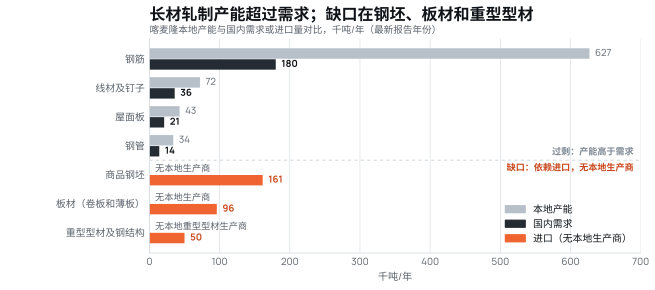
资料来源:Ocitram产能和需求数据,见《喀麦隆论坛报》(Cameroon Tribune)2026年5月11日报道[S03];联合国商品贸易统计数据库2023年进口量(热轧板材为2022年)[S05]。型材(HS 7216)吨位由金额推算。
ES.2 市场概况
喀麦隆钢铁市场集中于建筑业。在45万吨的年需求中,仅钢筋就约占18万吨,线材、钢丝和钉子约占3.8万吨[S03]。其余为用于屋面、钢管和家电的板材,用于工业厂房和基础设施的型材和钢结构,以及其他多种产品(第3章)。集中在杜阿拉周边的国内钢厂生产了该国所用的大部分长材,并每年出口约3.1万吨钢筋,主要销往乍得[S07][S05]。板材和重型型材依赖进口。
该国钢铁统计并不完整。没有官方的表观消费量序列,分产品贸易数据截至2023年,人口基数在人口普查初步结果公布后正在修订[S05][S15]。因此,本文对每个数字都注明来源和性质,公开每张图表背后的数据,并在第11章列出证据缺口。
ES.3 缺口究竟在哪里
进口记录是最清楚的证据。2019年至2025年,第72章进口量增长一倍以上,从182890吨增至412049吨,而平均单位价值较2022年峰值下降47%[S19][S07]。在有分产品数据的最近一年2023年,钢坯约占第72章进口额的一半,板材约占三分之一,型材约占8%[S05]。随着本地轧制产能投产,线材进口从2021年的5.81万吨骤降至2023年的0.78万吨;自2016年禁令以来,钢筋进口已微不足道[S05][S04]。
规律是一致的:凡是喀麦隆拥有轧制能力和保护措施的产品,成品进口随之消失,而半成品原料进口随之增加。钢坯进口从2019年的5.25万吨增至2023年的16.14万吨[S05]。国内废钢无法填补这一缺口:唯一的定量研究估计2006年废钢产生量为每年5.3万至6.2万吨,行业称废钢约满足40%的需求,且废钢价格已上涨约30%[S27][S03][S01]。该国对外国钢铁的依赖已向上游转移,从棒材转向制造棒材所需的铁。
ES.4 2040年前需求如何增长
第7章的情景将世界银行的人口预测与三条人均钢材消费路径相乘。低情景下人均消费几乎不变,2040年需求约68.5万吨。基准情景下人均消费升至21.8千克,接近目前埃及和南非以外非洲地区的平均水平,需求约92万吨。高情景下人均消费升至29.1千克,即目前整个非洲的平均水平,需求约123万吨[S18][S02]。这些是示意性情景,而非预测;其方法见全文版附录A。
三项结论在所有情景下都成立。钢筋仍是最大产品,但增速低于型材和板材,因为基础设施投资正转向铁路、港口、电力和矿山。即使在高情景下,钢筋需求也低于目前62.7万吨的已安装产能。而含铁原料缺口,即国内长材轧机在本地废钢之外所需的金属,将从约17万吨扩大到每年22.5万吨至52万吨。若计入其他CEMAC国家(2023年第72章进口额约1.91亿美元),基准情景下2040年区域市场约为140万吨,此为指示性数字[S06]。
ES.5 价格与竞争
价格印证了这一结构。2026年10月3日,中国和俄罗斯钢坯FOB报价为每吨465至480美元,运抵土耳其的CFR报价为515至525美元;土耳其出口钢筋FOB报价为620至630美元[S22]。在喀麦隆,钢筋价格由商务部核定,2023年10月的价目表意味着12毫米FE500钢筋每吨约63.3万中非法郎,约合965欧元[S24]。这一高于进口平价的溢价依靠进口禁令维持,并受任何政策变化影响。对新生产商而言,持久的基准是进口钢坯的到岸成本,按2026年10月价格完税后约为每吨570至650美元(推算)。第8.6节将其与以进口废钢和热压块铁在克里比生产钢坯的指示性成本(不含资本费用约为每吨590至780美元)进行比较:两个区间仅在低端重叠,即按旧高压合同电价购电的情形。因此,决定性的本地变量是含铁原料成本及其所缴关税、电价,以及将来以喀麦隆矿石和天然气生产的铁(第8章)。
竞争将来自亚洲和俄罗斯的过剩钢坯、拥有天然气基含铁原料的北非生产商、享受增值税优惠支持的加蓬新钢厂,以及喀麦隆自身未充分利用的轧制产能[S22][S28][S29][S20]。邻国的钢筋市场,如加蓬5.1万吨和刚果(布)3.3万吨的进口量,正因其本国新建产能而逐步收窄[S06][S21][S30]。
ES.6 对新生产商的意义
证据给出了清晰的优先次序(第9章)。第一是含铁原料:国内再轧厂原本需要进口的商品钢坯,以及长期而言与喀麦隆铁矿项目相关的矿基铁,喀麦隆铁矿项目占全球开发中铁矿产能的9%[S31]。第二是重型型材、梁和钢结构,这一细分市场完全依赖进口,且在所有情景中增长最快。第三是钢筋和线材,但仅限于能够通过认证质量、一体化和区域覆盖实现差异化的部分。板材确实存在缺口,但所需规模目前仅靠本国市场尚不足以支撑。
本文以Cameroon Steel在克里比港综合工业区姆博罗(Mboro)规划的钢铁综合体为实例。据2025年1月报道,其设计产能为每年100万吨,分期建设[S32]。在参考配置RC-1(规划估算)中,一期为配备钢坯连铸机的电弧炉炼钢车间、钢筋轧机和线材轧机,名义产能每年30万吨,预计持续产量约27万至30万吨;后续各期增加型材和重型工字钢[S33]。对照证据来看,一期炼钢车间生产钢坯,其产品可在轧材与供应再轧厂的商品钢坯之间灵活分配,而再轧厂目前约60%的炉料依赖进口。由于钢筋市场已经饱和,一期产量必须用于替代进口(首先是钢坯,其次是线材)和出口至CEMAC;仅靠新增钢筋产能并不能填补任何缺口(第9.8节及表9.2)。商品钢坯能否盈利销售,取决于第8.6节的成本比较。
主要市场风险包括低价过剩进口、国内长材产能过剩、政策逆转的可能、价格管制、原料和电力的成本与供应,以及外汇约束。共同的应对之道是定位于市场短缺之处,并依靠成本、质量和服务而非保护来竞争。
ES.7 政策可以发挥的作用
喀麦隆的政策保护了生产的最后环节,即成品棒材,而使为其供料的含铁原料、本国不生产的板材和需要进口的型材处于无保护状态。2023年的关税甚至对线材征收5%,而对轧制线材所用的钢坯征收10%[S23]。2025年钢铁进口占货物贸易逆差的13%[S07]。第10章提出了分步实施的议程:建立年度国家钢铁平衡表;公布CEEAC与CEMAC统一关税中的钢铁税目并纠正关税倒挂;以透明、有时限的贸易工具取代无限期禁令;将强制认证从钢筋扩展至结构钢;公共采购要求使用认证钢材并按时向承包商付款;减免熔炼用含铁原料的进口关税;将激励措施集中于炼钢、直接还原和型材轧制;为采矿协议中已有的本地加工条款制定可操作的安排[S34][S35]。每项政策工具都与紧张的财政空间相容;国际货币基金组织评估该国存在较高的债务困境风险[S36]。
ES.8 本文阅读指南
第1章和第2章介绍全球和非洲背景。第3章至第6章分析喀麦隆的需求驱动因素、进口、国内产业和CEMAC区域。第7章介绍需求情景,第8章分析价格,第9章阐述对新生产商的意义,第10章提出政策工具。第11章列出证据缺口。全文版附录A说明方法和假设,附录B为术语表,附录C列出全部引用资料及其日期和网址,附录D列出每张图的数据。[S12]等来源标记即指全文版附录C。图表均标有性质标签:来源、推算、假设或示意。本系列其他白皮书分别论述生产工艺路线及RC-1分期(白皮书03)、电力与天然气(白皮书05)、碳排放(白皮书06)和整体经济影响(白皮书09)。
利益声明。本文由正在克里比筹建钢铁厂的Cameroon Steel发布,旨在为公共讨论提供信息;其分析独立于任何商业要约,每个数字均注明来源或标明状态。
英文全文 11分钟 · 2495词Executive summary: the gap is upstream
Cameroon’s steel market is small, growing and widely misread. The country uses about 450,000 t of finished steel a year, roughly 15 kg per person, half the African average and 7% of the world’s [S01][S02]. Demand will grow with construction, infrastructure and towns, to between about 0.7 Mt and 1.2 Mt by 2040 in our scenarios. But the gap that a new producer can fill is not in reinforcing bar. Domestic rolling capacity for rebar is about 3.5 times domestic demand, and rebar imports have been suspended since 2016 [S03][S04]. The gap is in iron units, the billets and other metal that feed the mills, which were Cameroon’s largest steel import at 161 kt in 2023, 78% of them from Indonesia, and in flat steel and heavy sections, which are not made in the country at all [S05]. The regional market of CEMAC, worth about US$0.5bn a year in chapter 72 imports, adds scale for the same products [S05][S06].
ES.1 Ten findings
- The world is long in steel and short of defences in Africa. World output fell to 1,849.4 Mt in 2025, OECD-estimated excess capacity is heading from 640 Mt to 745 Mt by 2028, and China exported a record 119 Mt. Large markets have raised barriers, with 207 restrictions in 62 countries; Central Africa has almost none outside Cameroon’s rebar ban [S08][S09][S10][S11].
- Africa is the growth exception, and imports fill it. African steel use rose 10.4% to 45.0 Mt in 2025 against production of 29.8 Mt; imports jumped from 23.9 Mt to 32.9 Mt in a year, 59% from China. Sub-Saharan Africa’s shaft-furnace DR plants made only 0.09 Mt of direct-reduced iron (Midrex plant data); worldsteel estimates about 2.7 Mt more, mostly coal-based, in East Africa [S02][S12][S13].
- Cameroon’s market is about 450 kt and 15 kg per person. On the provisional census count of 22.7 million people the figure is about 20 kg; on any count it is below the 22.5 kg average of Africa outside Egypt and South Africa [S01][S14][S15][S02].
- The drivers of growth are in place. Construction grew 4.3% in 2024 and 2025 against GDP growth of 3.5%; the 2026 budget includes 2,026.3 bn FCFA of public investment; and the population is projected to reach 42.2 million by 2040, with 8 million more urban residents [S16][S17][S18].
- Imports are iron units and flat steel, not bars. Chapter 72 imports rose 125% from 2019 to 412 kt in 2025. In 2023 billets cost US$151.7m, 49% of the chapter 72 bill; bars and rebar cost US$3.3m, about 1% [S19][S07][S05].
- The domestic industry can roll more than it can feed. Installed transformation capacity is about 1.2 Mt at about 50% utilisation; rebar capacity is 627 kt (as read; section 5.2) against 180 kt of demand; local scrap covers about 40% of the mills’ needs and imported billets about 60% [S20][S01][S03].
- The largest producer is financing imported billets. On 28 September 2026 the Prometal group signed a €40m revolving facility with Afreximbank to import billets, a clear signal that metal, not mill capacity, limits output [S20][S21].
- Demand reaches 0.7 to 1.2 Mt by 2040, and the iron-unit gap widens in every scenario. In the base case demand is about 920 kt in 2040; sections and flat steel grow fastest; and the iron units needed beyond domestic scrap rise from about 170 kt to between 225 kt and 520 kt a year. Even in the high case, rebar demand stays below today’s capacity.
- Cheap billets set the benchmark, and on imported iron a Kribi billet matches it only at the low end. Billets were quoted at US$465 to 480 per tonne FOB from China and Russia on 3 October 2026 and land in Douala or Kribi at about US$570 to 650 duty-paid. An indicative cash cost for a billet melted at Kribi from imported scrap and hot-briquetted iron is about US$590 to 780, before capital charges; the 10% duty on imported metallics is about as large as the central gap. Rebar, by contrast, is priced administratively, at about 633,000 FCFA per tonne in October 2023 [S22][S23][S24] (section 8.6).
- Policy should move protection upstream and towards quality. Rules-based trade instruments, standards extended to structural steel, procurement that requires certified products and pays on time, and incentives for melting and section rolling would serve SND30’s goals better than an open-ended ban on one finished product [S25][S23][S26].
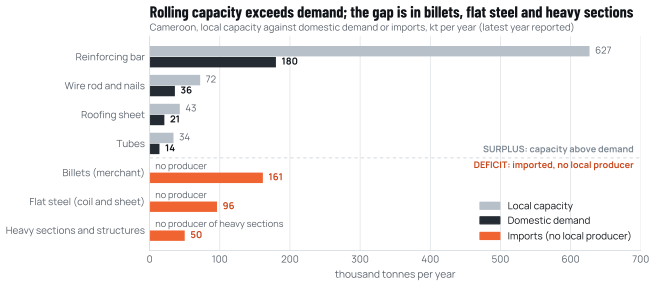
Source: Ocitram capacity and demand data as reported by Cameroon Tribune, 11 May 2026 [S03]; UN Comtrade import tonnages for 2023 (hot-rolled flat 2022) [S05]. Sections (HS 7216) tonnage derived from value.
ES.2 What the market is
Cameroon’s steel market is concentrated in construction. Reinforcing bar alone accounts for about 180 kt of the 450 kt of annual demand, and wire rod, wire and nails for about 38 kt [S03]. The rest is flat steel for roofing, tubes and appliances, sections and structures for industrial buildings and infrastructure, and a range of other products (Chapter 3). Domestic mills, clustered around Douala, produce most of the long products the country uses and export about 31 kt of reinforcing bar a year, mainly to Chad [S07][S05]. Flat steel and heavy sections are imported.
The country’s steel statistics are incomplete. There is no official apparent-use series, product-level trade data stop in 2023, and the population base is under revision after the provisional census [S05][S15]. This paper therefore states its sources and status for every number, publishes the data behind every chart, and lists its evidence gaps in Chapter 11.
ES.3 Where the gap really is
The import record is the clearest evidence. Chapter 72 imports more than doubled between 2019 and 2025, from 182,890 t to 412,049 t, while average unit values fell 47% from their 2022 peak [S19][S07]. In 2023, the latest year with product detail, billets accounted for about half of the chapter 72 import bill, flat products for about a third and sections for about 8% [S05]. Wire-rod imports collapsed from 58.1 kt in 2021 to 7.8 kt in 2023 as local rolling came on stream, and rebar imports have been marginal since the 2016 ban [S05][S04].
The pattern is consistent: where Cameroon has rolling capacity and protection, imports of the finished product disappear and imports of the semi-finished input rise. Billet imports grew from 52.5 kt in 2019 to 161.4 kt in 2023 [S05]. Domestic scrap cannot fill the gap: the only quantified study found arising of 53 to 62 kt a year in 2006, industry reports that scrap covers about 40% of needs, and scrap prices have risen by about 30% [S27][S03][S01]. The country’s dependence on foreign steel has moved upstream, from bars to the iron that makes them.
ES.4 How demand could grow to 2040
The scenarios in Chapter 7 multiply the World Bank’s population projection by three paths for steel use per person. In the low case use per person barely moves and demand reaches about 685 kt by 2040. In the base case it rises to 21.8 kg, close to today’s average for Africa outside Egypt and South Africa, and demand reaches about 920 kt. In the high case it rises to 29.1 kg, today’s average for Africa as a whole, and demand reaches about 1,230 kt [S18][S02]. These are illustrative scenarios, not forecasts; their method is set out in Annex A.
Three results are common to all scenarios. Reinforcing bar remains the largest product but grows more slowly than sections and flat steel, as infrastructure shifts towards railways, ports, power and mines. Rebar demand stays below today’s installed capacity of 627 kt even in the high case. And the iron-unit gap, the metal that domestic long-product mills need beyond local scrap, widens from about 170 kt to between 225 kt and 520 kt a year. Adding the other CEMAC states, whose chapter 72 imports were about US$191m in 2023, raises the regional market to roughly 1.4 Mt by 2040 in the base case, an indicative figure [S06].
ES.5 Prices and competition
Prices confirm the structure. On 3 October 2026 billets were quoted at US$465 to 480 per tonne FOB from China and Russia, and at US$515 to 525 delivered (CFR) to Türkiye; Turkish export rebar was quoted at US$620 to 630 FOB [S22]. In Cameroon, rebar prices are homologated by the Ministry of Commerce, and the October 2023 list implies about 633,000 FCFA per tonne for 12 mm FE500 bar, about €965 [S24]. That premium over import parity is sustained by the import ban and is exposed to any change in policy. For a new producer, the durable benchmark is the delivered cost of imported billets, about US$570 to 650 per tonne landed and duty-paid at October 2026 prices (derived). Section 8.6 sets it against an indicative cost of making a billet at Kribi from imported scrap and hot-briquetted iron, about US$590 to 780 per tonne before capital charges: the ranges overlap only at the low end, where power is bought at legacy high-voltage prices. The decisive local variables are therefore the cost of iron units and the duty paid on them, the price of power and, in time, iron made from Cameroonian ore and gas (Chapter 8).
Competition will come from surplus Asian and Russian billets, North African producers with gas-based iron, new mills in Gabon supported by a VAT preference, and Cameroon’s own under-used rolling capacity [S22][S28][S29][S20]. Neighbouring markets for reinforcing bar, such as Gabon’s 51 kt and Congo’s 33 kt of imports, are closing from inside [S06][S21][S30].
ES.6 What it means for a new producer
The evidence sets a clear order of priorities (Chapter 9). First, iron units: merchant billets that domestic re-rollers would otherwise import, and in the longer term ore-based iron linked to Cameroon’s iron-ore projects, which form 9% of the world’s pipeline of iron-ore mine capacity in development [S31]. Second, heavy sections, beams and structures, a fully imported segment that grows fastest in every scenario. Third, reinforcing bar and wire rod only where they can be differentiated by certified quality, integration and regional reach. Flat steel is a real gap but requires a scale that the market alone does not yet justify.
Cameroon Steel’s planned complex at Mboro, in the Kribi industrial-port zone, is used in this paper as a worked example. Its design capacity was reported in January 2025 as 1 Mt a year, built in phases [S32]. In the reference configuration RC-1, a planning estimate, Phase 1 is an electric arc furnace melt shop with a billet caster, a reinforcing-bar mill and a wire-rod mill, with a nameplate of 0.3 Mtpa and an expected sustained output of about 270 to 300 kt a year; later phases add sections and heavy beams [S33]. Read against the evidence, Phase 1’s melt shop makes billets, and its output is flexible between rolled products and merchant billets for re-rollers that import about 60% of their charge. Because rebar is saturated, Phase 1 tonnage has to go to import displacement, of billets first and wire rod second, and to CEMAC exports; new rebar capacity on its own closes no gap (section 9.8 and Table 9.2). Whether merchant billets can be sold at a margin depends on the cost comparison of section 8.6.
The main market risks are surplus imports at low prices, domestic overcapacity in long products, the possibility of policy reversal, administered prices, the cost and availability of feedstock and power, and foreign-exchange constraints. Their common mitigation is to position where the market is short and to compete on cost, quality and service rather than on protection.
ES.7 What policy can do
Cameroon’s policy has protected the last stage of production, finished bars, and left the iron units that feed it, the flat steel it does not make and the sections it imports exposed. The 2023 tariff even charged 5% on wire rod and 10% on the billets it is rolled from [S23]. Iron and steel imports absorbed 13% of the merchandise trade deficit in 2025 [S07]. Chapter 10 sets out a sequenced agenda: an annual national steel balance; publication of the steel lines of the harmonised CEEAC-CEMAC tariff and correction of inverted escalation; transparent, time-bound trade instruments in place of an open-ended ban; mandatory certification extended from rebar to structural steel; procurement that specifies certified steel and pays contractors on time; relief of the duty on iron units used for melting; incentives focused on melting, direct reduction and section rolling; and practical arrangements for the local-transformation clauses already written into mining conventions [S34][S35]. Each lever is compatible with tight fiscal space, which the IMF rates as carrying a high risk of debt distress [S36].
ES.8 How to read this paper
Chapters 1 and 2 set the global and African context. Chapters 3 to 6 analyse Cameroon’s demand drivers, imports, domestic industry and the CEMAC region. Chapter 7 presents the demand scenarios, Chapter 8 prices, Chapter 9 the implications for a new producer and Chapter 10 the policy levers. Chapter 11 lists the evidence gaps. Annex A sets out the method and assumptions, Annex B the glossary, Annex C every source cited, with its date and address, and Annex D the values plotted in every figure. Source markers such as [S12] refer to Annex C. Figures and tables carry a status chip: sourced, derived, assumed or illustrative. Companion papers in this series treat the production route and the phasing of RC-1 (White paper 03), power and gas (White paper 05), carbon (White paper 06) and the wider economics (White paper 09).
Statement of interest. This paper is published by Cameroon Steel, which is developing a steelworks at Kribi. It is written to inform public debate; its analysis is independent of any commercial offer, and every figure is sourced or labelled with its status.
本章引用的资料来源
方括号内的标记对应以下来源(按原文语言列出),完整列表见附录。 完整来源列表
- S01Cameroun: Prometal décroche 26,2 milliards FCFA d’Afreximbank. Camer.be,2026年10月1日.camer.be/actualites/economie/cameroun-prometal-decroche-262-milliards-…
- S02World Steel in Figures 2026 (page and PDF). worldsteel,2026年6月4日.worldsteel.org/data/world-steel-in-figures/world-steel-in-figures-2026…
- S07Évolution du commerce extérieur en 2025 (version provisoire). INS Cameroun,2026年2月(发布:2026年4月1日).ins-cameroun.cm/wp-content/uploads/2026/04/Note-sur-le-commerce-exteri…
- S05UN Comtrade public API, Cameroon (reporter 120), HS 72/73 and 6-digit lines, 2019-2023. UN Statistics Division.comtradeapi.un.org/public/v1/preview/C/A/HS?reporterCode=120&period=20…
- S03Production: les acteurs en présence. Cameroon Tribune,2026年5月11日.cameroon-tribune.cm/article.html/76600/fr.html/details_2
- S08December 2025 crude steel production and 2025 global totals. worldsteel,2026年1月23日.worldsteel.org/media/press-releases/2026/december-2025-crude-steel-pro…
- S09OECD: global steel excess capacity set to reach 745 million mt by 2028. EUROMETAL (Platts),2026年6月5日.eurometal.net/oecd-global-steel-excess-capacity-set-to-reach-745-milli…
- S10China increased steel exports by 7.5% y/y in 2025. GMK Center,2026年1月14日.gmk.center/en/news/china-increased-steel-exports-by-7-5-y-y-in-2025/
- S1162 countries implemented 207 restrictions against steel products from China. GMK Center,2025年10月13日.gmk.center/en/infographic/62-countries-implemented-207-restrictions-ag…
- S12World Steel in Figures 2025. worldsteel,2025年6月.worldsteel.org/data/world-steel-in-figures/world-steel-in-figures-2025…
- S132025 World Direct Reduction Statistics. Midrex Technologies,2026年9月.midrex.com/world-dri-statistics/world-dri-production-reaches-151-0-mt-…
- S14WDI API: SP.POP.TOTL; SP.URB.TOTL.IN.ZS (CMR). World Bank,更新:2026年10月8日.api.worldbank.org/v2/country/CMR/indicator/SP.POP.TOTL?format=json
- S15Cameroun: bouclage du 4e RGPH, 22,7 millions d’habitants recensés. Journal du Cameroun,2026年10月5日.fr.journalducameroun.com/cameroun-bouclage-du-4e-rgph-227-millions-dha…
- S16Les Comptes Nationaux de 2025. INS Cameroun,2026年8月(发布:2026年9月2日).ins-cameroun.cm/wp-content/uploads/2026/09/Comptes_Nationaux_2025_FR_V…
- S17Budget 2026-8 816,4 milliards FCFA…. MINFI,2025年11月26日.minfi.gov.cm/budget-2026-8-8164-milliards-fcfa-pour-consolider-la-stab…
- S18Population estimates and projections (source 40): SP.POP.TOTL and SP.URB.TOTL.IN.ZS, 2025 to 2040. World Bank,更新:2026年7月1日.api.worldbank.org/v2/country/CMR/indicator/SP.POP.TOTL?source=40&forma…
- S19Commerce extérieur du Cameroun en 2020. INS Cameroun,2021年7月.ins-cameroun.cm/wp-content/uploads/2025/07/Note-Commerce-exterieur-202…
- S20Cameroun: le groupe Prometal décroche 26 milliards FCFA auprès d’Afreximbank…. Sikafinance,2026年9月30日.sikafinance.com/marches/cameroun-le-groupe-prometal-decroche-26-millia…
- S21Prometal obtient 26 milliards FCFA d’Afreximbank pour soutenir son expansion industrielle. EcoMatin,2026年9月30日.ecomatin.net/prometal-obtient-26-milliards-fcfa-dafreximbank-pour-sout…
- S22Weekly steel prices (archive 40468). Arab Iron & Steel Union (AISU),2026年10月3日.aisusteel.org/en/archives/40468
- S23WITS TRAINS API, Cameroon reported MFN tariffs by HS6 (2023). World Bank / UNCTAD.wits.worldbank.org/API/V1/SDMX/V21/datasource/TRN/reporter/120/partner…
- S24Fer à béton: les producteurs acceptent une baisse des prix. EcoMatin,2023年10月23日.ecomatin.net/fer-a-beton-les-producteurs-acceptent-une-baisse-des-prix
- S25Stratégie Nationale de Développement 2020-2030 (SND30). Republic of Cameroon / MINEPAT (hosted by FAOLEX),2020年.faolex.fao.org/docs/pdf/cmr211554.pdf
- S26Cameroon rejects fresh push to revise rebar standard. Business in Cameroon,2026年1月26日.businessincameroon.com/construction/2601-15657-cameroon-rejects-fresh-…
- S04Press report of the sealing by customs of more than 7,300 t of imported reinforcing bar, December 2020 (headline and address not reproduced: they name the importer). Business in Cameroon,2020年12月16日.按标题和日期引用
- S27Bidoung J., Fomethe A., Yantio G., Melo U., La récupération et le recyclage des déchets ferromagnétiques: analyse de la situation au Cameroun (Déchets, Revue francophone d’écologie industrielle n°48). ENSP Yaoundé / MIPROMALO,2007年第四季度.eid.episciences.org/7942/pdf
- S06UN Comtrade public API, CEMAC & Nigeria (reporters 266 Gabon, 178 Congo, 140 CAR, 566 Nigeria; mirror partners 148 Chad, 226 Eq. Guinea). UN Statistics Division.comtradeapi.un.org/public/v1/preview/C/A/HS?reporterCode=266&period=20…
- S28Algeria’s steel industry: why is it growing. GMK Center,2026年7月28日.gmk.center/en/posts/algeria-s-steel-industry-why-is-it-growing/
- S29Le Gabon réduit la TVA sur le fer à béton local. EcoMatin,2026年8月4日.ecomatin.net/le-gabon-reduit-la-tva-sur-le-fer-a-beton-local-pour-stim…
- S30Gabon: le groupe Fokou lance une nouvelle unité d’acier à Port-Gentil. EcoMatin,2026年9月18日.ecomatin.net/gabon-le-groupe-fokou-lance-une-nouvelle-unite-dacier-a-p…
- S31Pedal to the Metal 2026. Global Energy Monitor,2026年5月.globalenergymonitor.org/sites/default/files/2026-05/Pedal%20to%20the%2…
- S32Industrialisation: la voie royale de l’émergence. Cameroon Tribune,2025年1月2日.cameroon-tribune.cm/article.html/68558/fr.html/details_2
- S33Cameroon Steel reference configuration RC-1 (planning estimate), edition 10 October 2026. Cameroon Steel,2026年10月10日.按标题和日期引用
- S34Cameroon Mining Company confirme l’entrée du projet Mbalam dans sa phase irréversible d’exécution. Camer.be(经AllAfrica转载),2025年12月12日.fr.allafrica.com/stories/202512120475.html
- S35Cameroon signs iron ore deal with Sinosteel (citing Reuters). Mining Technology,2022年5月23日.mining-technology.com/news/sinosteel-deal-iron-cameroon/
- S36IMF staff concludes Post-Financing Assessment mission to Cameroon (PR 26/314). IMF,2026年10月1日.imf.org/en/news/articles/2026/10/01/pr26314-imf-staff-concludes-assesm…
引用本章
Cameroon Steel(2026)。喀麦隆钢铁缺口在于含铁原料,而非钢筋(中文摘要版)。白皮书04,摘要:执行摘要:缺口在上游。CS-WP-04。https://www.cameroon-steel.com/zh/library/market-outlook/executive-summary/
来源