白皮书04 · 第2章 · 中文摘要
非洲是钢铁需求快速增长的唯一地区,而增长主要由进口满足
本章结论:非洲钢材消费增长迅速,但人均水平仍很低,消费与产量之间的缺口由进口填补;撒哈拉以南非洲增加了轧机,却几乎没有炼铁能力,稀缺的资产是铁。
本页为本章中文摘要;英文全文附于其后,可展开阅读。
本章目录(1)
2025年非洲成品钢材消费量为4500万吨,比2024年增长10.4%,而粗钢产量仅2980万吨,两者差距约1520万吨(推算)[S02]。世界钢铁协会预计2026年和2027年将分别增长3.8%和4.6%[S39]。非洲人均钢材消费29.2千克,仅为世界平均水平(209千克)的七分之一;埃及和南非以外地区为22.5千克[S02]。2025年非洲钢材进口从2390万吨增至3290万吨,其中1940万吨(59%)来自中国[S12][S02]。
非洲出口矿石、进口钢材:2024年非洲出口铁矿石8830万吨,几乎是其全部开采量[S02]。直接还原铁几乎全部产于北非:据Midrex工厂统计,撒哈拉以南非洲的竖炉直接还原厂2025年产量仅9万吨;世界钢铁协会另估计乌干达、肯尼亚和坦桑尼亚有约270万吨,主要为煤基[S13][S02]。三条经验值得注意:阿尔及利亚依靠天然气基炼铁和保护措施,从2021年约100万吨的缺口转为2025年约100万吨的净出口;南非的ArcelorMittal South Africa因能源、物流和废钢政策问题于2025年关停长材业务,影响约3500个岗位;而2026年9月达涅利在九天内宣布了两座年产30万吨的新棒线材轧机,这类轧机都需要采购钢坯[S57][S28][S61][S67][S68]。
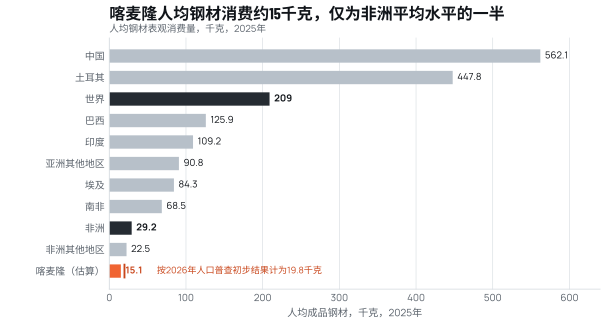
资料来源:世界钢铁协会《World Steel in Figures 2026》[S02];喀麦隆数据由45万吨行业估计[S01]及2988万人口(世界银行,2025年)[S14]或2270万人口(人口普查初步结果,2026年10月)[S15]推算。
英文全文 13分钟 · 2918词Africa is the one region where steel demand is rising fast, and imports fill most of it
Africa used 45.0 Mt of finished steel in 2025, 10.4% more than in 2024, while it produced only 29.8 Mt of crude steel [S02]. worldsteel now forecasts 3.8% growth in 2026 and 4.6% in 2027 and describes the change since 2023 as a transformative shift [S39]. Yet the continent’s steel use per person, 29.2 kg, is one seventh of the world average, and outside Egypt and South Africa it is 22.5 kg [S02]. The gap between use and production is filled by imports, which rose from 23.9 Mt in 2024 to 32.9 Mt in 2025, 59% of them from China [S12][S02]. North Africa shows that this gap can be closed with protection and gas-based iron; South Africa shows how quickly an established producer can fail when energy, logistics and feedstock go wrong. Sub-Saharan Africa has added rolling mills but little iron-making: its shaft-furnace DR plants produced only 0.09 Mt of direct-reduced iron in 2025 on Midrex plant data, and worldsteel estimates a further 2.7 Mt, mostly coal-based, in Uganda, Kenya and Tanzania [S13][S02].
2.1 Demand reached 45 Mt in 2025 and is forecast to keep growing
Africa’s apparent steel use fell from 39.2 Mt in 2021 to 35.3 Mt in 2022, then recovered to 38.6 Mt in 2023, 40.7 Mt in 2024 and 45.0 Mt in 2025 [S02]. Almost all of the growth came from outside the two large markets. Egypt used 10.0 Mt in 2025, about the same as in 2021, and South Africa 4.4 Mt, below its 2021 level of 5.0 Mt; the rest of the continent, which worldsteel reports as a single group, rose from 24.0 Mt to 30.6 Mt, a gain of 27.5% in four years [S02].
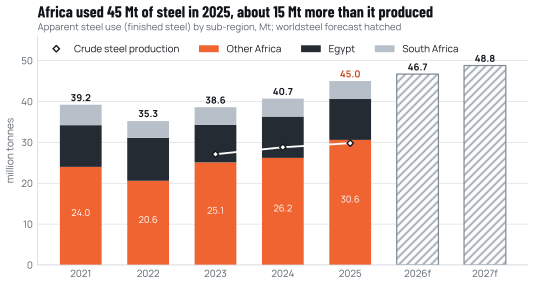
Source: worldsteel, World Steel in Figures 2026; Short Range Outlook, April 2026 [S02][S39].
The forecast is for continued, slower growth: 46.7 Mt in 2026 and 48.8 Mt in 2027 [S39]. Production is also rising. Africa produced 27.1 Mt of crude steel in 2023, 28.8 Mt in 2024 and 29.8 Mt in 2025, and in the first eight months of 2026 it was the fastest-growing producing region in the world, with output of 16.7 Mt, 9.4% more than a year earlier [S02][S38]. But production starts from a smaller base and is concentrated in three countries, so the absolute gap between use and production widened from about 11.5 Mt in 2023 to about 15.2 Mt in 2025 (derived from the series above). Africa accounted for 2.6% of world steel use and 1.6% of world production in 2025 [S02].
2.2 Per-capita use is the clearest measure of the gap
Steel use per person is the standard way to compare markets of different sizes, and it tells a consistent story. In 2025 the world used 209 kg per person, China 562.1 kg, Türkiye 447.8 kg, Brazil 125.9 kg and India 109.2 kg [S02]. Egypt used 84.3 kg and South Africa 68.5 kg. Africa as a whole used 29.2 kg, and the rest of Africa, excluding the two large markets, 22.5 kg [S02].
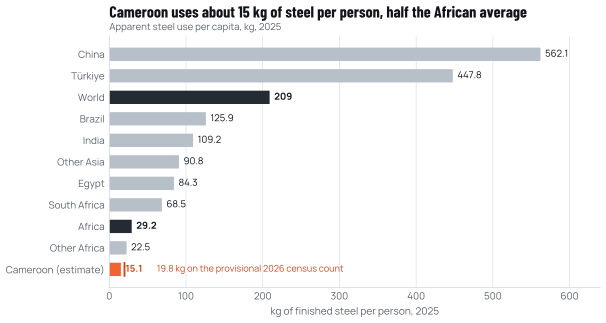
Source: worldsteel, World Steel in Figures 2026 [S02]; Cameroon derived from the industry estimate of 450 kt [S01] and population of 29.88 m (World Bank, 2025) [S14] or 22.7 m (provisional census, October 2026) [S15].
Cameroon’s own figure is an estimate, because the country does not publish an apparent steel use series. Industry sources put domestic steel demand at about 450,000 t a year [S01]. Divided by the World Bank population estimate for 2025, 29.88 million, this gives about 15 kg per person [S14]. The provisional results of the fourth general population census, released in October 2026, counted 22.7 million people, about 24% fewer than United Nations and IMF estimates; on that basis the figure would be about 20 kg [S15]. Either way, Cameroon sits below the average of the rest of Africa and far below the levels associated with middle-income economies. This paper uses the World Bank series for projections, because the census results are provisional, and treats per-capita values as a range (Annex A).
The relationship between income and steel use is not mechanical, but the direction is well established: as countries urbanise and build infrastructure, steel use per person rises, often quickly. India’s apparent steel use per person rose from 75.1 kg in 2021 to 109.2 kg in 2025, a gain of 45% in four years [S02]. The rest of Africa rose from 19.4 kg to 22.5 kg over the same period, a gain of 16% [S02]. These are the reference points used for the scenarios in Chapter 7.
2.3 Imports rose by 9 Mt in one year, and China supplied most of the increase
Africa imported 32.9 Mt of finished and semi-finished steel in 2025, up from 23.9 Mt in 2024. Imports from China rose from 13.8 Mt to 19.4 Mt and accounted for 59% of the total; 27.9 Mt came from outside Africa and the Middle East [S02][S12]. Intra-regional trade within Africa and the Middle East supplied 5.0 Mt, other European countries 2.6 Mt, the European Union 2.0 Mt, Russia and other CIS countries 1.7 Mt, and Japan and other Asian exporters 2.2 Mt [S02].
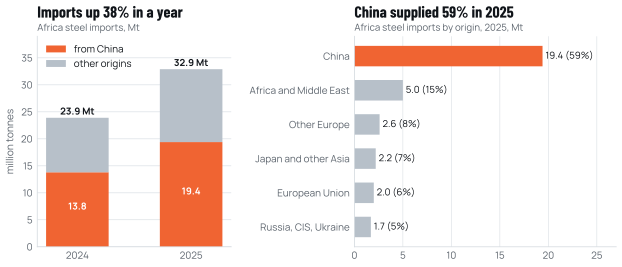
Source: worldsteel, World Steel in Figures 2026 and 2025 [S02][S12]. Shares derived.
The ratio of imports to use, 32.9 Mt against 45.0 Mt, or about 73%, overstates true import dependence because it mixes semi-finished and finished steel and includes re-exports, but it shows the scale of reliance on foreign steel [S02]. Chinese customs data point the same way: exports to African Union member states reached 13.78 Mt in the first ten months of 2025 [S37]. Africa is also a net importer of ferrous scrap, with 3.4 Mt imported and 1.2 Mt exported in 2025, which matters because scrap is the main feedstock of most African electric furnaces [S02]. Iron ore runs the other way: Africa produced 89.2 Mt of iron ore in 2024 and exported 88.3 Mt, most of it from South Africa [S02].
2.4 Production is concentrated in the north and in South Africa
Africa’s 29.8 Mt of crude steel in 2025 came overwhelmingly from Egypt (10.6 Mt), Algeria (5.5 Mt) and South Africa (4.5 Mt), followed by Morocco, Libya and a handful of Sub-Saharan producers [S02][S60]. Electric furnaces account for 89% of African output and oxygen converters for 11% [S02]. Direct-reduced iron, the gas-based iron unit that allows electric furnaces to make steel from ore rather than scrap, reached 16.3 Mt in 2025, almost all in North Africa: Egypt 6.6 Mt, Algeria 5.0 Mt on worldsteel’s estimate (6.70 Mt on Midrex plant data), Libya 1.7 Mt, with estimated, mainly coal-based volumes in Uganda (1.5 Mt), Kenya (1.0 Mt) and Tanzania (0.2 Mt) [S02][S13]. Sub-Saharan Africa made 0.09 Mt of DRI in 2025 on Midrex plant statistics, down from 0.20 Mt in 2024 and 0.22 Mt in 2023 [S13]. The two sources measure different things, and this paper quotes each with its basis. The region’s two shaft-furnace DR plants, at Warri in Nigeria (Delta Steel, 1.02 Mt a year, commissioned in 1982) and Saldanha in South Africa (ArcelorMittal South Africa, 0.80 Mt a year), are idle [S13].
Table 2.1 sourcedSelected African steel producers and projects
| Country | Crude steel 2025 | Main producers and projects | Relevance for Central Africa | Source |
|---|---|---|---|---|
| Egypt | 10.6 Mt | Ezz Steel 7 Mtpa; Suez Steel and Beshay 2.2 Mtpa each; rolling capacity about 20 Mtpa at about 50% use; exports 2.1 Mt | Gas-DRI model; protective duties on billets and coil | [S02][S60][S54] |
| Algeria | 5.5 Mt | Tosyali Algérie 6.2 Mtpa; AQS Bellara 2.2 Mtpa; net exporter of about 1 Mt in 2025 after a 1 Mt deficit in 2021 | Import substitution through protection and gas-DRI | [S02][S57][S28] |
| South Africa | 4.5 Mt | ArcelorMittal South Africa wound down its long-steel business in 2025 (about 3,500 jobs) | Energy, logistics and scrap policy can close an incumbent | [S02][S61] |
| Libya, Morocco | 1.1 Mt; 1.5 Mt | Libyan DRI 1.75 Mt; new DRI projects of 8.1 Mtpa planned with Tosyali | North African iron units expanding | [S60][S13][S62] |
| Kenya | 1.8 Mt (estimate) | Devki Kwale integrated plant, 500 kt a year, ore-based, 2,500 direct jobs | Sub-Saharan ore-based precedent | [S02][S63] |
| Ghana | n.a. | Sentuo Steel, Tema, 800 kt a year electric furnace | Large Sub-Saharan melt shop | [S31][S64] |
| Nigeria | not reported | 0.6 Mtpa operating (GEM); Stellar Steel US$450m hot-rolled coil plant; Delta Steel DRI idle | Large market, weak production record | [S31][S65][S13] |
| Uganda | DRI 1.5 Mt (worldsteel estimate, mostly coal-based) | Devki Tororo, US$500m, ground broken late 2025 | Regional iron-making | [S02][S66] |
| Tanzania, Côte d’Ivoire | n.a. | New 300 kt a year bar and wire-rod mills (GSM, Danieli, 2026; B5Plus Abidjan, start 2027) | Rolling capacity multiplying | [S67][S68] |
Source: as listed. GEM: Global Energy Monitor. n.a.: not available in the sources consulted.
Global Energy Monitor counts about 38.4 Mtpa of operating capacity in African plants of at least 0.5 Mtpa, led by Egypt (15.56 Mtpa), Algeria (8.69 Mtpa) and South Africa (4.81 Mtpa); Ghana’s 0.8 Mtpa and Nigeria’s 0.6 Mtpa are the largest in West Africa [S31]. Electric furnace capacity in development includes 4.5 Mtpa in Namibia (under construction), 4.4 Mtpa in Algeria and 3.0 Mtpa in Nigeria; direct reduction capacity in development is dominated by Libya (10.5 Mtpa), Algeria (4.5 Mtpa) and Egypt (2.5 Mtpa) [S31]. Africa’s iron-making future, on current plans, is North African.
2.5 Africa’s iron ore is reaching the market faster than its steel industry
The contrast between ore and steel is sharpening. Simandou in Guinea, designed for up to 120 Mtpa of ore at about 65% iron, started operations on 11 November 2025 and shipped its first commercial cargo to China on 2 December 2025; about 6 Mt had been shipped by mid-May 2026 and shipments of more than 20 Mt are possible in 2026 [S69][S70][S71]. Global Energy Monitor counts 179 Mtpa of iron-ore mine capacity in development in Australia, 124 Mtpa in China, 120 Mtpa in Guinea and 64 Mtpa in Cameroon, which ranks fourth in the world with 9% of the global pipeline [S31]. Cameroon’s government has set out a 2026 to 2030 iron-ore investment programme of about 1,748 bn FCFA across three projects: Kribi-Lobé, Mbalam and Bipindi-Grand Zambi [S72].
None of this ore is destined, on current plans, for African steelmaking at scale. Africa’s iron-ore exports, 88.3 Mt in 2024, already exceed its total steel use by a factor of about two [S02]. The opportunity that ore development creates for the steel industry is indirect but real: heavy-haul railways, ore terminals, power lines and mine infrastructure consume steel in sections, plate, rail and fabricated structures, and some project conventions in Cameroon include obligations to transform part of the ore locally, a point taken up in Chapters 9 and 10 [S34][S35].
Demand from transport infrastructure is the other continental theme. The African Union has identified a need for about 12,000 km of railways, according to the Egyptian industry’s own presentation of the African market in October 2026 [S73]. Smaller markets show the starting point: Mauritania, a significant iron-ore exporter, uses about 0.1 Mt of steel a year, all of it imported [S74]. Countries that mine and export ore can remain steel importers for decades unless iron-making follows.
2.6 Trade within Africa is small but growing
Most of Africa’s imported steel comes from outside the continent, but intra-regional flows are not negligible. In 2025 Africa received 5.0 Mt of steel from Africa and the Middle East combined, about 15% of its imports [S02]. North African producers are the main intra-African suppliers: Egypt exported about 2.1 Mt of steel in 2025, and Algeria turned from a deficit of about 1 Mt in 2021 into a net exporter of about 1 Mt in 2025 [S54][S28]. South Africa has historically supplied its neighbours, and its billets reached Cameroon in 2023, when it shipped 9.8 kt [S05].
The African Continental Free Trade Area could deepen these flows as tariffs within Africa fall. North African producers present the continent as a natural market for their surplus, emphasising its 55 member states, about 1.5 billion people and US$3.4 trillion of output [S73]. For Central Africa, the consequence is double-edged: lower barriers would open regional markets to Cameroonian products, and Cameroonian markets to Egyptian and Algerian ones. Producers that are competitive on cost, with access to gas-based iron and ports, will benefit most. Chapter 6 discusses the trade rules that apply in CEMAC.
Scrap is a special case: Africa as a whole imported 3.4 Mt of scrap in 2025 against exports of 1.2 Mt [S02]. Scrap-based mini-mills, the most common form of new capacity in Sub-Saharan Africa, therefore compete for a scarce resource across borders. That competition is one reason why the new mills announced in Tanzania, Côte d’Ivoire and Gabon are likely to need imported billets or other iron units as they grow (Chapters 5 and 6).
2.7 Three lessons from the continent
The first lesson comes from Algeria. In 2021 the country had a steel deficit of about 1 Mt; by 2025 it was a net exporter of about 1 Mt, and the share of imports in its steel use fell from 35% to 16% [S57][S28]. The change rested on large gas-based direct reduction and electric furnace complexes, notably Tosyali’s, supported by import management and protection of the domestic market [S57][S28]. It shows that import substitution in steel is achievable when cheap gas, iron ore, scale and consistent protection come together.
The second lesson comes from South Africa, where ArcelorMittal South Africa decided in February 2025 to wind down its long-steel business, with about 3,500 jobs affected, citing energy costs and reliability, logistics failures, scrap policy that favoured some competitors and weak protection against imports [S61]. Negotiations with the Industrial Development Corporation over the assets resumed in 2026 [S75]. An established producer in Africa’s most industrial economy closed a business line that its home market still needs, because the conditions around the plant deteriorated.
The third lesson is that rolling mills are easy to add and iron-making is hard. Danieli announced two new 300 kt a year bar and wire-rod mills in Africa within nine days in September 2026, one for GSM in Tanzania and one for B5Plus in Abidjan [S67][S68]. Such mills buy billets. Unless iron-making capacity grows alongside them, they deepen the continent’s dependence on imported semi-finished steel, which is precisely the pattern seen in Cameroon (Chapter 5).
2.8 What the African picture means for Cameroon and CEMAC
The African evidence sets realistic expectations for the scenarios in Chapter 7. Continental demand is growing at roughly 4% to 5% a year in worldsteel’s near-term forecast, after a 10.4% jump in 2025 [S39]. The rest of Africa raised its use per person by about 16% between 2021 and 2025 [S02]. A Cameroonian growth path between these benchmarks is plausible; one that assumes Cameroon will reach North African levels of use per person within fifteen years is not.
The evidence also identifies where competition will come from. North African producers with gas-based iron and surplus capacity, Egypt and Algeria in particular, are actively seeking African export markets; at an October 2026 business forum Ahmed Ezz, of Egypt’s Ezz Steel, made the case for "Invest Here… Produce Here" within the African Continental Free Trade Area of 55 countries, about 1.5 billion people and US$3.4 trillion of output [S73]. Asian exporters will continue to supply billets and flat steel at surplus prices. New rolling mills in East and West Africa will compete for the same imported billets that Cameroonian mills buy.
Finally, the African picture shows that the scarce asset is iron. Sub-Saharan Africa’s shaft-furnace output of direct-reduced iron, 0.09 Mt in 2025 on Midrex data, is negligible, its estimated 2.7 Mt of coal-based output is concentrated in East Africa [S13][S02], and its scrap is limited and partly exported or traded [S02]. A Central African producer able to supply consistent iron units, whether billets, direct-reduced iron or hot-briquetted iron, would be serving the bottleneck of the regional industry rather than adding to its most crowded segment. That theme runs through the rest of this paper.
Other sources cited in the English text
- S38August 2026 crude steel production. worldsteel, 24 Sep 2026.worldsteel.org/media/press-releases/2026/august-2026-crude-steel-produ…
- S37China’s rapidly growing steel exports will lose momentum from 2026 onwards. GMK Center, 24 Dec 2025.gmk.center/en/infographic/china-s-rapidly-growing-steel-exports-will-l…
- S60Steel production in Arab countries increased by 7.2% in 2025. AISU, 26 Jan 2026.aisusteel.org/en/archives/39369
- S54Egypt’s steel industry: protection from within. GMK Center, 23 Jul 2026.gmk.center/en/posts/egypt-s-steel-industry-protection-from-within/
- S62North African green steel will soon be in demand in the EU, an overview. GMK Center, 25 Aug 2025.gmk.center/en/posts/north-african-green-steel-will-soon-be-in-demand-i…
- S63Devki opens Sh50bn steel plant in Kwale. Capital FM Kenya, 20 Nov 2022.capitalfm.africa/devki-opens-sh50bn-steel-plant-in-kwale/
- S31Pedal to the Metal 2026. Global Energy Monitor, May 2026.globalenergymonitor.org/sites/default/files/2026-05/Pedal%20to%20the%2…
- S64Sentuo Steel Tema plant. Global Energy Monitor (GEM.wiki; tertiary), last edit 9 Oct 2026.gem.wiki/Sentuo_Steel_Tema_plant
- S65China’s Stellar Steel invests $450 million in a new steel plant in Nigeria. GMK Center, 27 Oct 2025.gmk.center/en/news/china-s-stellar-steel-invests-450-million-in-a-new-…
- S66A steel plant will be built in Uganda with investments of $500 million. GMK Center, 5 Dec 2025.gmk.center/en/news/a-steel-plant-will-be-built-in-uganda-with-investme…
- S69Simandou partners celebrate start of operations. Rio Tinto, 11 Nov 2025.riotinto.com/en/news/releases/2025/simandou-partners-celebrate-start-o…
- S70The first commercial shipment of iron ore from Simandou has departed for China. GMK Center, 3 Dec 2025.gmk.center/en/news/the-first-commercial-shipment-of-iron-ore-from-sima…
- S71Ore shipments from Simandou could exceed 20 million tonnes in 2026. GMK Center, 9 Jun 2026.gmk.center/en/news/ore-shipments-from-simandou-could-exceed-20-million…
- S72Cameroon plans $3.1B iron ore push starting 2026. Daba Finance (republished by AllAfrica), 14 Feb 2026.dabafinance.com/en/news/cameroon-mining-investment-2026-2030
- S34Cameroon Mining Company confirme l’entrée du projet Mbalam dans sa phase irréversible d’exécution. Camer.be via AllAfrica, 12 Dec 2025.fr.allafrica.com/stories/202512120475.html
- S35Cameroon signs iron ore deal with Sinosteel (citing Reuters). Mining Technology, 23 May 2022.mining-technology.com/news/sinosteel-deal-iron-cameroon/
- S73Ahmed Ezz: Opening African Markets… (Alamein-Africa Business Forum). AISU, 6 Oct 2026.aisusteel.org/en/archives/40504
- S74Mauritania’s steel market poised for growth. GMK Center, 31 Aug 2026.gmk.center/en/posts/mauritania-s-steel-market-poised-for-growth/
- S05UN Comtrade public API, Cameroon (reporter 120), HS 72/73 and 6-digit lines, 2019-2023. UN Statistics Division.comtradeapi.un.org/public/v1/preview/C/A/HS?reporterCode=120&period=20…
- S75ArcelorMittal South Africa and IDC resume negotiations. GMK Center, 22 Jan 2026.gmk.center/en/news/arcelormittal-south-africa-and-idc-resume-negotiati…
本章引用的资料来源
方括号内的标记对应以下来源(按原文语言列出),完整列表见附录。 完整来源列表
- S02World Steel in Figures 2026 (page and PDF). worldsteel,2026年6月4日.worldsteel.org/data/world-steel-in-figures/world-steel-in-figures-2026…
- S39worldsteel Short Range Outlook April 2026 (release + Table 1). worldsteel,2026年4月14日.worldsteel.org/media/press-releases/2026/worldsteel-short-range-outloo…
- S12World Steel in Figures 2025. worldsteel,2025年6月.worldsteel.org/data/world-steel-in-figures/world-steel-in-figures-2025…
- S132025 World Direct Reduction Statistics. Midrex Technologies,2026年9月.midrex.com/world-dri-statistics/world-dri-production-reaches-151-0-mt-…
- S57Protecting the steel market: how it’s done in North Africa. GMK Center,2026年9月2日.gmk.center/en/posts/protecting-the-steel-market-how-it-s-done-in-north…
- S28Algeria’s steel industry: why is it growing. GMK Center,2026年7月28日.gmk.center/en/posts/algeria-s-steel-industry-why-is-it-growing/
- S61Update: Final wind-down decision relating to the Long Steel Business. ArcelorMittal South Africa,2025年2月28日.arcelormittalsa.com/Portals/0/NEWS%20RELEASE%20-%20UPDATE%20-%20FINAL%…
- S67GSM Tanzania selects Danieli for new rebar and wire-rod mill. Danieli,2026年9月14日.danieli.com/en/GSM-Tanzania-selects-Danieli-for-new-rebar-and-wirerod-…
- S68B5Plus Group awards Danieli bar and wire-rod mill project. Danieli,2026年9月23日.danieli.com/en/B5Plus-Group-awards-Danieli-bar-and-wirerod-mill-projec…
- S01Cameroun: Prometal décroche 26,2 milliards FCFA d’Afreximbank. Camer.be,2026年10月1日.camer.be/actualites/economie/cameroun-prometal-decroche-262-milliards-…
- S14WDI API: SP.POP.TOTL; SP.URB.TOTL.IN.ZS (CMR). World Bank,更新:2026年10月8日.api.worldbank.org/v2/country/CMR/indicator/SP.POP.TOTL?format=json
- S15Cameroun: bouclage du 4e RGPH, 22,7 millions d’habitants recensés. Journal du Cameroun,2026年10月5日.fr.journalducameroun.com/cameroun-bouclage-du-4e-rgph-227-millions-dha…
引用本章
Cameroon Steel(2026)。喀麦隆钢铁缺口在于含铁原料,而非钢筋(中文摘要版)。白皮书04,第2章:非洲是钢铁需求快速增长的唯一地区,而增长主要由进口满足。CS-WP-04。https://www.cameroon-steel.com/zh/library/market-outlook/africa/
来源