白皮书04 · 第6章 · 中文摘要
CEMAC带来5亿美元的区域市场,但邻国正在建设自己的钢厂
本章结论:区域市场真实存在且在增长,但竞争日趋激烈;区域机会更有利于邻国不生产的产品,如钢坯和型材,而不是钢筋。
本页为本章中文摘要;英文全文附于其后,可展开阅读。
2023年CEMAC六国进口第72章钢铁约5.01亿美元,其中喀麦隆3.104亿美元,约占62%;乍得7340万美元,加蓬6850万美元,刚果(布)3390万美元,赤道几内亚1160万美元,中非共和国340万美元[S05][S06]。除喀麦隆外的五国合计约1.91亿美元,主要为成品:加蓬2023年进口钢筋5.07万吨,刚果(布)2024年进口3.28万吨[S06]。CEMAC人口预计将从2025年的6740万增至2040年的9720万[S18]。喀麦隆每年出口钢筋约3.1万吨,主要销往乍得(2023年为2.59万吨)[S07][S05]。
但邻国市场正在从内部收窄:2026年7月加蓬将本地生产钢筋的增值税从10%降至3%,Prometal集团在恩科克经济特区建设一期年产12万吨的废钢基钢筋厂[S29][S21]。尼日利亚第72章进口额在2021年至2024年间下降76%[S06]。共同货币是区域供应商的优势:CEMAC内部贸易以中非法郎结算,无汇率风险,而区外进口须动用仅相当于4.2个月进口额的外汇储备[S113]。按每吨700至900美元的假设均价,其他五国的进口约相当于每年21万至27万吨(推算)。
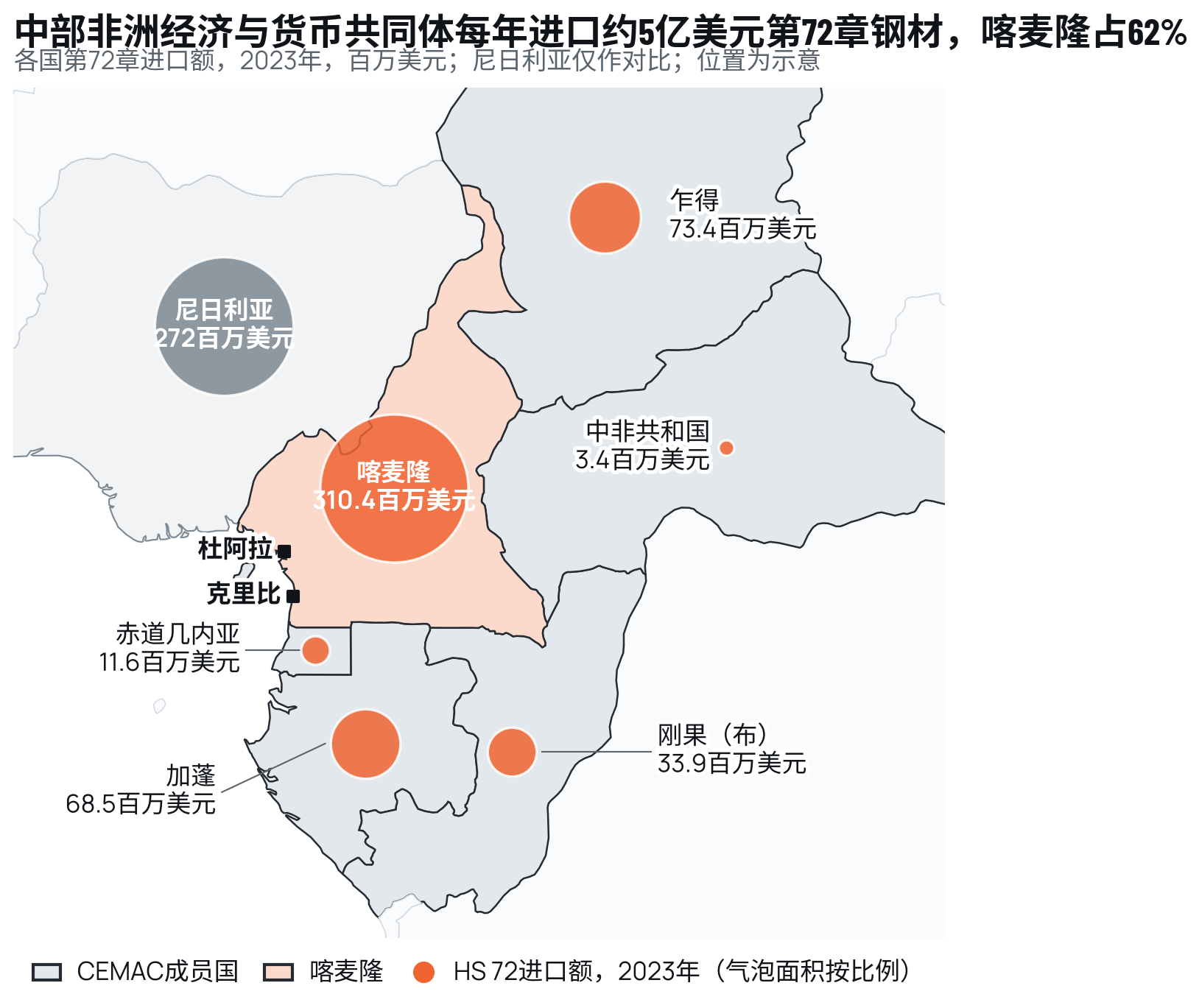
资料来源:联合国商品贸易统计数据库,申报国及伙伴国(镜像)数据,2023年[S05][S06]。乍得和赤道几内亚采用伙伴国数据;合计为推算;底图来自Natural Earth,位置为示意,未显示任何项目边界。
英文全文 11分钟 · 2626词CEMAC adds a regional market of half a billion dollars, but neighbours are building their own mills
The six CEMAC states imported about US$501m of chapter 72 iron and steel in 2023, and Cameroon accounted for about 62% of that total [S05][S06]. The other five, Chad, Gabon, the Republic of Congo, Equatorial Guinea and the Central African Republic, imported about US$191m, largely as finished products: Gabon and Congo alone imported about 84 kt of reinforcing bar in their latest reported years [S06]. CEMAC’s population is projected to grow from 67.4 million in 2025 to 97.2 million in 2040 [S18]. Cameroon already exports about 31 kt of reinforcing bar a year, mostly to Chad [S07][S05]. The regional market is real and growing, but it is also becoming contested: Gabon has reduced VAT on locally made reinforcing bar to 3%, and two scrap-based rebar projects are under way there [S29][S21][S30]. Nigeria, next door, is a much larger steel market whose imports have collapsed since its currency devaluation [S06]. The regional opportunity favours products neighbours do not make, such as billets and sections, more than reinforcing bar.
6.1 A market of 67 million people and half a billion dollars
The Central African Economic and Monetary Community (CEMAC) shares a currency pegged to the euro, a regional central bank and a common external tariff, now being harmonised with the wider Economic Community of Central African States (ECCAS, or CEEAC in French) [S131]. Its six members had a combined population of about 67.4 million in 2025 and a combined GDP of about US$134bn, of which Cameroon accounted for about 44% (derived) [S132].
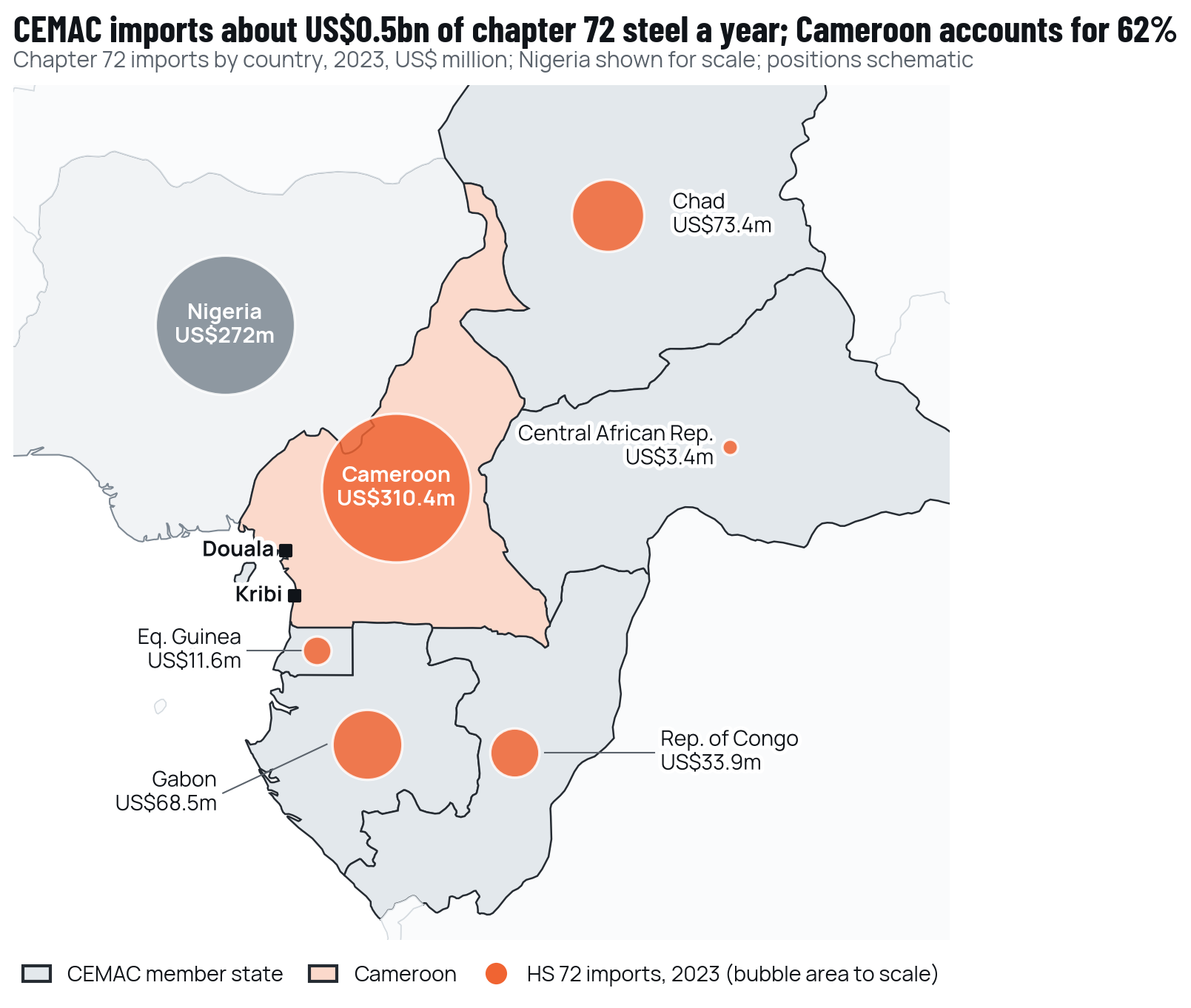
Source: UN Comtrade, reporter and partner (mirror) data, 2023 [S05][S06]. Chad and Equatorial Guinea from partner data. Total derived. Base map: Natural Earth; positions schematic; no project boundaries shown.
Comtrade reports CEMAC trade in values, not consistently in tonnes, so the regional market can only be sized in dollars with confidence. In 2023 Cameroon imported US$310.4m of chapter 72 products, Chad US$73.4m (on its partners’ export data), Gabon US$68.5m, the Republic of Congo US$33.9m, Equatorial Guinea US$11.6m and the Central African Republic US$3.4m [S05][S06]. The total, about US$501m, is the best available measure of the CEMAC chapter 72 market (derived). The structure differs sharply between Cameroon and its neighbours: Cameroon imports semi-finished steel to roll at home, while the others import mostly finished products, including reinforcing bar.
Table 6.1 sourcedCEMAC member states and Nigeria, selected indicators
| Country | Population 2025 (m) | Population 2040, projected (m) | GDP 2025 (US$bn) | GDP growth 2025 | Urban share 2025 | HS 72 imports (US$m) | Reinforcing bar (HS 7214) |
|---|---|---|---|---|---|---|---|
| Cameroon | 29.88 | 42.21 | 58.9 | 3.2% | 55.7% | 310.4 (2023) | Exports about 31 kt (2025) |
| Chad | 21.00 | 31.31 | 21.5 | 5.6% | 27.6% | 73.4 (2023, mirror) | Imports from Cameroon 25.9 kt (2023) |
| Gabon | 2.59 | 3.45 | 21.4 | 2.5% | 92.1% | 68.5 (2023) | Imports 50.7 kt (2023) |
| Rep. of Congo | 6.48 | 9.08 | 16.3 | 3.1% | 64.1% | 33.9 (2023); 45.5 (2024) | Imports 12.8 kt (2023); 32.8 kt (2024) |
| Equatorial Guinea | 1.94 | 2.67 | 12.8 | −5.9% | 71.6% | 11.6 (2023, mirror) | n.r. |
| Central African Rep. | 5.51 | 8.53 | 3.1 | 4.5% | 44.6% | 3.4 (2023); 2.6 (2024) | Imports about 1.0 kt |
| CEMAC | 67.40 | 97.24 | 134.0 | about 501 (2023) | |||
| Nigeria | 237.53 | 312.71 | 290.8 | 4.0% | 63.8% | 272.0 (2023); 225.7 (2024) | n.r. |
Source: World Bank, World Development Indicators and population projections (October and July 2026) [S132][S18]; UN Comtrade, reporter and mirror data [S05][S06]; INS foreign trade note for Cameroon’s exports [S07]. GDP growth from the World Bank series; INS reports 3.5% for Cameroon in 2025 [S16]. n.r.: not reported. Totals derived.
6.2 Chad and the Central African Republic: landlocked markets served through Douala
Chad is Cameroon’s natural export market for steel. It is landlocked, its trade runs largely through the Douala corridor, and its population, 21.0 million in 2025, is projected to reach 31.3 million in 2040 [S132][S18]. Its partners reported exports of US$73.4m of chapter 72 steel to Chad in 2023, of which US$36.1m came from Benin, US$26.5m from Cameroon and US$4.6m from the United Arab Emirates [S06]. Cameroon’s reinforcing-bar exports to Chad were 25.9 kt in 2023, worth US$23.1m, most of Cameroon’s total bar exports that year [S05]. The Central African Republic is much smaller, with chapter 72 imports of US$3.4m in 2023 and about 1.0 kt of reinforcing bar, and received 0.2 kt of Cameroonian bars [S06][S05].
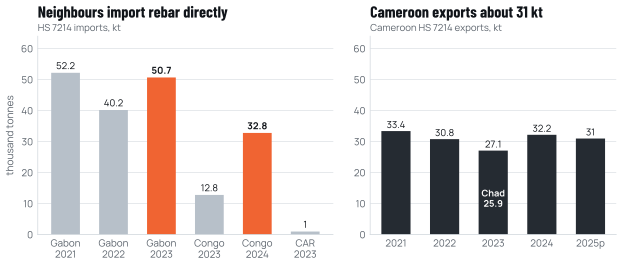
Source: UN Comtrade [S05][S06]; INS foreign trade notes for Cameroon’s exports [S114][S107][S07].
The corridors to Chad and the Central African Republic are among the reasons cited for the second phase of the Yaoundé-Douala motorway, which is expected to improve the Douala-N’Djamena, Douala-Bangui and Douala-Brazzaville routes [S77]. Benin’s significant share of Chad’s imports shows that Cameroon does not have a natural monopoly on this market: steel also reaches Chad from the Gulf of Guinea ports further west.
6.3 Gabon and the Republic of Congo: oil economies with growing rebar imports and new mills
Gabon is a small but relatively high-income market, with 2.59 million people, GDP per person of about US$8,263 and an urban share of 92% in 2025 [S132]. Its chapter 72 imports more than doubled from US$31.9m in 2019 to US$68.5m in 2023, and it imported 52.2 kt of reinforcing bar in 2021, 40.2 kt in 2022 and 50.7 kt in 2023, worth US$44.1m [S06]. A 2023 comparison found reinforcing bar in Cameroon about 25% cheaper than in Gabon and about 10% cheaper than in Côte d’Ivoire [S133].
Gabon is building its own capacity. The Prometal group is developing a plant at the Nkok special economic zone with a first phase of 120,000 t a year of scrap-based reinforcing bar for 38 bn FCFA, although other reports give 30 bn FCFA and 170,000 t [S21]. The Fokou group, which has operated Aciéries du Gabon with 70 kt a year of reinforcing bar and 10 kt of tubes since 2016, launched a new scrap unit at Port-Gentil of 2,500 t a month for 6 bn FCFA in September 2026 [S30]. In July 2026 Gabon cut VAT on locally made reinforcing bar from 10% to 3% [S29]. A press report of 1.107 Mt of Gabonese rebar production in 2024 is implausible against import volumes of about 51 kt and is not used here [S30].
The Republic of Congo, with 6.48 million people, imported US$33.9m of chapter 72 steel in 2023 and US$45.5m in 2024, and its reinforcing-bar imports rose from 12.8 kt to 32.8 kt between those years [S06]. Its chapter 73 imports, US$393.2m in 2023 and US$437.6m in 2024, are much larger than its chapter 72 imports, reflecting the tubes, structures and equipment used by its oil industry [S06]. Gabon’s chapter 73 imports, US$235.3m in 2023, follow the same pattern [S06].
6.4 Equatorial Guinea: a contracting oil economy
Equatorial Guinea, with 1.94 million people, has the second-highest GDP per person in CEMAC but a shrinking economy: the World Bank series shows real GDP falling 5.9% in 2025 [S132]. Its partners reported US$11.6m of chapter 72 exports to it in 2023, of which US$4.7m came from China, US$4.2m from Türkiye and US$0.85m from Cameroon [S06]. Cameroon also exported 0.8 kt of reinforcing bar there in 2023 [S05]. It is a small, project-driven market.
6.5 Nigeria: a large market whose imports have collapsed
Nigeria is not a member of CEMAC, but its border with Cameroon and its size make it relevant. Its population is projected to grow from 237.5 million in 2025 to 312.7 million in 2040 [S18]. Its chapter 72 imports were US$683.2m in 2019 and US$930.4m in 2021, then fell to US$560.0m in 2022, US$272.0m in 2023 and US$225.7m in 2024, a decline of 76% from the 2021 level, after the naira devaluations reduced dollar GDP from about US$487bn in 2023 to about US$252bn in 2024 [S06][S132]. Its chapter 73 imports were US$754.8m in 2024 [S06]. Nigeria’s statistics bureau recorded iron and steel imports of more than N1 trillion in 2025, and industry representatives put the annual steel import bill at about US$4bn, a figure that depends heavily on definitions and exchange rates [S134].
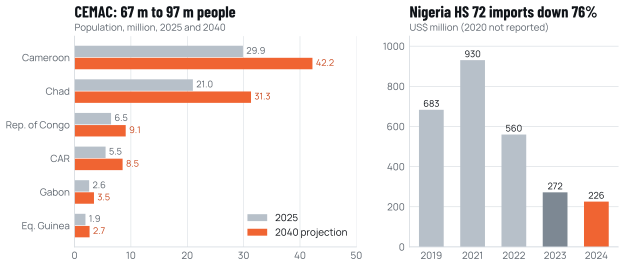
Source: World Bank population estimates and projections [S132][S18]; UN Comtrade [S06].
Nigeria’s own production base is weak relative to its size. Global Energy Monitor counts about 0.6 Mtpa of operating capacity in plants of at least 0.5 Mtpa and 3.0 Mtpa of electric furnace capacity in development; the Delta Steel direct reduction plant at Warri (1.02 Mt a year) is idle, and the Ajaokuta complex, designed for up to 5.2 Mt a year, has remained largely dormant [S31][S13][S134]. A Chinese investor, Stellar Steel, announced a US$450m hot-rolled coil plant with a target of mid-2026 [S65]. For a Cameroonian producer, Nigeria is a market to watch rather than a base case: its currency and trade policy are volatile, and its land border with Cameroon carries limited formal steel trade.
6.6 Trade rules: CEMAC, CEEAC and the African Continental Free Trade Area
Cameroon applies the CEMAC common external tariff. Its 2023 structure had bands of 0%, 5%, 10% (raw materials and equipment), 20% (intermediate goods) and 30% (consumer goods) [S135]. A harmonised CEEAC-CEMAC common external tariff, adopted on 18 October 2024, has applied in Cameroon since 1 January 2026; sources describe its bands differently, as 0% to 40% or 0% to 30%, and its rates for steel lines had not been published at the research cut-off [S131][S135][S136]. Originating goods have traded duty-free within CEEAC since 1 January 2018 [S124]. Cameroon’s 2025 Finance Law, which withdraws customs facilities from imported goods that have local equivalents, expressly exempts trade under CEMAC, CEEAC and the African Continental Free Trade Area, as well as the economic partnership agreements with the European Union and the United Kingdom [S137].
Cameroon signed the African Continental Free Trade Area agreement on 21 March 2018, ratified it on 31 January 2020 and deposited its instrument on 1 December 2020; 50 ratifications had been deposited by 4 September 2026 [S138][S139]. The rules of origin for chapter 72 products and CEMAC’s tariff schedule for reinforcing bar under the agreement could not be verified for this paper [S140]. They matter. A billet melted in Cameroon from imported direct-reduced iron, or a section rolled from imported billets, may or may not qualify as originating, and that will decide whether such products enter neighbouring markets duty-free. In October 2026 the AfCFTA Secretary-General urged member states to move from negotiating rules, such as the recently concluded automotive rules of origin, to investment and jobs [S141].
6.7 Money and payments: the advantage of a common currency
CEMAC’s monetary arrangements shape regional steel trade in ways that are easy to overlook. Its members share the CFA franc, pegged to the euro at 655.957 FCFA per euro, and a central bank, the BEAC. Trade between Cameroon and its CEMAC neighbours is therefore settled without exchange risk or the need to buy foreign currency. Imports from outside the zone, by contrast, must be paid in dollars, euros or yuan, drawing on reserves that fell to 6,377.3 bn FCFA at the end of 2025, equivalent to 4.2 months of imports [S113]. Transfers abroad above 50m FCFA require authorisation by the central bank under the CEMAC foreign-exchange regulation, and Cameroon’s 2026 Finance Law prohibits purchases from foreign suppliers without an effective transfer of funds [S142][S136].
For a buyer in Chad, Gabon or Congo, a supplier in Cameroon therefore offers more than a shorter delivery time: it offers payment in the buyer’s own currency, without the delays and costs of foreign-exchange approval. For the zone as a whole, every tonne of steel supplied from within CEMAC rather than imported from outside saves foreign exchange, which is the binding constraint on the region’s external accounts. The BEAC raised its main policy rate to 4.75% in December 2025, which raises the cost of financing imported stocks [S113]. These conditions favour regional suppliers of the products that the zone imports in bulk, notably billets, sections and structures.
6.8 Logistics: Douala’s corridors and Kribi’s deep water
Douala remains the main gateway for Chad and the Central African Republic. Kribi, the deep-water port to the south, handled 12.7 Mt of traffic in 2025, 19% more than in 2024, including 555,398 twenty-foot equivalent units, and claims 37.5% of national container traffic [S99]. Its container terminal is under strain: container traffic rose 82.4% in the year after the second terminal opened and import dwell time reached 25.28 days in 2026 [S143][S100]. No railway reaches Kribi yet; a memorandum on an Edéa-Kribi-Lolabé-Campo line of about 185 km was signed on 4 June 2026 [S88]. For regional distribution of steel, road links to Edéa and Douala, the multipurpose terminal and the mineral terminal at Kribi, the subject of a memorandum of understanding of 4 November 2025 with completion targeted within five to six years of March 2026, will matter more than the container terminal [S89][S91].
6.9 Sizing the regional opportunity
Because tonnage data are incomplete, the regional market can only be sized indicatively. The five CEMAC members other than Cameroon imported about US$191m of chapter 72 steel in 2023 (derived) [S06]. At an average delivered value of US$700 to 900 per tonne, an assumption bracketing international rebar export prices of US$545 to 630 per tonne plus freight, duties and product mix (Chapter 8), that corresponds to roughly 210 to 270 kt a year (derived; assumption in Annex A). Chapter 7 projects this envelope to 2040 under the same scenarios used for Cameroon.
Three features of this market shape the opportunity. It is dominated by finished products, so its value to a Cameroonian producer depends on what that producer makes. It is dispersed across five countries with different logistics, from Gabon’s coast to landlocked Chad. And it is contested: Gabonese mills, North African exporters and Asian surplus all compete for it. The most defensible regional positions are therefore in products where Cameroon’s neighbours have no production at all, such as heavy sections, structures and merchant billets for the new mills being built in Gabon, and in markets such as Chad where Cameroon already has a logistics advantage.
Other sources cited in the English text
- S131Cameroon applies CEEAC common external tariff from January 1, 2026. Business in Cameroon, 12 Jan 2026.businessincameroon.com/public-management/1201-15594-cameroon-applies-c…
- S132World Development Indicators API: population, GDP (current US$), GDP growth, urban share for CMR, TCD, GAB, COG, GNQ, CAF, NGA. World Bank, updated 8 Oct 2026.api.worldbank.org/v2/country/CMR
- S16Les Comptes Nationaux de 2025. INS Cameroun, Aug 2026 (posted 2 Sep 2026).ins-cameroun.cm/wp-content/uploads/2026/09/Comptes_Nationaux_2025_FR_V…
- S114Note sur le commerce extérieur 2022. INS Cameroun, Dec 2023 (rev. 13 Feb 2024).ins-cameroun.cm/wp-content/uploads/2025/07/Note-sur-le-Commerce-Exteri…
- S107Évolution du commerce extérieur en 2024. INS Cameroun, Aug 2025.ins-cameroun.cm/wp-content/uploads/2025/12/Commext_2024_FR_Edite-final…
- S77Autoroute Yaoundé-Douala phase II: 1 072 milliards F pour 141 km à livrer en 2028. Journal du Cameroun, 17 Apr 2025.fr.journalducameroun.com/autoroute-yaounde-douala-phase-ii-1072-millia…
- S133Métallurgie: les locaux battent le fer chaud. Cameroon Tribune, 17 Aug 2023.cameroon-tribune.cm/article.html/59491/fr.html/details_2
- S30Gabon: le groupe Fokou lance une nouvelle unité d’acier à Port-Gentil. EcoMatin, 18 Sep 2026.ecomatin.net/gabon-le-groupe-fokou-lance-une-nouvelle-unite-dacier-a-p…
- S134Steel imports cost Nigeria over N1trn in 2025 as Ajaokuta remains idle. Opinion Nigeria, 31 Aug 2026.opinionnigeria.com/steel-imports-cost-nigeria-over-n1trn-in-2025-as-aj…
- S31Pedal to the Metal 2026. Global Energy Monitor, May 2026.globalenergymonitor.org/sites/default/files/2026-05/Pedal%20to%20the%2…
- S132025 World Direct Reduction Statistics. Midrex Technologies, Sep 2026.midrex.com/world-dri-statistics/world-dri-production-reaches-151-0-mt-…
- S65China’s Stellar Steel invests $450 million in a new steel plant in Nigeria. GMK Center, 27 Oct 2025.gmk.center/en/news/china-s-stellar-steel-invests-450-million-in-a-new-…
- S135Cameroon, Import Tariffs (Country Commercial Guide). US International Trade Administration, 10 Apr 2026.trade.gov/country-commercial-guides/cameroon-import-tariffs
- S136Cameroun: les principales innovations de la loi de finances pour 2026. Deloitte Société d’Avocats, 24 Mar 2026.blog.avocats.deloitte.fr/cameroun-les-principales-innovations-de-la-lo…
- S124Cameroon, Republic of: Corporate, Other taxes. PwC Worldwide Tax Summaries, reviewed 14 Aug 2026.taxsummaries.pwc.com/republic-of-cameroon/corporate/other-taxes
- S137Innovations douanières de la Loi de Finances 2025. MINFI, Direction Générale des Douanes, Jan 2025.minfi.gov.cm/wp-content/uploads/2025/01/EXPOSE_DGD_LF_2025.pdf
- S138List of countries which have signed, ratified/acceded to the AfCFTA Agreement. African Union Commission, 22 May 2026.au.int/sites/default/files/treaties/36437-sl-AGREEMENT_ESTABLISHING_TH…
- S139Status of AfCFTA ratification. tralac, upd. 7 Sep 2026.tralac.org/resources/infographic/13795-status-of-afcfta-ratification.h…
- S140AfCFTA e-Tariff Book. AfCFTA Secretariat, n.d..au-afcfta.org/etariff/
- S141AfCFTA Secretary-General urges shift from automotive rules to investment and jobs. AfCFTA Secretariat, 2 Oct 2026.au-afcfta.org/2026/10/afcfta-secretary-general-urges-shift-from-automo…
- S1422024 Investment Climate Statements: Cameroon. US Department of State, 2024.state.gov/reports/2024-investment-climate-statements/cameroon/
- S99Au Cameroun, le port de Kribi revendique la place de premier terminal à conteneurs. EcoMatin, 22 Apr 2026.ecomatin.net/au-cameroun-le-port-de-kribi-revendique-la-place-de-premi…
- S143Port de Kribi: l’explosion du trafic commence à saturer le terminal à conteneurs. EcoMatin, 5 Oct 2026.ecomatin.net/port-de-kribi-lexplosion-du-trafic-commence-a-saturer-le-…
- S100Port de Kribi: le trafic conteneurisé bondit de 82% un an après la mise en service du 2e terminal. EcoMatin, 14 May 2026.ecomatin.net/port-de-kribi-le-trafic-conteneurise-bondit-de-82-un-an-a…
- S88Ligne ferroviaire Edéa-Kribi-Lolabé-Campo: une nouvelle étape pour la connectivité du port de Kribi. Port Autonome de Kribi (PAK), 4 Jun 2026.Cited by title and date
- S89Port de Kribi: un terminal minéralier d’avenir. Port Autonome de Kribi (PAK), 4 Nov 2025.Cited by title and date
- S91Zone industrialo-portuaire de Kribi (KPIZ): jusqu’à +8 points de croissance et 150 000 emplois attendus sur 15 ans. Investir au Cameroun, 4 Mar 2026.investiraucameroun.com/gestion-publique/0403-23163-zone-industrialo-po…
本章引用的资料来源
方括号内的标记对应以下来源(按原文语言列出),完整列表见附录。 完整来源列表
- S05UN Comtrade public API, Cameroon (reporter 120), HS 72/73 and 6-digit lines, 2019-2023. UN Statistics Division.comtradeapi.un.org/public/v1/preview/C/A/HS?reporterCode=120&period=20…
- S06UN Comtrade public API, CEMAC & Nigeria (reporters 266 Gabon, 178 Congo, 140 CAR, 566 Nigeria; mirror partners 148 Chad, 226 Eq. Guinea). UN Statistics Division.comtradeapi.un.org/public/v1/preview/C/A/HS?reporterCode=266&period=20…
- S18Population estimates and projections (source 40): SP.POP.TOTL and SP.URB.TOTL.IN.ZS, 2025 to 2040. World Bank,更新:2026年7月1日.api.worldbank.org/v2/country/CMR/indicator/SP.POP.TOTL?source=40&forma…
- S07Évolution du commerce extérieur en 2025 (version provisoire). INS Cameroun,2026年2月(发布:2026年4月1日).ins-cameroun.cm/wp-content/uploads/2026/04/Note-sur-le-commerce-exteri…
- S29Le Gabon réduit la TVA sur le fer à béton local. EcoMatin,2026年8月4日.ecomatin.net/le-gabon-reduit-la-tva-sur-le-fer-a-beton-local-pour-stim…
- S21Prometal obtient 26 milliards FCFA d’Afreximbank pour soutenir son expansion industrielle. EcoMatin,2026年9月30日.ecomatin.net/prometal-obtient-26-milliards-fcfa-dafreximbank-pour-sout…
- S113Zone Cémac: la BEAC annonce un ralentissement de croissance à 2,4%. AllAfrica (Les Dépêches de Brazzaville),2025年12月17日.fr.allafrica.com/stories/202512170629.html
引用本章
Cameroon Steel(2026)。喀麦隆钢铁缺口在于含铁原料,而非钢筋(中文摘要版)。白皮书04,第6章:CEMAC带来5亿美元的区域市场,但邻国正在建设自己的钢厂。CS-WP-04。https://www.cameroon-steel.com/zh/library/market-outlook/cemac/
来源