白皮书04 · 第4章 · 中文摘要
喀麦隆进口的是含铁原料和板材,而不是钢筋
本章结论:进口结构是本文最重要的单项证据。喀麦隆并不缺棒材,缺的是制造棒材的金属,以及本国不轧制的板材和重型产品。
本页为本章中文摘要;英文全文附于其后,可展开阅读。
喀麦隆第72章(钢铁)进口量从2019年的182890吨增至2025年的412049吨,增长125%,2025年进口额为1701亿中非法郎,约合2.59亿欧元[S19][S07]。同期平均单位价值从2022年每公斤783中非法郎的峰值降至413中非法郎,降幅47%(推算)。在有分产品数据的最近一年2023年,钢坯及半成品是最大进口品类,达16.14万吨、1.517亿美元,约占第72章进口额(3.104亿美元)的49%,其中78%(12.55万吨)来自印度尼西亚[S05]。板材约9.6万吨,型材和钢结构约5万吨,而公众讨论最多的钢筋仅330万美元,约占1%[S05]。
规律十分清楚:凡有本地轧制能力和保护措施的产品,成品进口随之消失,而原料进口随之上升。随着杜阿拉新的线材产能投产,线材进口从2021年的5.81万吨降至2023年的0.78万吨;钢坯进口则从2019年的5.25万吨增至2023年的16.14万吨[S05][S117]。2025年第72章和第73章进口合计2781亿中非法郎,约占货物贸易逆差的13.0%(推算)[S07]。减少这笔支出需要国产含铁原料,而不是更多的轧制产能。
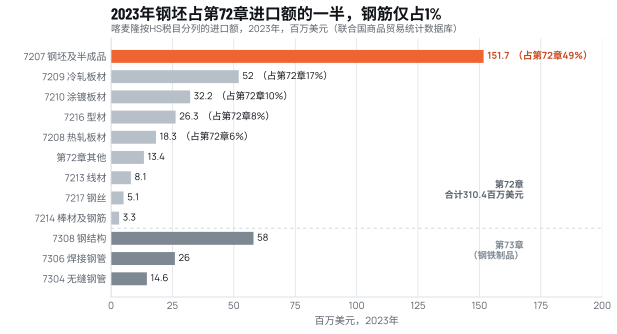
资料来源:联合国商品贸易统计数据库,喀麦隆按HS税目分列的进口,2023年[S05]。“第72章其他”为章合计的余额;比例为推算。
英文全文 11分钟 · 2596词Cameroon imports iron units and flat steel, not reinforcing bar
Cameroon’s imports of iron and steel (customs chapter 72) rose from 182,890 t in 2019 to 412,049 t in 2025, an increase of 125%, and cost 170.1 bn FCFA in 2025, about €259m [S19][S07]. Articles of iron and steel (chapter 73) added 84,008 t and 108.0 bn FCFA [S07]. The composition of these imports is the most important single piece of evidence in this paper. In 2023, the latest year with product detail, billets and other semi-finished steel were the largest import line at 161.4 kt and US$151.7m, about half of the chapter 72 bill, and 78% of those billets came from Indonesia [S05]. Flat steel accounted for about 96 kt and sections and structures for about 50 kt. Reinforcing bar, the product most discussed in public debate, cost US$3.3m, about 1% of the bill [S05]. Cameroon does not lack bars. It lacks the metal to make them, and the flat and heavy products it does not roll.
4.1 Volumes have more than doubled while unit values have fallen
The national statistics institute (INS) publishes annual foreign-trade notes based on customs data. They show chapter 72 imports of 182,890 t in 2019, 278,981 t in 2020, 297,633 t in 2021, 283,589 t in 2022, 304,062 t in 2023, 309,682 t in 2024 and, on provisional data, 412,049 t in 2025 [S19][S114][S115][S107][S07]. The 2025 increase, 33% in one year, is the largest in the series.
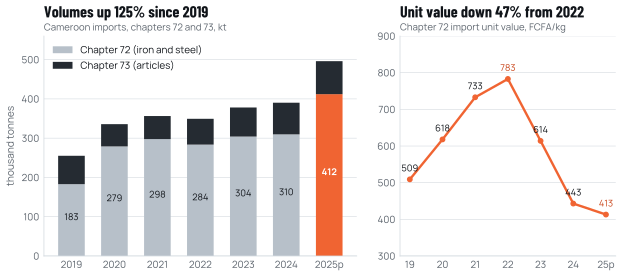
Source: INS, notes on foreign trade 2020, 2022, 2023, 2024 and 2025 (provisional) [S19][S114][S115][S107][S07]. Unit values derived as value divided by tonnage.
Values moved differently. Chapter 72 imports cost 93.0 bn FCFA in 2019, peaked at 222.1 bn FCFA in 2022, fell to 137.2 bn FCFA in 2024 and rose to 170.1 bn FCFA in 2025 [S19][S07]. The implied average value per kilogram rose from 509 FCFA in 2019 to 783 FCFA in 2022, during the post-pandemic price spike, and then fell to 443 FCFA in 2024 and 413 FCFA in 2025, about €629 per tonne (derived). Falling unit values with rising tonnage point to two effects: lower world prices for semis and flat steel after 2022 (Chapter 8), and a shift in the mix towards cheaper semi-finished steel.
Chapter 73, which covers fabricated articles such as structures, tubes, tanks, fasteners and wire products, was steadier: 72,253 t in 2019 and 84,008 t in 2025, at values between 74.3 bn FCFA and 116.6 bn FCFA [S19][S07]. Including all base metals and their articles, Cameroon imported 554,638 t worth 420.2 bn FCFA in 2025, up from 429,202 t and 309.6 bn FCFA in 2024 [S07]. Chapters 72 and 73 together, 278.1 bn FCFA, represented 5.3% of Cameroon’s total imports of 5,229.2 bn FCFA in 2025 (derived) [S07].
4.2 The 2025 jump: more tonnes, lower prices
The provisional 2025 data deserve particular attention because they show the largest annual increase in the series. Chapter 72 tonnage rose by 102,367 t, or 33%, while value rose by 32.9 bn FCFA, or 24% (derived) [S107][S07]. The average value per kilogram therefore fell again, from 443 FCFA to 413 FCFA. Without product detail for 2025, it is not possible to say with certainty which products drove the rise. Three explanations are consistent with the evidence. Billet imports may have grown as domestic rolling capacity expanded and scrap became scarcer, which is what industry statements suggest [S01][S116]. Imports of flat steel may have grown with construction and roofing demand. And lower world prices may have encouraged stock-building by importers and mills. The first explanation is the most likely to be significant, given that billets were already the largest line in 2023, but it cannot be confirmed until product data for 2025 are published (Chapter 11).
The 2025 increase also coincided with a rise in total imports. Cameroon’s imports of all goods rose 4.6% to 5,229.2 bn FCFA in 2025, and the merchandise trade deficit widened by 22.8% to 2,145.2 bn FCFA [S07]. Iron and steel therefore grew faster than imports as a whole. Imports of all base metals and their articles, a wider category that includes aluminium and other metals, rose from 429,202 t to 554,638 t [S07].
4.3 The product mix: billets first, flat steel second, bars last
The INS notes do not break chapter 72 down by product. For that, this paper uses the United Nations Comtrade database, to which Cameroon had reported detailed data up to 2023 at the research cut-off [S05]. Comtrade values are in US dollars and do not match the INS totals exactly, because of differences in valuation, timing and coverage, but the product structure is clear.
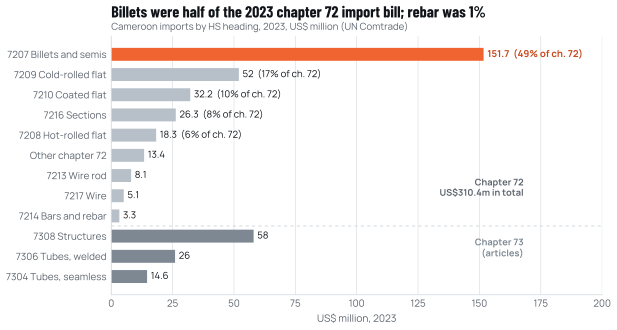
Source: UN Comtrade, Cameroon imports by HS heading, 2023 [S05]. "Other chapter 72" is the residual of the chapter total; shares derived.
Chapter 72 imports were worth US$310.4m in 2023 [S05]. Billets and semis (HS 7207) accounted for US$151.7m, cold-rolled flat products (HS 7209) for US$52.0m, coated flat products (HS 7210) for US$32.2m, sections (HS 7216) for US$26.3m and hot-rolled flat products (HS 7208) for US$18.3m [S05]. Wire rod (HS 7213), wire (HS 7217) and bars and reinforcing bar (HS 7214) together accounted for US$16.5m. In chapter 73, structures and parts of structures (HS 7308) cost US$58.0m, welded tubes (HS 7306) US$26.0m and seamless tubes (HS 7304) US$14.6m [S05].
One caution applies. Comtrade’s implied unit value for Cameroonian billet imports was about US$940 per tonne in 2023 and US$1,274 per tonne in 2022, well above market billet prices in those years (Chapter 8) [S05]. Values for this line may include costs or classifications that inflate them. This paper therefore relies on tonnages where possible and treats values as indicative.
4.4 Billets: the largest import and the true measure of dependence
Billet imports more than tripled in four years: 52.5 kt in 2019, 89.9 kt in 2020, 110.5 kt in 2021, 151.2 kt in 2022 and 161.4 kt in 2023 [S05]. Billets are the semi-finished feedstock of the re-rolling mills that make reinforcing bar, wire rod and light sections in Douala. Their growth tracks the growth of domestic rolling capacity described in Chapter 5, and their volume is the clearest measure of how far the domestic industry depends on foreign iron.
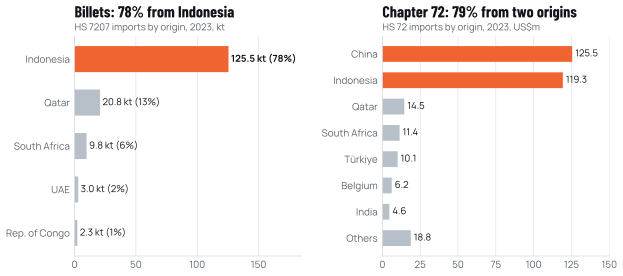
Source: UN Comtrade, Cameroon imports by partner, 2023 [S05]. Shares and the "others" residual derived.
The origin of billets is highly concentrated. In 2023 Indonesia supplied 125.5 kt (US$119.3m), Qatar 20.8 kt, South Africa 9.8 kt, the United Arab Emirates 3.0 kt and the Republic of Congo 2.3 kt [S05]. For chapter 72 as a whole, China supplied US$125.5m and Indonesia US$119.3m, followed by Qatar (US$14.5m), South Africa (US$11.4m), Türkiye (US$10.1m), Belgium (US$6.2m) and India (US$4.6m) [S05]. Concentration of this degree is a supply risk: a change in Indonesian export policy, in freight rates on the route, or in the commercial terms of a few traders would affect most of the iron units used in Cameroon.
Local scrap is the only domestic alternative, and it is limited. Industry sources state that local scrap covers about 40% of the mills’ needs and imported billets about 60% [S03][S20][S116]. Chapter 5 shows what this implies for the iron-unit balance of the industry.
4.5 Flat steel and heavy sections: fully imported
Cameroon has no hot or cold strip mill, so all flat steel is imported. Hot-rolled flat imports (HS 7208) rose from 9.4 kt in 2019 to 18.0 kt in 2022 [S05]. Cold-rolled flat imports (HS 7209) were 18.0 kt in 2019, 42.7 kt in 2021 and 47.5 kt in 2023, of which 43.9 kt came from China [S05]. Coated flat products (HS 7210), mainly galvanised and painted sheet, rose from 20.3 kt in 2019 to 30.5 kt in 2022 and 2023 [S05]. Together, flat imports were about 96 kt in 2023, using the 2022 figure for hot-rolled coil, which was not reported by tonnage for 2023 (derived).
Much of this flat steel is processed locally. Industry data show local capacity of 43 kt a year for roofing sheet against domestic demand of 21 kt, and 34 kt for tubes against 14 kt, both made from imported coil [S03]. Cameroon therefore has a flat-steel processing industry without a flat-steel producer, in the same way that it has a bar-rolling industry without enough iron.
Sections and structures are the third gap. Imports of sections (HS 7216) were 17.4 kt in 2019 and 26.6 kt in 2020, and cost between US$26.2m and US$29.6m a year from 2020 to 2023 [S05]. Imports of structures (HS 7308) were 25.7 kt in 2023 [S05]. Together, sections and structures amount to about 50 kt a year, using an estimate of about 24 kt for sections in 2023 derived from their value. Light angles, channels and flats are rolled locally by Prometal’s newer mill, but heavy sections, beams and H-sections used in industrial buildings, bridges and infrastructure are imported [S117][S05].
Table 4.1 sourcedCameroon imports of selected steel products, 2019 to 2023 (kt; US$m in brackets)
| HS heading | Product | 2019 | 2020 | 2021 | 2022 | 2023 |
|---|---|---|---|---|---|---|
| 7207 | Billets and semis | 52.5 (42.3) | 89.9 (94.4) | 110.5 (137.1) | 151.2 (192.7) | 161.4 (151.7) |
| 7208 | Hot-rolled flat | 9.4 (8.4) | 12.3 (14.4) | 13.6 (29.2) | 18.0 (22.5) | n.r. (18.3) |
| 7209 | Cold-rolled flat | 18.0 (15.4) | n.r. (46.3) | 42.7 (57.1) | 21.3 (27.9) | 47.5 (52.0) |
| 7210 | Coated flat | 20.3 (19.2) | 24.3 (29.4) | 21.3 (25.2) | 30.5 (35.7) | 30.5 (32.2) |
| 7213 | Wire rod | 50.8 (40.6) | 53.9 (55.6) | 58.1 (74.0) | 22.8 (26.6) | 7.8 (8.1) |
| 7214 | Bars and reinforcing bar | 3.7 (3.7) | 14.0 (12.5) | 7.3 (9.2) | 4.9 (6.9) | n.r. (3.3) |
| 7216 | Sections | 17.4 (16.8) | 26.6 (29.6) | n.r. (29.1) | n.r. (26.2) | n.r. (26.3) |
| 7217 | Wire | 2.3 (2.8) | 3.1 (4.0) | 4.3 (5.3) | 4.9 (6.3) | 3.6 (5.1) |
| 7308 | Structures | 22.4 (70.9) | 18.6 (47.6) | 17.2 (68.0) | 13.6 (57.4) | 25.7 (58.0) |
| 72 | Chapter 72 total (US$m) | 158.7 | 300.4 | 392.8 | 358.5 | 310.4 |
Source: UN Comtrade, Cameroon (reporter 120), imports, 2019 to 2023 [S05]. n.r.: tonnage not reported. Cameroon had not reported 2024 or 2025 product detail at the research cut-off.
4.6 Wire rod and rebar show what local rolling can do
Two lines of Table 4.1 show the effect of domestic rolling capacity. Wire rod imports were stable at 50.8 kt to 58.1 kt a year from 2019 to 2021, then fell to 22.8 kt in 2022 and 7.8 kt in 2023 [S05]. The fall coincided with the commissioning of new wire-rod rolling capacity in Douala, which culminated in the inauguration of the Prometal 4 and Prometal 5 plants in January 2024 [S117][S118]. Within two years, local rolling displaced almost 90% of wire-rod imports.
Reinforcing bar imports have been marginal throughout, between 3.7 kt and 14.0 kt a year, because they have been suspended since 2016 [S05][S04]. The residual volumes reflect derogations, project imports and enforcement gaps. In December 2020, for example, customs sealed more than 7,300 t of reinforcing bar imported by a contractor for the Kribi port works, for which the port authority had sought an authorisation covering 17,500 t [S04]. Cameroon is also a modest net exporter of bars: it exported between 27,103 t and 33,437 t of HS 7214 products a year from 2021 to 2025, 31,033 t in 2025, mostly to Chad [S114][S107][S07][S05].
Both cases point to the same conclusion. Where Cameroon has rolling capacity and protection, imports of the finished product disappear, but imports of the semi-finished input rise. The 2023 figures make this explicit: wire-rod imports were 50.3 kt below their 2021 level, while billet imports were 108.9 kt above their 2019 level (derived) [S05].
4.7 Tubes and fabricated products
Chapter 73 includes tubes and fabricated steel, which are relevant to a producer considering downstream products. Welded tube imports (HS 7306) were 9.5 kt in 2023, worth US$26.0m; seamless tubes (HS 7304) cost US$14.6m and large welded line pipe (HS 7305) US$0.9m [S05]. Cameroon’s chapter 73 imports were worth US$181.3m in 2023, less than those of the Republic of Congo (US$393.2m) or Gabon (US$235.3m), whose oil and gas industries import large volumes of tubular goods and structures [S05][S06]. Chapter 6 returns to these regional markets.
4.8 Steel’s weight in the trade balance
Iron and steel are a significant item in Cameroon’s external accounts. Chapters 72 and 73 cost 278.1 bn FCFA in 2025, about 13.0% of the merchandise trade deficit of 2,145.2 bn FCFA (derived) [S07]. The share was 14.8% in 2023 and 13.8% in 2024 (derived) [S115][S107]. Billets alone represented about half of chapter 72 value in 2023 [S05]. Reducing that bill requires domestic iron units, not more rolling capacity. Chapter 10 develops the policy implications.
4.9 What the import record tells a producer
The import record supports three conclusions that shape the rest of this paper.
The first concerns size. The market for products that are not made in Cameroon is substantial: about 161 kt of billets, 96 kt of flat steel and 50 kt of heavy sections and structures in 2023, together roughly 300 kt a year [S05]. That is equivalent to about two-thirds of apparent steel use, although billets are an input to domestic production rather than a final product, and it is growing.
The second concerns structure. Each of these three gaps calls for a different kind of plant. Billets require a melt shop with a reliable supply of iron units: scrap, direct-reduced iron, hot-briquetted iron or pig iron. Sections require a melt shop and a section mill, with product certification. Flat steel requires a hot strip mill, which is capital-intensive and normally built at a scale of several million tonnes a year; Tosyali’s flat-products complex in Algeria, for example, is sized at 2.5 Mt a year [S119]. The three gaps cannot be closed by one plant at once.
The third concerns risk. Imported billets are cheap because of the global surplus described in Chapter 1. A domestic melt shop that replaces them must compete with that price on delivered cost, while offering re-rollers advantages that imports cannot: shorter lead times, less working capital tied up in shipments, consistent chemistry and protection against freight and currency shocks. The evidence on price is examined in Chapter 8.
Other sources cited in the English text
- S114Note sur le commerce extérieur 2022. INS Cameroun, Dec 2023 (rev. 13 Feb 2024).ins-cameroun.cm/wp-content/uploads/2025/07/Note-sur-le-Commerce-Exteri…
- S115Commerce extérieur du Cameroun en 2023. INS Cameroun, Apr 2024.ins-cameroun.cm/wp-content/uploads/2025/07/Note-sur-le-Commerce-Exteri…
- S107Évolution du commerce extérieur en 2024. INS Cameroun, Aug 2025.ins-cameroun.cm/wp-content/uploads/2025/12/Commext_2024_FR_Edite-final…
- S01Cameroun: Prometal décroche 26,2 milliards FCFA d’Afreximbank. Camer.be, 1 Oct 2026.camer.be/actualites/economie/cameroun-prometal-decroche-262-milliards-…
- S11640 millions d’euros d’Afreximbank: Prometal sécurise ses billettes d’acier alors que la ferraille camerounaise s’épuise. Cameroun24, 10 Oct 2026.cameroun24.net/article/76267-40-millions-d-euros-d-afreximbank-prometa…
- S03Production: les acteurs en présence. Cameroon Tribune, 11 May 2026.cameroon-tribune.cm/article.html/76600/fr.html/details_2
- S20Cameroun: le groupe Prometal décroche 26 milliards FCFA auprès d’Afreximbank…. Sikafinance, 30 Sep 2026.sikafinance.com/marches/cameroun-le-groupe-prometal-decroche-26-millia…
- S118Cameroun: Prometal (Hayssam El Jammal) se dote de deux nouvelles usines de production d’aciers. EcoMatin, 19 Jan 2024.ecomatin.net/cameroun-prometal-hayssam-el-jammal-se-dote-de-deux-nouve…
- S04Press report of the sealing by customs of more than 7,300 t of imported reinforcing bar, December 2020 (headline and address not reproduced: they name the importer). Business in Cameroon, 16 Dec 2020.Cited by title and date
- S06UN Comtrade public API, CEMAC & Nigeria (reporters 266 Gabon, 178 Congo, 140 CAR, 566 Nigeria; mirror partners 148 Chad, 226 Eq. Guinea). UN Statistics Division.comtradeapi.un.org/public/v1/preview/C/A/HS?reporterCode=266&period=20…
- S119Tosyali Algérie: mise en service du complexe des tôles d’acier plat (2,5 Mt). Algérie Eco, 28 Nov 2024.algerie-eco.com/2024/11/28/tosyali-algerie-mise-en-service-du-complexe…
本章引用的资料来源
方括号内的标记对应以下来源(按原文语言列出),完整列表见附录。 完整来源列表
- S19Commerce extérieur du Cameroun en 2020. INS Cameroun,2021年7月.ins-cameroun.cm/wp-content/uploads/2025/07/Note-Commerce-exterieur-202…
- S07Évolution du commerce extérieur en 2025 (version provisoire). INS Cameroun,2026年2月(发布:2026年4月1日).ins-cameroun.cm/wp-content/uploads/2026/04/Note-sur-le-commerce-exteri…
- S05UN Comtrade public API, Cameroon (reporter 120), HS 72/73 and 6-digit lines, 2019-2023. UN Statistics Division.comtradeapi.un.org/public/v1/preview/C/A/HS?reporterCode=120&period=20…
- S117Prometal inaugure deux usines évaluées à 57 milliards F. Journal du Cameroun,2024年1月19日.fr.journalducameroun.com/prometal-inaugure-deux-usines-evaluees-a-57-m…
引用本章
Cameroon Steel(2026)。喀麦隆钢铁缺口在于含铁原料,而非钢筋(中文摘要版)。白皮书04,第4章:喀麦隆进口的是含铁原料和板材,而不是钢筋。CS-WP-04。https://www.cameroon-steel.com/zh/library/market-outlook/imports/
来源