白皮书04 · 第1章 · 中文摘要
钢铁过剩的世界正将剩余产量输往缺乏防御的市场
本章结论:喀麦隆所采购的全球钢铁市场产量萎缩、产能膨胀,主要进口市场正在关闭;在过剩持续期间,进口钢坯将保持低价,而喀麦隆生产商面对的是全球最大产业的边际吨位。
本页为本章中文摘要;英文全文附于其后,可展开阅读。
2025年世界粗钢产量连续第二年下降,降至18.494亿吨,比2021年19.63亿吨的峰值低5.8%;成品钢表观消费量降至17.182亿吨,世界钢铁协会预计2026年和2027年分别为17.241亿吨和17.62亿吨[S02][S08][S39]。经合组织估算,过剩产能将从2025年的6.4亿吨增至2028年的7.45亿吨,产能利用率从76%降至74%以下[S09]。2025年中国按海关口径出口钢材1.19亿吨,创历史纪录;2025年前10个月钢坯等半成品出口1190万吨,为上年同期的2.6倍[S10][S37]。
与此同时,62个国家已对中国钢铁产品实施207项限制措施;欧盟将配额外关税提高到50%,美国关税提高到50%[S11][S41][S47]。被挤出的吨位转向仍然开放的市场:2025年非洲钢材进口在一年内增加900万吨[S12][S02]。喀麦隆年消费仅约45万吨,是各类进口产品的价格接受者。2026年10月3日,中国和俄罗斯钢坯FOB报价为每吨465至480美元(完税运抵喀麦隆约570至650美元,见第8.6节),土耳其出口钢筋为620至630美元,这一价格构成任何喀麦隆含铁原料必须对标的基准[S22]。
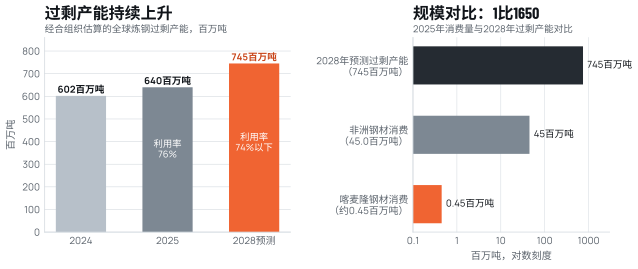
资料来源:经合组织估算,见欧盟第2026/1384号条例及EUROMETAL/Platts(2026年6月5日)[S41][S09];喀麦隆表观消费量为行业估计[S01];比值为推算。
英文全文 12分钟 · 2761词A world long in steel is sending its surplus to markets without defences
The global steel market that Cameroon buys from is shrinking in output, swollen in capacity and closing its largest import markets. World crude steel production fell for a second consecutive year in 2025, to 1,849.4 Mt, 5.8% below its 2021 peak, while excess capacity estimated by the OECD reached 640 Mt and is projected to rise to 745 Mt by 2028 [S08][S09]. China exported a record 119 Mt on a customs basis and almost doubled its exports of billets and other semi-finished steel [S10][S37]. As the United States, the European Union, Mexico, India and others raise their barriers, surplus tonnes look for markets that have none, and much of Sub-Saharan Africa, including Central Africa, is such a market. For a Cameroonian buyer this means cheap imported billets for as long as the surplus lasts; for a Cameroonian producer it means competing against the marginal tonne of the world’s largest industry.
1.1 Output has fallen since its 2021 peak while demand looks for a floor
World crude steel production peaked at 1,963 Mt in 2021, fell to about 1,889 Mt in 2022, recovered to 1,904 Mt in 2023 on the 2026 data vintage, and fell again to 1,886.8 Mt in 2024 and 1,849.4 Mt in 2025, a decline of 2.0% in the latest year [S02][S08]. The decline is a Chinese story. China produced 960.8 Mt in 2025, down 4.4% from 1,005.1 Mt in 2024, while India grew 10.4% to 164.9 Mt and became, by a wide margin, the fastest-growing large producer [S08]. The first eight months of 2026 continue the pattern: the 70 countries reporting monthly to worldsteel produced 1,225.2 Mt, 0.7% less than a year earlier, with China down 3.1% to 651.9 Mt, India up 6.0% to 115.9 Mt and Viet Nam up 29.1% to 20.6 Mt [S38].
Demand has fallen faster than output. World apparent steel use, measured as finished steel, declined from 1,778.5 Mt in 2023 to 1,751.1 Mt in 2024 and 1,718.2 Mt in 2025 [S02]. worldsteel’s April 2026 Short Range Outlook expects demand to bottom out: 1,724.1 Mt in 2026, a rise of 0.3%, and 1,762.0 Mt in 2027, a rise of 2.2%, with the world outside China growing 4.0% in 2027 [S39]. China’s own demand fell 7.1% to 796.0 Mt in 2025 on official data and is forecast to slip a further 1.5% in 2026 and to stay flat in 2027; India’s is forecast to grow 7.4% and 9.2% in the same years [S39]. The October 2026 edition of the outlook had not been published at the research cut-off [S39].
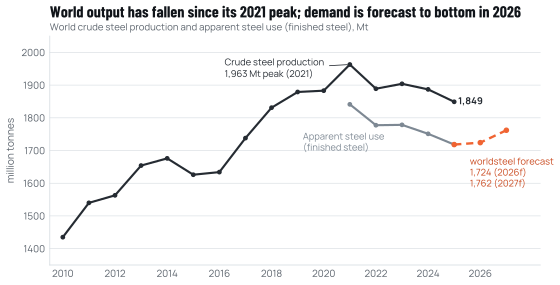
Source: worldsteel, World Steel in Figures 2026 and press release of 23 January 2026; Short Range Outlook, April 2026 [S02][S08][S39].
Two features of world demand matter for Cameroon. The first is composition: building and infrastructure account for 52% of world steel use, ahead of mechanical equipment (16%), automotive (12%) and metal products (10%) [S02]. Steel demand in a country at Cameroon’s stage of development is even more concentrated in construction, which is why Chapter 3 treats construction as the principal driver. The second is intensity: the world used 209 kg of finished steel per person in 2025, down from 231.7 kg in 2021 as Chinese use per head fell from 669.1 kg to 562.1 kg [S02]. Global averages are therefore falling for reasons that have nothing to do with Africa, where use per head is rising from a very low base (Chapter 2).
1.2 Growth outside China comes from India, the Middle East and Africa
Behind the global averages, demand is moving between regions. worldsteel expects India’s steel use to grow 7.4% in 2026 and 9.2% in 2027, after 8.0% in 2025, making it the largest single source of new demand [S39]. The Middle East and North Africa used 80.2 Mt in 2025; their demand is forecast to fall 4.5% in 2026, with the Middle East down 7.4% because of regional conflict, before rebounding 7.7% in 2027 [S39]. Africa, examined in Chapter 2, is forecast to grow 3.8% and 4.6% in the same two years [S39]. The result is that the world outside China is expected to grow 4.0% in 2027, while China’s own demand stays flat [S39].
The technology of steelmaking is shifting more slowly. Electric furnaces produced 30.3% of world crude steel in 2025, up from 29.1% in 2024, and world output of direct-reduced iron, the ore-based feed for electric furnaces, rose from 138.7 Mt in 2023 to 145.8 Mt in 2024 and 153.0 Mt in 2025 on worldsteel’s data (151.0 Mt on Midrex’s) [S02][S13]. Gas-based processes account for about 65% of direct reduction worldwide and coal-based kilns for about 35%; India and Iran are the largest producers [S13]. This matters for Cameroon because the growth of electric steelmaking raises worldwide demand for the iron units it depends on, scrap and direct-reduced iron, and because a future ore-based iron industry in Central Africa would compete in that market.
For a small importing country, the regional pattern has a practical consequence. The exporters that serve Africa are increasingly those with surplus capacity and limited access to protected markets: China, Indonesia, Russia and Türkiye in particular. Their export prices, not the prices of European or American mills, set the cost of steel delivered to Douala.
1.3 Excess capacity is structural, not cyclical
Capacity has not adjusted to weaker demand. The OECD Steel Committee estimated global crude steelmaking capacity at 2,547 Mt at the end of 2025, rising to 2,656 Mt by 2028 [S40]. Its Steel Outlook 2026 puts excess capacity, the difference between capacity and production, at 640 Mt in 2025, heading to 745 Mt by 2028, with capacity utilisation falling from 76% in 2025 to 74% or less and up to 138.8 Mt of new capacity (5.7%) added by 2028 against demand growth of about 0.9% a year [S09]. An earlier OECD estimate, cited in the European Union’s 2026 steel regulation, was 602 Mt in 2024 and 721 Mt by 2027 [S41]. China accounts for more than half of the excess [S42].
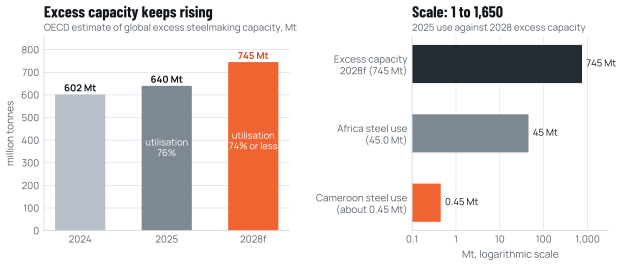
Source: OECD estimates as reported in Regulation (EU) 2026/1384 and by EUROMETAL/Platts (5 June 2026) [S41][S09]; Cameroon apparent use, industry estimate [S01]; ratio derived.
The persistence of the surplus is explained in part by state support. The OECD found that the median Chinese steel firm received about 15 times the subsidies, relative to assets, of producers elsewhere in 2024, against 10 times in 2023 [S43]. Capacity is also being rebuilt in a different technological form. Global Energy Monitor’s 2026 tracker counts 2,216 Mtpa of operating capacity in plants of at least 0.5 Mtpa, of which electric arc furnaces represent 34%; electric furnaces account for 50% of capacity in development and 71% of capacity under construction [S31]. The surplus is therefore not a problem that will fade as old blast furnaces close: new, efficient electric capacity is being added at the same time.
1.4 China’s exports set records, and semi-finished steel matters most for Cameroon
China exported 119.02 Mt of steel in 2025 on a customs basis, 7.5% more than the 111.1 Mt of 2024, itself 23.1% above 2023 [S10][S37]. Definitions matter: worldsteel counts 133.6 Mt of Chinese exports in 2025 (126.6 Mt net of imports) and the OECD, using Platts data, 131.2 Mt, or 41% of world steel exports [S02][S09]. World steel exports totalled 456.5 Mt in 2025, 26.4% of output [S02]. Whatever the measure, China alone exports more steel each year than the whole of Africa consumes.
For Cameroon the more relevant series is semi-finished steel. China exported 11.9 Mt of billets and other semis in the first ten months of 2025, 2.6 times the level of a year earlier and almost double the 6.3 Mt exported in the whole of 2024 [S37]. Chinese exports to member states of the African Union reached 13.78 Mt over the same ten months [S37]. Billets are exactly the product Cameroon’s re-rolling mills import (Chapter 4), and their price is set at the margin by this flow.
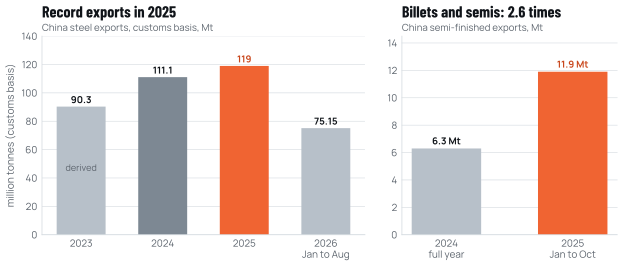
Source: GMK Center from Chinese customs data (14 January 2026; 24 December 2025; 8 September 2026) [S10][S37][S44]. The 2023 value is derived from the 2024 level and its reported growth of 23.1%.
There are signs of moderation. From 1 January 2026 China introduced export licensing for about 300 steel product types, including pig iron, semis, flat and long products, pipe and rail, with six-month licences [S45]. In January to August 2026 Chinese exports were 75.15 Mt, 3% less than a year earlier; in August alone they were 10.15 Mt at an average of US$722 per tonne [S44]. A slower pace of Chinese exports would not end the surplus, because the excess capacity described above remains, but it may shift the source of marginal supply towards other exporters such as Indonesia, Russia, Türkiye and the Gulf, several of which already supply Cameroon (Chapter 4).
1.5 Trade defence is closing the large markets
The response of importing countries has been a wave of trade defence. By October 2025, 62 countries had implemented 207 restrictions against steel products from China [S11]. Table 1.1 lists the measures that have the largest effect on where surplus steel can go.
Table 1.1 sourcedPrincipal steel trade-defence measures in force or announced, 2024 to 2026
| Market | Measure | Level | In force | Source |
|---|---|---|---|---|
| European Union | Tariff-rate quota replacing the safeguard, Regulation (EU) 2026/1384 | Quota of 18,345,922 t a year (13% import share of 2024 use); out-of-quota duty 50% (was 25%); overall quota cut about 46% | 1 Jul 2026; melt-and-pour evidence from 1 Oct 2026 | [S41][S46] |
| United States | Section 232 | Tariff on steel and aluminium raised from 25% to 50% | 4 Jun 2025 | [S47] |
| Mexico | Tariff increases on non-FTA origins | Up to 50% on more than 1,400 tariff lines, steel included | 1 Jan 2026 | [S48] |
| India | Provisional safeguard on flat steel | 12% for 200 days; three-year schedule of 12%, 11%, 10% recommended (final notification not verified) | 21 Apr 2025 | [S49][S50] |
| Viet Nam | Provisional anti-dumping on Chinese hot-rolled coil | 19.38% to 27.83% | 7 Mar 2025 | [S51] |
| Brazil | Import quotas on 11 steel products | 25% above quota | Apr 2024 | [S52] |
| Egypt | Provisional and revised duties | Hot-rolled coil 13.6% (minimum US$75.25/t); billet 13% (minimum US$65/t) | Sep 2025; Apr 2026 | [S53][S54] |
| South Africa | Provisional safeguard on hot-rolled coil | 9% for 200 days; lapsed | 28 Jun 2024 | [S55] |
| Cameroon | Suspension of rebar imports | Ban "until further notice"; no measure on billets, flats or sections | 31 May 2016; reaffirmed 3 Apr 2023 | [S04][S56] |
Source: as listed. Measures are summarised; consult the legal texts for scope and exemptions.
The common thread is that the largest consuming markets outside Asia have made access conditional on quotas, high tariffs or proof of origin. The EU’s melt-and-pour rule, applied from October 2026, is designed to stop steel melted in one country from entering under another country’s quota after minor processing [S41]. Türkiye, one of the world’s largest rebar exporters and a supplier to Africa, saw its EU quota cut by up to 56%, about 3.5 Mt [S46]. Tonnes displaced from Europe and North America do not disappear; they are offered elsewhere, at lower prices.
1.6 Where the displaced tonnes go: Africa’s imports rose by 9 Mt in a year
The clearest evidence of diversion is in Africa’s own import statistics. The continent imported 23.9 Mt of finished and semi-finished steel in 2024, of which 13.8 Mt came from China; in 2025 it imported 32.9 Mt, of which 19.4 Mt came from China [S12][S02]. A rise of 9 Mt in one year, at a time when Africa’s own steel use rose by about 4.3 Mt, is consistent with surplus steel being placed in the few large markets that remain open [S02]. Chapter 2 examines the African picture in detail.
Steel-specific trade defence in Sub-Saharan Africa is rare. South Africa’s provisional safeguard on hot-rolled coil lapsed [S55]; North African producers such as Egypt and Algeria are protected by duties, minimum prices and import management [S57][S54]. Cameroon’s 2016 suspension of rebar imports is one of the few measures in Central Africa, and it covers only one product. It does not cover billets, which the country imports in large quantities, nor flat products or sections [S04][S56]. The effect, examined in Chapters 4 and 5, is a domestic industry that is protected at the finished-bar stage and fully exposed at the iron-unit stage, which suits re-rollers while billets are cheap and leaves the country dependent on imported metal.
1.7 Prices: cheap billets, firmer rebar
International prices reflect this structure. On 3 October 2026 billets were quoted at US$465 to 470 per tonne free on board (FOB) from China and US$470 to 480 FOB from Russia, and at US$515 to 525 delivered to Türkiye from the Commonwealth of Independent States; Turkish rebar for export was quoted at US$620 to 630 FOB [S22]. Iron ore, the main raw material of primary steel, averaged US$100.2 per dry tonne in 2025, down from US$120.6 in 2023, and the World Bank expects US$97 in 2026 and US$95 in 2027 [S58][S59]. Chapter 8 analyses these series and what they mean for a producer in Cameroon.
1.8 Implications for Cameroon and Central Africa
Three implications follow for the rest of this paper.
First, imported iron units will remain available and cheap while the surplus lasts. Billets at US$465 to 480 per tonne FOB, about US$570 to 650 once landed duty-paid in Cameroon (section 8.6), set the benchmark against which any Cameroonian iron unit, whether a billet melted from scrap, from imported direct-reduced iron or eventually from Cameroonian ore, must compete [S22]. A domestic melt shop is justified only if it can match that delivered cost with acceptable reliability, or if it offers something imports cannot: shorter lead times, lower working capital, consistent chemistry for downstream mills, and protection against freight and currency shocks.
Second, the absence of trade defence for semis and flat products in Central Africa is a structural feature, not an oversight to be corrected overnight. Policy options exist and are discussed in Chapter 10, but they must be consistent with Cameroon’s commitments in CEMAC, the African Continental Free Trade Area and the World Trade Organization, and with the interest of the many Cameroonian firms that buy steel as an input.
Third, the global cycle is likely to remain difficult until at least 2028, the horizon of the OECD’s capacity projection [S09]. Demand growth outside China, notably in India and Africa, is the main source of new tonnes, and Africa’s share of world steel use, 2.6% in 2025, is small but rising [S02]. A producer in Kribi will be one of the few new suppliers located inside the growing market rather than exporting to it, and the value of that position is examined in the chapters that follow.
Other sources cited in the English text
- S38August 2026 crude steel production. worldsteel, 24 Sep 2026.worldsteel.org/media/press-releases/2026/august-2026-crude-steel-produ…
- S132025 World Direct Reduction Statistics. Midrex Technologies, Sep 2026.midrex.com/world-dri-statistics/world-dri-production-reaches-151-0-mt-…
- S40OECD Steel Committee: global overcapacity hits record levels as China’s exports surge. EUROMETAL, 7 Nov 2025.eurometal.net/oecd-steel-committee-global-overcapacity-hits-record-lev…
- S42OECD: global steel capacity reaches record high. EUROMETAL (Platts), 28 Mar 2026.eurometal.net/oecd-global-steel-capacity-reaches-record-high/
- S43Excess steel production capacity continues to weigh on global markets, OECD. GMK Center, 4 Jun 2026.gmk.center/en/news/excess-steel-production-capacity-continues-to-weigh…
- S31Pedal to the Metal 2026. Global Energy Monitor, May 2026.globalenergymonitor.org/sites/default/files/2026-05/Pedal%20to%20the%2…
- S44China increased steel exports by 0.3% m/m in August. GMK Center, 8 Sep 2026.gmk.center/en/news/china-increased-steel-exports-by-0-3-m-m-in-august/
- S45Licensing of steel exports from China should ease trade tensions. GMK Center, 19 Dec 2025.gmk.center/en/news/licensing-of-steel-exports-from-china-should-ease-t…
- S46The cost of protection: global reactions to the EU’s new steel TRQs. GMK Center, 14 Jul 2026.gmk.center/en/posts/the-cost-of-protection-global-reactions-to-the-eu-…
- S48Mexico approves tariff increases on Chinese and other Asian imports. GMK Center, 12 Dec 2025.gmk.center/en/news/mexico-approves-tariff-increases-on-chinese-and-oth…
- S49India imposes a temporary 12% safeguard duty on certain steel imports. GMK Center, 22 Apr 2025.gmk.center/en/news/india-imposes-a-temporary-12-safeguard-duty-on-cert…
- S50India considers new three-year protective duty on steel imports. GMK Center, 26 Nov 2025.gmk.center/en/news/india-considers-new-three-year-protective-duty-on-s…
- S51Vietnam revises provisional anti-dumping duties on hot-rolled steel from China. GMK Center, 13 May 2025.gmk.center/en/news/vietnam-revises-provisional-anti-dumping-duties-on-…
- S52Brazil introduces import quotas on 11 types of steel products. GMK Center, 24 Apr 2024.gmk.center/en/news/brazil-introduces-import-quotas-on-11-types-of-stee…
- S53Egypt has imposed a temporary duty on imports of HRC at 13.6%. GMK Center, 15 Sep 2025.gmk.center/en/news/egypt-has-imposed-a-temporary-duty-on-imports-of-ho…
- S54Egypt’s steel industry: protection from within. GMK Center, 23 Jul 2026.gmk.center/en/posts/egypt-s-steel-industry-protection-from-within/
- S55South Africa imposes safeguard duty on imports of hot-rolled steel. GMK Center, 1 Jul 2024.gmk.center/en/news/south-africa-imposes-safeguard-duty-on-imports-of-h…
- S04Press report of the sealing by customs of more than 7,300 t of imported reinforcing bar, December 2020 (headline and address not reproduced: they name the importer). Business in Cameroon, 16 Dec 2020.Cited by title and date
- S56Métallurgie: les importations du fer à béton interdites jusqu’à nouvel ordre. EcoMatin, 10 Apr 2023.ecomatin.net/metallurgie-les-importations-du-fer-a-beton-interdites-ju…
- S57Protecting the steel market: how it’s done in North Africa. GMK Center, 2 Sep 2026.gmk.center/en/posts/protecting-the-steel-market-how-it-s-done-in-north…
- S58Commodity Markets Outlook, Historical Data, Annual (xlsx). World Bank, 2 Sep 2026.thedocs.worldbank.org/en/doc/74e8be41ceb20fa0da750cda2f6b9e4e-00500120…
- S59Commodity Markets Outlook April 2026, Forecasts (Table 1). World Bank, Apr 2026.thedocs.worldbank.org/en/doc/f3138644a1e8e2bb631399ae11d6c408-00500120…
本章引用的资料来源
方括号内的标记对应以下来源(按原文语言列出),完整列表见附录。 完整来源列表
- S02World Steel in Figures 2026 (page and PDF). worldsteel,2026年6月4日.worldsteel.org/data/world-steel-in-figures/world-steel-in-figures-2026…
- S08December 2025 crude steel production and 2025 global totals. worldsteel,2026年1月23日.worldsteel.org/media/press-releases/2026/december-2025-crude-steel-pro…
- S39worldsteel Short Range Outlook April 2026 (release + Table 1). worldsteel,2026年4月14日.worldsteel.org/media/press-releases/2026/worldsteel-short-range-outloo…
- S09OECD: global steel excess capacity set to reach 745 million mt by 2028. EUROMETAL (Platts),2026年6月5日.eurometal.net/oecd-global-steel-excess-capacity-set-to-reach-745-milli…
- S10China increased steel exports by 7.5% y/y in 2025. GMK Center,2026年1月14日.gmk.center/en/news/china-increased-steel-exports-by-7-5-y-y-in-2025/
- S37China’s rapidly growing steel exports will lose momentum from 2026 onwards. GMK Center,2025年12月24日.gmk.center/en/infographic/china-s-rapidly-growing-steel-exports-will-l…
- S1162 countries implemented 207 restrictions against steel products from China. GMK Center,2025年10月13日.gmk.center/en/infographic/62-countries-implemented-207-restrictions-ag…
- S41Regulation (EU) 2026/1384 (steel TRQ replacing the safeguard). EU, Official Journal L,2026年6月24日.eur-lex.europa.eu/eli/reg/2026/1384/oj/eng
- S47Adjusting Imports of Aluminum and Steel into the United States. The White House,2025年6月3日.whitehouse.gov/presidential-actions/2025/06/adjusting-imports-of-alumi…
- S12World Steel in Figures 2025. worldsteel,2025年6月.worldsteel.org/data/world-steel-in-figures/world-steel-in-figures-2025…
- S22Weekly steel prices (archive 40468). Arab Iron & Steel Union (AISU),2026年10月3日.aisusteel.org/en/archives/40468
- S01Cameroun: Prometal décroche 26,2 milliards FCFA d’Afreximbank. Camer.be,2026年10月1日.camer.be/actualites/economie/cameroun-prometal-decroche-262-milliards-…
引用本章
Cameroon Steel(2026)。喀麦隆钢铁缺口在于含铁原料,而非钢筋(中文摘要版)。白皮书04,第1章:钢铁过剩的世界正将剩余产量输往缺乏防御的市场。CS-WP-04。https://www.cameroon-steel.com/zh/library/market-outlook/global-context/
来源