白皮书04 · 第10章 · 中文摘要
政策应将保护从成品棒材转向质量、含铁原料和公平贸易
本章结论:现行政策保护了生产的最后环节,催生了三倍于市场的轧制能力,而含铁原料却以10%的关税进口,线材关税仅5%,低于其原料钢坯;更有效的政策工具在其他方面。
本页为本章中文摘要;英文全文附于其后,可展开阅读。
本章目录(1)
2023年至2025年,第72章和第73章钢铁进口每年耗资2403亿至2958亿中非法郎,相当于货物贸易逆差的13.0%至14.8%(推算)[S115][S107][S07]。约一半的第72章进口额是钢坯,因此用国产棒材替代进口棒材几乎没有节省外汇,替代进口含铁原料才能节省更多。《2020至2030年国家发展战略》(SND30)将采矿、冶金和钢铁列为九个优先工业子行业之一,目标是到2030年制造业增加值占国内生产总值25%,而2025年约为13.3%[S25][S16]。
本章建议的政策工具包括:以透明、有时限、针对具体产品的贸易工具(保障措施、反倾销和最低价格关税能力)取代无限期禁令;在CEEAC与CEMAC统一关税中纠正关税倒挂,并减免熔炼用含铁原料的进口关税(第8.6节显示,对进口废钢和热压块铁征收的10%关税,约为每吨钢坯47至52美元,与克里比钢坯和进口钢坯之间的成本差距大致相当);将强制标准和合格评定从钢筋扩展至结构型材、钢丝和板材,并建设认可实验室;公共采购要求使用认证钢材并按时付款;根据第2013/004号投资法,将激励集中于炼钢、直接还原和型材轧制;落实姆巴拉姆(Mbalam)和克里比-洛贝采矿协议中15%的本地加工条款;建立年度国家钢铁平衡表。实施顺序为:2026至2027年先抓数据和标准,2027至2030年完善贸易和激励框架,2030年后随着矿山和天然气项目成熟再处理矿基铁问题[S34][S35][S142]。
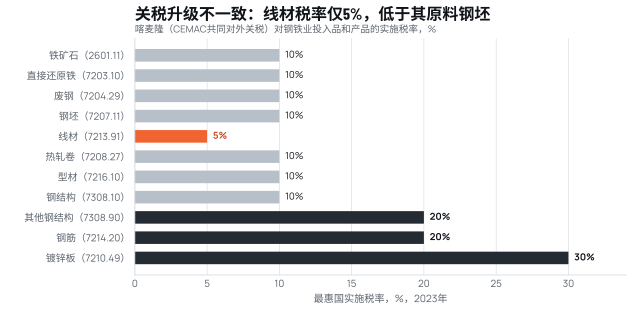
资料来源:世界银行WITS,喀麦隆申报的最惠国实施税率,2023年[S23]。2026年1月1日起实施的CEEAC与CEMAC统一关税尚未按钢铁税目公布[S131]。
英文全文 13分钟 · 2937词Policy should move protection from finished bars to quality, iron units and fair trade
Cameroon’s steel policy has protected the last stage of production. The 2016 suspension of reinforcing-bar imports, the mandatory rebar standard and homologated prices have built rolling capacity three times larger than the market, while the iron units that feed it are imported at a 10% duty and wire rod enters at 5%, less than the billets it is rolled from [S04][S03][S23]. Iron and steel imports absorbed 13% of the merchandise trade deficit in 2025 [S07]. The policy levers that would serve the national objectives in the development strategy, SND30, which names mines-métallurgie-sidérurgie among nine priority industrial sub-sectors and targets manufacturing value added of 25% of GDP by 2030 against about 13.3% in 2025, lie elsewhere [S25][S16]. They are: transparent and rules-based trade instruments in place of an open-ended ban; standards and certification extended from rebar to structural steel; public procurement that specifies certified products and pays on time; and incentives that favour domestic iron-making rather than additional rolling. Each must work within a fiscal position the IMF describes as carrying a high risk of debt distress [S36].
10.1 Why steel policy matters for the external accounts
Iron and steel are a material item in Cameroon’s trade balance. Imports of chapters 72 and 73 cost 295.8 bn FCFA in 2023, 240.3 bn FCFA in 2024 and 278.1 bn FCFA in 2025, between 13.0% and 14.8% of the merchandise trade deficit in each year (derived) [S115][S107][S07]. The deficit itself widened to 2,145.2 bn FCFA in 2025, with a cover ratio of exports to imports of 59.0% [S07]. In the CEMAC monetary union, foreign-exchange reserves fell to 6,377.3 bn FCFA at the end of 2025, equivalent to 4.2 months of imports [S113].
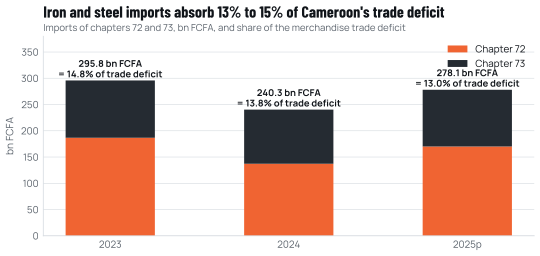
Source: INS, notes on foreign trade 2023, 2024 and 2025 (provisional) [S115][S107][S07]. Shares derived.
The composition matters more than the total. About half of the chapter 72 bill is billets, which domestic mills turn into bars [S05]. Substituting imported bars, as the 2016 ban did, saved little foreign exchange because the iron was still imported; substituting imported iron units would save much more. Policy aimed at the external accounts should therefore look upstream.
10.2 The policy framework today
The framework that applies to steel combines national strategy, investment incentives, trade measures and sector regulation.
At the level of strategy, SND30 lists mines-métallurgie-sidérurgie among its nine priority industrial sub-sectors and calls for accelerating import substitution while expanding exports [S25]. It sets a target of manufacturing value added of 25% of GDP by 2030; the national accounts give about 13.3% in 2025 (derived) [S25][S16]. The industrialisation master plan of 2016 to 2017, which emphasised metallurgy and steel, is under revision, which offers a window to update its steel chapter [S171][S172]. The government’s import-substitution plan for 2024 to 2026, PIISAH, covers agricultural, livestock and fisheries products only and does not include steel [S173].
For investment, Law No. 2013/004 of 18 April 2013 on private investment incentives provides exemptions for up to five years during establishment and up to ten years of operation, and expressly lists the iron and steel industry among the priority sectors for specific incentives [S142]. The ports of Douala and Kribi are classified as economic zones, while industrial free-zone status requires 80% of output to be exported, which would not suit a producer serving the domestic market [S142].
For trade and regulation, the instruments are the rebar import suspension of 2016, reaffirmed in 2023; the mandatory standard NC 236/2024/06; price homologation by the Ministry of Commerce; the CEMAC common external tariff; the national preference article of the 2025 Finance Law; and a new environmental tax of 5,000 FCFA per tonne on reinforcing bar from 2026 [S04][S56][S26][S24][S23][S137][S124].
10.3 Trade measures: from an open-ended ban to rules-based instruments
The rebar suspension rests on administrative correspondence: a letter from the Prime Minister’s office of 31 May 2016 and a customs note of 3 April 2023 that cites a presidential instruction [S04][S56]. It has been effective in building domestic rolling capacity, but it has three weaknesses. It is open-ended and discretionary, so investors cannot rely on it and derogations, such as those sought for large contractors, undermine it [S04]. It protects one product only, leaving the iron units on which the industry depends, and the heavy sections and flat products it does not make, fully exposed. And it reduces competition in a market where prices are already administered.
The tariff schedule has its own inconsistency. Under the CEMAC tariff reported for 2023, iron ore, direct-reduced iron, scrap, billets, hot-rolled coil and most sections paid 10%; reinforcing bar and some structures 20%; galvanised sheet 30%; and wire rod only 5% [S23]. Wire rod, a finished product rolled from billets, therefore paid half the duty of the billets themselves. The same schedule taxes the iron units of a melt shop: section 8.6 shows that the 10% duty on imported scrap and hot-briquetted iron, about US$47 to 52 per tonne of billet, is roughly the margin by which a billet melted at Kribi trails an imported one at October 2026 prices.
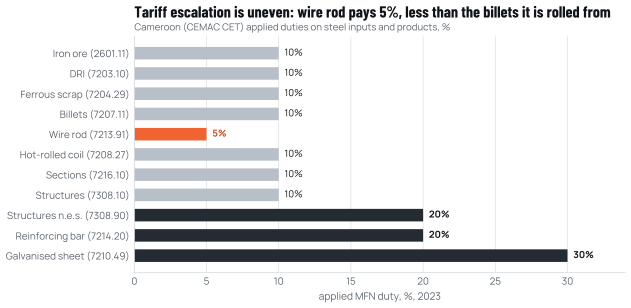
Source: World Bank WITS, Cameroon reported applied MFN tariffs, 2023 [S23]. The harmonised CEEAC-CEMAC tariff applied from 1 January 2026 has not yet been published by line for steel [S131].
Cameroon has wide legal room to adjust its tariffs: only 0.2% of its non-agricultural tariff lines are bound at the World Trade Organization, so steel duties are effectively unbound [S174]. But tariffs are set at the CEMAC level, and the harmonised CEEAC-CEMAC tariff that has applied since 1 January 2026 is still being implemented [S131]. Any change requires regional agreement.
The experience of other countries suggests what works. Egypt has used provisional duties with minimum specific amounts, such as a 13% billet duty with a minimum of US$65 per tonne from April 2026, to stabilise its market while keeping imports possible [S53][S54]. South Africa’s provisional safeguard on hot-rolled coil lapsed after 200 days, and shortly afterwards its main producer decided to wind down its long-steel business, citing weak protection among other factors [S55][S61]. Algeria combined protection with large investments in gas-based iron and became a net exporter [S57][S28]. The common lesson is that trade measures work best when they are transparent, time-bound, product-specific and accompanied by investment in competitive capacity.
10.4 Standards and quality: from rebar to structural steel
Standards are the instrument with the least fiscal cost and the most direct effect on safety. Cameroon has made a reinforcing-bar standard mandatory since 2022 and enforced it, including through ANOR’s sanction of a producer for Fe450 bars in 2024; in January 2026 the Prime Minister’s office refused to revise it [S26][S110]. Consumer complaints and reports of counterfeit bars show that enforcement remains a challenge [S111][S80].
Three steps would strengthen this lever. Mandatory standards and conformity assessment could be extended to structural sections, hollow sections, wire products and roofing sheet, which are increasingly used in public buildings and infrastructure and are today imported or produced without a common reference. Testing capacity, including accredited laboratories for tensile and chemical testing, would support enforcement; SND30 already calls for laboratory upgrades [S25]. And standards could be harmonised at the CEMAC level, so that certified products from any member state can circulate freely, which would also support the rules of origin of the African Continental Free Trade Area.
10.5 Public procurement: the State as the largest steel buyer
The State is the largest single buyer of steel through its public investment budget, 2,026.3 bn FCFA in 2026, and the road programme of the Ministry of Public Works, 740 bn FCFA [S17][S76]. Procurement rules shape demand more directly than trade measures.
Article 8 of the 2025 Finance Law introduced a national preference: imported goods for which a local equivalent exists lose their customs facilities, with exceptions for goods under the economic partnership agreements with the European Union and the United Kingdom, the African Continental Free Trade Area, CEMAC and CEEAC, and for certified shortages; the stated objective is to limit foreign-exchange outflows [S137]. Applied to steel, the measure could favour local products in public works, but its effect depends on how "equivalent" is defined. A rule that required certified products in public works, published the steel quantities of large tenders in advance and allowed local producers to bid for supply packages would support domestic sections and structures as well as bars.
Procurement also depends on payment. The Minister of Public Works acknowledged in 2026 that cash-flow tensions were affecting payments to contractors [S76]. Contractor arrears are passed on to their steel suppliers. Timely payment is the most effective procurement measure a government can take for its domestic industry.
10.6 Local content, iron units and incentives
The most important policy choice for the next decade is whether to encourage domestic iron-making. Several instruments already point that way.
The Mining Code, Law No. 2023/014 of 19 December 2023, reserves 95% of non-skilled jobs in mining for nationals and requires priority for Cameroonian subcontractors [S175]. It also requires each mining convention to set out how a share of production, at least 15%, is made available for local transformation (the text of the law is cited in White paper 01). Project conventions apply that rule: the convention for the Mbalam deposit is reported to provide for 15% of production to be transformed locally (the same press report presents a national steel hub as part of the programme), and the Kribi-Lobé convention reserves 15% for the local market [S34][S35]. These clauses could become a significant source of iron units if they are translated into practical supply arrangements, technical specifications and timelines.
The 2013 investment law already lists iron and steel as a priority sector [S142]. Incentives could be focused on the activities that close the gap, namely melting, direct reduction and section rolling, rather than on additional rolling of products already in surplus. Scrap policy matters too: no legal ban on scrap exports was found, although recorded exports fell to near zero after 2019 [S05][S123]. Formalising scrap collection, with traceability and environmental standards, would improve both supply and data.
Energy is part of industrial policy for steel. A melt shop or direct reduction plant is a large, steady electricity load. A published framework for high-voltage industrial supply above 10 MW, which does not exist today, and timely completion of transmission links would help every energy-intensive industry [S93][S92]. White paper 05, Chapter 10, sets out the rules such a framework would need.
Table 10.1 derivedPolicy levers for the steel sector, current state and options
| Lever | Current state | Option | Expected effect | Constraint or risk |
|---|---|---|---|---|
| Trade: rebar suspension | Administrative ban since 2016, reaffirmed 2023; derogations sought | Replace over time with transparent, time-bound and product-specific measures (safeguard or anti-dumping capacity, minimum-price duties) | Predictability for investors; fewer ad hoc derogations | Requires investigative capacity; CEMAC coordination |
| Trade: tariff structure | Wire rod 5%; billets, ore, DRI and scrap 10%; rebar 20% (2023) | Remove inverted escalation in the CEEAC-CEMAC tariff; relieve the duty on iron units used for melting, for example through inward processing | Consistent incentives along the chain | Regional negotiation; cost to downstream users |
| Standards | Rebar standard mandatory and enforced | Extend to structural sections, wire and sheet; accredited laboratories; CEMAC harmonisation | Safety; level field with imports | Laboratory capacity; transition time |
| Public procurement | National preference (Finance Law 2025, Art. 8) | Require certified steel in public works; publish steel quantities; pay contractors on time | Predictable domestic demand for certified products | Fiscal space; trade commitments |
| Local content and iron units | 15% local-transformation clauses in two mining conventions | Translate into supply agreements, specifications and timelines | Domestic source of iron units | Mining project delays; ore quality |
| Investment incentives | Law 2013/004 lists iron and steel as priority | Target incentives at melting, direct reduction and section rolling | Investment where the gap is | IMF scrutiny of tax expenditures |
| Price regulation | Rebar prices homologated | Publish the formula; review periodically; avoid extending to non-homologated products | Transparency; investor confidence | Consumer price sensitivity |
| Scrap | No legal export ban found; collection informal | Formal collection and traceability; data | More and better feedstock; reliable statistics | Informal sector livelihoods |
| Energy | No published tariff above 10 MW; 150 MW industrial demand unmet | Industrial high-voltage framework; dedicated supply arrangements | Feasibility of melting and direct reduction | Utility finances; grid investment |
| Data | No official apparent-use series; Comtrade detail to 2023 | Publish annual steel balance (production, trade, use) | Better policy and investment decisions | Statistical capacity |
Source: Cameroon Steel analysis [S04][S56][S23][S131][S26][S137][S34][S35][S142][S24][S123][S93][S92][S05].
10.7 Lessons from neighbours and peers
Cameroon’s neighbours and peers offer recent examples of steel policy. Gabon reduced VAT on locally made reinforcing bar from 10% to 3% in July 2026, a fiscal preference rather than a ban, in support of new mills at Nkok and Port-Gentil [S29][S21][S30]. Egypt protects its market with duties that combine a percentage with a minimum amount per tonne, applied to billets and hot-rolled coil after investigation [S53][S54]. Algeria combined import management with very large investments in gas-based iron and steel and moved from deficit to surplus in four years [S57][S28]. South Africa’s experience shows the limits of protection when energy, logistics and feedstock policy fail [S61].
Two features distinguish successful cases. Protection was linked to investment in competitive capacity, so that it was temporary in effect if not always in law. And it was applied through instruments that investors could read in advance: published duties, investigations with defined procedures and time limits, and clear rules on feedstock. Cameroon’s rebar ban has delivered the first, in the form of new rolling capacity, but not the second.
10.8 Data as a public good
Several of the uncertainties in this paper would disappear if Cameroon published an annual steel balance: domestic production by product, imports and exports by product and apparent use. The data exist, in customs records and in producers’ accounts, but they are not assembled. A balance compiled by the statistics institute with the industry associations, and published each year, would allow the government to monitor import surges, evaluate trade measures, plan public procurement and track progress towards the SND30 objectives. It would also help lenders and investors assess projects on a common basis. It is the cheapest of all the levers discussed here, and it would improve the use of every other one.
10.9 Fiscal and macroeconomic limits
Every lever must respect the macroeconomic constraints. The IMF found a 2025 non-oil primary deficit of 2.6% of GDP against a target of 1.4% and assesses a high overall risk of debt distress; its post-financing assessment will go to its Board in December 2026 [S82][S36]. Tax exemptions will be scrutinised, which argues for incentives that are targeted, time-bound and transparent. CEMAC’s reserves, at 4.2 months of imports at the end of 2025, and the requirement for central-bank authorisation of transfers above 50m FCFA, make foreign-exchange availability a constraint for importers and investors alike [S113][S142]. The 2026 Finance Law also prohibits purchases from foreign suppliers without an effective transfer of funds [S136].
These constraints strengthen rather than weaken the case for iron-unit substitution. Domestic iron reduces the foreign-exchange cost of the existing industry; certified domestic sections reduce the import content of public investment. The policy agenda that follows is modest in fiscal cost: clarify and regularise trade instruments, extend standards, use procurement intelligently, focus incentives where the gap lies, and publish the data that investors and policymakers need.
10.10 A sequenced agenda
The levers can be sequenced over the period covered by this paper. In 2026 and 2027, the priorities are data and standards: an annual national steel balance, publication of the steel lines of the harmonised tariff, extension of mandatory certification to structural steel and payment discipline in public works. From 2027 to 2030, the priorities are the trade and incentive framework: transparent instruments to replace the open-ended ban, correction of inverted tariff escalation at the CEMAC level, incentives focused on melting and section rolling, and practical arrangements for local-transformation clauses in mining conventions. Beyond 2030, as ore and gas projects mature, policy can turn to the long-term question of ore-based iron in Cameroon. Throughout, the goal is the one set by SND30: import substitution together with exports, in a sector the strategy itself names as a priority [S25].
Other sources cited in the English text
- S113Zone Cémac: la BEAC annonce un ralentissement de croissance à 2,4%. AllAfrica (Les Dépêches de Brazzaville), 17 Dec 2025.fr.allafrica.com/stories/202512170629.html
- S05UN Comtrade public API, Cameroon (reporter 120), HS 72/73 and 6-digit lines, 2019-2023. UN Statistics Division.comtradeapi.un.org/public/v1/preview/C/A/HS?reporterCode=120&period=20…
- S171Le Cameroun se dote d’un nouveau Plan directeur d’industrialisation. Le360 Afrique, 4 Apr 2017.afrique.le360.ma/autres-pays/economie/2017/04/04/10804-le-cameroun-se-…
- S172« Des actions concrètes pour renforcer les infrastructures industrielles » (MINMIDT). Cameroon Tribune, 1 Nov 2024.cameroon-tribune.cm/article.html/67712/fr.html/details_2
- S173Cameroon cuts PIISAH allocation to CFA12.5bn in 2026. Business in Cameroon, 15 Dec 2025.businessincameroon.com/public-management/1512-15509-cameroon-cuts-piis…
- S04Press report of the sealing by customs of more than 7,300 t of imported reinforcing bar, December 2020 (headline and address not reproduced: they name the importer). Business in Cameroon, 16 Dec 2020.Cited by title and date
- S56Métallurgie: les importations du fer à béton interdites jusqu’à nouvel ordre. EcoMatin, 10 Apr 2023.ecomatin.net/metallurgie-les-importations-du-fer-a-beton-interdites-ju…
- S26Cameroon rejects fresh push to revise rebar standard. Business in Cameroon, 26 Jan 2026.businessincameroon.com/construction/2601-15657-cameroon-rejects-fresh-…
- S24Fer à béton: les producteurs acceptent une baisse des prix. EcoMatin, 23 Oct 2023.ecomatin.net/fer-a-beton-les-producteurs-acceptent-une-baisse-des-prix
- S137Innovations douanières de la Loi de Finances 2025. MINFI, Direction Générale des Douanes, Jan 2025.minfi.gov.cm/wp-content/uploads/2025/01/EXPOSE_DGD_LF_2025.pdf
- S124Cameroon, Republic of: Corporate, Other taxes. PwC Worldwide Tax Summaries, reviewed 14 Aug 2026.taxsummaries.pwc.com/republic-of-cameroon/corporate/other-taxes
- S174Tariff profile: Cameroon. WTO, n.d..wto.org/english/res_e/statis_e/daily_update_e/tariff_profiles/CM_e.pdf
- S53Egypt has imposed a temporary duty on imports of HRC at 13.6%. GMK Center, 15 Sep 2025.gmk.center/en/news/egypt-has-imposed-a-temporary-duty-on-imports-of-ho…
- S54Egypt’s steel industry: protection from within. GMK Center, 23 Jul 2026.gmk.center/en/posts/egypt-s-steel-industry-protection-from-within/
- S55South Africa imposes safeguard duty on imports of hot-rolled steel. GMK Center, 1 Jul 2024.gmk.center/en/news/south-africa-imposes-safeguard-duty-on-imports-of-h…
- S61Update: Final wind-down decision relating to the Long Steel Business. ArcelorMittal South Africa, 28 Feb 2025.arcelormittalsa.com/Portals/0/NEWS%20RELEASE%20-%20UPDATE%20-%20FINAL%…
- S57Protecting the steel market: how it’s done in North Africa. GMK Center, 2 Sep 2026.gmk.center/en/posts/protecting-the-steel-market-how-it-s-done-in-north…
- S28Algeria’s steel industry: why is it growing. GMK Center, 28 Jul 2026.gmk.center/en/posts/algeria-s-steel-industry-why-is-it-growing/
- S110Cameroun: le gouvernement rejette une demande de révision de la norme du fer à béton. EcoMatin, 5 Feb 2026.ecomatin.net/cameroun-le-gouvernement-rejette-une-demande-de-revision-…
- S111Interdiction des importations du fer à béton: les consommateurs dénoncent la mauvaise qualité de la production locale. EcoMatin, 13 Apr 2023.ecomatin.net/interdiction-des-importations-du-fer-a-beton-les-consomma…
- S80Métallurgie: les industriels dénoncent la présence du fer à béton contrefait. EcoMatin, 22 Jun 2023.ecomatin.net/metallurgie-les-industriels-du-secteur-denoncent-la-prese…
- S17Budget 2026-8 816,4 milliards FCFA…. MINFI, 26 Nov 2025.minfi.gov.cm/budget-2026-8-8164-milliards-fcfa-pour-consolider-la-stab…
- S76Cameroon targets 476 km of new roads in 2026 infrastructure plan. Business in Cameroon, 16 Feb 2026.businessincameroon.com/construction/1602-15761-cameroon-targets-476-km…
- S175Mining 2026, Cameroon (Chazai Wamba). Chambers Global Practice Guides, updated 27 Jan 2026.practiceguides.chambers.com/practice-guides/mining-2026/cameroon
- S123Lutte contre la vie chère: le Cameroun limite les exportations de certains produits. EcoMatin, 27 Apr 2022.ecomatin.net/lutte-contre-la-vie-chere-le-cameroun-limite-les-exportat…
- S93Rapport d’activités 2025 de l’ARSEL. ARSEL (electricity regulator), 7 Sep 2026.arsel-cm.org/wp-content/uploads/2026/09/Rapport-ARSEL-2025.pdf
- S92Nachtigal power line delays leave 150 MW of industrial demand unmet. Business in Cameroon, 9 Oct 2026.businessincameroon.com/public-management/0910-16939-nachtigal-power-li…
- S29Le Gabon réduit la TVA sur le fer à béton local. EcoMatin, 4 Aug 2026.ecomatin.net/le-gabon-reduit-la-tva-sur-le-fer-a-beton-local-pour-stim…
- S21Prometal obtient 26 milliards FCFA d’Afreximbank pour soutenir son expansion industrielle. EcoMatin, 30 Sep 2026.ecomatin.net/prometal-obtient-26-milliards-fcfa-dafreximbank-pour-sout…
- S30Gabon: le groupe Fokou lance une nouvelle unité d’acier à Port-Gentil. EcoMatin, 18 Sep 2026.ecomatin.net/gabon-le-groupe-fokou-lance-une-nouvelle-unite-dacier-a-p…
- S82IMF Executive Board concludes 2026 Article IV consultation with Cameroon (PR 26/096). IMF, 30 Mar 2026.imf.org/en/news/articles/2026/03/30/pr-26096-cameroon-imf-executive-bo…
- S36IMF staff concludes Post-Financing Assessment mission to Cameroon (PR 26/314). IMF, 1 Oct 2026.imf.org/en/news/articles/2026/10/01/pr26314-imf-staff-concludes-assesm…
- S136Cameroun: les principales innovations de la loi de finances pour 2026. Deloitte Société d’Avocats, 24 Mar 2026.blog.avocats.deloitte.fr/cameroun-les-principales-innovations-de-la-lo…
- S03Production: les acteurs en présence. Cameroon Tribune, 11 May 2026.cameroon-tribune.cm/article.html/76600/fr.html/details_2
本章引用的资料来源
方括号内的标记对应以下来源(按原文语言列出),完整列表见附录。 完整来源列表
- S115Commerce extérieur du Cameroun en 2023. INS Cameroun,2024年4月.ins-cameroun.cm/wp-content/uploads/2025/07/Note-sur-le-Commerce-Exteri…
- S107Évolution du commerce extérieur en 2024. INS Cameroun,2025年8月.ins-cameroun.cm/wp-content/uploads/2025/12/Commext_2024_FR_Edite-final…
- S07Évolution du commerce extérieur en 2025 (version provisoire). INS Cameroun,2026年2月(发布:2026年4月1日).ins-cameroun.cm/wp-content/uploads/2026/04/Note-sur-le-commerce-exteri…
- S25Stratégie Nationale de Développement 2020-2030 (SND30). Republic of Cameroon / MINEPAT (hosted by FAOLEX),2020年.faolex.fao.org/docs/pdf/cmr211554.pdf
- S16Les Comptes Nationaux de 2025. INS Cameroun,2026年8月(发布:2026年9月2日).ins-cameroun.cm/wp-content/uploads/2026/09/Comptes_Nationaux_2025_FR_V…
- S34Cameroon Mining Company confirme l’entrée du projet Mbalam dans sa phase irréversible d’exécution. Camer.be(经AllAfrica转载),2025年12月12日.fr.allafrica.com/stories/202512120475.html
- S35Cameroon signs iron ore deal with Sinosteel (citing Reuters). Mining Technology,2022年5月23日.mining-technology.com/news/sinosteel-deal-iron-cameroon/
- S1422024 Investment Climate Statements: Cameroon. US Department of State,2024年.state.gov/reports/2024-investment-climate-statements/cameroon/
- S23WITS TRAINS API, Cameroon reported MFN tariffs by HS6 (2023). World Bank / UNCTAD.wits.worldbank.org/API/V1/SDMX/V21/datasource/TRN/reporter/120/partner…
- S131Cameroon applies CEEAC common external tariff from January 1, 2026. Business in Cameroon,2026年1月12日.businessincameroon.com/public-management/1201-15594-cameroon-applies-c…
引用本章
Cameroon Steel(2026)。喀麦隆钢铁缺口在于含铁原料,而非钢筋(中文摘要版)。白皮书04,第10章:政策应将保护从成品棒材转向质量、含铁原料和公平贸易。CS-WP-04。https://www.cameroon-steel.com/zh/library/market-outlook/policy/
来源