White paper 01 · Value chain
From ore to steel: Cameroon’s missing link is ironmaking, not rolling
Cameroon holds the ore and a growing market, yet captures little value: the gap lies upstream, in iron units and billets.
Derived Counted from the English manuscript when the site was generated; print equivalent = words ÷ 350.
You are reading the full English edition. Also online: Édition française complète中文摘要版
Executive summary
What the study shows
Read the full executive summaryCameroon holds large iron ore deposits, some of them high-grade, and a growing construction market, yet captures little of the value between the mine and the building site. The gap is upstream, in iron units and billets. Local processing under the 2023 Mining Code and a steel chain built in phases at Kribi can turn ore exports into industrial value.
Source: white paper 01, executive summary; bracketed markers refer to the list of sources in the annex.
Main findings
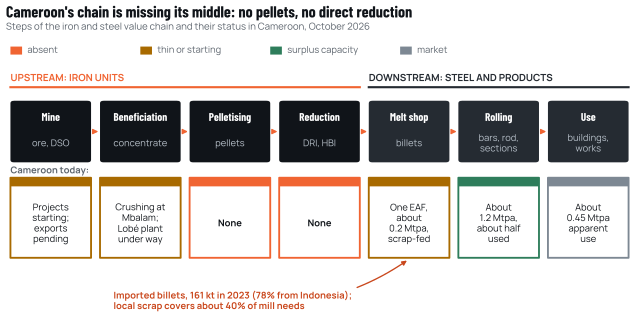
- Cameroon’s steel chain has its ends but not its middle. The country has 64 Mtpa of iron-ore mine capacity in development, the world’s fourth-largest pipeline [G18], and about 1.2 Mtpa of steel rolling and transformation capacity [C38]. Between the two there is no pelletising, no direct reduction and no blast furnace; Sub-Saharan Africa as a whole made only 0.09 Mt of direct-reduced iron in 2025 on Midrex plant statistics [T13].
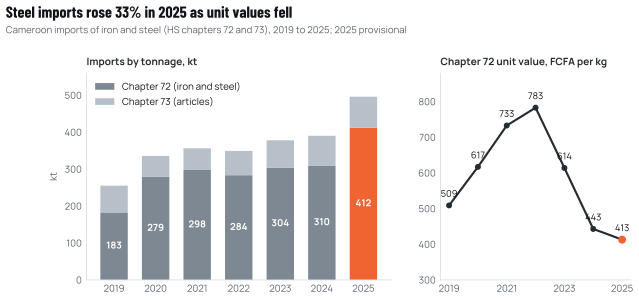
- The import bill is a bill for iron units. Chapter 72 imports rose 33% to 412,049 t in 2025, worth 170.1 bn FCFA; with chapter 73 articles, steel accounted for 13.0% of the trade deficit [C05]. Billets were the largest single import in 2023, at 161.4 kt and about half of chapter 72 spending, 78% of them from Indonesia [C06].
- Rolling is saturated; feed is the constraint. Rebar capacity of 627 kt/yr is about 3.5 times domestic demand of 180 kt/yr [C30], mills run at about 50% [C38][C40], and local scrap covers only about 40% of their needs [C38]. In September 2026 the leading producer borrowed €40 m from Afreximbank specifically to import billets [C38][C39].
- Tonnage is not the constraint; grade is. The only code-compliant reserve, Mbalam-Nabeba, holds 517 Mt at 62.2% Fe, about 154 Mt of it on the Cameroonian side and 363 Mt in Congo, and 5,638 Mt of itabirite at 33.4% Fe, 3,924 Mt of it at Mbarga in Cameroon [O05]. Its direct-shipping ore suits export and blast furnaces, not gas-based direct reduction, which needs pellets near 67.5% Fe with low silica and alumina [N16]. A 68% Fe concentrate meeting that basis has been made only in 2014 testwork [O04].
- DR-grade feed is scarce worldwide, which raises its value. Merchant demand for DR-grade pellets could grow from 46.4 Mt in 2022 to 117.3 Mt in 2033, leaving 31.6 Mtpa without an identified source [N01]; the Middle East and North Africa alone need 30 to 40 Mtpa more within a few years [N02]. A Cameroonian DR-grade concentrate would have buyers at home and abroad.
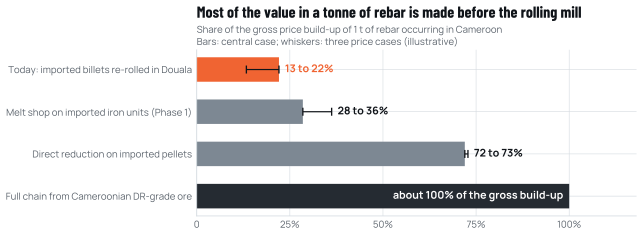
- Most of the value of a tonne of rebar is made before the rolling mill. On dated 2025 and 2026 prices, ore and ironmaking account for 64 to 72% of the value of a tonne of rebar, melting for 6 to 15% and rolling for 13 to 22% (illustrative, Chapter 8). Carried through to rebar, a tonne of DR-grade concentrate is worth about 3.6 times as much as the same tonne sold as ore.
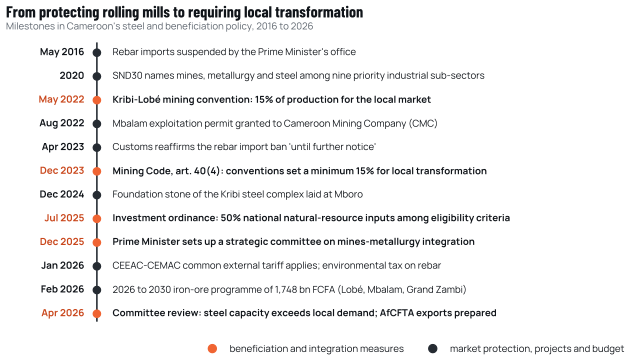
- Policy now requires local transformation but does not yet make it bankable. Article 40(4) of the Mining Code sets a 15% minimum [Z42], the Mbalam and Lobé conventions contain 15% clauses [O17][O33], and a committee at the Prime Minister’s office has coordinated mines-metallurgy integration since December 2025 [Z79]. No public text yet defines transformation, grade, price or timing, and the tariff charges billets the same 10% as iron ore [P24].
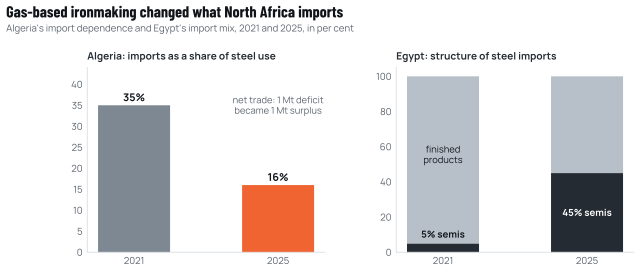
- Successful producers built backwards from a port-based melt shop or DR plant. Algeria moved from a 1 Mt steel deficit to a 1 Mt surplus between 2021 and 2025 with gas-based DRI [A04]; Egypt’s imports shifted towards billets as its rolling outgrew its ironmaking [A07]; Vietnam built a coastal complex on imported ore [N13]. Nigeria’s Ajaokuta, a mismatched megaproject, has never produced liquid steel [N14].
- A phased chain at Kribi can capture the value step by step. A melt shop first, sections on evidence of demand, and direct reduction of Cameroonian concentrate when grade, gas and scale allow. Cameroon Steel’s reference configuration RC-1 illustrates the sequence: Phase 1 at a nameplate of 0.3 Mtpa (expected sustained output 270 to 300 kt), with works targeted from 2029 and a first heat in the second half of 2030, rising to a design capacity of 1 Mtpa after 2034, with a reserve for about 1 Mtpa of DRI later (planned / indicative) [F01][X04]. Phase 1’s billets can be rolled into wire rod and rebar or sold to the existing re-rollers, which import about 60% of their charge [C38]; on imported iron units it competes behind the tariff and saves little foreign exchange relative to those re-rollers (White paper 09).
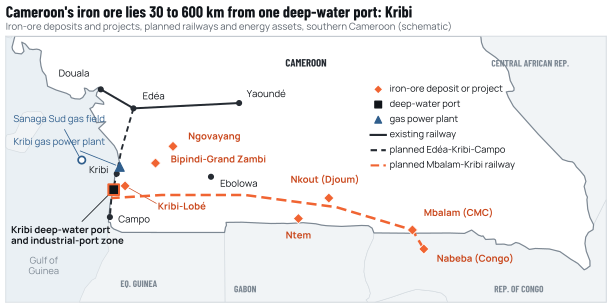
- Kribi is the hinge, and its later links must be secured. Kribi offers a 16 m quay [Z37], an industrial zone with a steel cluster [Z4], a 225 kV supply of 100 MW for the whole port platform from the end of 2026 [Z43] and a gas field that lost its LNG buyer in July 2026 [E09]. A DR module would need about 9 bcf of gas a year, about 12% of 2025 output [E04], firm power at the substation’s later 330 to 400 MW stage, bulk handling and the Mbalam railway.
Contents
12 chapters, 4 annexes
Every chapter opens with its conclusion. The annexes set out the method, the glossary and the list of sources.
- SummaryExecutive summary11 min · 1 fig.
- Chapter 1The gap is upstream: Cameroon rolls steel but makes no iron11 min · 3 fig.
- Chapter 2Cameroon’s ore is large enough; its grade decides the route11 min · 4 fig.
- Chapter 3Cameroon imports iron units and flat steel, not rebar11 min · 3 fig.
- Chapter 4Successful producers matched ironmaking to their gas, their ore and their market13 min · 2 fig.
- Chapter 5Policy now requires local transformation; it does not yet make it bankable10 min · 2 fig.
- Chapter 6A phased chain: melt first, then sections, then iron from Cameroonian ore15 min · 3 fig.
- Chapter 7Kribi is the hinge: where ore, gas, power and deep water meet12 min · 4 fig.
- Chapter 8Ironmaking is the prize; the melt shop is the door to it12 min · 2 fig.
- Chapter 9Sixteen risks, four critical, and most of them concern iron units and energy10 min · 2 fig.
- Chapter 10Recommendations: make the 15% rule produce iron11 min · 2 fig.
- Chapter 11Evidence gaps: what is not yet known and how it will be resolved8 min
Annexes
Go further
Related white papers
- WP03Electric steelmaking is the right route for Central AfricaTechnology · 2.9 h
- WP04Cameroon’s steel gap lies in iron units, not in rebarMarket · 3.1 h
- WP09Domestic steel saves foreign exchange only when it competes at border pricesEconomics · 2.9 h
Related Labs tools
- Value-chain explorer
How many tonnes go in and out at each stage, from ore to finished product?
- Import-substitution simulator
What share of steel imports could local production replace?
- Project timeline
What is verified, what is planned, and when?
Cite this white paper
CS-WP-01
Cameroon Steel (2026). From ore to steel: Cameroon’s missing link is ironmaking, not rolling. White paper 01, CS-WP-01. https://www.cameroon-steel.com/en/library/ore-to-steel/
- Reference
- CS-WP-01
- Edition
- 10 October 2026
- Status
- First edition
- Classification
- Public