White paper 01 · Chapter 9
Sixteen risks, four critical, and most of them concern iron units and energy
An ore-to-steel chain in Cameroon faces sixteen material risks. Four are both likely and severe: saturation of the rebar market, shortage of iron units, the absence so far of DR-grade feed, and firm power. A further four are severe if they occur: gas reserves and pricing, import surges, financing and foreign exchange, and capital-cost overruns. Most can be reduced by the phased design itself, which commits capital one phase at a time, and by a handful of policy measures that cost the budget little.
In this chapter (6)
9.1 How the risks were assessed
The risks below were identified from the evidence in Chapters 1 to 7 and rated by Cameroon Steel’s analysts on two scales: the likelihood that the risk materialises over the next decade, and its impact on the chain if it does. Both are judgements, informed by the cited evidence; they are not probabilities. Each risk is paired with mitigations and with the party best placed to lead them. Figure 9.1 places the sixteen risks on a likelihood-impact grid, and Table 9.1 sets out the register.
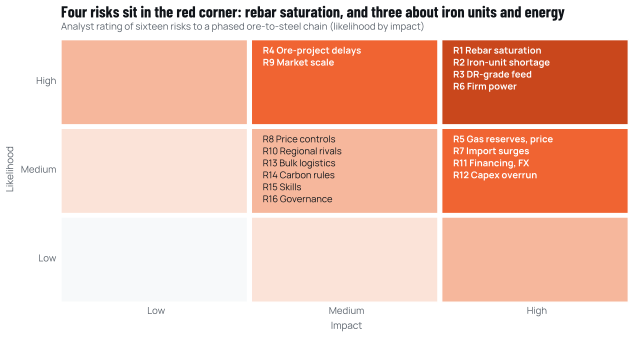
Source: Cameroon Steel risk assessment based on the evidence cited in Table 9.1. Status: derived (analyst judgement).
9.2 The four critical risks
R1. Rebar saturation. Cameroon’s rebar capacity of 627 kt/yr is about 3.5 times domestic demand of about 180 kt/yr [C30]; the industry as a whole runs at about 50% [C38][C40] and held more than 30 bn FCFA of unsold stock in September 2026 [C41]. The Prime Minister’s committee on mines-metallurgy integration reached the same conclusion in April 2026 [Z79]. The region is filling up too: a 120 kt/yr scrap-based rebar mill is under construction in Gabon, which has cut VAT on local rebar, and 300 kt/yr bar and wire-rod mills were ordered in 2026 for Abidjan and Tanzania [C39][C52][A21][A22]. Any new rolling capacity that adds rebar without adding iron units divides a saturated market further.
Mitigation. Justify Phase 1 by its melt shop, not its rolling mill; compete on certified quality; offer merchant billets to the existing re-rollers, which import about 60% of their charge [C38]; move into medium and heavy sections, which are not produced in Cameroon (Chapter 3); and develop exports under AfCFTA, which the mines-metallurgy committee is already preparing [Z80].
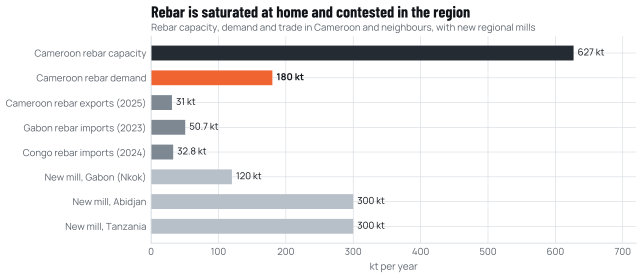
Source: [C30] (capacity and demand), [C05] (exports), [C07] (Gabon and Congo imports), [C39], [A21], [A22] (new mills).
R2. Iron-unit shortage. National scrap arising was last measured at 53,000 to 61,833 t/yr [C42], local scrap covers about 40% of existing mills’ needs [C38], scrap prices have risen by about 30% [C40], and the leading producer is borrowing €40 m to import billets [C38]. RC-1 needs 0.36 Mtpa of metallics at Phase 1 and 1.21 Mtpa at full capacity, and assumes only about 30 kt/yr of domestic scrap (0 to 60) [F01]; contracted supply and the delivered cost of the imported HBI, DRI and scrap are not yet established. The global market for DR-grade pellets and merchant iron units is tight and expected to stay so until about 2030 [N01][N02][D12].
Mitigation. Long-term supply contracts for HBI and DRI from several origins; a scrap-collection programme that brings informal collectors into the formal chain; and the direct-reduction module on Cameroonian ore as the durable answer.
R3. DR-grade feed not yet available. Cameroon’s only code-compliant reserve is direct-shipping ore at 62.2% Fe [O05]. A 68% Fe concentrate suitable for direct reduction has been produced only in 2014 testwork [O04], and no concentrator or pellet plant producing DR grade is in any published plan.
Mitigation. Pilot-scale concentration, pelletising and reduction tests on Mbalam itabirite and Lobé magnetite; a grade clause in the 15% offtake terms; the DRI-plus-smelter route, which tolerates lower-grade pellets [N01], as a fallback; and imported DR pellets as a bridge.
R6. Firm power. Industrial demand of 150 MW was unmet nationally in October 2026 because of delays to the Nachtigal evacuation line [E16]; the Kribi gas plant ran at about a 30% capacity factor in 2025 [E15]; hydropower, about 90% of generation in 2025, is seasonal [E15]. RC-1 needs about 36 MW on average at Phase 1 and about 94 MW at full capacity, more with a DR module [F01].
Mitigation. Size Phase 1 within the initial 100 MW of the Kribi 225 kV supply, which is designed with N-2 redundancy through the southern grid [Z43], and agree with the grid operator an allocation of that shared supply and power-quality measures for the arc furnace (static VAR compensation, adequate short-circuit capacity); negotiate a high-voltage contract with a capacity charge and indexation; reserve the later 330 to 400 MW stage of the substation for the full chain [Z43]; consider dedicated generation, for example the unbuilt 114 MW extension of the Kribi gas plant [E25].
9.3 Severe risks to manage
R5. Gas reserves and price. Gas production is concentrated in the Sanaga Sud field, where about 600 bcf were developed for the LNG vessel and are in natural decline; certified remaining reserves are not public; and the larger Yoyo-Yolanda resource of about 2.5 Tcf needs about US$4 bn and has no investment decision [E02]. The applicability of the 70 FCFA/m³ tax on natural gas to gas used as a reductant is unclear [E11].
Mitigation. An independent reserve audit before the DR module; a long-term gas sales agreement with take-or-pay flexibility; a hydrogen-ready shaft furnace; and a modular DR plant that can start below 1 Mtpa.
R7. Import surges and policy reversal. Global excess steel capacity is expected to grow from 640 Mt in 2025 to 745 Mt by 2028 [G16]; Chinese billets traded at US$465 to 470/t FOB in October 2026 [G34]; and contractors on large public works have sought rebar imports despite the ban, as with the 7,300 t sealed at Kribi in 2020 [C20]. Cameroon has no trade-remedy practice in steel (Chapter 5).
Mitigation. Build anti-dumping and safeguard capacity; apply the national preference of the Finance Law 2025 [P18] explicitly to locally made billets and sections; enforce quality standards on imports as well as local products.
R11. Financing, foreign exchange and sovereign risk. The IMF rates Cameroon at high overall risk of debt distress [P32]; CEMAC foreign reserves fell to 4.2 months of imports at the end of 2025 [P07]; transfers above 50 m FCFA require central-bank authorisation [P10]; and the Finance Law 2026 prohibits payments to foreign suppliers without an effective transfer of funds [P11].
Mitigation. Structure financing with development-finance institutions and export-credit agencies; keep export revenues in offshore accounts where regulations allow; commit capital phase by phase rather than in one tranche; and use regional lenders already active in Cameroonian steel [C38].
R12. Capital-cost overrun and technology. Large steel projects overrun. Sweden’s hydrogen-based Stegra project raised €6.5 bn for its first phase in 2024 and has since sought additional funding as costs rose and its start slipped to 2027 [T24][T25][T26]; Nucor raised the estimate for its West Virginia sheet mill to US$3.1 bn in 2023 [T19]. For DRI-EAF plants, IEA-derived benchmarks span about US$510 to 1,310 per tonne of capacity in 2019 dollars [T02].
Mitigation. Proven technology from established suppliers; fixed-price contracts with performance guarantees; an independent engineer; and the phased design, which limits the capital at risk at each phase.
9.4 Likely but manageable
R4. Ore-project delays. Mbalam’s first exports moved from the first quarter of 2026 towards 2027 [O24][O28]; Kribi-Lobé moved to July 2027 [O35]; Grand Zambi’s first export has not been confirmed [O38]; Nkout is blocked by a dispute between investors [O47]. Because the phased chain does not depend on Cameroonian ore until the DR module, these delays affect timing, not viability.
Mitigation. Design Phases 1 to 3 on imported and local scrap and imported iron units; keep the DR module open to several ore sources; align the DR module with the Mbalam rail phase from 2030 [O25].
R9. Market scale. At 1 Mtpa, RC-1 would produce more than twice Cameroon’s 2025 chapter 72 imports [C05] and about twice apparent steel use [C40]. Without exports, the later phases would not be absorbed.
Mitigation. Trigger Phases 2 and 3 on evidence of demand; secure CEMAC and AfCFTA customers; consider HBI exports from the DR module into markets short of iron units.
9.5 Medium risks
R8. Price controls. Rebar prices are homologated by the Ministry of Commerce and producers accepted reductions in October 2023 [C44]. Mitigation: focus on products outside homologation; agree a transparent, cost-based formula for those within it.
R10. Regional rivals. Gabon’s new mills and VAT preference, and new mills in West and East Africa, will compete for the same export markets [C39][C52][A21][A22]. Mitigation: target products the neighbours do not make, such as sections and billets.
R13. Bulk logistics. The mineral terminal is at the memorandum stage, no railway reaches Kribi, and container import dwell times reached about 25 days in 2026 [O31][Z45][E45]. Mitigation: secure berth and storage rights in the planned terminal’s steel cluster [O31]; use the multipurpose terminal for Phase 1.
R14. Carbon rules on exports. The EU’s CBAM entered its definitive phase on 1 January 2026, certificates go on sale from 1 February 2027, and it covers DRI, billets, rebar, wire rod and pellets [D01][D02][D08]; free allocation for EU producers falls from 97.5% in 2026 to zero in 2034 [D07]; a UK CBAM applies from 1 January 2027 [D10]. Mitigation: measure and verify emissions from the first day; use Cameroon’s hydro-based grid; choose hydrogen-ready equipment.
R15. Skills. No Cameroonian institution offers a dedicated ferrous-metallurgy programme, although ENSP Yaoundé, the Ngaoundéré mining schools and IUT Douala provide relevant engineering and technician training [K02][K03][K08]. Mitigation: a training centre with these institutions and supplier training packages, consistent with the local-employment rules of the Mining Code [O36].
R16. Governance and reputation. Cameroon was suspended from EITI in February 2024 [O52], and lenders apply international environmental and social standards. Mitigation: an environmental and social impact assessment to IFC Performance Standards; publication of offtake terms under the 15% rule; transparent reporting.
Table 9.1 Risk register for a phased ore-to-steel chain
| ID | Risk | Key evidence | L | I | Main mitigation | Lead |
|---|---|---|---|---|---|---|
| R1 | Rebar saturation | 627 kt capacity vs 180 kt demand [C30] | H | H | Melt shop first; merchant billets; sections; exports | Investor |
| R2 | Iron-unit shortage | Scrap covers about 40% of needs [C38] | H | H | Long-term HBI/DRI contracts; DR module | Investor |
| R3 | No DR-grade feed yet | DR concentrate in testwork only [O04] | H | H | Pilot tests; grade clause; smelter fallback | Miner, State |
| R6 | Firm power | 150 MW industrial demand unmet [E16] | H | H | Allocation; power quality; capacity contract | State, utility |
| R4 | Ore-project delays | Mbalam start may slip to 2027 [O28] | H | M | No phase depends on one mine | Investor |
| R9 | Market scale | 1 Mtpa vs 0.45 Mtpa use [C40] | H | M | Phase by demand; exports | Investor |
| R5 | Gas reserves and price | Reserves not certified [E02] | M | H | Reserve audit; flexible contract | State, SNH |
| R7 | Import surges | 745 Mt excess capacity by 2028 [G16] | M | H | Trade-remedy capacity | State |
| R11 | Financing, FX | High risk of debt distress [P32] | M | H | DFI and ECA structure; phases | Investor, DFIs |
| R12 | Capex overrun | Large projects overrun [T25][T26] | M | H | Proven technology; fixed-price EPC | Investor |
| R8 | Price controls | Homologated rebar prices [C44] | M | M | Cost-based formula | State |
| R10 | Regional rivals | New mills in Gabon and beyond [C39] | M | M | Differentiated products | Investor |
| R13 | Bulk logistics | Mineral terminal at MoU stage [O31] | M | M | Berth rights in steel cluster | Port, zone |
| R14 | Carbon rules | CBAM certificates from 2027 [D02] | M | M | Measured MRV; hydro power | Investor |
| R15 | Skills | No ferrous-metallurgy programme [K02] | M | M | Training centre | Investor, universities |
| R16 | Governance | EITI suspension, 2024 [O52] | M | M | IFC-standard ESIA; transparency | All |
Source: Cameroon Steel analysis. L: likelihood; I: impact; H: high; M: medium. Ratings are analyst judgements.
9.6 The phased design is itself the main mitigation
Most of the critical and severe risks share a cause: they would all bite at once on a project that tried to build the whole chain in one step. A DR plant built before its feed, its gas contract and its market would face R2, R3, R5, R6, R9 and R12 simultaneously. A phased chain spreads them over time and attaches each to a decision point:
- Phase 1 faces R1, R2 and R6, and can manage them with its product mix and merchant billets, supply contracts, and an agreed share of the first 100 MW at Kribi;
- Phases 2 and 3 face R9 and R10, and should be triggered by demand;
- The DR module faces R3, R5 and R12, and should be built only when grade, gas and cost are proven.
This is the lesson of Chapter 4 restated as risk management: the countries that succeeded built in modules behind secure feed; the project that failed tried to do everything at once.
Sources cited in this chapter
Bracketed markers refer to these sources; the full list is in the annex. Full list of sources
- C30Production: les acteurs en présence. Cameroon Tribune, 11 May 2026.cameroon-tribune.cm/article.html/76600/fr.html/details_2
- C38Cameroun: le groupe Prometal décroche 26 milliards FCFA auprès d’Afreximbank…. Sikafinance, 30 Sep 2026.sikafinance.com/marches/cameroun-le-groupe-prometal-decroche-26-millia…
- C40Cameroun: Prometal décroche 26,2 milliards FCFA d’Afreximbank. Camer.be, 1 Oct 2026.camer.be/actualites/economie/cameroun-prometal-decroche-262-milliards-…
- C4140 millions d’euros d’Afreximbank: Prometal sécurise ses billettes d’acier alors que la ferraille camerounaise s’épuise. Cameroun24, 10 Oct 2026.cameroun24.net/article/76267-40-millions-d-euros-d-afreximbank-prometa…
- Z79Cameroon reviews metals industry to address supply and energy constraints. Business in Cameroon, 29 Apr 2026.businessincameroon.com/public-management/2904-16094-cameroon-reviews-m…
- C39Prometal obtient 26 milliards FCFA d’Afreximbank pour soutenir son expansion industrielle. EcoMatin, 30 Sep 2026.ecomatin.net/prometal-obtient-26-milliards-fcfa-dafreximbank-pour-sout…
- C52Le Gabon réduit la TVA sur le fer à béton local. EcoMatin, 4 Aug 2026.ecomatin.net/le-gabon-reduit-la-tva-sur-le-fer-a-beton-local-pour-stim…
- A21GSM Tanzania selects Danieli for new rebar and wire-rod mill. Danieli, 14 Sep 2026.danieli.com/en/GSM-Tanzania-selects-Danieli-for-new-rebar-and-wirerod-…
- A22B5Plus Group awards Danieli bar and wire-rod mill project. Danieli, 23 Sep 2026.danieli.com/en/B5Plus-Group-awards-Danieli-bar-and-wirerod-mill-projec…
- Z80Le Cameroun prépare l’exportation de son acier vers les marchés de la ZLECAf. Ecomatin (V. Bagal), 16 Apr 2026.ecomatin.net/le-cameroun-prepare-lexportation-de-son-acier-vers-les-ma…
- C05Évolution du commerce extérieur en 2025 (version provisoire). INS Cameroun, Feb 2026 (posted 1 Apr 2026).ins-cameroun.cm/wp-content/uploads/2026/04/Note-sur-le-commerce-exteri…
- C07UN Comtrade public API, CEMAC & Nigeria (reporters 266 Gabon, 178 Congo, 140 CAR, 566 Nigeria; mirror partners 148 Chad, 226 Eq. Guinea). UN Statistics Division.comtradeapi.un.org/public/v1/preview/C/A/HS?reporterCode=266&period=20…
- C42Bidoung J., Fomethe A., Yantio G., Melo U., La récupération et le recyclage des déchets ferromagnétiques: analyse de la situation au Cameroun (Déchets, Revue francophone d’écologie industrielle n°48). ENSP Yaoundé / MIPROMALO, Q4 2007.eid.episciences.org/7942/pdf
- F01Cameroon Steel reference configuration RC-1 (planning estimate), edition 10 October 2026 (RC-1.1). Cameroon Steel, 10 Oct 2026.Cited by title and date
- N01Iron ore supply for direct reduction: outlook and challenges (J. Atherton), Arab Steel Summit presentation. International Iron Metallics Association (IIMA), Oct 2024.2024.aisusteel.org/wp-content/uploads/2024/10/Dr-John-Atherton_IIMA.pd…
- N02MENA will need an additional 30-40 million tons of DR pellets in the near future. GMK Center, 24 Nov 2025.gmk.center/en/news/mena-will-need-an-additional-30-40-million-tons-of-…
- D1215 Insights on the Global Steel Transformation. Agora Industry, 15 Jun 2023.agora-industry.org/publications/15-insights-on-the-global-steel-transf…
- O05Mbalam-Nabeba resources and reserves statement as at 20 May 2015 (JORC). Former holder of the Mbalam-Nabeba project (ASX-listed), 2015.sdl.live.irmau.com/irm/content/resources-reserves.aspx?RID=236
- O04Mbalam-Nabeba project presentation, Mining Indaba 2014 (itabirite testwork). Former holder of the Mbalam-Nabeba project (ASX-listed), Feb 2014.sdl.live.irmau.com/irm/PDF/2752_0/PresentationMiningIndaba2014
- E16Nachtigal power line delays leave 150 MW of industrial demand unmet. Business in Cameroon, 9 Oct 2026.businessincameroon.com/public-management/0910-16939-nachtigal-power-li…
- E15Rapport d’activités 2025 de l’ARSEL. ARSEL (electricity regulator), 7 Sep 2026.arsel-cm.org/wp-content/uploads/2026/09/Rapport-ARSEL-2025.pdf
- Z43Kribi franchit la ligne électrique 225 kV. PAK, 6 Aug 2025.Cited by title and date
- E25The AfDB praises the impacts of the planned extension of the Kribi gas-fired power plant. Business in Cameroon, 1 Jul 2020.businessincameroon.com/energy/0107-10486-the-afdb-praises-the-impacts-…
- E02Cameroon’s SNH eyes Yoyo-Yolanda and new exploration blocks to sustain gas growth. Business in Cameroon, 6 Jul 2026.businessincameroon.com/energy/0607-16422-cameroon-s-snh-eyes-yoyo-yola…
- E11Industrial gas: Cameroon suspends GDC’s 20% price hiking plan. Business in Cameroon, 18 Jul 2023.businessincameroon.com/energy/1807-13291-industrial-gas-cameroon-suspe…
- G16OECD: global steel excess capacity set to reach 745 million mt by 2028. EUROMETAL (Platts), 5 Jun 2026.eurometal.net/oecd-global-steel-excess-capacity-set-to-reach-745-milli…
- G34Weekly steel prices (archive 40468). Arab Iron & Steel Union (AISU), 3 Oct 2026.aisusteel.org/en/archives/40468
- C20Press report of the sealing by customs of more than 7,300 t of imported reinforcing bar, December 2020 (headline and address not reproduced: they name the importer). Business in Cameroon, 16 Dec 2020.Cited by title and date
- P18Innovations douanières de la Loi de Finances 2025. MINFI, Direction Générale des Douanes, Jan 2025.minfi.gov.cm/wp-content/uploads/2025/01/EXPOSE_DGD_LF_2025.pdf
- P32IMF staff concludes Post-Financing Assessment mission to Cameroon (PR 26/314). IMF, 1 Oct 2026.imf.org/en/news/articles/2026/10/01/pr26314-imf-staff-concludes-assesm…
- P07Zone Cémac: la BEAC annonce un ralentissement de croissance à 2,4%. AllAfrica (Les Dépêches de Brazzaville), 17 Dec 2025.fr.allafrica.com/stories/202512170629.html
- P102024 Investment Climate Statements: Cameroon. US Department of State, 2024.state.gov/reports/2024-investment-climate-statements/cameroon/
- P11Cameroun: les principales innovations de la loi de finances pour 2026. Deloitte Société d’Avocats, 24 Mar 2026.blog.avocats.deloitte.fr/cameroun-les-principales-innovations-de-la-lo…
- T24H2 Green Steel secures EUR 6.5 billion. North Sweden Business, 22 Jan 2024.northswedenbusiness.com/news/2024/januari/h2-green-steel-secures-eur-6…
- T25Stegra scrambles for 10 billion as steel project costs spiral. Norran, 14 Oct 2025.norran.se/english/engelska/artikel/stegra-scrambles-for-10-billion-as-…
- T26Stegra requires additional funding for the construction of a green plant. GMK Center, 1 Oct 2026.gmk.center/en/news/stegra-requires-additional-funding-for-the-construc…
- T19Nucor ups estimate for W.Va. sheet mill to $3.1B. Steel Market Update, 23 Feb 2023.steelmarketupdate.com/2023/02/23/nucor-ups-estimate-for-w-va-sheet-mil…
- T02Iron and Steel Technology Roadmap. IEA, Oct 2020.iea.blob.core.windows.net/assets/eb0c8ec1-3665-4959-97d0-187ceca189a8/…
- O24Cameroun: les premières exportations du fer de Mbalam repoussées au 1er trimestre 2026. EcoMatin, 4 Dec 2025.ecomatin.net/cameroun-les-premieres-exportations-du-fer-de-mbalam-repo…
- O28Exploitations: la revue des gisements. Cameroon Tribune, 11 May 2026.cameroon-tribune.cm/articles/11125/fr/details_2
- O35Sinosteel reporte les exportations du fer de Kribi-Lobé à 2027 malgré 120 milliards FCFA déjà investis. EcoMatin, 11 Mar 2026.ecomatin.net/cameroun-sinosteel-reporte-les-exportations-du-fer-de-kri…
- O38Grand Zambi iron ore project now targets first exports in August 2025. Business in Cameroon, 3 Jun 2025.businessincameroon.com/mining/0306-14716-grand-zambi-iron-ore-project-…
- O47Une bataille entre investisseurs bloque l’exploitation du fer de Nkout. EcoMatin, 9 Sep 2026.ecomatin.net/cameroun-une-bataille-entre-investisseurs-bloque-lexploit…
- O25Mbalam iron ore mine delays first exports to early 2026. Business in Cameroon, 13 Dec 2025.businessincameroon.com/public-management/1312-15495-mbalam-iron-ore-mi…
- C44Fer à béton: les producteurs acceptent une baisse des prix. EcoMatin, 23 Oct 2023.ecomatin.net/fer-a-beton-les-producteurs-acceptent-une-baisse-des-prix
- O31CNPS, G-Stones join Kribi port mineral terminal project. Business in Cameroon, 7 Nov 2025.businessincameroon.com/mining/0711-15312-cnps-g-stones-join-kribi-port…
- Z45Ligne ferroviaire Édéa-Kribi-Lolabé-Campo: une nouvelle étape…. PAK, 4 Jun 2026.Cited by title and date
- E45Port de Kribi: l’explosion du trafic commence à saturer le terminal à conteneurs. EcoMatin, 5 Oct 2026.ecomatin.net/port-de-kribi-lexplosion-du-trafic-commence-a-saturer-le-…
- D01Carbon Border Adjustment Mechanism. European Commission (DG TAXUD), n.d..taxation-customs.ec.europa.eu/carbon-border-adjustment-mechanism_en
- D02EU adopts CBAM Omnibus Regulation. EY, 22 Oct 2025.ey.com/en_gl/technical/tax-alerts/eu-adopts-cbam-omnibus-regulation
- D08Regulation (EU) 2023/956 (CBAM), Annex I. EUR-Lex (OJ L 130), 16 May 2023.eur-lex.europa.eu/legal-content/EN/TXT/PDF/?uri=CELEX:32023R0956
- D07Directive (EU) 2023/959 (EU ETS revision). EUR-Lex (OJ L 130), 16 May 2023.eur-lex.europa.eu/legal-content/EN/TXT/?uri=CELEX:32023L0959
- D10Check if you’ll need to register for CBAM; Prepare for CBAM. HMRC / GOV.UK, upd. Jul-Sep 2026.gov.uk/government/collections/carbon-border-adjustment-mechanism
- K02ENSPY homepage (departments). ENSP Yaoundé, n.d..polytechnique.cm/
- K03EGEM, fiche d’identification. Université de Ngaoundéré, n.d..univ-ndere.cm/fr/etablissements/egem/
- K08ISTD / IUT Douala (homepage). iut-dla.cm, n.d..iut-dla.cm/
- O36Mining 2026, Cameroon (Chazai Wamba). Chambers Global Practice Guides, updated 27 Jan 2026.practiceguides.chambers.com/practice-guides/mining-2026/cameroon
- O52Cameroon, country page (Validation, reports, Mining Code reference). EITI International Secretariat.eiti.org/countries/cameroon
Cite this chapter
Cameroon Steel (2026). From ore to steel: Cameroon’s missing link is ironmaking, not rolling. White paper 01, chapter 9: Sixteen risks, four critical, and most of them concern iron units and energy. CS-WP-01. https://www.cameroon-steel.com/en/library/ore-to-steel/risks/
Source