White paper 01 · Summary
Executive summary
Cameroon holds large iron ore deposits, some of them high-grade, and a growing construction market, yet it captures little of the value between the mine and the building site. The gap is not in rolling, where the country already has more mills than it needs; it is upstream, in the iron units and billets that its mills import and that no Cameroonian plant makes. The 2023 Mining Code’s requirement that at least 15% of mine output be available for local transformation, together with a steel chain built in phases at Kribi, can turn ore exports into industrial value, provided the rule is made to deliver iron-grade feed rather than raw ore.
In this chapter (5)
ES.1 Ten findings
- Cameroon’s steel chain has its ends but not its middle. The country has 64 Mtpa of iron-ore mine capacity in development, the world’s fourth-largest pipeline [G18], and about 1.2 Mtpa of steel rolling and transformation capacity [C38]. Between the two there is no pelletising, no direct reduction and no blast furnace; Sub-Saharan Africa as a whole made only 0.09 Mt of direct-reduced iron in 2025 on Midrex plant statistics [T13].
- The import bill is a bill for iron units. Chapter 72 imports rose 33% to 412,049 t in 2025, worth 170.1 bn FCFA; with chapter 73 articles, steel accounted for 13.0% of the trade deficit [C05]. Billets were the largest single import in 2023, at 161.4 kt and about half of chapter 72 spending, 78% of them from Indonesia [C06].
- Rolling is saturated; feed is the constraint. Rebar capacity of 627 kt/yr is about 3.5 times domestic demand of 180 kt/yr [C30], mills run at about 50% [C38][C40], and local scrap covers only about 40% of their needs [C38]. In September 2026 the leading producer borrowed €40 m from Afreximbank specifically to import billets [C38][C39].
- Tonnage is not the constraint; grade is. The only code-compliant reserve, Mbalam-Nabeba, holds 517 Mt at 62.2% Fe, about 154 Mt of it on the Cameroonian side and 363 Mt in Congo, and 5,638 Mt of itabirite at 33.4% Fe, 3,924 Mt of it at Mbarga in Cameroon [O05]. Its direct-shipping ore suits export and blast furnaces, not gas-based direct reduction, which needs pellets near 67.5% Fe with low silica and alumina [N16]. A 68% Fe concentrate meeting that basis has been made only in 2014 testwork [O04].
- DR-grade feed is scarce worldwide, which raises its value. Merchant demand for DR-grade pellets could grow from 46.4 Mt in 2022 to 117.3 Mt in 2033, leaving 31.6 Mtpa without an identified source [N01]; the Middle East and North Africa alone need 30 to 40 Mtpa more within a few years [N02]. A Cameroonian DR-grade concentrate would have buyers at home and abroad.
- Most of the value of a tonne of rebar is made before the rolling mill. On dated 2025 and 2026 prices, ore and ironmaking account for 64 to 72% of the value of a tonne of rebar, melting for 6 to 15% and rolling for 13 to 22% (illustrative, Chapter 8). Carried through to rebar, a tonne of DR-grade concentrate is worth about 3.6 times as much as the same tonne sold as ore.
- Policy now requires local transformation but does not yet make it bankable. Article 40(4) of the Mining Code sets a 15% minimum [Z42], the Mbalam and Lobé conventions contain 15% clauses [O17][O33], and a committee at the Prime Minister’s office has coordinated mines-metallurgy integration since December 2025 [Z79]. No public text yet defines transformation, grade, price or timing, and the tariff charges billets the same 10% as iron ore [P24].
- Successful producers built backwards from a port-based melt shop or DR plant. Algeria moved from a 1 Mt steel deficit to a 1 Mt surplus between 2021 and 2025 with gas-based DRI [A04]; Egypt’s imports shifted towards billets as its rolling outgrew its ironmaking [A07]; Vietnam built a coastal complex on imported ore [N13]. Nigeria’s Ajaokuta, a mismatched megaproject, has never produced liquid steel [N14].
- A phased chain at Kribi can capture the value step by step. A melt shop first, sections on evidence of demand, and direct reduction of Cameroonian concentrate when grade, gas and scale allow. Cameroon Steel’s reference configuration RC-1 illustrates the sequence: Phase 1 at a nameplate of 0.3 Mtpa (expected sustained output 270 to 300 kt), with works targeted from 2029 and a first heat in the second half of 2030, rising to a design capacity of 1 Mtpa after 2034, with a reserve for about 1 Mtpa of DRI later (planned / indicative) [F01][X04]. Phase 1’s billets can be rolled into wire rod and rebar or sold to the existing re-rollers, which import about 60% of their charge [C38]; on imported iron units it competes behind the tariff and saves little foreign exchange relative to those re-rollers (White paper 09).
- Kribi is the hinge, and its later links must be secured. Kribi offers a 16 m quay [Z37], an industrial zone with a steel cluster [Z4], a 225 kV supply of 100 MW for the whole port platform from the end of 2026 [Z43] and a gas field that lost its LNG buyer in July 2026 [E09]. A DR module would need about 9 bcf of gas a year, about 12% of 2025 output [E04], firm power at the substation’s later 330 to 400 MW stage, bulk handling and the Mbalam railway.
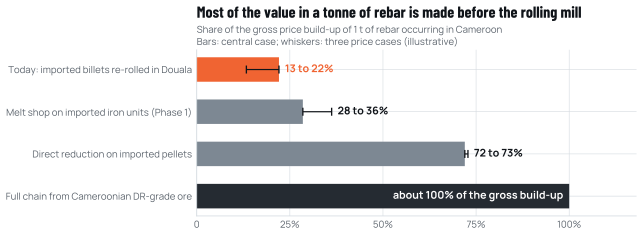
Source: Cameroon Steel calculation from [G31], [N03], [G34], RC-1 yields [F01] and pellet ratio [N01]; method in Chapter 8 and Annex A. Gross price spreads, not value added. Status: illustrative.
ES.2 The diagnosis: an hourglass economy
Cameroon is about to become an iron-ore exporter. The State’s 2026 to 2030 programme commits 1,748 bn FCFA, about US$3.1 bn, to three projects: Mbalam, Bipindi-Grand Zambi and Kribi-Lobé [O29]. Mbalam’s developer plans up to 10 Mtpa of exports by road until 2029 and 25 Mtpa by rail from 2030 [O25]; Lobé plans to raise concentrate output to 8 Mtpa by 2031 [O35]. At the same time, the country’s steel industry runs on imported billets and scarce scrap, and its rolling mills run at half capacity.
That combination, a large and growing ore stream at the top, a saturated rolling industry at the bottom and nothing in between, is the hourglass this paper describes in Chapter 1. It explains why Cameroon can export ore and import steel at the same time, and why more rolling mills would not change the picture. The constraint is iron.
The demand side is solid but small. Apparent steel use is about 450 kt/yr [C40], roughly 15 to 20 kg per inhabitant depending on the population estimate [C13][C14], against 29.2 kg for Africa and 209 kg for the world [G05]. Construction grew 4.3% in real terms in 2025 [C09], the housing deficit is estimated at 1.8 to 2.0 million units [C15] and Africa’s steel use is forecast to grow by 3.8% in 2026 and 4.6% in 2027 [G09]. A national chain at the scale of 1 Mtpa would need export markets in CEMAC and beyond: Cameroon already exports about 31 kt of rebar a year, mostly to Chad [C05][C06].
ES.3 The proposal: a chain built in phases
The paper proposes a chain built backwards from the melt shop, with each step designed to stand on its own merits and none committed before its conditions are met (Chapter 6).
- Phase 1: make billets in Cameroon. An electric arc furnace, ladle furnace and billet caster, with a bar and wire-rod mill, running on scrap and imported DRI or HBI. In RC-1 this phase has a nameplate of 0.3 Mtpa of finished product (expected sustained output 270 to 300 kt), needs about 0.36 Mtpa of metallics and draws about 36 MW of average load, within the first 100 MW that the 225 kV line brings to the whole port platform; an allocation to the steelworks remains to be agreed [F01][Z43]. Works are targeted from 2029, with a first heat in the second half of 2030 and ramp-up in 2031 [F01]. Its output is flexible between wire rod and rebar and merchant billets for the existing re-rollers, which import about 60% of their charge as billets (161 kt in 2023) [C06][C38]; with rebar capacity at 3.5 times demand [C30], its tonnage has to displace imported billets and wire rod or be exported within CEMAC, not add to domestic rebar. On imported iron units it saves about as much foreign exchange per tonne as today’s re-rollers and competes behind the tariff (White paper 09), so its case rests on quality, merchant billets and the outlet it creates for local iron. It also builds the skills and infrastructure that later phases need.
- Phases 2 and 3: sections and heavy long products. Light angles and flats are rolled locally in small quantities [C25]; medium and heavy sections and H-beams are not produced in Cameroon and are imported [C06]. Phase 2 (second melt line and light/medium sections mill), indicatively 2032 to 2034, and Phase 3 (melt-shop expansion and heavy-section mill), after 2034, would take RC-1 to its design capacity of 1 Mtpa [F01][X04]; both should follow evidence of demand, including exports.
- The direct-reduction module: Cameroonian concentrate, when its conditions are met. A module of about 1 Mtpa of DRI, needing about 1.45 Mtpa of DR-grade pellets [N01] and 8.4 to 9.1 bcf/yr of gas [T09][T10], held in reserve in RC-1 and indicative after 2034 [F01]. It should be built only when DR-grade concentrate has been proven at pilot scale and contracted under the 15% rule, when gas is secured by an audited long-term contract, and when firm power and bulk handling are in place.
The order mirrors what worked elsewhere and avoids what failed (Chapter 4): it starts where the import bill is, uses modular and proven equipment, secures feed before each furnace and sits at a deep-water port. It also manages the four critical risks identified in Chapter 9: rebar saturation, the legacy of rolling without iron, and three that concern iron units and energy, namely iron-unit shortage, the lack so far of DR-grade feed, and firm power.
On carbon, the chain starts low. On Cameroon’s hydro-based grid, RC-1 Phase 1 has an estimated intensity of about 0.32 t of CO2 per tonne of finished steel for direct and electricity emissions, and about 0.58 t including the upstream emissions of imported DRI [F01], against a world average of 1.92 t [T01]. That matters because the EU’s carbon border adjustment mechanism now covers DRI, billets, rebar, wire rod and pellets [D08].
ES.4 What the paper asks of government, investors and partners
Chapter 10 sets out seventeen recommendations. Five carry most of the weight.
- An implementing text for article 40(4) that defines transformation by depth, prices local supply at export parity, links the obligation to DR-grade concentrate, and requires public reporting.
- A gas allocation for industry at Kribi, backed by an independent audit of Sanaga Sud reserves, now that the LNG offtake has ended.
- A framework for heavy-industry power contracts above 10 MW, timely delivery of the 225 kV supply and its later stage, and published allocation and power-quality terms for arc-furnace loads.
- Tariffs and trade remedies that reward ironmaking: duties that escalate from ore to semis to finished steel, national preference for locally made billets and sections, and a capacity to respond to import surges.
- For investors, a melt shop first and the DR module prepared now: pilot testwork on DR-grade concentrate, grade and price terms with convention holders, and hydrogen-ready equipment, with development-finance institutions financing phase by phase.
None of these requires a large public subsidy. Together they would move the share of the gross price build-up of a tonne of rebar occurring in Cameroon from about one-fifth today towards one-third with a melt shop, and towards most of it, before imported consumables and capital service, once Cameroonian ore is reduced at home (Figure ES.1).
ES.5 About this paper
This is the first of ten white papers published by Cameroon Steel, which is developing a phased steel complex at Mboro, in the Kribi industrial-port zone, with a design capacity of 1 Mtpa [X04]; its foundation stone was laid on 30 December 2024 by the Prime Minister, representing the Head of State [X01]. Cameroon Steel’s sister company, Cameroon Mining Company, holds the Mbalam exploitation permit [X01]. The paper is written from that vantage point, and readers should weigh it accordingly; for that reason it relies on public, cited evidence wherever possible.
Sources. Every figure carries a marker that maps to the list of sources in Annex C: international data from worldsteel, the OECD, the World Bank, the IEA and Midrex; Cameroonian data from the national statistics institute (INS), the electricity regulator, the national hydrocarbons company and the national press; and company, ministry and port documents cited by title and date. The data cut-off is 10 October 2026.
Status of figures. Figures marked derived are analyst arithmetic on sourced inputs, with the method in Annex A. Figures marked illustrative show orders of magnitude and are not forecasts of any plant’s revenue or margin. Figures for Cameroon Steel’s reference configuration, RC-1, are planned or indicative: they are engineering planning values, not commitments, and they will change with detailed design. The paper gives no investment amounts or financial returns for the project.
Structure. Chapter 1 sets out the value-chain gap; Chapter 2 the ore endowment and grades; Chapter 3 consumption and imports; Chapter 4 lessons from six producers; Chapter 5 beneficiation policy; Chapter 6 the phased chain; Chapter 7 Kribi; Chapter 8 the economics of value capture; Chapter 9 risks; Chapter 10 recommendations; and Chapter 11 the evidence that is still missing and how it will be obtained. Four annexes follow: the method and assumptions (Annex A), a glossary (Annex B), the sources (Annex C) and the data behind every exhibit (Annex D).
Statement of interest. This paper is published by Cameroon Steel, which is developing a steelworks at Kribi. It is written to inform public debate; its analysis is independent of any commercial offer, and every figure is sourced or labelled with its status.
Sources cited in this chapter
Bracketed markers refer to these sources; the full list is in the annex. Full list of sources
- O05Mbalam-Nabeba resources and reserves statement as at 20 May 2015 (JORC). Former holder of the Mbalam-Nabeba project (ASX-listed), 2015.sdl.live.irmau.com/irm/content/resources-reserves.aspx?RID=236
- C05Évolution du commerce extérieur en 2025 (version provisoire). INS Cameroun, Feb 2026 (posted 1 Apr 2026).ins-cameroun.cm/wp-content/uploads/2026/04/Note-sur-le-commerce-exteri…
- C06UN Comtrade public API, Cameroon (reporter 120), HS 72/73 and 6-digit lines, 2019-2023. UN Statistics Division.comtradeapi.un.org/public/v1/preview/C/A/HS?reporterCode=120&period=20…
- C38Cameroun: le groupe Prometal décroche 26 milliards FCFA auprès d’Afreximbank…. Sikafinance, 30 Sep 2026.sikafinance.com/marches/cameroun-le-groupe-prometal-decroche-26-millia…
- C40Cameroun: Prometal décroche 26,2 milliards FCFA d’Afreximbank. Camer.be, 1 Oct 2026.camer.be/actualites/economie/cameroun-prometal-decroche-262-milliards-…
- Z42Loi n° 2023/014 du 19 décembre 2023 portant Code minier, Article 40(4) (official text, mirror). Rural-info (copy of the official text), 19 Dec 2023.rural-info.net/wp-content/uploads/2024/11/Loi-N°2023-014-du-19-decembr…
- G18Pedal to the Metal 2026. Global Energy Monitor, May 2026.globalenergymonitor.org/sites/default/files/2026-05/Pedal%20to%20the%2…
- T132025 World Direct Reduction Statistics. Midrex Technologies, Sep 2026.midrex.com/world-dri-statistics/world-dri-production-reaches-151-0-mt-…
- C30Production: les acteurs en présence. Cameroon Tribune, 11 May 2026.cameroon-tribune.cm/article.html/76600/fr.html/details_2
- C39Prometal obtient 26 milliards FCFA d’Afreximbank pour soutenir son expansion industrielle. EcoMatin, 30 Sep 2026.ecomatin.net/prometal-obtient-26-milliards-fcfa-dafreximbank-pour-sout…
- N16Launch of DR-grade iron ore pellet premium weekly indicator. Fastmarkets, 1 Dec 2022.fastmarkets.com/insights/launch-of-dr-grade-iron-ore-pellet-premium-we…
- O04Mbalam-Nabeba project presentation, Mining Indaba 2014 (itabirite testwork). Former holder of the Mbalam-Nabeba project (ASX-listed), Feb 2014.sdl.live.irmau.com/irm/PDF/2752_0/PresentationMiningIndaba2014
- N01Iron ore supply for direct reduction: outlook and challenges (J. Atherton), Arab Steel Summit presentation. International Iron Metallics Association (IIMA), Oct 2024.2024.aisusteel.org/wp-content/uploads/2024/10/Dr-John-Atherton_IIMA.pd…
- N02MENA will need an additional 30-40 million tons of DR pellets in the near future. GMK Center, 24 Nov 2025.gmk.center/en/news/mena-will-need-an-additional-30-40-million-tons-of-…
- O17Cameroon Mining Company confirme l’entrée du projet Mbalam dans sa phase irréversible d’exécution. Camer.be via AllAfrica, 12 Dec 2025.fr.allafrica.com/stories/202512120475.html
- O33Fer de Lobé: l’État octroie le permis d’exploitation à Sinosteel. EcoMatin, 7 Sep 2022.ecomatin.net/fer-de-lobe-malgre-des-contestations-letat-octroie-le-per…
- Z79Cameroon reviews metals industry to address supply and energy constraints. Business in Cameroon, 29 Apr 2026.businessincameroon.com/public-management/2904-16094-cameroon-reviews-m…
- P24WITS TRAINS API, Cameroon reported MFN tariffs by HS6 (2023). World Bank / UNCTAD.wits.worldbank.org/API/V1/SDMX/V21/datasource/TRN/reporter/120/partner…
- A04Algeria’s steel industry: why is it growing. GMK Center, 28 Jul 2026.gmk.center/en/posts/algeria-s-steel-industry-why-is-it-growing/
- A07Egypt’s steel industry: protection from within. GMK Center, 23 Jul 2026.gmk.center/en/posts/egypt-s-steel-industry-protection-from-within/
- N13Hòa Phát Group proposes development of Thạch Khê iron ore mine. AIST, 27 May 2026.aist.org/hoa-phat-group-proposes-development-of-thach-khe-iron-ore-min…
- N14Mr. President, it’s time to make final decision on Ajaokuta Steel, NIOMCO. ThisDay, 15 Jul 2026.thisdaylive.com/2026/07/15/mr-president-its-time-to-make-final-decisio…
- F01Cameroon Steel reference configuration RC-1 (planning estimate), edition 10 October 2026 (RC-1.1). Cameroon Steel, 10 Oct 2026.Cited by title and date
- X04Industrialisation: la voie royale de l’émergence. Cameroon Tribune, 2 Jan 2025.cameroon-tribune.cm/article.html/68558/fr.html/details_2
- Z37Guide du Port de Kribi. PAK (PDF), Aug 2020.Cited by title and date
- Z4Zone industrialo-portuaire de Kribi (KPIZ): jusqu’à +8 points de croissance et 150 000 emplois…. Investir au Cameroun, 4 Mar 2026.investiraucameroun.com/gestion-publique/0403-23163-zone-industrialo-po…
- Z43Kribi franchit la ligne électrique 225 kV. PAK, 6 Aug 2025.Cited by title and date
- E09Le navire usine quitte le Cameroun, le gaz s’arrête. Camer.be, 9 Jul 2026.camer.be/93911/12:1/le-navire-usine-quitte-le-cameroun-le-gaz-sarrete-…
- E04Données pétrolières 2025. SNH, posted Jun 2026.snh.cm/wp-content/uploads/2026/06/Donnees-petrolieres-2025.pdf
- G31Commodity Markets Outlook, Historical Data, Annual (xlsx). World Bank, 2 Sep 2026.thedocs.worldbank.org/en/doc/74e8be41ceb20fa0da750cda2f6b9e4e-00500120…
- N03BPI and HBI prices on the rise in Europe. SteelOrbis, 23 Jan 2026.steelorbis.com/steel-prices/steel-prices-market-analyses/scrap-and-raw…
- G34Weekly steel prices (archive 40468). Arab Iron & Steel Union (AISU), 3 Oct 2026.aisusteel.org/en/archives/40468
- O29Cameroon plans $3.1B iron ore push starting 2026. Daba Finance (republished by AllAfrica), 14 Feb 2026.dabafinance.com/en/news/cameroon-mining-investment-2026-2030
- O25Mbalam iron ore mine delays first exports to early 2026. Business in Cameroon, 13 Dec 2025.businessincameroon.com/public-management/1312-15495-mbalam-iron-ore-mi…
- O35Sinosteel reporte les exportations du fer de Kribi-Lobé à 2027 malgré 120 milliards FCFA déjà investis. EcoMatin, 11 Mar 2026.ecomatin.net/cameroun-sinosteel-reporte-les-exportations-du-fer-de-kri…
- C13WDI API: SP.POP.TOTL; SP.URB.TOTL.IN.ZS (CMR). World Bank, updated 8 Oct 2026.api.worldbank.org/v2/country/CMR/indicator/SP.POP.TOTL?format=json
- C14Cameroun: bouclage du 4e RGPH, 22,7 millions d’habitants recensés. Journal du Cameroun, 5 Oct 2026.fr.journalducameroun.com/cameroun-bouclage-du-4e-rgph-227-millions-dha…
- G05World Steel in Figures 2026 (page and PDF). worldsteel, 4 Jun 2026.worldsteel.org/data/world-steel-in-figures/world-steel-in-figures-2026…
- C09Les Comptes Nationaux de 2025. INS Cameroun, Aug 2026 (posted 2 Sep 2026).ins-cameroun.cm/wp-content/uploads/2026/09/Comptes_Nationaux_2025_FR_V…
- C152024 Housing Finance Yearbook, Cameroon profile. Centre for Affordable Housing Finance in Africa (CAHF), Jan 2024 (PDF Mar 2025).housingfinanceafrica.org/wp-content/uploads/2025/03/CAMEROON.pdf
- G09worldsteel Short Range Outlook April 2026 (release + Table 1). worldsteel, 14 Apr 2026.worldsteel.org/media/press-releases/2026/worldsteel-short-range-outloo…
- C25Prometal inaugure deux usines évaluées à 57 milliards F. Journal du Cameroun, 19 Jan 2024.fr.journalducameroun.com/prometal-inaugure-deux-usines-evaluees-a-57-m…
- T09ENERGIRON technology (DRI-EAF with natural gas or H₂). EC ICIT, ref. 12 Feb 2026.innovation-centre-for-industrial-transformation.ec.europa.eu/innovativ…
- T10Suez Steel sets new benchmark in energy consumption for DRI production. Danieli, 16 Apr 2026.danieli.com/en/news-media/news/suez-steel-sets-new-benchmark-energy-co…
- T01Sustainability Indicators 2025 report. worldsteel, Nov 2025 (upd. Feb 2026).worldsteel.org/wider-sustainability/sustainability-indicators/sustaina…
- D08Regulation (EU) 2023/956 (CBAM), Annex I. EUR-Lex (OJ L 130), 16 May 2023.eur-lex.europa.eu/legal-content/EN/TXT/PDF/?uri=CELEX:32023R0956
- X01Kribi: le Premier ministre, chef du gouvernement est là. Cameroon Tribune, 30 Dec 2024.cameroon-tribune.cm/article.html/68499/fr.html/details_2
Cite this chapter
Cameroon Steel (2026). From ore to steel: Cameroon’s missing link is ironmaking, not rolling. White paper 01, Executive summary. CS-WP-01. https://www.cameroon-steel.com/en/library/ore-to-steel/executive-summary/
Source